Leaderboard



Popular Content
Showing content with the highest reputation on 01/22/2026 in all areas
-
@George Braly I was on the side on G100UL until recently. Now I am not against but not really for it anymore. What I have seen during this process is appalling to an engineer. The court proceedings, the lack of transparency in testing the systems. Very open about the engine test, but when it came to other systems, it is like area 51. Now you had a chance to handle this well when issues happened, but it seems more like hiding than dealing. I might speak for others as well but all i am looking for is truth in testing, if things need to be changed out like o-rings, paint touch up with specific material, or specific tank sealants etc, we would like to know clearly and specifically. This would have allowed owners to plan the inspection and replacement over a period of years and ensure we are prepping for the switch. But seems all we get is obfuscation and blaming. Saying Mooney design is shit is one of the problems, those designs are some of the best in the industry, so good infact there are tanks that hadn't need to be resealed in 50 or so years. Truth carries a lot of weight, obfuscation destroys it. The future of gami is in your hands and what you do next. That should be truthfulness in materials testing, actual scientific tests make it open. Earn trust. Even if there are material issues, make it known and a plan. Lastly, no such thing as a drop in replacement, always need something to change and would be great to know prior.9 points
-
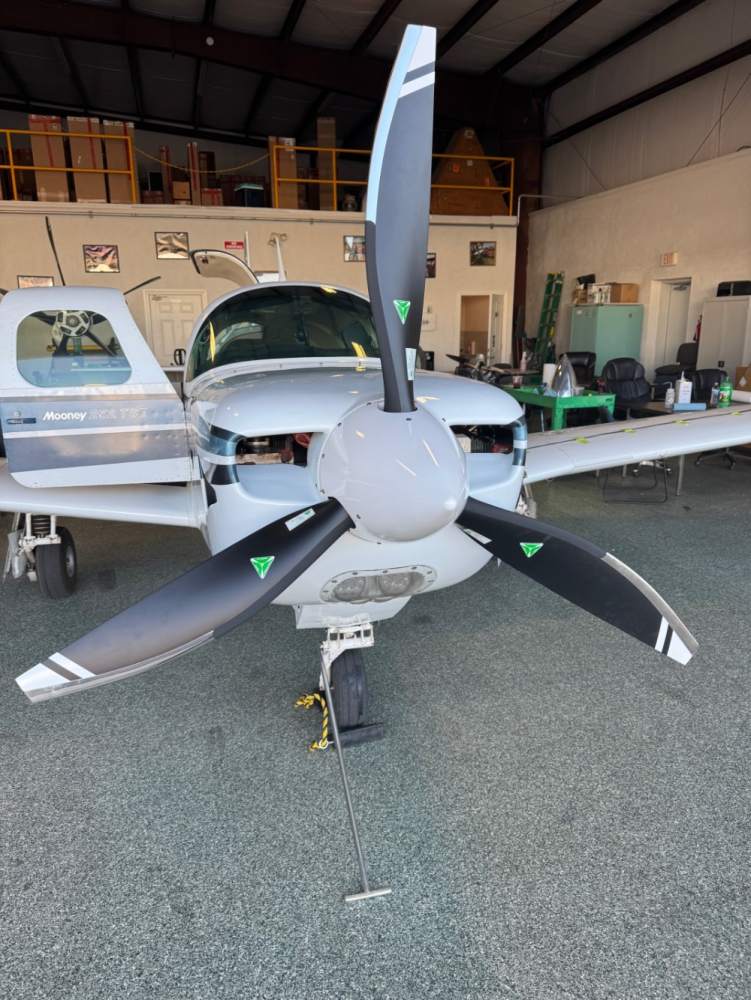
Well since my mccauley 2 bladed prop was starting to leak i decided to change from essentially a 1980’s design to a 2010 ish designed prop. I would loved if MT made a 2 blade scimitar prop for M20K aircraft but alas that’s just not the case. Since i am not FIKI certified and my 2 blade prop was labeled inop for prop heat anyway i elected to not install the MT heated blades either both as a weight savings and speed savings. By removing the heater ring and brushes as well as the mount i also gained 2 more pounds of weight loss. The total being 13 lbs off the nose. This really helped in the uptrim department as before i would be bumping up to full nose up trim now I’m half way between takeoff and full up. Cruise I’m below the takeoff box in the trim setting. Top end speed seems the same as before down low (2000-8000ft) i have not tested it yet higher as the winds were punishing high above 8000 on the way back home from kded to dfw. They were able to dynamically balance my prop to 0.082 ips which feels amazing. Before i hated to run at 2500rpm as it just felt better at 2300 on the 2 blade but now 2500 feels better that 2300 and is faster too. The biggest change for me is the takeoff and climbout. I genuinely feel the increase both in vvi and how quickly i get airborne which was my number 1 reason I chose to go with this prop over overhauling my 2 blade as my home airport only has a 2600ft runway and in the summer time it’s pushing the edge of my comfort zone for takeoffs. The prop noise is a different kind of noise. It is quieter than my 2 blade but not as much as i had heard from other people that have switched. The biggest change reduction is in the beats the 2 blade made that are now more like a buzz than beats if that makes since. At just above idle i hear the famous whispering the blades make but passed 1800 or so that either disappears or the engine noise drowns it out. Also changing rpm’s is now lightning quick i find using the twisting of the vernier prop knob much smoother than pushing the knob in because it’s just too sensitive otherwise. Now for the bad part that i loath and so wished they had a 2 blade option, taking the cowl off or on is a nightmare with the scimitar type blade they are much fatter at the base right where the cowl front edge needs to clear. I already have the first scratch marks on the back of the blades as the cowl is such a tight fit. The guys at the MT recommend wrapping the lower blades in wrapping plastic and using painter’s tape on the front end of the cowl to keep from making any more scratches hopefully that will help but changing my oil has now become a 2 person job for me where as before i could do it by myself. Anybody else have a better method please let me know.
 4 points
 -
I think George already stated that if your tank leak is because your aircraft has an inferior design or was not maintained correctly. Also, if you have any issue with your fuel system is because you have neglected your airplane for many many years. Finally, if your paint gets damaged it's because you don't exercise standard refueling hygiene. Any issue that you have in your airplane after you start using G100UL is due to correlation, not causation. Fancy words to say: it was just coincidence that your tanks started leaking after you switched to G100UL, it would have happened exactly the same if you would've continue with 100LL. I'm not saying that I agree with Mr Braly, I'm just summarizing what he has repeated everywhere, in some cases, as a expert witness in the CEH California trial.4 points
-
Exactly. In today's regulatory environment, 100LL and G100UL can coexist and compete - except in Santa Clara County, where political circumstances created a G100UL monopoly in the market that cannot accept UL94. Elsewhere, we as consumers vote with our wallets for the "imperfect" fuel of our liking. The case of KWVI, where both 100LL and G100UL are available, clearly shows what that vote is. I think it is abundantly clear that a considerable cohort of pilots do not want your product. Our decisions are based on independent data, be it scientific or empirical, and have nothing to do with lead or no lead; it is clear as day that leaded avgas is going away. We just do not want this fuel in our planes.4 points
-
So is everyone who knows anything about what is killing our engines. There is a reason why lead is a top line metal in your oil analysis. It is the greatest predictor of future engine problems. All that "sludge" in you crank shaft hollow? Lead. All that crap on your valves and plugs? Lead. Common. reason for sticking valves? Lead. I can't wait to get rid of lead in my engine.3 points
-
This is George Braly declation, defending the motion to ban 100LL in California. https://drive.google.com/file/d/14JkPLQIAVY-hA24TZQWy0i3UhMost47B/view DECLARATION OF GEORGE W.BRALY IN SUPPORT OF PLAINTIFF CENTER FOR ENVIRONMENTAL HEALTH’S REPLY TO SETTLING DEFENDANTS’ OPPOSITION TO MOTION TO ENFORCE CONSENT JUDGMENT AND MOTION TO MODIFY CONSENT JUDGMENT Which includes a passage specific about the defective Mooney design (quote from Mr Braly declaration): "Mooney aircraft have a unique and inadequate type of fuel tank construction, as compared to the standards for the certified aircraft industry."3 points
-
It is important to remember that good old George was advocating for banning 100LL state wide in California. Such a nice guy and advocate of General Aviation he is.3 points
-
I have a $1.8M Executive available, I respond to all requests unless you are on my ignore list. Let’s do a deal!3 points
-
I owned N19NS which was an Embry Riddle trainer and held a different tail number during that time. The logbooks were a mile long of handwritten entries. The places that serviced it never made much/any note of high-hours issues... But ERAU certainly took great care of it, and so did the subsequent owner or owners. I purchased with around 6900 hours and sold with around 7200.2 points
-
You really need to try full rich, full rpm, 120mph, cowl flaps full open in the climb. It will be hard for you to lean in the climb to target egt as the others do since you don’t have an engine monitor. I definitely wouldn’t try lop in the climb without an engine monitor. How do you know all 4 cylinders are on the lean side? And even if they are, how far past peak? The red box for lean of peak is pretty big at high power and you have no idea how far past peak each individual cylinder is or what temp each cylinder is running? Your gage only shows one cylinder. Also you should definitely get the timing checked. There were some models set to 25 degrees btdc and then lycoming recommended 20 degrees which is cooler for chts. It would be nice to know your mags are the same and what they are set to. I also had a Surefly mag and I didn’t notice any increase in temps. It shouldn’t advance timing at high power in the climb, but maybe if you’re pulling back the power somehow by trying to climb lean of peak. I don’t think that’s healthy.2 points
-
as the last data I pulled back in august KWVI was selling 2-400 gallons per month of G100UL so all these planes flying around using G100UL is BS. Obviously GAMI has yet to hire a competent PR/Marketing person to help them2 points
-
The more they talk, the worse it gets.2 points
-
I am just finishing up an 8 month process to overhaul my TIO-540-AF1B and what an experience. The challenge is there are only ~140 of these Bravos flying so parts are very hard to come by. The hardest part to get is the valve guides because they are oil cooled and Lycoming doesn't make them very often. I called around and found a shop that did an overhaul of this engine the previous year and they bought two sets knowing someone like me would call eventually. That was a big time saver and lucky break. I chose a field overhaul by an engine shop instead of a reman because most people I talked to said it would take up to 2 years to get a reman sent because its a long wait for new cylinders. My cylinders and pistons were in reasonable shape to be overhauled and with new guides, springs and rods I should be ok. The base cost of the overhaul was $110K, but by the time you add all the new hoses, overhauled alternator, v-band clamp, prop governor overhaul, various filters, mounts, specialty nuts, and shop rates to pull and replace the engine, I am closer to $142K. In my case, I also had to overhaul the prop and ended up buying 3 new blades for a cool additional $20K (kill me now). I should have the final cost in a few weeks but I'm at about $165K all-in with an 8mo turnaround. My engine overhaul was done by Twin Engine Aircraft in Newnan, GA and they did a fantastic job managing the overhaul process with all the many overhauled parts that had to be sent out to shops around the country. Gilmer Aviation in Pell City, AL pulled the engine and put it back on and also did a great job.2 points
-
The microswitch on the throttle cable is adjustable. I would be surprised if the problem lies with the throttle cable itself. However, if that is the case, throttle cables are readily available from McFarlane Aviation Products. It may have to be made to order so it might take a couple of weeks.2 points
-
Everything out the door was about $80 AMU that's adding on Electro Air 15000 and a few other things that are not seen. It took about 8 weeks total to complete and everything money related was always agreed upon and we stay within that budget.2 points
-
Chris, A lot of people not involved in actual FAA aircraft and engine certification work may not appreciate the "science" of when "good enough" is "good enough". Lycoming and Continental can certify a brand new - - "clean sheet" engine design and get it certified by doing a single 150 hour engine test - - following a defined / prescribed "protocol". Then they can produce them and sell them as fast as they can make them, if they have customers. One engine. 150 hours. In engineering, we should normally be looking for "boundary conditions". If you, "worst case" conditions or applications. For example, GAMI, unlike the PAFI program, was able to work with the FAA to identify a "worst case" (i.e., boundary condition) engine and associated operating conditions, so that a then "robust" detonation test matrix, executed on that "worst case" (boundary condition) engine would establish that all of the remaining engines, operating under design and operating envelope conditions which are then known to be "less severe" than the "test day" engine & operating conditions - - would be assured of being able to operate on G100UL Avgas free of detonation. Otherwise, if you approach the problem in any other manner, you end up with a constant chorus of "... Yeah! But - - but - - but whattabout my IO-550 with 9:1 CR" or . . . "... whatabbout our R-2800 on our CAF A26 or our CW-3350 on FIFI ?" The same applies to "hot day / hot fuel" climb cooling / vapor lock testing. On September 5th, 2012, we completed that testing under direct supervision / participation of four senior FAA propulsion engineers who were on site at GAMI. By requirement - - it was a real 100+F OAT day. (105F to be exact). At Ada, that translates into a 110 degree day at S.L. With fuel that was custom produced to be very near the maximum permissible Reid Vapor Pressure. AND to do that "back to back" same-day - - using 100LL that was also custom blended to be near the upper end of the RVP range permitted in the specification. AND, to do that on a turbocharged engine at various altitudes up to and including 25,000 feet. With fuel temperature sensors scattered around to record the temperature of the two fuels in the fuel tanks and at the firewall and coming out of the gascolator going into the fuel pump. It is that type of approach, using a "boundary condition" philosophy for the testing that allows any progress to be made in the general aviation aircraft world. Yes, some things are statistical - - fatigue cracks are an example. When we did the repair on the wing structure of the fleet of T-34s - - that was a requirement for portions. Example, we developed a new high strength wing bolt using a well proven state of the art metallurgy. Lots of fatigue/damage tolerant engineers would look at the specification for that material and simply "nod their heads" that was good enough. However, we took multiple samples of the new bolts and the old bolts to the test lab. All of the old bolts broke between 75 and 79,000 lbs of tensile load. All of the new bolt design broke between 94 and 97,000 lbs. That is an example of the application of testing multiple articles - - when it is appropriate. So, in our judgment, and that of the FAA, the approach we used for the certification of G100UL was appropriate. I think one of our failings was in our lack of robust understanding or appreciation of the issues involved with our rapidly aging fleet of aircraft. (Example, the Mooney fatal crash in Australia, two years ago, due to a 29 year old nitrile O-ring that failed in 100LL and caused a fuel leak in the engine compartment. - - - if that aircraft had been using G100UL avgas then the fuel would have been blamed for that tragedy.) One other thought: There is no perfect fuel. Not 100LL. Not G100UL avgas. Your questions and concerns are always welcome. George2 points
-
I work in IT and this is how most issues end up being resolved- it just starts working for an unknown reason. All you need to do now is tell me your address so I can send you an invoice.2 points
-
You might try staying rich just to see what the temps do. Most folks lean to maintain EGT as they climb. For example, if my climb EGT starts at 1200, I will gradually lean to maintain that (I cheat since I have an Auto-Lean system that does it for me). The idea is that you maintain a rather rich mixture to stay away from detonation when at high power and poor cooling. Magneto timing can be a problem if advanced too far. Surefly is the same, be sure the timing is proper. At high power, the Surefly should not be advancing. Since your cruise temps. sound to be reasonable, I’m not so sure you will find an issue with timing. As far as engine analyzers, I may not be the right person since I myself have an antique, but others will chime in or you will find a number of threads on the topic.2 points
-
Last time I was here I was kicking the tires on a late 80's Mooney M20J. Against the nearly unanimous chorus of Mooney owners warning against it, I bought it. More than 1000 hours later I can't say it wasn't without problems, but I think in general I came out WAY ahead. Through some effort I was able to rebuild the logs that were missing, with one hole I still can't explain. All signs point to this aircraft having a gear up landing at some point... but never could find FAA reports or any logs or mechanics that had worked on it. On to the point of the post. My aircraft is nearing 9000 hours on its airframe. The only thing I can find is people warning about the tail trim and mounting and to watch that. What else do I need to watch as I bravely bring this aircraft into 5 digit airframe time? Holler if you have a Mooney with more airframe time than mine and what you learned from your "high time" Mooney.1 point
-
Closing the loop on this, or at least my part of it. I put the Garmin Pilot advanced profile I built for my M20M in the downloads section. Don't use the output from this profile until you have validated it for your specific application. The output from the profile checks well against the Foreflight profile I have trusted for years, as well as against my historical empirical flight data. I only validated it at my SOP cruise setting of 30/2200, 13.2GPH LOP. The data basis is the POH, so the profile should be accurate enough for planning purposes at other cruise settings. But don't get too excited if you're looking for a comprehensive profile that will work for any power setting, 'cause this isn't it. It's pretty much the same as the Foreflight M20M profile in that it only has performance data for the RPM/MP combinations in the POH, and I only entered airspeed data for ISA +/- 20ºC up to 20,000'. So if you cruise at 2200RPM between 24 and 30", or at 2400RPM between 32 and 34", you're in luck. If you're running 29/2400, which I believe a lot of people use, this profile doesn't have data to support that planning. It's a fairly easy but tedious task to add your empirical 29/2400 performance data to the profile table, but it may be easier to just enter a single basic set of cruise parameters (TAS and FF) and accept the variability in accuracy with altitude and temperature changes. I entered the peak TIT data directly from the Section 5 charts into the Garmin Pilot advanced performance table to set the ground truth model. Nobody flies like that, but those are the only numbers in the book. Fortunately GP has a function called "Cruise Modifiers" that allows you to apply an adjustment to the values in the table to match your empirical performance. It works by applying a % increase or decrease to MP, TAS and FF from the performance table. Each parameter is independent and can have its own adjustment up or down. I put in a selectable modifier for 35º LOP TAS (-4%) and FF (-8%), and another one for 100º ROP TAS (+3%) and FF (+19%). I came up with the adjustment factors by comparing the GP output for a flight plan with the Foreflight output for the same flight plan at several altitudes and then picked the "best fit" adjustment factor. I also compared adjusted GP output to flight data for validation. All of this can be modified by the user to fit your specific application. If you run 150º ROP you can adjust the ROP modifier up to accurately reflect your increased FF and TAS. I also derived specific LOP and ROP tables external to GP as a part of this exercise. I originally had entered them into GP (780 data entries... ) but realized it would be easier in actual use to employ the Cruise Modifier function with only the peak TIT numbers entered. At least I have all that tabulated data now. Oh boy. If anyone has or finds something better please let me know. I'd like to say building this was a fun task, but...1 point
-
I know no more or have more confidence in this whole debacle than I did 58 pages ago. And that is the problem.1 point
-
I definitely understand your testing philosophy, and the sophistication required to accomplish the testing parameters required by engine manufacturers/faa. I don't think this is the issue though. I applaud your effort in creating a suitable alternative to 100LL. I don't fear for engine issues if I were to use G100UL. Unfortunately, there is a but.. I also understand the impossible task of testing your fuel on all the different aircraft types out there. As an aircraft owner though, I am responsible for the entire aircraft, not just the engine. I don't know about you, but I cannot afford to be repairing the paint on my aircraft every few years because the fuel I have to use was replaced with G100UL. I also don't see any warranties regarding any repairs to the paint or other items along the fuel system. All I am asking for is an acknowledgement that you are aware of and have seen the evidence that your fuel is ruining paint if it gets on it. It would be nice to also know that you are looking in to these reports, and seeing if there is anything that can be done to remedy this. We do not have much time left before we are forced out of 100LL.. 2030 will be here before we know it. I hope that us mooney owners, and other aircraft with wet tanks are not just seen as outside the "boundary condition". And that we just have to deal with the risks once 100LL is no longer available. -Chris1 point
-
left Europe 35 years ago, had been working for a defense contractor that was rapidly downsizing, now all of a sudden defense is hot again over there, when Fukushima blew up nukes were out, now the reactor is being resurrected to my understanding, things move in circles, avgas in the US is essential for transportation in Alaska and for flight training, possible 100LL development in Europe is beyond my pay grade, maybe you can make your own like two stroke mix in the olden days, think it only takes 3-4 ounces of TEL and scavenger for a 50 gal tank, pilots are creative, somebody is going to figure it out...1 point
-
1 point
-
If let's say 300 Bravos are flying and an engine hangs in there 10-20 years 15-30 Bravo engines get overhauled per year, cylinder is the major unique part of the engine and exhaust valve guide is the unique part of the cylinder, airplanes from the 30s and 40s are still being maintained and so will the Bravos, just getting harder, going east with a tailwind the thing is a magic carpet, worth all the aggravation and then some
 1 point
 -
Dear me, what have I gotten myself into having this plane.1 point
-
You forgot the shutdown wait 10 sec reboot1 point
-
Digikey has them also: https://www.digikey.com/en/products/detail/mallory-sonalert-products-inc/SC628/528117?so=90562273&content=productdetail_US&mkt_tok=MDI4LVNYSy01MDcAAAGYDKVkxY0d8stYDHb57PU5RT9nuqtLqfkjSQsNXjwXLgnC5b60wE6EJ1q1g9J9znhhZ-OiPa-FrV_0CqndcriqT7XwkcRjuQ9-G4Li61pi -Don1 point
-
so please read about GAMI. 1. they may actually not do anything out of the box, you need to go through a process and potentially swap the injectors to level them. I would actually not touch the injectors. Spend time making sure the FF at take off is what it needs to be and the temps are right at take off, cruise and descent. GAMI won't do magic1 point
-
To give an idea, the Mallory Sonalert is a little and common electrical item. You can get them at Frys and Radio Shack in the day. Amazon has some. Ebay has some Mooney salvage ones. Looks like this, or similar.1 point
-
They are listed here, at the bottom of the page: https://www.mooneysafety.com/
 1 point
 -
@TheAv8r I’m in! Once the weather gets a bit better will be in touch! The AeroCruze is pretty nice and would be happy to demo… -Don1 point
-
Whenever I was having a problem with our software, invariably one of my colleagues would say "Huh, works on my machine".1 point
-
Update: The Ocala PPP is sold out.1 point
-
I'm sure someone will be along shortly to correct me, but I have not seen DLC lifters used on Continentals. Usually it's Lycomings that eat lifters and cams, while Continentals eat valves. If the cam looks okay, I would probably replace all the lifters and move on. They are pretty easy to check at each annual.1 point
-
should be an easy fix, why not just fix it?1 point
-
I had that thought as well but I couldn't find any mention of it online anywhere. You would think if this was a "thing" there would be some discussion of it on one of the aviation forums. However, I'll try to experiment with that idea when the next cycle comes out. Retired guys with time on their hands look forward to these kinds of activities.1 point
-
As noted, the balance of flow is not what people were talking about. The concern was/is takeoff power total flow. Not sure what GAMI's will do with cylinder temps although maybe you mean exhaust gas temps. Also not sure how GAMI injectors would impact manifold pressure. Not sure what engine data set you sent GAMI either. Obviously, it wasn't the short flight where you just about blew up the engine (sorry to be tough but that is very much a risk). Without being harsh and based on what you've written so far, you really need to find two things: 1. A mechanic who understands turbocharged engines. Even better would be someone who has experience with these older version small block turbo Conti's and understands the variations of turbo Conti's setups wrt wastegate, fuel and air intake, and intercoolers. Unfortunately, I don't have any mechanic references. 2. A sharp pilot/instructor who understands turbo charged engines and has access to the supplements and POH for operating said engine who can teach you how to operate the engine. Actual experience would be even better. I only have a few thousand hours in various turbo piston engines including as a CFI, but what you've written is very scary to me. I don't write that lightly. I get you don't know what you don't know, but you really need a good resource. Lots of really good instructors available who know and have experience in this engine including the aftermarket setup. Seek them out. Best of luck William Btw, I would also check the sparkplugs. Those are usually the first to go in a detonation event like you seem to have had. See recommendation 1 above.1 point
-
IIRC they should be set so that closed is a 1" gap1 point
-
The curious thing is that I was about to delete and reload GP on all three devices but decided to exercise the “insanity option” first - try doing the same thing over again and expect a different outcome - and low and behold it worked. I didn’t even do the common sense power off - power on step. As I discovered throughout my career, how you hold your mouth as you’re executing the steps to operate any technology influences the FM that makes all of this stuff work.1 point
-
If it's plumbed to the MAP, then it will increase the advance, which will lead to higher cht. I gained about 10F on CHT after installing surefly. But it's still way below high range. You might be leaving the mixture just above peak, which maximizes CHT.1 point
-
I was a supporter and advocate for G100UL from the moment they got their STC. I was looking forward to running it in my engine, and was glad that there was finally a lead-free solution for our engines. I attended George Braly’s seminars at Oshkosh over the years to hear and learn more. At last year’s, he seemed to blame Mooney fuel leaks on Mooneys, the Mooney design, and Mooney owners. He came across as a lawyer-turned-salesman who was using lawyerly obfuscation and deflection to shift blame away from his product. I left halfway through the seminar. Needless to say, I’m no longer an advocate for G100UL.1 point
-
Hmm, sorry but I wouldn't recommend that. I lean to maintain full power sea level EGTs (mid 1200s for my plane) until I'm at cruise; only then do I go LOP.1 point
-
For some reason I thought you had multi cylinder CHT. Having only 1, I suppose it could read false high. Yes, that should be checked. I find your leaning in climb unusual. Maybe I’m old school, but I typically start the climb full rich and full power. I note my EGT and hold that through the climb. In other words, I only lean enough to maintain that. Leaning more aggressively at high power risks detonation and hot CHTs. Aggressive lean of peak in climb can reduce ChT but with reduced power, extending your climb. Maybe try a full rich, full power climb and see what happens….of course if the temp goes up…don’t continue. Can’t recall, was magneto timing checked? As a side note, absolute values of EgT vary too much cylinder to cylinder and aircraft to aircraft to be very useful.1 point
-
A GoPro mount?1 point
-
Have you considered doing no upgrades at all until you complete your IFR training? Perhaps unpopular opinion: spending a lot of money on avionics upgrades at the start of IFR training isn't a great idea. For one thing, it might take as long or longer to get a shop to complete the upgrade than it would take to complete your training in your already airworthy, IFR-capable airplane. And as you've already observed, you don't know what you don't know yet. Better to get a bunch of hours under your belt before upgrading, because while there are a few factual truths about equipment and capability, a lot of resto-mod panel design boils down to personal preference. The panel you already have is adequate to train for and pass the instrument rating practical test, at which point you'll be proficient in one airplane. Perhaps the most proficient you'll ever be for the rest of your life. That's a great place to be when thinking about what kind of instrument flying you're really going to do, and what equipment you want to feel safe and comfortable while you do it. Some ugly truths to consider, from an old CFII: A lot of pilots who start instrument training never finish. Some pilots who finish instrument training decide never to fly in IMC, particularly those based in areas of the country where there isn't much piston-single-flyable IMC. Some pilots who fly IMC limit themselves to "gentleman's" IFR conditions, e.g. punching through a thin layer that's a couple thousand feet above the ground. Some pilots with instrument ratings and fancy panels are actually quite bad at basic instrument flying, and are hindered as much as helped by all the gizmos they've got in the panel. I don't say these things to discourage you, just to inject a dose of realism before you break out the wallet. Prove to yourself you have the perseverance to complete the rating. After (or while) you do, lean on friends and/or rentals and/or AATD simulators to gain experience with additional equipment. Then, with rating in hand, decide what kind of IMC flying you're actually going to do. At that point, you'll be in pretty good shape to think about upgrades.1 point
-
Looks like PowerUp now makes a Bendix clone. In some cases it may be more economical after buying parts and labor. Don’t know the quality, but the parts have been on PMA market for a while. https://hartzell.aero/news-release/hartzell-engine-techs-powerup-magnetos-receive-pma-for-bendix-s-20-s-200-series/1 point
-
Dear Repulo I have a French EASA workshop based in south east of France. I can perform this prebuy of you want Have a nice day Gontrand1 point
-
I would think most knowledgeable buyers would much prefer to buy the airplane with the runout engine, fly it for awhile assuming it’s still airworthy and then get the overhaul of their choice so that they can go through everything as the owner. A seller can’t really afford to do it right and re-coop all their cost, and will have to continue paying other fixed cost while it’s going through OH. Sent from my iPhone using Tapatalk1 point
-
There is one BIG rule with dual mags- Pay Attention! NEVER AND I MEAN NEVER loosen a mag hold down nut with a star washer underneath without replacing the star washer for a new one!! Dual mags (and others) have fallen off because of this very problem. Anytime a hold down nut has been tightened and then loosened for any reason- THE STAR WASHER MUST BE REPLACED WITH A BRAND NEW ONE.PERIOD!!! End of sermon.1 point