Leaderboard


Popular Content
Showing content with the highest reputation on 12/13/2025 in all areas
-
Flew my Mooney for my 3rd flight without transition CFI (takair). Brought my wife up with me. We just did a short flight, for her to get used to the plane, and weather was looming so we went back and landed. Probably my best landing ever. I could barely feel my mains touch and rode them all the way out, gently touching the nose wheel down. "Are you feeling this awesome wheelie?!?" I was laughing out loud and so excited. My wife just shook her head. A landing that would've made my instructor proud. But alas, he was not there, as he has kicked me out of the transition training nest. I guess I should start instrument training soon then3 points
-
https://www.glapinc.com/Mooney/ There was much said about the difficulty of installing the thicker windows. it is all pretty much bs. I cut and prepped and dry fit all of the windows for the plane in one day. Installed them all the next day and prepped and dryfit the windshield in the same day. Removing and cleaning the old stuff is the hard part. IF anyone wants to know the tricks i learned for the thicker windows feel free to pm me.3 points
-
I owned a 231 with manual flaps with closed, open and one spot in between. I much preferred the electric flaps with infinite positions I had in the Bravos and the Encore I owned. You could get it at just the right spot to keep the temperatures where you needed them to be and not sacrifice cruise speed. However the last two designs that Mooney made, the Ovation (also the Eagle - same airframe) in 1994 and on, and the Acclaim in 2006 and on (plus their Ultra versions) were designed without cowl flaps and a much better design. The best cowl flaps are no cowl flaps.3 points
-
More things to break, more things to make, more things to sell.3 points
-
Certifying engine and propeller combinations is difficult. Just look how many installations have yellow arcs, and you cannot 'feel' the vibrations they are concerned about - its all internal to the engine / crankshaft / counterbalance weights etc. Once a propeller has been installed on an 'unapproved' combination, there is no telling what damage has been done. Yes I get it that it might be the same engine / prop combination that you might find on a certified plane. And yes that might be an approved combination. And my guess is the engine is more at risk than the propeller for hidden damage. Garmin sell 'experimental' G5's for less than certified. Lycoming sell 'experimental' engines for less than certified. Hartzell? Their approval and insurance costs are probably less for Experimental? So why would you expect 'free trade' between certified and experimental? Be grateful that you got all this information before buying. And thanks for sharing, it is a good learning experience for all of us.2 points
-
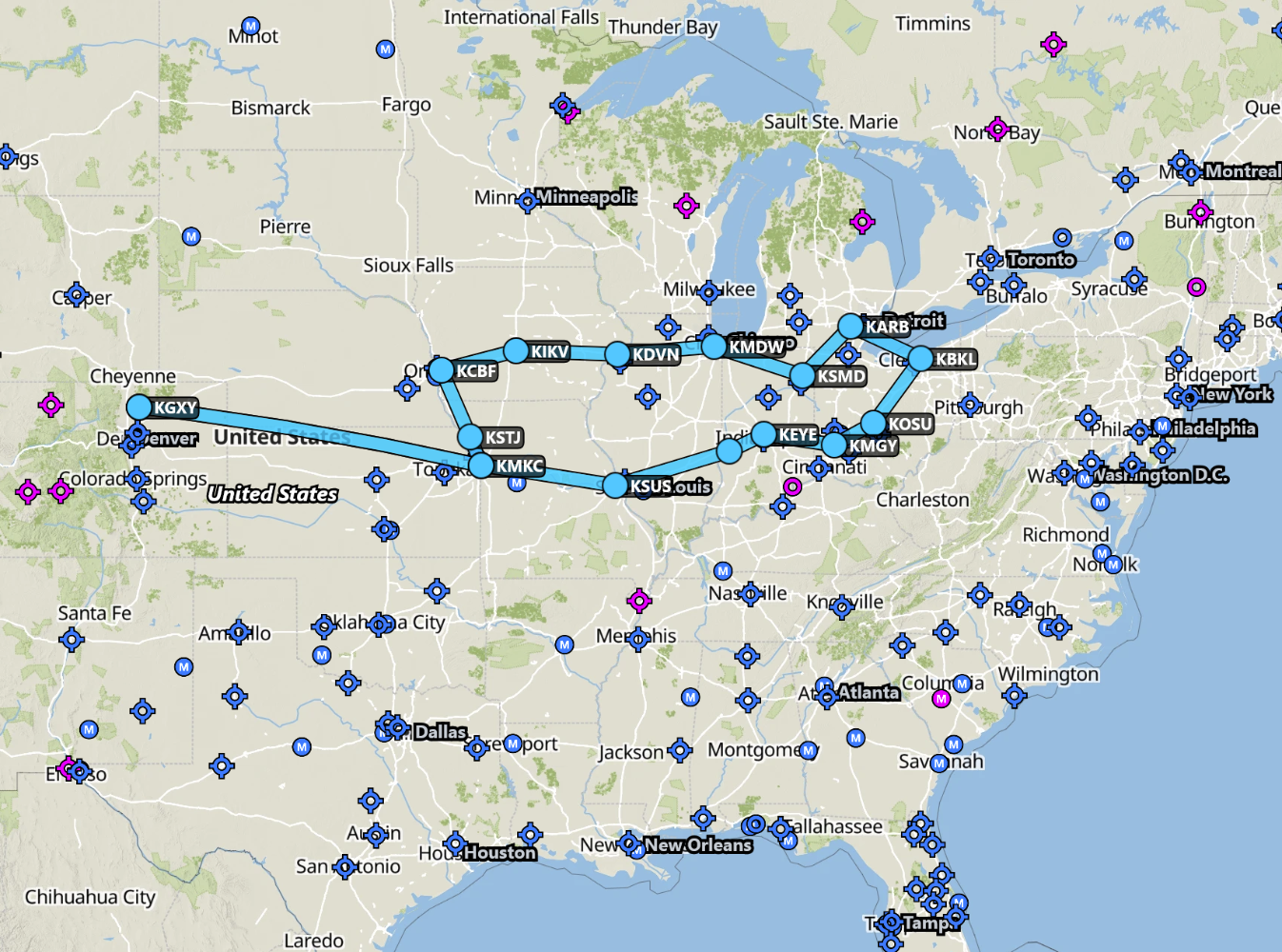
https://inspire.eaa.org/2025/11/20/1925-national-air-reliability-tour-100th-anniversary-commemorative-mooney-edition/ I wrote up our recreation of the 1925 Air Reliability Tour for EAA. Fun trip and great to see so many new places! We had great weather, no mechanicals, caught a Cubs game ("In Chicago what do you say? Cubs are going to win today!"). We started and finished at KMKC Charles Wheeler Downtown in Kansas City...this is an all time favorite airport of mine. Love to come in landing south, come in from the west and ATC directs you right over the top of KMCI at 4000', then turns you south for an extended final for Rwy 19 with great views of the city the entire way! Free parking at City Park tie downs, and usually decently priced self fuel. What's not to like?!? The Mooney has had a BUSY last couple of months!! Already time for another oil change! As a side note, KBKL Burke Lakefront in Cleveland, OH right off of Lake Eerie is a new favorite! Unfortunately there are pressures trying to close the airport. Reminds me of what Mayor Daley did in Chicago with Meigs Field in 2003. https://www.aopa.org/news-and-media/all-news/2025/november/20/aopa-joins-ohio-coalition-supporting-burke-lakefront-airport2 points
-
https://www.amazon.com/Verizon-Wireless-Unlocked-Advanced-Included/dp/B09FXP1G86/ref=mp_s_a_1_1?dib=eyJ2IjoiMSJ9.Z758UekhlfbXYCxVrOcaWdT2NNMRzvOKhNIpWl7ehgLgnNJEpoUfCaEvqKSRbQlHlN-zn5O8EsvLZB_NgotC-ALhr5gkQLCEpBviQzCjT1NcsQ5_crXw3krHOTPGwXb1TPdaj9jlKj60mBC3mmvvg28heweOq9Ao-SnIUdPiEcp4WGeQdIPTihhCRbFZVrePWcDBmo8ZvoRnpH5e68DQPA.HHzWK922l6YGYaiy6gU68Bck0oVA0EHQQViPURNcxfI&dib_tag=se&keywords=Verizon+Hotspot+WiFi+Device&qid=1765634451&sr=8-1 i use an older version of this one.2 points
-
this is from the webpage of the vendor where I bought my windows and windshield SC-represents the new solar control material. UVA exposure will eventually damage your interior allowing it to fade and is the leading cause of skin cancer. UV radiation increases about 5% with every 1,000 ft of altitude. While the standard clear and grey will block virtually all of the UV rays it only blocks about 80% of the UVA. The SC product blocks all of the UV and 99% of the UVA which will help maintain your interior and prevent harmful rays for you and your passengers. The SC- material also blocks near infrared radiation (NIR) which causes heat. You can reduce the NIR radiation (solar energy heat) by approximately 30% with the SC- material!2 points
-
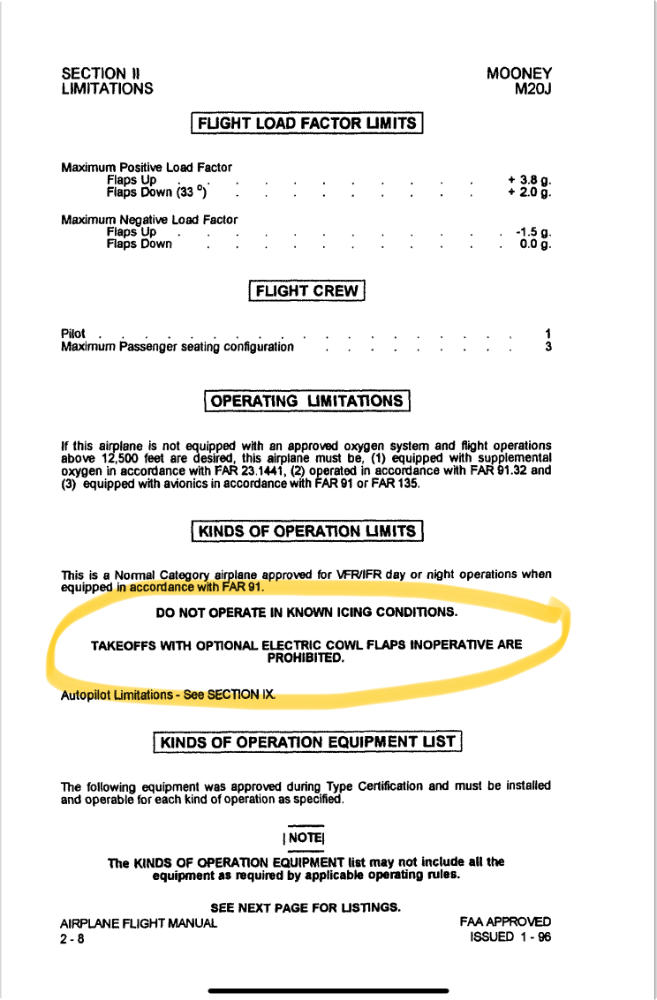
Ooof So if it breaks it grounds the plane, and it was even an option someone paid more $$ for? Oooof x22 points
-
The rub is that there is a prohibition against taking off with inoperative electric cowl flaps in the POH/AFM Limitations and FAR 91.9 prohibits operating contrary to a limitation.
 2 points
 -
https://www.controller.com/listing/for-sale/250893789/1965-mooney-m20e-super-21-piston-single-aircraft1 point
-
The best bet is to get LASAR to order some new ones. If they won't or can't, If somebody would send me a dead motor, I might start an STC process for a replacement. The world is full of cheap DC gear motors. Domestic motors are getting kind of scarce.1 point
-
In my early flying years, for whatever reason, I would log every leg of a trip as a separate flight. So it took forever to enter those into a spreadsheet. And my instructor chicken scratch logbook entries from early training days were just almost impossible to read. Fortunately the later entries are easier, where I compress multiple stops into a single logbook row, and I don’t have to try to reproduce instructor shorthand in my digital log. Still, it’s a painful effort.1 point
-
My problem was having a really bad first experience with GP. The first thing I tried to do was to import all the data I have in ForeFlight. I followed Garmin's procedure and it failed with "Something went wrong" type of error. I reach out to support, and they were not able to help me. I had to debug GP using Chrome's dev tools to get the import to work. Even after that, the logbook entries were all messed up.1 point
-
If you have googlefi you get 2 free data sims with your cell phone line, they use your cell phone data but for most stuff like this that data use is nothing https://fi.google.com/about/plans1 point
-
Yeah, I was using the web version, just trying to copy over all the info I have in ForeFlight over to GP. The experience was so bad, with the app itself and with support that I decided that it was enough. Now I realized that after the cancellation they gave me a 30 days free demo (I used the original 30 days demo a couple of years ago). So maybe I'm going to give it another try inflight. Thanks for the advise on MyFlightBook, in 2 minutes I was able to import all my logbook entries from FF and everything matches, my currency is showing up correctly, etc.1 point
-
I wonder how much they would charge for a group purchase? Previously they said 4 minimum. Probably need mooney or lasar to buy them from Globe/Allied.1 point
-
Just to confirm... You did take the .CSV file you Exported from ForeFlight and then copied over the data from each column (minus the Header) into the appropriate column in the G Pilot .CSV Template? Then you Imported the G Pilot .CSV Template into G Pilot? It also appears that Pilot deals with Aircraft differently, so you don't want the Aircraft Section at the top of the Export from FF. Probably the best way would be to search for a specific N# and then with that list it would be easer to copy the Aircraft Type into the appropriate fields. As for the potential changes in FF due to the sale, I figure it will take a while before it trickles down. So I'm in a wait-and-see mode to see if market pressures win out and there won't be much change in the CURRENT product. More likely there will just be no improvement and FF will stager. That will give Pilot, or whomever, time to get their act together to then have surpassed FF and we can move to a more superior product vs going backwards just because we don't like that FF sold.1 point
-
I don’t like subscriptions and paying all year for the data I don’t need, so I’m using an iot sim card in my Verizon hotspot. It’s a one time fee of like $15 for 500mb data which is plenty if you just want a wifi switch. I unplugged it in the summer. I got it from 1nce. Seemed sketch but it’s been good for a year so far.1 point
-
https://a.co/d/i7Wtmz1 This is the one I use. I started with a hotspot device front-mobile but it went offline all the time so I switched to this one. As a bonus, you can easily install a cheap WiFi security camera in your hangar using the data from the hotspot. Sent from my iPhone using Tapatalk1 point
-
It sounds like you were using the Garmin Pilot web version? This is very very new, and I have almost zero experience with it - sounds like it might still have some rough edges. I’ve used GP for years both on iOS and Android, and I think it’s a solid EFB. One of the key advantages to GP over ForeFlight for me is the real-time engine data that gets streamed from Garmin EIS. You can view the engine data in the app during flight (which I always think would be valuable if the LCD crapped out) and it’s also captured in the Garmin logbook. The automated logbook is pretty neat, because it syncs the engine parameters with a graphical depiction of your flight - so if you want to look back and see what the engine was doing at any point, you have it right there in GP. I don’t use GP as my primary logbook - I use MyFlightBook for that - but I’m interested to hear more about the web app and happy to help on any iOS app questions if I can.1 point
-
In the case of a crash I would take a "past the expiration date" airbag seat belt over a replacement non-airbag seat belt any day.1 point
-
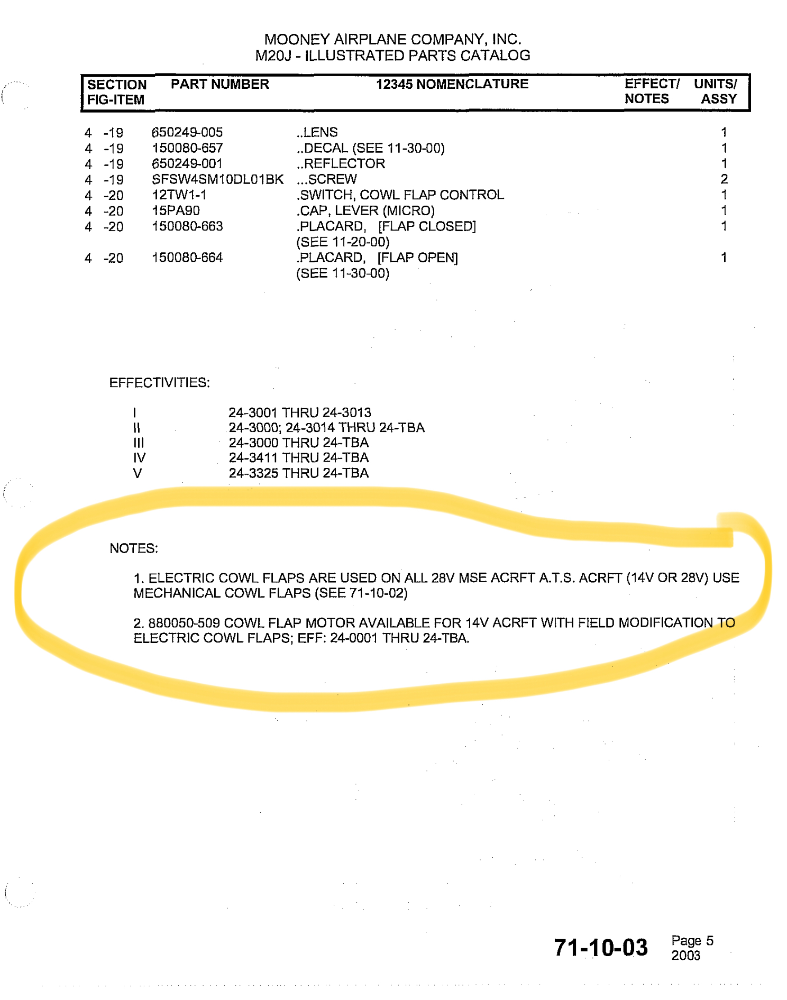
Early Js and all 231s had manual cowl flaps with three positions. Starting in 1986 with the 252 (28v), the K model had electric cowl flaps and then a few years later when the J model went to 28v they had them. All M models had them.1 point
-
1 point
-
Maybe you are right. I was just referencing the IPC.
 1 point
 -
What are you guys talking about. 3 positions? I’ve got a ‘91 MSE with manual cowl flaps. Doesn’t get anymore “infinitely adjustable” than that. They were an option, has nothing to do with being a 28V machine. The limitation that Skip quoted is legitimate. Funny that in the exact same airplane with manual flaps, taking off with them closed is not an issue. In the winter months, I hardly ever open mine except for start (in case of a fire). When it’s as cold as it gets here in Canada, you’d never get the engine up to temp if you opened them.1 point
-
Tint works on the back windows, but the other windows are compound curves and I haven’t found a tint that would work, one of them could bend as aggressively. Exposure at higher altitudes, the atmosphere is thinner, which means less UV radiation is absorbed. For every 1,000 feet increase in elevation, UV exposure can increase by approximately 6% to 10%. This means that at 6,000 feet, UV exposure can be about 36% higher than at sea level, and at 9,000 feet, it can be around 42% higher1 point
-
I'm pretty sure that we could have get enough folks to commit to get to $2K min. Or order it from overseas and make it even cheaper.1 point
-
There are some Mooney CB's who spent several hundred dollars on a sticker saying that it is OK to put paint stripper (aka G100UL) in their tanks1 point
-
My plane came with an oil sump heater. I got one of the afore mentioned Switcheon remote switches, even though I live less than 10 minutes from my hanger. When it is really cold. I put in the cowl plugs and have a Mac's insulated cowl cover. I toss it over, but don't strap it one. I put a BT thermometer in the oil door and typically see 80 degrees after over night. This has worked very well down to 5F1 point
-
Add in - talk to ATC, watch for traffic, arrange routing around thunderstorms/build ups, climb and descend to stay visual or avoid ice, get re-routed around MOAs and restricted areas, and be ready to land in a 15g25 crosswind after your instrument approach, which wasn't forecasted when you took off 7 hours ago. On the right day it can work out, but I personally just plan a stop at 3-3.5 hours. If I am thinking about a longer flight, I take plenty of gas and keep the mindset that if I get fatigued, the weather changes, or I just need a break, I'll find somewhere along the route to stop short.1 point
-
In between flights when airplane is resting in hanger, I keep a Twin Hornet plugged in underneath the cowl, cowl plugs inserted, a thick blanket draped over the cowl and spinner, and cowl flaps shut. When i pull the plane out of the hangar i usually see CHT's around 65-70 degrees on the engine monitor. https://www.aircraftspruce.com/catalog/eppages/aircraftheaters_08-12217.php1 point
-
There is no way of knowing what sorts of non-certified things happen to it on an experimental airplane, so there's good reason to handle it that way. I don't know wether that status changes if you send it to a proper shop for overhaul, but that probably makes it uneconomical.1 point
-
Just in case there are some impressionable new or wannabe pilots reading this, it is a rare pilot that can sit for 7+ hours (don’t forget taxi, hold, release, and landing taxi) never stand or stretch, listen to/feel the constant drone of noise (ANR doesn’t stop everything) ,feel the constant vibration of the engine/prop, experience turbulence, pee in a bottle (or hold it for 7 hours), fly above 10k with O2 and “never notice it” and be fresh for an instrument approach at the end….1 point
-
Mike: I know you want to promote your business but flying someone from Florida to the West Coast and back probably isn't a cost effective solution for a 3 hour flight.1 point
-
@bonal the Ford Trimotors were produced between 1925 and 1933. The one that flies at Osh every year is from 1929. The beginning of commercial flight! Design was taken from the Fokker F.VII Trimotor produced by Anthony Fokker. He was super excited to fly the Fokker Trimotor in the original 1925 Air tour that he painted his name in large letters all over the aircraft as advertising. https://www.fokker-history.com/en-gb/ford-national-reliability-air-tour I’ll have to check when the Ford Trimotor first flew in the tour…I was thinking it was the 1927 tour… Amazing to think of the early titans of industry and intrepid aviators of the time.1 point
-
Here is a better pic:
 1 point
 -
I know the Carson speed for my airplane, and I’m glad for it. I figure there are 3 good speeds to know for your airplane: full-tilt, where you go fast but burn an idiotic amount of fuel; best range, where you are most efficient but go an idiotically slow speed; and Carson’s speed, which is basically the least idiotic speed to fly. With all that said, I cannot remember a single flight where I intentionally flew Carson’s speed. There have been a couple of flights around 11-12,000 feet where I happened to glance at the airspeed and noted I happened to be at my Carson speed. I’ll admit it was very rewarding basking in the warm glow knowing I was perhaps slightly less of an idiot those times.1 point