
1964-M20E
-
Posts
4,111 -
Joined
-
Last visited
-
Days Won
10
Content Type
Profiles
Forums
Blogs
Gallery
Downloads
Events
Store
Everything posted by 1964-M20E
-

Procedures for clogged injector or turbocharger failure
1964-M20E replied to FloridaMan's topic in General Mooney Talk
Thankfully I have never had to do this but if I am correct you pull the prop handle all the way out and I was told during initial training that if you slow the plane some past the best glide the pop will stop and then you can resume your glide. I guess one could try this with enough altitude and near an airport actually stop the engine completely. Maybe next time I find the need to use all fuel in one tank and if I am by myself I might try this. -
no I'm just a pilot
-
I have seen that happen on a Beech Musketeer but the hose was not replaced after a water landing. This did cause another off airport emergency landing due to a collapsed hose. Also the length of unsupported Scat hose would be minimal in the E and F models only about 2" just enough to allow for vibrations between the cowling and the engine.
-
I'm thinking the only restriction you have is the air filter and that should be minimal 0.5" the rest of the pressure drop from ambient comes from the throttle body if the air-filter is clogged you have the bypass. An easy way to find out would be to put an old MP gauge with a line hooked to the air box just behind the filter.
-
yes it will help in identifying where leaks are coming form and possibly reveal a crack that was hidden by dirt. When washing my engine I primarily lower half around the crank case.
-
G1000 WAAS upgrade parts availability ending
1964-M20E replied to Oldguy's topic in Modern Mooney Discussion
This is one reason I don't like glass. However, it is not the glass that is the problem the problem is how it was implemented by being integrated into the type certificate. These panels should be treated like any other TSO instrument in the panel. The FAA needs to come out and give a blanket approval to replace these glass panel avionics inside the aircraft with TSO type avionics and move oven all in the name of safety and nex gen. -
Yeah $300 +/- is pretty expensive for the boot but at the end of the day is it really worth trying to make a new molded rubber one if the originals are available? I thought of using a piece of 2 1/2" maybe 3" scat hose and making an adapter to fit on the throttle body and the cowling with a flat piece of aluminum and a piece of 2 1/2" aluminum pipe. It's simple, short, easily replaceable with commonly available items. The most fabrication you have is some cutting and welding on aluminum. Is there any real drawback to this? Intake collapsing maybe? Maybe not enough room to make it work? There is very little differential pressure on this part and it would not be very long at all maybe 2" of unsupported duct for the flex between the engine and cowling. Surely the SCAT is capable of handing anything the rubber boot we now have has to handle. Don't other manufacturers use SCAT to direct intake air form the filter to the throttle body or carburetor? I've really only worked on the Mooney with my A&P of course. Shoot away if you want. Just my thoughts.
-
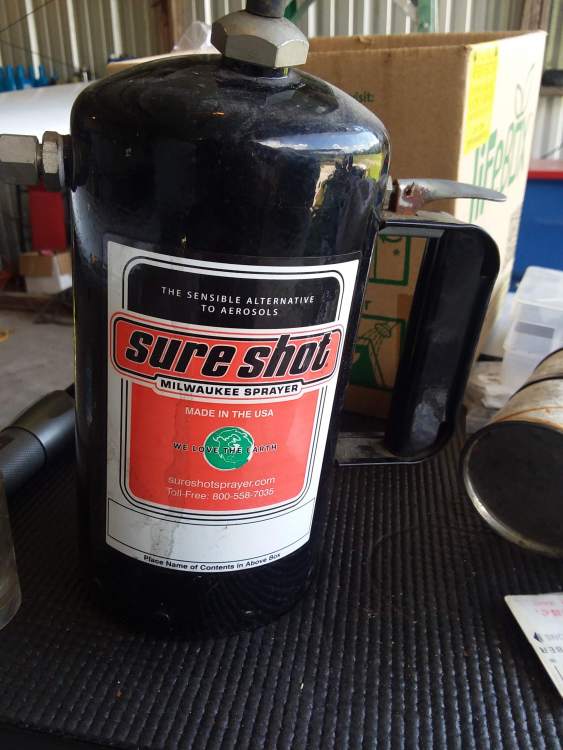
I'll use some denatured alcohol after the mineral spirits makes for a nice clean engine. Wipe all accessible area like with a cloth. I use these sprayers (made in USA) they work real well put about 80psi of air in them with a quart of liquid. I even have one with brake fluid for bleeding brake lines when necessary.
-
Procedures for clogged injector or turbocharger failure
1964-M20E replied to FloridaMan's topic in General Mooney Talk
If the prop is still spinning the magnetos will still be firing assuming they were firing before the engine quit regardless if you have a turbo or not. I'm not sure what trying to start the engine with the starter would have to do with that. Now maybe the propeller will not windmill at higher altitudes I have not been that high to find out. However, if I did have an engine failure and was trying a restart I'm going to let the prop windmill for that attempt and then if unsuccessful and have to put it down somewhere I'll try and stop the windmilling for greater glide if needed. I have done a restart in the air already when I intentionally ran one tank dry on a long flight and yes I did lean the mixture before switching tanks so the engine would not over-speed when it started getting fuel again. -
131 pages of light reading thanks Yetti. Would you care to summarize it for us literary challenged folks around here? Not only a CB but lazy too.
-
Mag or ignition switch troubles, KVNY
1964-M20E replied to TStepp's topic in Vintage Mooneys (pre-J models)
I agree with DOC the ground wire from the ignition switch maybe you issue especially since you cannot shut it down with the ignition switch. Which also means you have hot mags so be careful when rotation the engine by the prop. This would make starting harder and kickback a possibility since you are not grounding the right mag and the normal points on the left mag. i.e not using the retard points when starting and trying to stat at 25 degrees BTC timing. -
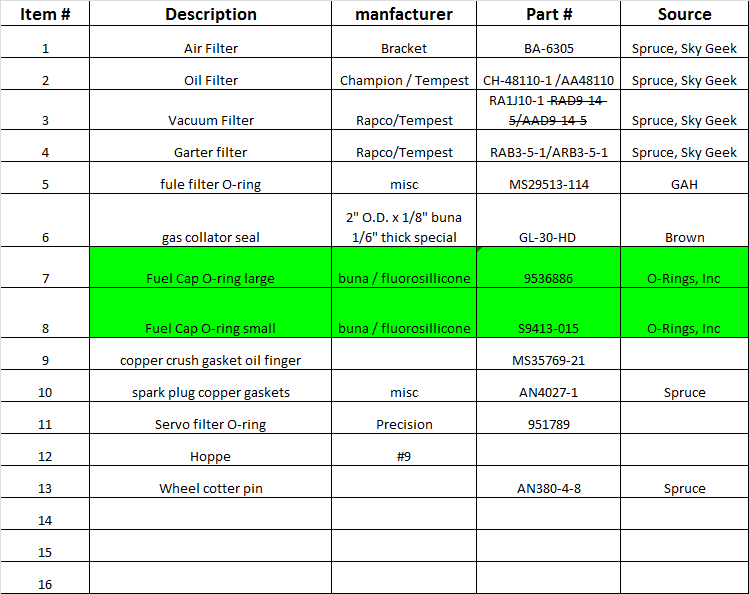
Here this should get you started. Don't forget an assortment of screws, nuts, washers etc that you inevitably need.
-
Not very noticeable especially before I understood how the circuit was wired and works. That makes a big difference.
-
Lets start at the beginning and if I get any o f the tech stuff wrong anyone is more than welcome to correct me. We have a 60ohm resistance based fuel level system. When the gauge sees 60 +/- ohms it shows full, 0+/- ohms it shows empty. I you have an open circuit on the sending units it will peg the needle all the way past full and a short on the wire from the gauge to the inboard sending unit to ground and it will show completely empty. A short to ground on the wire to the outboard sending unit and you will never see more than half full. On the F and J models we have 2 sending units in each tank one inboard and one outboard each rated at 30+/- ohms with the float fully raised and 0 +/- ohms fully lowered. The outboard unit is grounded at the wing rib. These units are connected in series 30 ohms + 30 ohms = 60 ohms. The inboard sending unit should be isolated from ground using the nylon spacers in the screw holes. A single wire runs from center terminal of the outboard sending unit to the inboard sending unit where it is connected to the surface of the inboard sending unit with a special insulated connector that will keep it isolated from ground and from the screw that attaches it to sending unit but allow it to connect to the surface of the inboard sending unit. The center terminal of the inboard sending unit is then connected to the fuel gauge. Hopefully the attached schematics will explain things better. Now if all you are reading is 1/2 full then the wire from the outboard sending unit to the inboard sending unit is making contact with ground thereby removing the outboard sending unit from the circuit, or the outboard sending unit has shorted out and is not adding any resistance to the circuit. This is what was happening with mine. Hopefully this makes everything clear as mud. [AECOM] Scanned from a Xerox Multifunction Printer.tif Scanned from a Xerox Multifunction Printer.pdf
-
Sure can you put the turbo on mine too?? Good luck with you business adventures we wish you well.
-
Well my issue has been resolved. Turns out ti was a unintentional ground at the inboard sending unit. Things like this will drive you crazy. Talking with the Griggs folks (thanks) my outboard sending unit was not in the best place so that is resolved as well. @Stephen I have not forgotten about you shipping fees on the way.
-
So I guess not F-14s in this one.
-
$90 is step for a refill especially for a small portable cylinder. However, when in Rome if you need it you pay it. I am guessing that since you have a 67F you are using portable O2 tanks. There are some other threads on cascading one or more welding O2 cylinders at your hangar to refill you own portable tanks or even installed tanks. It is not difficult and is safe if configured correctly. Essentially you need a large welding O2 cylinder a connector that attaches to the welding tank valve, a connector that will attach to your portable tank valve, a high pressure O2 gauge and about 5' of high pressure minimum 3000psi working pressure hose between the tank connectors and maybe some type of high pressure 3 way valve to relive the pressure in the line before you disconnect it from the tanks. Remember do NOT use oil on O2 connectors. Connect the 2 cylinders together open the valve on the portable cylinder and then open the valve on the large cylinder slowly at first. Let the tanks stabilize for a while the smaller tank will warm up due to the O2 rushing in. You could always cool the portable cylinder before hand to compensate for this. Shut off the tank valves and disconnect. You will get less and less O2 pressure in your portable cylinder for each successive refill then you will need to swap out the large cylinder for a new refilled one. If you use O2 quite regularly you might want to have 2 large cylinders and then working them to get the most O2 in your portable as you can. This does involve moving large O2 cylinders that weigh 60 or 70 pounds +/- you will need a truck to get them to and from the airport and welding supply unless you can get the welding shop to deliver the. They may be hesitant suspecting that you will be using it for aviation. Just make sure you have a welding torch there to show them that you are actually welding oh and don't forget a few pieces of cut steel with welding and cut marks on them for good measure. .
-
now we are talking I'm getting excited.
-
arghhhh I was hoping to see the panel strip naked.
-
if you go bladders definitely get the 64 gallon version. I have the 54 gallon version and would like to have the extra 10 gallons on a few of my flights.
-
Just put the 149nl on my plane yesterday. During annual found the solenoid cap on the old one was loose. Starter was still working fine but didn't want to get stranded somewhere. The 149nl is easier to bolt up then the old one as a bonus.
-
Why we like the U.P. in the winter time
1964-M20E replied to Yooper Rocketman's topic in Miscellaneous Aviation Talk
what engine he has in the fox the propeller is on backwards? -
Could it be done as an overlay with GPS?? I guess they will clear you to the airport and maybe even the VOR approach. Of course a moot point right now since it appears to be foggy with 100 to 200 foot ceilings in the general area.
-
Yes it is sad. I can remember when I was getting my license dreaming of having a plane with 2 King dual flip flop NAV/COMs so I could easily triangulate my position from 2 VORs. Heck LORAN was only in a very select few aircraft at that time. Today I only have a King CDI in my plane. The KLN94 and KY97A were removed for the Avidyne IFD540. I don't even have Garmin in my plane but I do have Narco.