skydvrboy
-
Posts
944 -
Joined
-
Last visited
-
Days Won
2
Content Type
Profiles
Forums
Blogs
Gallery
Downloads
Events
Store
Everything posted by skydvrboy
-
This comment was NOT directed at you, or anyone else in particular. I'm sorry that I offended you, I didn't have any specific post in mind when I wrote that. Just a general observation that in order to improve our skills, we have to introduce a measured amount of risk to test limits, too much risk and we become a statistic ourselves. Also, with respect to ADM, it is absolutely an invaluable tool to use, both before and during the flight. It can get you out of, or prevent you from getting into, many bad situations. However, it's not a silver bullet that can make up for poor stick and rudder skills. I know I personally struggle with the macho attitude, thinking I can handle this, so I constantly have to tell myself, don't take unnecessary chances. I was recently invited to a fly-in at an airport with a 1000' runway. All of my old training buddies were going with their cubs, pacers, and home builts. At first I thought, I can do this, I can stop and take off in 900' just about every time. Then my ADM kicked in and said, hey stupid, what about the "just about every time" did you not get. Not worth the risk. Landing on a 1000' runway is a lot different than only using 1000' of a 4000' runway from a risk standpoint.
-
It seems there are two very distinct views represented here on what makes for a safe pilot. One school of thought seems to be simply avoid any situation that adds additional risk, fly every approach the same, and rely on their superior ADM skills. On the other hand are those that think constantly pushing themselves to improve their skills is the better approach. Frankly, the first type of pilots scare the hell out of me and I think they are a statistic waiting to happen. Can you handle the unexpected when it happens? If you're flying over a forest and your engine quits, can you land on that 3000' strip with tall pines on either end or is "don't fly over forests" part of your ADM process? If your flaps quit working in flight, what speed do you fly final, how long of a runway do you need? I'm in the second camp and like to challenge myself. If I practice making the 1000' turnoff and make it consistently, I know that 1500' crosswind runway is available when the winds favor it. When my flaps failed in flight, I knew 90 mph approach, 85 short final, and that 2900' runway I was flying into was sufficient for both landing and takeoff. I know those in the first camp would think I was crazy for knowingly taking off with INOP flaps, but having practiced flying without them, it was just another routine flight. After all, flaps aren't required equipment and aren't needed to ensure a safe flight. It's not just stick and rudder that I practice either. I regularly leave the GPS and iPad in the flight bag. Calculate my crosswind correction and time to various waypoints and practice dead reckoning. I try not to ever let my night currency lapse (though it's tough in the summer) and intentionally land with the landing light off on occasion. I think all of this makes me a better pilot for when something unexpected happens, but maybe I'm just trying to kill myself by taking unnecessary risks.
-

Ooops. This isn't Kansas, Toto!
skydvrboy replied to Mooneymite's topic in Miscellaneous Aviation Talk
You wouldn't be the first, nor would you have been the last. There are airports all over in Wichita, the air capital of the world. I can think of 6 without looking at the map, but I know there are a few more. -
I'll throw in my $.02 as a low time pilot with about a year of Mooney experience. When I refer to "on my numbers," I'm referring to a specific number I have in my mind as I fly my approach. That number varies based on flaps, gross weight, and wind gusts. I'll admit, it's mostly a SWAG, but it's my approach speed for that landing that I do not want to deviate from. I also have to agree that most Mooney pilots fly from long paved runways to other long paved runways. I started a thread a while back asking for help with my short field technique and you'd have thought I asked about neurosurgery. There were 226 views, but I only got a total of 4 responses and only 2 of those sounded like they were experienced with short fields. It seems some on here think that a 3000' runway qualifies as a short field. As for landing technique, my instructor told me to aim for the runway and just miss it for as long as possible (on center line of course). I think I count the number of times I've let the nose wheel touch first using only my thumbs. Did I mention I was a low time pilot. As for the poster who asked about slipping the F model, my instructor who flew an F said I could slip it just like any other plane. Although, he reminded me that if I needed to slip it on a normal approach, a go-around might be a better option. If I didn't have the slip in my bag of tricks, I'm not sure I could make the turnoff 1700' past the 25' power lines. Miss that and the runway narrows to 25', so turning around means get out and push!
-
If you can knock your paint off with a garden hose, that paint needs to come off ASAP!!! It is just inviting corrosion to start under the paint. Better to have bare aluminum than loose paint.
-
I fully agree, but I doubt that many who complain about the gear being difficult are waiting until cruise to put the gear up. The inner gear doors probably also make a big difference, but again, how many who are complaining have those? My point was that anytime "reasonable" time during initial climb out, it should be easy to put the gear away unless something has changed from the factory.
-
I've mentioned on here before, I have no issues raising the gear in my 67F at any speed. I don't know it it's rigged "just right" or what, but I don't do the dip or anything special. My standard practice is to put the gear up right as I leave the runway, but the times that I waited, no problem up to 90 - 95 mph. I've never tried it above that.
-
Like many others, I hadn't heard. In times like this there just aren't any words that are adequate. Sorry for your loss, hang in there.
-
Media is going to get it wrong anyway
skydvrboy replied to jackn's topic in Miscellaneous Aviation Talk
They're obviously not the only one. -
You won't find anything, I've already checked. Par had them custom make his, so they would still have the plans and all, but as I understand, they only build them on request, not a catalog item.
-
This thread gives me another reason I'm glad I live in KS. All aircraft are exempt from sales & use tax. Business or antique (30 yrs) aircraft are exempt from property tax. We are a VERY aviation friendly state as we consider ourselves the "Air Capital of the World."
-
I'm in the same boat you are. I also fly a '67 F with the Johnson bar and lap belts only. If you want one right away @SantosDumont has one for sale in the classified section for $200. You'll need the $17.50 hardware kit from Alpha Aviation (http://alphaaviation.com/mooney-minor-change-kit-m20-a-thru-g-and-early-j/) However, you will have to deal with the unbuckling/knuckle busting that some complain about with the flip lever style belts. Some say it's an issue, some say slow down and be more careful. As for new, you have the Alpha Aviation kits: fixed strap ($369) or inertia reel ($489), plus the hardware kit for each side. You will get different opinions on the fixed strap or inertia reel, but it seems the plurality is for the inertia on the pilot side and fixed strap on the copilot. That eliminates the need to remove or loosen the strap to reach the J-bar, or more challenging, the fuel selector, when you may be in an impending forced landing situation. The fixed strap on the copilot side makes ingress and egress to the back seats easier. The other option available recently is the Hooker Harness custom belts. There isn't any info online about the Mooney version, but according to @par the price is $417 including shipping for both (plus the hardware kit for each). Look up the Hooker Harness thread, bottom of second page, for an install photo. No mention of an inertia reel available, but they show one on their price list for other harnesses. I will be giving them a call this week for more info, as with lap belts only, I'm living on borrowed time.
-
This knuckle-busting problem, is it just the pilot side that you bust your knuckles or both? I'm thinking I might be able to use this on the passenger side where it would brush the backside of my hand and get the push button style for the pilot side. Of course, I'd need to check with the wife to see if she'd OK two different styles in the plane.
-
High Oil consumption on a Low time Engine
skydvrboy replied to FlyboyKC's topic in General Mooney Talk
My plane uses one quart every 4-5 hours and I've talked to both the A&P and the IA about it. Both say it's a little on the high side, but still within normal limits. -
My comment would be much shorter if they just had a "drool" emoji. Very nice!
-
This is a great reminder that we first need to understand the problem before trying to come up with solutions. As gsxrpilot mentioned, airspeed isn't the problem (alone), so something wired into your airspeed indicator to tell you that you are going too slow won't help. I can make your plane stall at 100 kts and can fly it well below the stall speed indicated on your ASI without stalling. In addition to the factors gsxrpilot already mentioned, bank angle and turn coordination are probably the two biggest factors leading to a stall and whether or not that stall will lead into a spin. The AOA indicator KSMooniac has is a HUGE improvement, but even that has it's limitations. Remember, the AOA is not the same along the entire surface of the wings if the ailerons are being used. The down aileron increases the angle of attack and visa versa for the up aileron. As such, different sections of the wing can stall at different times. That's why in a skidding turn stall, the plane will just spin into the ground toward the inside of the turn as the inside wing stalls first. In a slipping turn, the airplane will flip over the top toward the outside of the turn as the outside wing stalls first, which is probably more alarming to the pilot, but actually makes it easier to recover from. I personally think (private pilot only) that this situation is better addressed through training and understanding the aerodynamics than through technology. For a "fail safe" technology solution, you would need 3 AOA indicators and even that might not be able to catch every possible scenario.
-
A word of caution from experience. Be very careful with the adhesive remover, it is a much better paint remover than adhesive remover!
-
Cylinder head/barrel separation at 14,500ft.
skydvrboy replied to DanM20C's topic in General Mooney Talk
Nice to hear you're safe and sound on the ground! -
Landing gear isn't part of your landing checklist? Yikes!
-
That's why we didn't talk to approach!
-
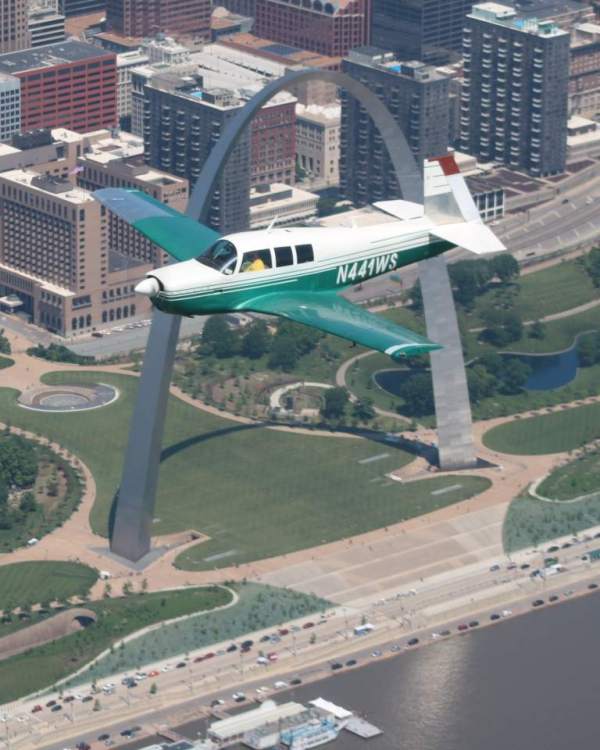
Man, first reply throws down the gauntlet with an amazing pic with three little kids. It's hard to compete with kids or puppies! But alas, it's worth the try.
- 67 replies
-
- 10
-

-
I wouldn't worry about whether any of your previous experience officially transfers over or not. There is enough to learn in beyond how to control the plane that you won't run out of things to learn before you hit that 40 hour minimum. The point is that what you learned and absorbed will transfer over and make the training go that much easier. I had a skydiving background and none of that officially transferred over, but the skills and exposure helped me learn a lot faster. If you are on a budget (I was), don't worry about high wing/low wing, find the cheapest plane to fly. You can transition into your aircraft later. I'll also echo the comments about finding a small airport, less taxi time, more personalized instruction, and better support. In my case, the airport only trained about 2 pilots a year, so everyone knew me was VERY interested in seeing me succeed. Also, you are on the right track with self study for the written. The FAA provides everything you will need to know to pass your written free of charge, spend the time reading it. There are also some great websites for this http://www.ascentgroundschool.com/ or http://www.free-online-private-pilot-ground-school.com/, either will cover everything you need to know. My paid "ground school" consisted of my instructor quizzing me for 30 minutes before signing me off for the written. Last, I wouldn't wait to save up even $5,000 before starting. Yes, that would be nice, but isn't required. Don't be shy about asking the FBO operator if there's anything you can do in exchange for flight time, wash & wax the plane(s), mow the grounds, run errands, etc. Chances are good they are paying an A&P to do these tasks now instead of working on planes.
-
The smoke height will be defined by the mixing layer. Go to NOAA's website and get the location you are interested in. Here is the one for Santa Barbara: https://forecast.weather.gov/MapClick.php?lat=34.4194&lon=-119.699#.W2nnfNJKhEY Near the bottom of the page on the right you will find the Hourly Weather Forecast graphs. At the top of that page is a section for Fire Weather, so select the Mixing Height and hit submit. At the bottom of the graphs you will find the forecast mixing height for the day/time you are interested in. You will need to pick multiple locations to get a picture for your route. Here's a more applicable one for Reno: https://forecast.weather.gov/MapClick.php?lat=38.8935&lon=-119.9963#.W2npbdJKhEY
-
Fluorosilicone Fuel Cap O-ring Kits
skydvrboy replied to OSUAV8TER's topic in Avionics / Parts Classifieds
Mine showed up yesterday, thanks! -
I'm well aware of how quick they sell and how hard they are to find, so I'm not overly concerned about the issues. Their stellar reputation is why I found Phil Monday morning at Oshkosh before he ran out. I like the light feel and not having my head in a vice, so I'd rather figure out how to make them work well rather than sell them, but that's always an option. I have and it seems to make no difference, other than I can make one ear louder than the other that way. I can think of multiple scenarios where that would be preferable or at least a good excuse.