Hank
-
Posts
20,387 -
Joined
-
Last visited
-
Days Won
126
Content Type
Profiles
Forums
Blogs
Gallery
Downloads
Events
Store
Everything posted by Hank
-
And we're done . . . But NC's problems are far from over yet. ****************** Flight ops in North Carolina by us are ended as of yesterday. Some local folks are continuing on a smaller scale on their own, but we decided that Sunday was a good stopping point for us. We are, after all, a week one disaster response organization. There are jobs better done by trucks, and jobs that a Blackhawk needs to do instead of a civilian airplane. North Carolina is largely into those phases now. We shattered all previous metrics that we used to measure our success on this one. Number of flights, number of volunteers both pilot and non, number of tons delivered; all are records in terms of this organization. Thank you all for making that happen. 517 flights 280,000 pounds of cargo 468 volunteer pilots All of those numbers reached in less time than we spent on Houston last year. Until next time,
-
I took my C to a good grass field this summer; it had been raining for almost a week, and rained all four days that I was there. When we landed and rolled out, turning around without stopping almost bogged down, but full power and relaxing the turn radius kept me (bafely) moving. When it came time to leave on Monday, more rain was forecast for Sunday night. So I flew out Sunday evening to a nearby paved field and had my wife drive 30 minutes to get me. We loaded up and left from there Monday morning between rain showers with no problem. My wet grass, soft field takeoff (solo, less than half tanks, no baggage) was a little longer than normal with Takeoff flaps, while my normal takeoff is No Flaps. After the squishy landing and almost bogging down, I was cautious. I also walked the runway before takeoff, checking water levels and soft spots. It's not something I'd want to do regularly. Just one more thing to consider . . .
-
When samples are reported in whole numbers, yiu are likely to have several repprted with the median value (same numbers of values abive as below), but are unlikely to have any report with the average value, such as 386.73°. But out of 100 samples, there may be several reported at the median value of 382, with 42 higher, 42 lower and 8 right at 382°. Also remember: there are lies, damned lies and statistics.
-
The thing to remember about averages, regardless of what is being averaged, is that fully 50% of the samples will be above average; the other 50% will be below average. On the other hand, Photos #3 & 4 look like the baffling was not cut to size correctly, or else put together wrong. But I'm not an A&P, so whadda I know?
-
Found the Marvel Schleber book! Lots of information and diagrams, troubleshooting, etc. But no mention of carb temp probes . . . . Guess I should put it in the Download section under Engine Reference Manuals. MA-4 Carb Manual.pdf
-
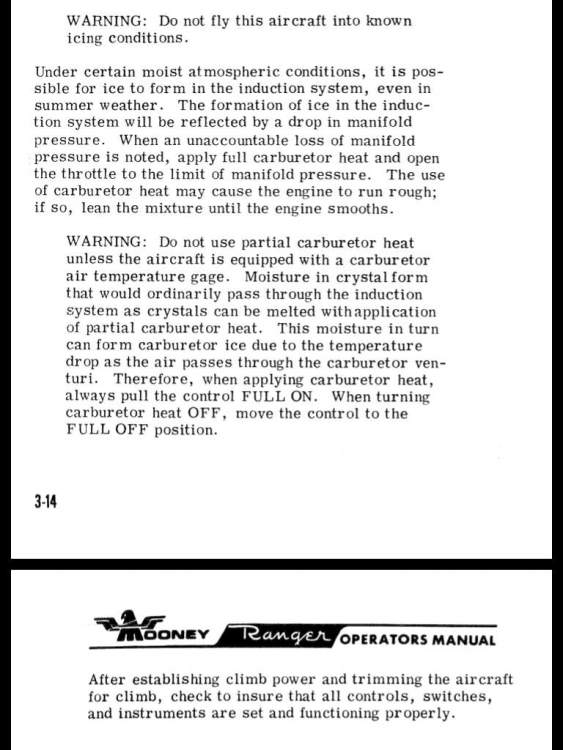
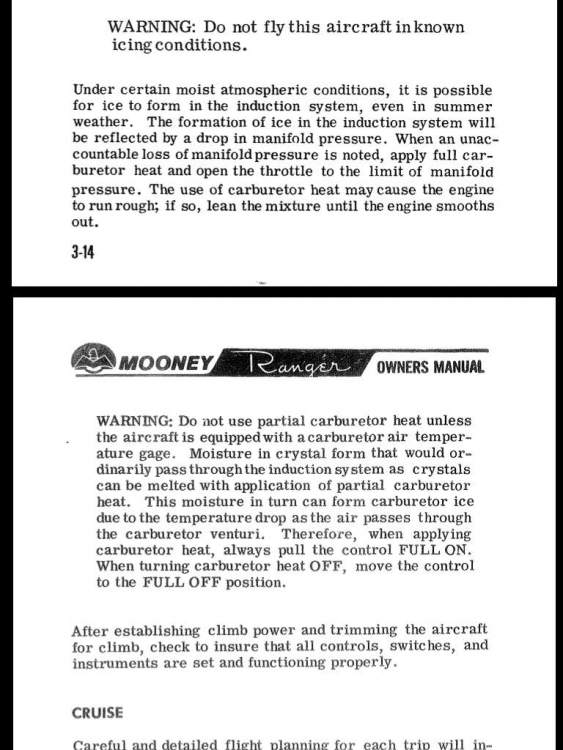
The 1977 C Owners Manual says pretty much what my 1970 one above did, phrased slightly differently:
-
I need to backtrack through thus whole thread . . . Yes, the Optional Carb Temp Gage is a wonderful thing. In six years' flying along the Ohio River, I pulled carb heat in flight to get the needle out of the orange stripe twice, both on winter instrument training flights with my CFII (once in the clouds, once below some darkish-gray clouds). Flights in IMC over southern WV, through light snow that didn't stick anywhere I could see, carb temp was fine even if my nerves were not. The 4 years since I moved back South, none at all. This covers almost 700 hours' tach time, more than that in my logbooks. Checking carb heat function is in the Post-Engine Start checklist, but my Owners Manual doesn't say near as much about its use as the 172 manuals when I was getting my PPL. Let's see what I can find . . . Right, not much. Because I am so equipped, I live by the first sentence affer the word "Warning": Do not use partial carburetor heat unless the aircraft is equipped with a carburetor air temperature gage. Although it doesn't explicitly say so, I use enough carb heat to get the needle out of the marked orange stripe, which is in °C while my OAT is in °F . . . . . More later, it's bedtime.
-
I used to take my C into a 2000' grass strip before I relocated. My personal limit was 2 people and half tanks. No trouble taking a 172 there, nor any of the taildraggers based there. Then skydivers moved in, pranged their 182 after running out of gas and bought a C206. So 2000' can be done, and can be done in a Mooney. But can it be done regularly, often, in a J, with a load? I'm not sure, and that's as far as I'll go (because I don't fly a J).
-
RDU was a zoo on Tbursday, I can only imagine what it will be like today (Saturday)!
-
So maybe it's a thing now that installed equipment can be adapted. If my AI fails, I must adapt by using DG, Altimeter and TC instead . . .
-
I thought that if you saw the lights, you could go another 100' but you must see the runway to go lower.
-
The big round ones aimed at both seats are heat. Follow the fat orange tubing on the right, it should go to the heat shroud around the muffler. The eyeball vent is outside air, you can look through the NACA scoop on the cowl and see inside the plane. In my C, the Cabin Vent knob opens a vent in the center below the throttle quadrant. Check your roof scoop, make sure it opens. Then check in flight and make sure air is coming through the round overhead vents (2 in the front, 2 in the back); there are several threads here in fixing the scoop and vent lines. Other than that, just fly high. Yesterday afternoon, despite heavy sweat on the ground, at 8500' I closed the roof scoop, closed the Cabin Vent most of the way and cracked Cabi Heat about a half inch.
-
dp
-
It's worth the trip! Less than a tank each way. Then just eat cheap. Only takes one day off of work, Friday, u less you want additional "beach time."
-
It's quite an accomplishment, I thought much more difficult than the original PPL cert. But man, is it worthwhile! Congrats, Lance.
-
While that's all well and good, our planes are neither approved nor qualifiable for Cat III approaches. And I'm not ready to turn in my cert . . . .
-
No fancy tools needed, just a long thin oiece of scrap sheet metal or a piece of drip edge from Home Depot. Although 3D printed parts are cool, this has no extra work when using--just slide it under the filter, position a bucket and loosen away.
-
If they try this on you when processing a claim, call your state insurance regulator. Regardless of which "they" insurance company it is.
-

Plane & Pilot Magazine- aircraft of the year
Hank replied to 0TreeLemur's topic in General Mooney Talk
Dude, my C will go 1043 on 52 gallons, plus a 45-minute reserve, if I go high and slow. It also costs less than your F. Gross weight, however, limits range to a mere 970 miles. I generally use power & altitudes that limit my range to 800-plus miles, and get there much quicker. -
Many roads in SE NC are still flooded. At least one dam broke this week, near Pembroke. In two trips, i carried about a pickup load. They were very excited about the 32 lb box of batteries (a medium box cut down to about 6" tall)--said the Fire Dept. really needed them. It just fit standing on end, up against the wall in the baggage area.
-
There were no fees at the MS museum flyin and lunch meet. I also didn't stay overnight.
-
Why not? --curious short body owner
-
But they opened the doors "to slow down" a gullwing Lancair! I bet those things grab an awful lot of air!
-
Congratulations!! That's a serious accomplishment!
-
It'd be fun, but it's 3 hours each way getting there. Haven't had a 9-hour day in the cockpit before . . . . I saw some other Mooneys, including a nice blue and white C (3638-something?). Just like traveling with my wife, I ran out of space well before hitting my weight limit (with half tanks, I can carry 600 lbs).