exM20K
-
Posts
1,697 -
Joined
-
Last visited
-
Days Won
2
Content Type
Profiles
Forums
Blogs
Gallery
Downloads
Events
Store
Everything posted by exM20K
-
with an O2D2, i refill maybe once a year and fly on 02 1-2 people probably 70 hours per year
-
If you're a foreflight performance plus or higher subscriber, you can download the performance profiles which are built from the POH. With TKS, I back the speeds off 5%. For W&B, My plane (TKS, No A/C) is Basic Empty CG (in) 45.518 Basic Empty Weight (lbs) 2490 The 310 HP Acclaim Type S was built off my poh. -dan
-
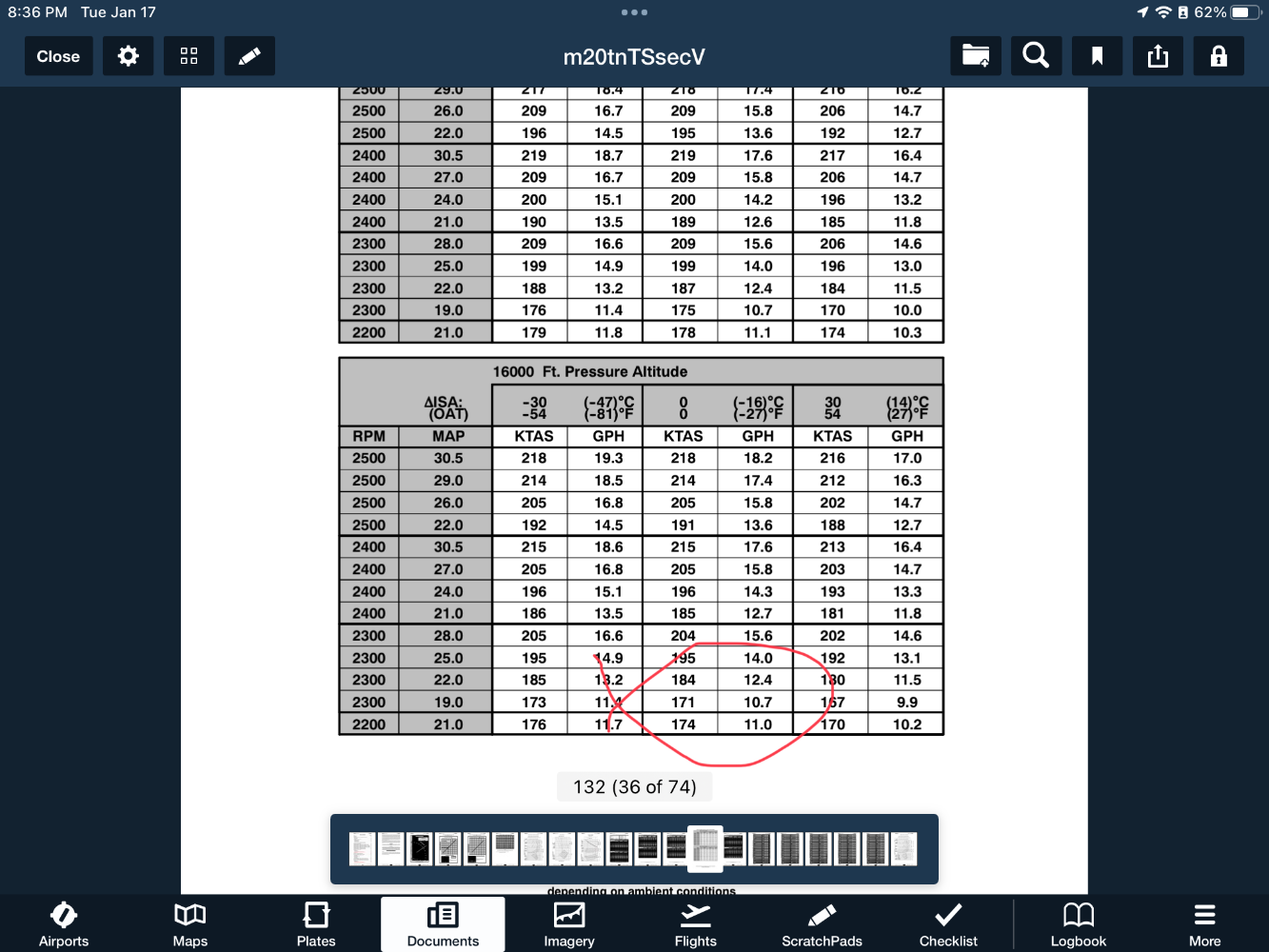
Lowest power settings in the POH Tailwind 50-60 knots according to windy. 7.7 hrs at 10-11 GPH. Plus climb fuel. Doable, just not w/pax you want to fly with you again.
-
Ditto the acclaim. I do know one guy who flies ROP lat 21+ GPH to get very high TAS numbers, but most don’t. There are two major differences with respect to performance vs the acclaim for both the Rocket and Bravo. Acclaim cowling is cleaner than either. The cowling is optimized not to need cowl flaps and is a much more modern design, and the Type S changes are meaningful. It’s my understanding that Bravo’s will fly LOP. All Acclaims will very happily. Not sure about TSIO520NB lop. Vs the long body planes, the mid body must generate more downforce to balance the heavy engine, which creates more drag. Speed reports without corresponding fuel flows are meaningless. My plane can be a 210 KTAS 16.5 GPH at 16-17,000, or it can be 220 KTAS at 21 GPH. I don’t find that juice worth the squeeze. TKS costs 8-10 KTAS. I do find that juice worth the squeeze. i imagine being able to sustain 12-1500 FPM climbs (310 HP) does more to shorten a trip than does a 5-10% cruise difference. -dan
-
2009 acclaim. So likely the newer version. Thanks
-
I guess I should be glad they didn’t fail in the Up position. This failure mode: push the button, they extend 2/3 of the wan, and then they snap right back to stowed. Any ideas on how to troubleshoot? -dan
-
Yup. My old boss has a sign behind his desk that reads: “What’s obvious is obviously wrong.” He is a billionaire many times over and possesses a unique set of skills. it seems to me that we are wired for mean reversion expectations, especially in a rising price environment. I’m sure there is plenty in the scientific literature to name and describe this tendency, and in plain English, it’s some stew of Fear of (or embarrassment from) missing out and envy. As pointed out above, CAPEX is a small part of total cost of ownership. Buy the best plane for your mission that you can afford on a TCO basis. Price fluctuations, especially over larger time spans will barely make the needle quiver on the cost meter. -dan
-
Amen. Within the last six months, I was able to identify a failing fuel pump by comparing the data traces on comparable flights in the past. Data visualization works great for me, and I’m grateful to Savvy for offering their visualization tools and expert advice. I don’t get hung up on absolute levels on the engine monitor. Sometimes, oil pressure wants to sit at 57 PSI, and sometimes it wants to be at 60, or 55, or whatever. Ditto oil and cylinder head temps. Sometimes one jug or the oil will tick up or down 25or 5 degrees respectively with no change in OAT. If nothing else corroborates such a move, no big deal. We are monitoring non-precision devices with precision gauges. A data logging engine monitor enables me to put a flight’s engine data into the context of a lot of other flights. Excursions well outside the normal range and especially if corroborated by other data are, to me, what matter. Can we do oil analysis next :-)
-
Leaving yourself an “out” begins at least as early as the takeoff roll. Dinky little airports with not-great snow removal may mean you’re committed to fly soon after you apply takeoff power. No thanks. and when you fly the (non-precision) approach into a snowy dinky little strip, don’t forget the 120KIAS minimum icing speed. This speed applies to approach just as it does to climb. and when you fly the approach into the dinky little field, don’t forget that the FIKI planes are limited to takeoff flaps only if icing has been encountered. Figure 83 KIAS Vref vs 73. Do you know you can get stopped on a contaminated dinky little runway in an unfamiliar configuration, sight picture, and airspeed? real winter weather flying for me is a big airport thing. YMMV. -dan (based part of the time at a dinky little strip in Illinois)
-
I can't get out to the hangar just now. If yours is set up like mine, just pop open the left side cover. It is sitting just inside and aft with a handful of breatkers. -dan
-
If you have a battery minder(s), how did you route the wires to the exterior? Also, I assume it one minder per battery, correct? -dan Edit…. Reading is fundamental. From the spruce product page…. Maintain up to 2 batteries at a time. (requires BatteryMINDer® Y-Connector Accessory 210-AY)
-
Also, check that the trickle charger breaker is in. Just inside the left battery access door on my Acclaim. Mine was tripping all the time when the right side battery was dying. -dan
-
 I have considered one as an upgrade. Pressurization is nice, the Malibu runs well LOP with good range and UL. It is about 3” too long with the RV in the back of my hangar. Mirage is not on my radar because of the pathetic climb rate. Look at flightaware PA46 flights. These things crawl into the flight levels at maybe 500 FPM. This time of year they look a bit better with the cold OAT permitting slower climb speeds. The Malibu is really not much better. A friend went from Acclaim to M350 (mirage) and likes it very much. I mentioned the climb rate concern, and his attitude was, “so what?” For me, 40 minutes of climb at 40GPH and 120 KIAS, carefully watching the CHT is inferior to the Acclaim’s balls to the wall, 35 GPH, 12-1500 FPM @130 KIAS. Set it and forget it. Just remember low boost passing 12,000. And flip the boom cannula down. And monitor blood O2. And stay 11,000 if the dog is onboard. PA46 of any flavor is probably double the purchase price of a good Bravo. And that’s just the ante. Recurring costs, like hangar and insurance, are significantly higher. For an average $5-600,000 PA46, you could well be looking at $15-20,000 annual, recurring insurance premium. My premium for a $450,000 hull value is <$5,000 for $1MM smooth. A friend is selling his Malibu because of the insurance cost and current high prices he thinks he can tap. Perhaps @Parker_Woodruff can confirm my anecdotes. High recurring costs are a bad bleed. PA46 is a great platform that, along with SETP, put the final nail in the coffin for the cabin class pressurized twins as anything other than a niche market. But it is a whole different cost category than our planes. -dan
 -
One more consideration from me: If you live in an area that can flood, and you plan on finishing the interior, do the bottom 2-3 feet of sidewall in greenboard with bagged insulation and a barrier between it and what's above. When the hangar floods, maybe the greenboard is caulked well enough to keep the interior of the wall dry, maybe now. But if not, you're replacing 2-3 feet of interior and insulation all the way around three sides of the building and not 14' -dan
-
perhaps, but the management have been there before - 400 planes in 2007 dwindled to <150 for most of the 2011-2018 period. Maybe this boom goes on forever, but.... a tree doesn't grow to the sky. -dan
-
Social media and "influencers" like Matt G and Baron Pilot helped Textron deliver a total of 0 Bonanzas and 0 Barons in 2021. There are better things for Mooney's management team to be focusing their time and attention on while they figure out how to make a viable parts and support company. Diamond has made some efforts in social media (youtube is the only one i've seen as I don't hang out on facespace) with a camera-friendly delivery pilot. But the company has a product for which demand well exceeds their ability to produce, so, again, I doubt that even in the case of a successful manufacturer, social media does much more than help owners feel validated in their choice of plane. -dan
-
also check how property taxes are assessed. Attached hangars are taxed at a house rate here in Du Page county, IL, which is much higher than an out-building.
-
The reason I went with stick built vs pole barn is that building materials are standardized around this, well, standard. windows and doors fit into some multiple of 16" on center framing, insulation bats do as well. Anything wall mounted is easier. The overall look fits better in a residential airpark. We have a couple of steel-sided pole barns in the neighborhood, and they really are not so attractive. Yes, you can of course put wood siding on a pole barn, but when people are going cheap (pole barn) they tend to finish cheap. -dan
-
Stick-built is better than pole barn if you intend to heat it. insulate the foundation. put radiant heat in the floor. if at all possible, have the door facing south or east. A NW facing door around here (IL) will have you forever moving the snow that blew up against it. hydraulic doors seal better than bi-fold, and they can make a nice, shady area in the summer. blacktop rather than concrete on the ramp lets the sun help keep it clear in the winter. allow enough ceiling height for a https://bigassfans.com that will make you the envy of your neighbors. make provisions for a car or RV door in the rear if possible. add a 50 Amp outlet for RV storage. -dan
-
Leaving the Certified world for Experimental!!
exM20K replied to gmonnig's topic in General Mooney Talk
more like the handling from an AA1 with inop flaps. Yikes I spent some time with the people at LX-7, who turn the LNC4's into reasonable aircraft. Cool project. Long lead times. Insurance more than a little difficult I really like what they are doing, but the lead times killed it for me. For this year, at least.... -dan -
There is a 252 based at Howell (KOZW). I don’t know the owner, but maybe you could ask around or look him up and get a 1st person feel for the 252. https://flightaware.com/resources/registration/N252EM -dan
-
Acclaim, especially with the 310HP climbes *significantly* better. I routinely see 12-1500 FPM at MTOW and 130KIAS. K model is more like 700 FPM @ 120 KIAS IIRC. Acclaim is quite a bit faster but will burn more fuel. I flight plan 205 KTAS at 16-17,000 on approx 16.2 GPH LOP. I don’t remember what my 231 did exactly, but my recollection is something like 175 KTAS on 12GPH. Acclaim carries more fuel but has less UL. Figure just under 900# for a FIKI Acclaim vs 1050 for FIKI Encore. The better climb rate makes trips @ 16,000 and above painless. no experience with the bravo for me. flightaware performance plus has good models for the acclaim and likely for the 252/encore/bravo. See which works best for your missions, but be sure to subtract 5% from cruise for TKS. -dan
-
For your mission, I’d choose a turbo. You will easily top the fair weather cumulus in the summer and ice in the winter. Especially for those Destin trips, you’ll appreciate the speed and possibility of not needing a fuel stop. I would buy a plane, not a project. Panel re-do’s are time and money sinkholes. Adding FIKI TKS is very expensive now (I heard but not from @CAV Ice that a FIKI installation is pushing $100,000 now) and for at least some other models, there are no reservoir tanks, or they are bigly backordered. I’m with @Schllcregarding G1000/GFC700. They just work and will be supported for longer than I’m likely to have a medical. However, your budget would not cover an acclaim, and the handful of G1000 Bravos out there have an Stec autopilot, so ever I d about all that if you go turbo. FIKI Encores are the unicorn planes. If I could have found one when I bought the Acclaim, I probably would have bought it. prepare yourself, if you haven’t already, for the current state of aircraft prices. Elevated, to say the least. If you can make the stretch into an Acclaim, do it! They aren’t making any more, and it is simply an astoundingly capable aircraft. We owned a TKS equipped 231 1997-2009 and flew it some 2000 hours. Great plane. My company has owned the acclaim since 2016, and I haven’t found anything as well suited to my mission, hangar, and runway constraints. Good luck.
-
IMSAFE, just as with any other Illness / flight -dan
-
Interesting, and that makes sense to me. Speed brakes are good for 20ish KIAS all other stuff being unchanged. This permits a very quick slow-down to gear speed from the descent.