kortopates
-
Posts
6,862 -
Joined
-
Last visited
-
Days Won
87
Content Type
Profiles
Forums
Blogs
Gallery
Downloads
Events
Store
Everything posted by kortopates
-
But an iPad can connect to many bluetooth devices at one time. I have the GMA 35, but not the the bluetooth option so can't speak to connecting to it and the FS 510 simultaneously, but I bluetooth connect to both my FS 510 and my GTX 345 on every flight, I am also blue tooth connected to my Apple pencil which is another bluetooth device. In addition to the FS, I also connect to the GTX 345 as a backup ADHRS ready to go without any effort in the very unlikely scenario I was to lose my G500 ADHRS which is primary. IMO. The backup GTX 345 ADHRS isn't much of a backup if I have to take precious time to get connected to it. I know you have near the same panel so I recommend exploiting the capability to connect to your GTX for backup as well. I figure as long as I am connected to it, I'll never need it.
-
@afward absolutely you can change the K factor in program mode. See your Pilot Guide. Sent from my iPhone using Tapatalk
-
Yes, multiple Bluetooth connections aren't a problem. Sent from my iPhone using Tapatalk
-
My guess is your stick is exceeding their allowable size. If it fits, it should be the correct adapter. They might have the size limit in the pilot guide but they are still in open now. Sent from my iPhone using Tapatalk
-
I am having a hard time following your issue. JPI provided a USB memory stick and the adapter for it with the unit shipped that your installer should have passed onto you? If it’s been lost, they have been known to send another out to you with a phone call. At least, That has been my experience. If you don’t want to wait, you should be able to find the adapter to interconnect the micro port of the EDM to a USB stick, but I don't recall the standard you'll be looking for. But a call to them can resolve that. Also I believe there is a limit on the size of memory you can plug in to be recognized. Make sure unit has started up before plugging memory in. Sent from my iPhone using Tapatalk
-

Mooney down at W00 Freeway Airport in Bowie, Maryland
kortopates replied to sdflysurf's topic in General Mooney Talk
Dupe thread - see earlier thread -
^+1 Its a requirement, unless negligible. Besides, you want to get every pound you are entitled to of useful load.
-
CFI Airplane add-on checkride completed
kortopates replied to NotarPilot's topic in Miscellaneous Aviation Talk
I've lost track so not really sure, but my understanding was that each FSDO made that decision on their own. Some punted to a DPE saying they were too busy while others thought it was too important to delegate wanting to make sure they approved of folks becoming CFI's in their area since it was their last chance. I'll have to ask my FSDO FPM. -
CFI Airplane add-on checkride completed
kortopates replied to NotarPilot's topic in Miscellaneous Aviation Talk
Awesome! You’ll find the Instrument add-on a breeze after the initial ASEL CFI. Did you get tested by an FAA inspector? Sent from my iPhone using Tapatalk -
I installed mine exactly the same. My master solenoid is mounted on the battery box 3 inches away from the positive terminal of the battery. If I am not mistaken, the ring connector on the cable was the correct size for the solenoid bolt as well, but not large enough for the battery post, so that actually made it an easier and cleaner install.
-
I certainly don't disagree with your statement nor @jaylw314 at all - most of the time LNAV min are plenty good enough. But WAAS isn't just good for just LPV minimums. So many are quick to dismiss it because they can only translate it into LPV minimums. It has huge benefits and just because those huge benefits don't directly translate into increased minimums doesn't mean they aren't easily justified or really of value to pilots. Are they required? Of course not, but they greatly simply flying approaches for all of us and probably more so for the pilot that isn't flying frequently. I'd argue that they add a tangible amount of safety with improved situational awareness and the ability to fly more approach leg types - even though I realize we have yet to ever see the accident rate decrease from leaps in technology in the cockpit. But what I am referring to is the added VNAV or +V capability and 5 hz update rate that comes with WAAS. To highlight a few benefits of WAAS beyond LPV, start with the 5 hz update rate. In a partial panel emergency we now have a more reliable box for flying partial panel using just GPS ground track information that's continuously precise even in a turn unlike the compass bobbing up and down in turbulence. Then we have the other benefits that it adds additional approach types such as LP and vertical nav brings us advisory glideslope (+V) on all GPS approaches; including LNAV & LP. With the latest GTN series we also now get support for heading leg types that we didn't have previously when flying missed approaches, ODP's and SIDs - which have Heading legs(rather than course); and even RF leg support. Do you really need this stuff to get down? No, usually not, but it sure is handy when the weather is low and everyone that flys with WAAS knows the added situational awareness is really helpful. Perhaps one of the best examples how its really helpful is the GTN support for a visual approach into every runway at every airport including with +V (when lack of obstacles permits) which is a great tool for even flying VFR into an unfamiliar airport. Like every leap in technology, to be useful, the pilot has to train to know how to use their avionics well. But when things aren't going well, the technology gives us far better tools to work with for those that have mastered it, and I personally find this just as valuable as the LPV approach capabilities. LPV approaches are only touching the surface of what WAAS brings us in a modern box but so many don't seem to understand how useful it really is beyond LPV approaches.
-
That sure looks like its worn well beyond the limits of 10% of the thickness of the tube which is .065" thick on a my Mooney K model, but you'll have to verify what the thickness of the tubing used by Rocket in case its different. But if the wear is say .01" now, you know there is no hope. Its not terribly expensive to repair the mount, its the labor to pull off the engine and put it back on; probably with new lord mounts that get's pricey. But avoiding this is straight forward, keeping the tubes covered with paint by cleaning up rust and exhaust leak damage at every annual and touching up with paint etc. I also use aluminum tape to protect it at the engine mounts location area where mine got the most heat damage previously.
- 13 replies
-
- 3
-

-
- corrosion
- engine mount
- (and 2 more)
-
We're actually not trying to set it so that stays on redline on takeoff since because of the rpm variation that will guarantee it exceeds redline. Instead we try to set it so that it will be very near redline without actually exceeding redline. At Savvy we don't recommend adjusting it up unless it's more than 40 rpm low, but if its exceeding redline on every takeoff by 10-20 or more, it should be turned down. Pilots naturally want the maximum performance out of their engine so they tend to fixate on wanting to see it at redline. But the bigger concern should be on not exceeding limits and longevity.
-
Why are airplane batteries terrible?
kortopates replied to RobertGary1's topic in General Mooney Talk
AN hardware is an example of Standard parts, but batteries are not. The TCDS specifies 4 different batteries for the E, anything that isn't PMA'd for those will require a 337. Given approved batteries are readily available I doubt your FSDO would entertain it, but you could certainly reach out to your FSDO and ask an inspector about it. Even if they'll approve, an IA (or DER) will end up needing to write up a 337 that includes an ICA and other analysis that will cost $ to get it signed off (unless you can find someone else that got a 337 for it approved to use) . -
Another reason why an extension is unlikely is that the FAA already has plans for a website to allow people to request a flight exemption, one flight at a time, along the guidelines stated in 91.225. They're basically automating request for flight exemptions but warned it can't be used repeatedly and indefinitely. The FAA announcement is located here: https://www.federalregister.gov/documents/2019/04/01/2019-06184/statement-of-policy-for-authorizations-to-operators-of-aircraft-that-are-not-equipped-with-automatic There is a thread on it here in MS :
-
Ugh... Random Engine arythmia (rocket)
kortopates replied to Austintatious's topic in General Mooney Talk
That was meant as kudos to you for getting to the bottom of this before further flight and finding the issue. We don't always see that. Now its just a matter of time. But in my limited experience, its usually the other way around in that metal contaminants from the engine get into the governor. I thought I recall a metal screen on the gasket for the governor as well that would offer some protection - but that's just my recollection - but odds should be very much in your favor that its clean. But of course wise to verify carefully to be sure. -
O2 310 HP STC Conversion Question(s)
kortopates replied to flyingscot's topic in Modern Mooney Discussion
correct, but actually three, when you include the idle mixture with the low unmetered fuel pressure and the high metered fuel pressure. But changing either will often necessitate a change to the other and then you iterate till everything is perfect. You're night about the issue as well, the OP's complaint on idle stall is almost always a combination of idle mixture and the low unmetered fuel pressure - sounds like they only got half of it right when they did the 310HP setup. -
Ugh... Random Engine arythmia (rocket)
kortopates replied to Austintatious's topic in General Mooney Talk
Glad you got it resolved soonest! Yep, I never understood why Rocket went with a twin pop/governor on a single, but it is what it is. Thankfully governor failures are rare, but engine oil pressure losses are not in turbo's so good to be aware and to use that soon to be installed engine monitor to help prevent you from being caught up at altitude with low oil pressure. -
Not that I know of. As far as I am aware of, none exist in the GA single piston world. They certainly exist in the multi-turbine world but I am not sure at what level, weight or seat capacity, they begin. For our part 91 purposes, the above AC provides guidance on what is FAA approved by referencing industry standards.
-
That's why we're mostly discussing halon, check this out: https://www.h3rcleanagents.com/support_faq_2.htm Also see FAA AC 20-42D which specifically approves of the blended Halon 1211 and Halon 1301 for both part 91 and part 125 aircraft use: https://www.faa.gov/documentLibrary/media/Advisory_Circular/AC_20-42D.pdf Although its conceivable that we might need to extinguish a fire in the cockpit in flight, its unlikely given most cockpit fires are the result of an electrical short that can usually be quickly extinguished by turning off the master. We'll usually smell smoke before a fire gets out of hand given the fire retardant material used in the cockpit. The more dangerous engine fire, such as from a exhaust leak or turbo failure, isn't going to be helped by a fire extinguisher in the cockpit in flight, but after an emergency descent to an off airport landing and after any off airport landing it can make all the difference in egressing out the cockpit over perhaps a burning wing from fuel that will also likely be draining into the cockpit area. Egressing a burning plane I do expect would be a much more common usage for our cockpit fire extinguisher than in the confined cockpit at altitude. Yet we can still replenish the cabin air in flight very quickly when needed.
-
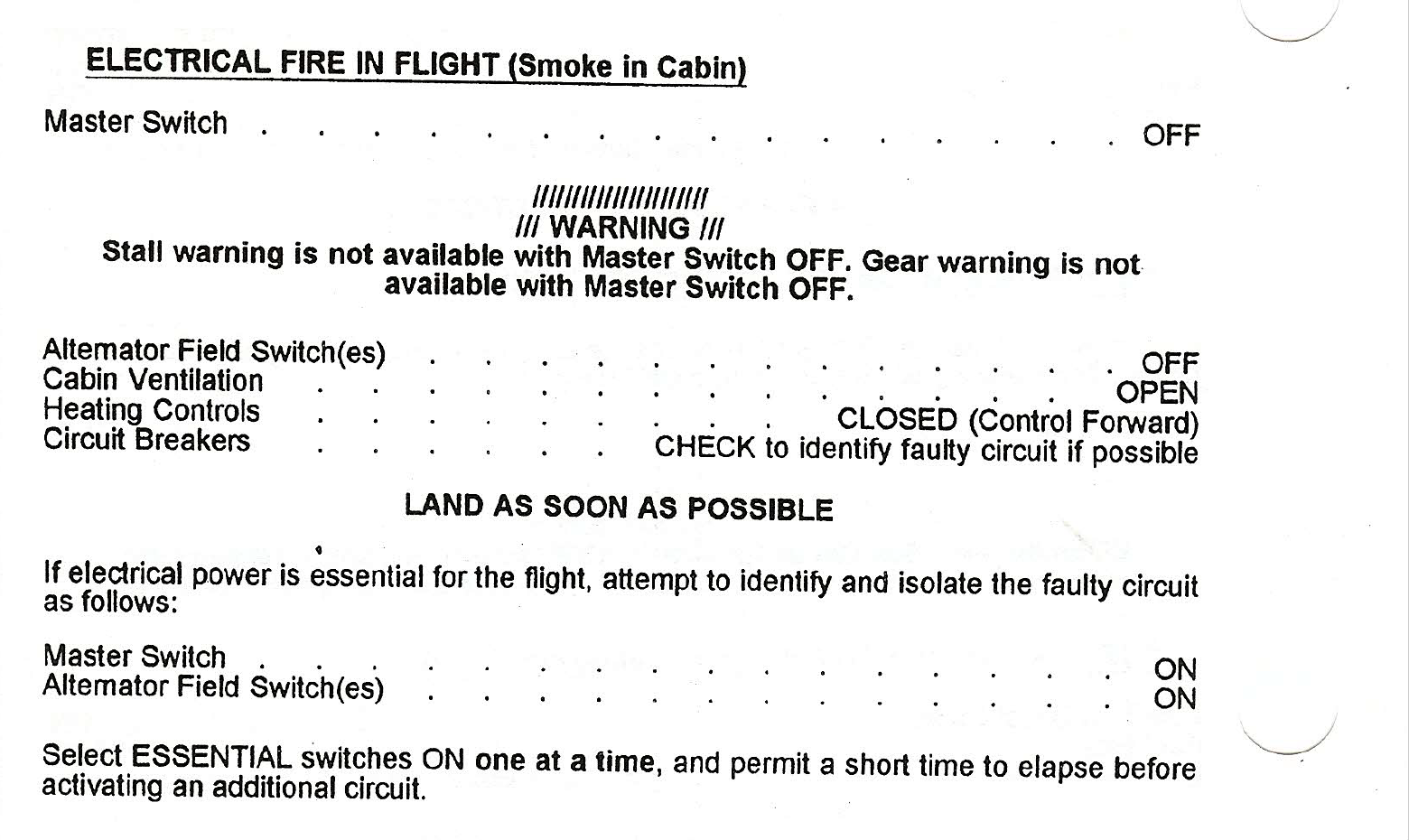
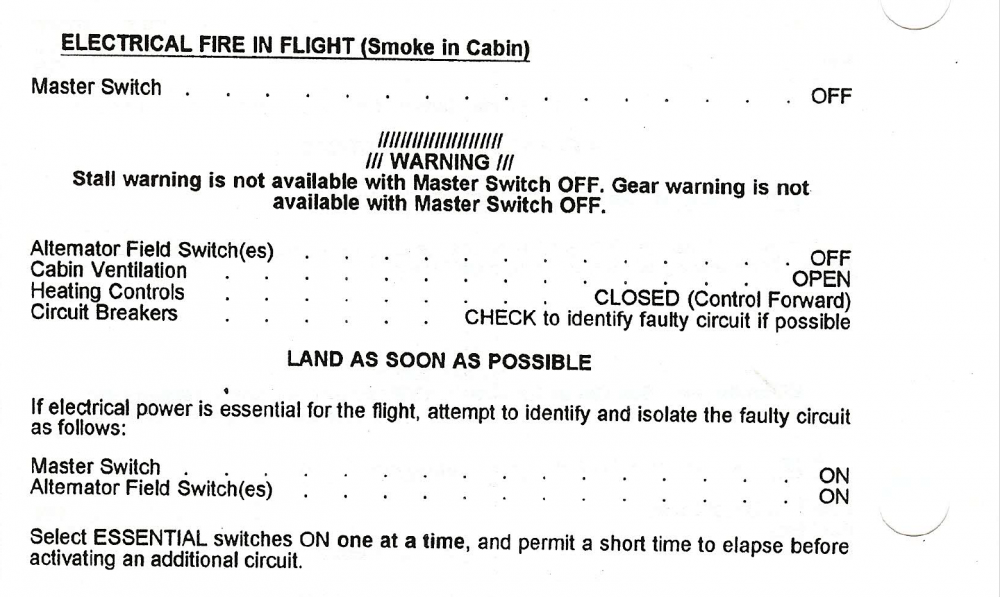
Electrical fires do call for opening the cabin ventilation - after turning off the master. Your earlier POH may not cover this, but here is an excerpt from the Encore:
-
I am using this unit from Spruce with 0.9 lbs of Halon https://www.aircraftspruce.com/catalog/pspages/rta400.php Still going strong many years after installing, although per their reviews, not everyone has been as fortunate.
-
That's exactly what I did, I have a label with the original weight in oz and date installed. I re-weight it annually. Its secured with a bracket on the floor behind emergency gear release.
-
I don't know exactly, but I have heard first hand encounters that opening the side window in the Mooney vents smoke instantly. That assumes the source has been extinguished and may not be sufficient to get a burning plane on the ground from altitude. But nevertheless I found that re-assuring and just passing it on for what its worth.
-
Hedrick Fire Protection (866-306-8130) says they can refill Halon portables, but they send it to their HQ in Chino, CA and it takes 1-2 weeks. I am still using a non refillable unit at 0.8 lbs for Halon that I thought I would eventually upgrade to a refillable one when it expires. But the smallest refillables are at 1.25 lbs and since mine hasn't lost pressure since 2011 I have yet to make the move. Given the longevity I might just stick with the the non-refillable since they are also exempt from what I thought was a mandatory 6 yr hydro test (if that applies to the small portables).