kortopates
-
Posts
6,897 -
Joined
-
Last visited
-
Days Won
87
Content Type
Profiles
Forums
Blogs
Gallery
Downloads
Events
Store
Everything posted by kortopates
-
I believe Scott @RogueOne posted this from the youtube link in the Mooney vs Cirrus thread before Avweb got hold of it.
-

TCM TSIO360-LB Throttle sensitivity
kortopates replied to whiskytango's topic in Modern Mooney Discussion
Agreed, which suggest possible re-installation issue such as a leaky pneumatic hose that feeds the UDP to the wastegate or other rigging issue. But behaviour is like a sticking wastegate which can also come from a leaking UDP connection as @Aerodon mentions above. Its like bootstrapping, but technically speaking, bootstrapping occurs when the compressor is at maximum output with the wastegate fully closed and and the automatic control system is no longer able to maintain constant UDP. Because the system becomes unregulated we'll see large MP variations. Proof that bootstrapping is occurring is shown by seeing it clear with another 50+ rpm. -
From what I read, i the Halon formula is only legal for aviation use - apparently banned for any other use. Apparently its made in Canada now (although there be other sources). But I think the gist is we can only get from an aviation supplier.
-
FWIW, I like the White, Burgundy and Blue tops (first, fifth and sixth) . Don't care for fairly solid grey as it doesn't have enough contrast. The vintage mooney designs at the bottom are well done too, but I don't think they belong on a K model.
-
Sorry, I have to strongly disagree. The only text above that stands out as being readable is perhaps what you bolded or changed fonts for. (e.g., Arial and "Merriam-Webster...") I have no clue why this isn't obvious to you unless you're mistaken about "it doesn't display differently on different computers" since the difference are night and day between your post and mine - and everyone else's for that matter. Half of us also use a software app called Tapatalk - that also can introduce differences in display quality of text. But looking at your posts in Tapatalk they are considerably more readable than here on my Windows 10 PC. I certainly agree with you that "meaning, diction, and grammar" are important, but only if we can see it to read it! I highly suggest just sticking to the default font - its works and enables your "meaning, diction, and grammar" to come through clearly. Certainly not trying to be critical, but its obvious from your comments you apparently may not be seeing how difficult it is to read your postings. So offering a second opinion in the spirit of trying to be helpful. BTW, the good news is that you do have the FAA approved AFMS for your Rocket. Its only unapproved supplemental info your missing, standby and somebody is likely to have a digital copy that they can share with you. But beware, leaning recommendations on the power schedule is some of the worst places to leave the mixture based on the science we have today.
-
Surefly electronic ignition question
kortopates replied to charlesual's topic in Vintage Mooneys (pre-J models)
We can easily see split timing as little as 1/2 degree difference from a LOP Mag test in the downloaded data- its pretty obvious actually. But I don't think anyone could see that in the cockpit doing the test. You need to be able to see the isolated mags side by side in the downloaded data. -
Good point Bob, I just added your update with your Pic to my request to Chris.
-
I agree the E should be its own cohort. The F made sense to include with the J because of the same airframe. Although the E has the same engine as the F/J the airframe and cowling differences do alter some of the airframe related values. I have spoken to Chris about breaking out the E's before, including adding them to the F/J cohort. I think his main concern was the relatively small number of E's - we currently have 42 of them, which is still low. I'll remind him of this situation though and see what he says.
-
I think that's exactly the right approach to go. With the cylinders off you can get a good idea of the Cam and bottom end by checking one of two of the crank rod bearing and then decide your next steps. You might also check your engine logbook to see if the at the last overhaul the crankshaft was machined to its final undersize and if so you'll be aware that you could need a new crank which makes a Lyc rebuilt/overhaul exchange suddenly more attractive when factoring in a new crankshaft.
- 42 replies
-
- 2
-

-
- top overhaul
- cylinders
- (and 1 more)
-
Thanks for explaining it Erik. We have much better ways of leaning these days as Erik touched on in his last paragraph. Leaning by using TIT as a proxy is a terrible way to do it by today's standards. I can't imagine operating a turbo aircraft without a modern engine analyzer. With a modern engine analyzer we know we want we to have our richest cyl a certain number of degrees LOP, or our leanest cyl a certain number of degrees ROP based on the percent power we are operating. That's the ONLY way to ensure all cylinders are truly at the target number of degrees either ROP or LOP. Gami provides excellent guidance on what that target should be for both ROP and LOP in their AFMS for their injectors and this is good approved guidance regardless of whether your using Gami injectors. Without an engine monitor, you have no way of determining this critical info and would do better to stick to very rich ROP settings. Otherwise you'll be for a surprise like many people that lean by TIT to find out that not all there cylinders are as lean or as rich as they thought. So only after you do your due diligence and lean properly to ensure you're operating where you want to be, and understand where your TIT actually is relative to your EGTs, only then should you begin to rely on using TIT as a proxy. But you should still verify this from time to time. Mike B takes this a step further and knows his engine so well that he uses CHT as a proxy to lean, but he is doing this at very low power settings (<65%) where it doesn't matter where one leaves the mixture. At 65% and above, you need to be much more precise on how you manage mixture. So my advice, ignore this old and very poor advice and learn how to use a modern engine analyzer to do it efficiently and safely - or stick to very rich ROP power settings which may not be as efficient but will ensure all the cylinders are out of the red box.
-
All of you on Savvy can run a report card on your aircraft and see how your FF compares to the entire cohort of M20J/F's that we have data on, which is over a couple hundred aircraft. You'll find the median value is just under 18 GPH, with 75% of them ranging from 17-18.5 GPH. If you have lower than median max FF, and you are familiar with the Target EGT method for leaning at any altitude in flight, you can make up for this it climb by targeting for a richer EGT than what you see at sea level takeoff. For example if your max FF is on the lean side, you'll be seeing max EGTs of 1350 or higher; rather than in the 1200's with a max just under or close to 1300F. So rather than lean to your higher sea level for rich EGTs in climb, keep it rich till you see your max EGTs drop to 1300F, which is going to be really close to what the 18+ GPH max FF will look like taking off from sea level. You should be there within a few thousand feet. If its really low, a RSA or fuel specialist repair station can adjust it up for you. I don't see many PowerFlow's on J's but if you do have one, you likely really do need higher than normal FF to keep it cool.
-
2 Mooneys Touch Mid-Air Inbound to OSH?
kortopates replied to mooneyflyer's topic in General Mooney Talk
Couldn't agree more as I have said many times!!!! Sent from my iPhone using Tapatalk -
ALL very true points, unfortunately . Sent from my iPhone using Tapatalk
-
TCM TSIO360-LB Throttle sensitivity
kortopates replied to whiskytango's topic in Modern Mooney Discussion
Was the Merlyn overhauled as well? Not much else it could be outside of throttle rigging. But make sure from your downloaded data that the MAP is fluctuating and not unstable FF leading to MAP fluctuations if that makes sense.(I.e. not being caused by unstable FF) Sent from my iPhone using Tapatalk -
I don't think I follow. If he couldn't sign off for the annual, how could he sign off right after? Any A&P can sign off on discrepancies, it's not an inspection requiring an IA. Sent from my iPhone using Tapatalk
-
This is true, FAA legal has stated from regulatory standpoint only the OEM maintenance manual from when the plane was manufactured applies. But reality is you won't find any shop in the country that operates as a repair station that can get away with this. As a part of doing business each repair station must write up an FAA approved operations manual that covers every aspect of how they do business from training to documentation. Of course they will all say that they will follow the latest OEM documentation for controlling their maintenance. Such repair stations have their hands tied behind their back with respect to this. But in such a situation as this, an owner can always ask for them to complete the annual inspection with a list of discrepancies and have another A&P make an appropriate entry to clear the discrepancy.
-
Another alternative is the chromed hub caps sold by LASAR. Very nice but they do need to come off to add air. But that issue is greatly reduced with butyl tubes. Sent from my iPhone using Tapatalk
-
That's no way to search Mooneyspace! Especially for a pro like you. Google is much better, search in Google: mooneyspace.com Redline Sidewinder Sent from my iPhone using Tapatalk
-
What about this HRT A400 with Halon 1211-1301 Blend. Its an 8x3 size bottle I have in my aircraft. Been going strong for 9 years so far. The element looks appealing too, but lack of control for in cockpit use is concerning and although cheaper than the above solution, bit pricey to buy just to test out.
-
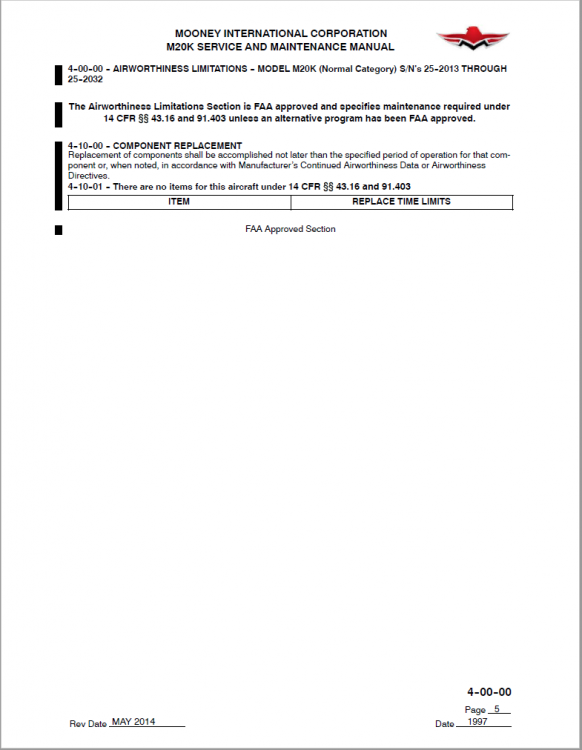
Negative on the No Clutch back spring - I was mixing apples and oranges into the discussion and should have clarified. What I posted was only the Maintenance Manuals Time limited components and I should have clarified - I listed it really to your point earlier when you used the word "rare", I thought you were referring to Mooney's time limited component section where we don't have any but the reference to SB's for clutch. But I should have included these are an example of non-mandatory requirements for us Part 91 operators since because they are not included in Section 4 - Airworthiness Limitations Section which I'll post below. These changes came about just a few years ago at the direction of the FAA to include Airworthiness Limitations Section 4 in the maintenance manual. Previous MM revisions did not include a Sect 4, just a Section 5. Also they cleaned up Section 5 and made it much more conservative. For example they use to cite the Engine manufacturers TBO limits, but now they refer to the OEM's Continued Airworthiness Data instead which is a much cleaner way of doing it and really leaving it up the OEM to define any "mandatory" requirements since they would be the only ones that could (not that they would) - but certainly not Mooney. Notice also that section 4 is FAA approved and it only references serial numbers starting with the Encore (2000 and up) and foremost it doesn't list any of the items we see in Section 5 - in fact its blank. That's because we have a plane that has very few certification requirements under Part 23. In contrast, Cirrus is certified entirely under part 23 and they have lots of expensive mandatory items listed. I don't recall if the J model was similarly updated, but all the longbodys where just like this.
-
Wow, I did not notice that till you just pointed that out. I miss-assumed that all of Section 4 was titled Airworthiness Limitations Section - but its not. Section 4 is ICA (Instructions for Continued Airworthiness). Since only the ALS (which is only 4.1) defines mandatory requirements and there are none listed in 4.1, I believe you are correct and therefore the Section 4.3 is not mandatory. My bad for misconstruing the section titles and mistaking 4.1 for being all of 4. Just to be sure though, I'll double check with my team, but I believe you're right.
-
Ah, yes, they're upto Rev 11 now, this is the current version off the Garmin site http://static.garmin.com/pumac/190-01007-A1_11.pdf As you'll see, there is a lot of stuff, but almost all "on condition" except for the annual visual check and a 10 yr/2000 hr bonding check (some others for composite aircraft only which aren't applicable to us).
-
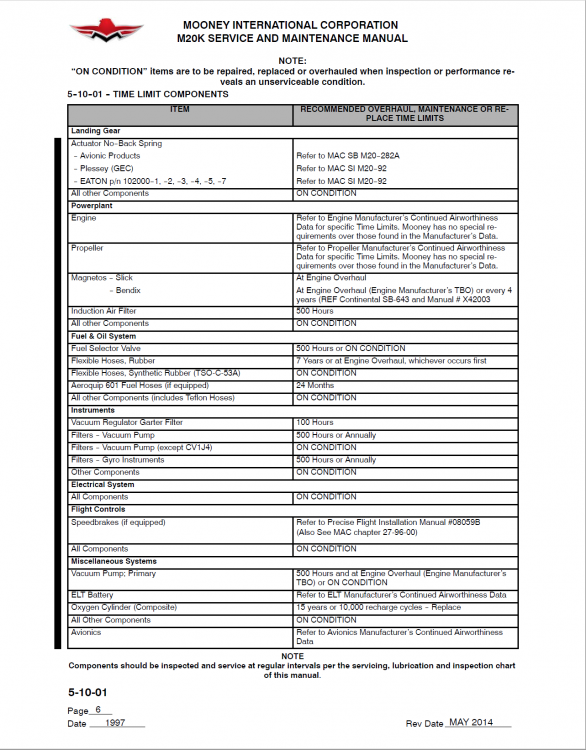
It only has to be approved by the FAA, just read the first page of section 4. AD's need to go through a NPRM, not Airworthiness Limitations. Its true that we don't really have any but the no clutch back spring in the gear actuators in the Mooney, most are on condition, but here is a example Mooney list for the K model:
-
I think you may be misconstruing the meaning of the boiler plate preface text "There are no additional Airworthiness Limitations...that result from this modification." This is not to contradict the remainder of the Section 4 (Airworthiness Limitations Section) but references the basis of where these came from as a requirements for of Part 23 Appendix A that defines the required scope for "Instructions of Continued Airworthiness" - its just saying that there are no additional requirements beyond those listed in Section 4.
-
Thanks for going to the trouble of looking up Mike's writing on this. I was with you entirely until your last line. Your quotation of 91.403 (c) is Mike saying that the Airworthiness Limitations Section are mandatory to be complied with just like AD's. Why do you then say "In other words, the only things required by regulation are the items in the Airworthiness Limitations section of an ICA, which is not common and does not apply to the Garmin ICA above." We are indeed only talking about items in the Airworthiness Limitations section of the Garmin (OEM) ICA - the entire section 4 I posted above is FAA approved data and mandatory to comply with. (I don't understand why you think they are not common and don't apply to the Garmin ICA - they certainly do and very common in avionics STCs) The rules for ICA are precisely the same as the rules for maintenance manuals. Specifically, if an ICA has a clearly identified Airworthiness Limitations section, then everything in that section (and ONLY that section) must be complied with, precisely as if it were in an AD.