Guitarmaster
-
Posts
1,663 -
Joined
-
Last visited
-
Days Won
10
Content Type
Profiles
Forums
Blogs
Gallery
Downloads
Events
Store
Everything posted by Guitarmaster
-

Slick mags and P-Leads (Caution!)
Guitarmaster replied to Guitarmaster's topic in General Mooney Talk
Love my Dremel! -
Slick mags and P-Leads (Caution!)
Guitarmaster replied to Guitarmaster's topic in General Mooney Talk
Thanks Clarence.... I am fastidious about torque, especially on things like this. Sent from my Pixel 2 XL using Tapatalk -
Slick mags and P-Leads (Caution!)
Guitarmaster replied to Guitarmaster's topic in General Mooney Talk
True, but had it failed, I would have had another one to keep me going... [emoji13] Sent from my Pixel 2 XL using Tapatalk -
Thought I would pass this on... I have a new-to-me airplane with Continental O-470's on it and I am still finding all the "easter eggs." One of those eggs came in the form of a hot mag. I found the hot mag during an in-flight mag check; no drop on the left mag on the left engine. Broken p-lead... easy... and it was... except... I fixed the p-lead and reattached to the mag. Cool. Taxied out and did my run-up only to find the left mag dead. Clearly it was being grounded out, but how? I checked all connections. Disconnected the p-lead again and it ran fine. The switch (it's just a toggle) tested fine as did the p-lead. Stumped... Finally went to the mag shop on the field and low and behold they had a Slick sitting on the bench with an insulating washer on the connection. I found the problem! An insulating washer on each post of each mag and, volia! Everything works as it should. The confusing part was, there was no washer on either mag so it appeared to be normal from my perspective. Someone left the insulating washer off of both the mags, it just so happened the lug I reattached was touching the case and grounding it out. Basically, it was a situation where either or both mags could have grounded ON THEIR OWN and that would have resulted in total engine failure over a washer. Moral to the story, if you have Slick mags, check the p-lead post and make sure there is an insulating washer installed! I wish I had taken pictures, but I didn't
-
Must be all that horsepower in the new plane messing with his brain! Sent from my Pixel 2 XL using Tapatalk
-
I flew Dave’s airplane around for a couple months while we were working on mine. I can tell you that it is probably the fastest C model out there. Sent from my iPad using Tapatalk
-
M20J GAMI spread issue (flow divider?)
Guitarmaster replied to jkarch's topic in General Mooney Talk
What are your cylinder head temps and exhaust gas temp look like when you're running about a hundred Rich of peak? A partially plugged fuel injector or line will make the rest of them run rich. In this case, I would expect to see #2 CHT abnormally low and egt high. From your bottle test, number 2 is clearly restricted somehow. I doubt seriously it's your fuel spider. more than likely you have a restriction in the #2 line or the injector itself. it really doesn't take much of a restriction to cause some strange numbers. As MK indicated, do the bottle test with and without the injectors. Sent from my Pixel 2 XL using Tapatalk -
I have an STEC 30/GPSS that likes to hang out to the right of course. It does this on both GPS and VOR/LOC. In addition, it tracks about 4 degrees to the right of the heading bug. I have checked the pot under the bottom, right mounting screw and it is trimmed all the way CCW. In other words, it should be tracking left of course with this setting. Here's where it gets weird.... On the 430W, if I set the CDI to auto then back to .3, it centers up with the GPS, but Still tracks to the right on a LOC. This feels like an installation error, but where would that error be? Thanks!
-
This was what I was looking for. Thanks! Sent from my iPad using Tapatalk
-
A long time ago I run across a chart that was a rule of thumb for figuring percent power if you don't have an engine monitor. I cannot find that anywhere. Does anybody have one they want to share on this thread? It's something like 47 is equal to 65% power or something like that. Sent from my Pixel 2 XL using Tapatalk
-
ARI mod and Wing Landing lights?
Guitarmaster replied to Captnmack's topic in Vintage Mooneys (pre-J models)
Talk to John Breda about the wings lights. Sent from my Pixel 2 XL using Tapatalk -
Laminar Flow Wing and disturbed flow
Guitarmaster replied to Bob_Belville's topic in General Mooney Talk
Summertime flying gave me a gain of 4 knots. Winter time flying saw a gain of 6 knots. I had the LASAR closure as the only mod to my airplane prior. Sent from my Pixel 2 XL using Tapatalk -
Laminar Flow Wing and disturbed flow
Guitarmaster replied to Bob_Belville's topic in General Mooney Talk
As a point of reference, I have seen as much as 3 knots of decreased air speed while flying in rain. The laminar flow airfoil is extremely sensitive to contamination. Not as much as a Varieze, but still. You probably said an earlier post, but how much airspeed do you think you have lost? Sent from my Pixel 2 XL using Tapatalk -
I'm going to chime with: Panel, Interior, paint. As Paul said, you will use the panel on all flights. Solid, reliable instruments and systems are a must... interior and paint are niceties.
-
The Ice shows up very well on the black that's painted on the front of my wings. Sent from my Pixel 2 XL using Tapatalk
-
Holy crap!! .207?!?! Great call on the controller’s part! Sent from my iPad using Tapatalk
-
Yep...Another Brittain Question - Surgical Tubing
Guitarmaster replied to pilot_jb's topic in Vintage Mooneys (pre-J models)
Take a really close look at the red and green tubing. The red stuff gets brittle and cracks and you won't even see it. if you don't have one already, go to Harbor Freight Tools and buy a brake bleeder kit. Pull the vacuum line off each side running to your servos. plug the hand vacuum pump into that line and pump to about 5 PSI. The system should hold pressure, or at the very least, bleed off very very slowly. Both the red and green tubing in my airplane were very brittle and broken. Jerry told me a good way to check for leaks is to smoke a cigar and blow the smoke through the system. I don't smoke cigars, so that was out for me but I did do the vacuum check. In addition to my tubing, I had two servos that were leaking. You wouldn't know it by looking at them, you could only tell when there was pressure applied to them with soapy water as an indicator. Sent from my Pixel 2 XL using Tapatalk -
What’s your short field landing procedure?
Guitarmaster replied to 3914N's topic in General Mooney Talk
My short-field technique is to not go off the end of the runway. -
@M20Doc would probably be able to provide some info.
-
Looks pretty icy around 5,000 feet. Sent from my Pixel 2 XL using Tapatalk
-
I use Skew-t Log Pro for the iPad. Sent from my Pixel 2 XL using Tapatalk
-
Interesting. Sent from my Pixel 2 XL using Tapatalk
-
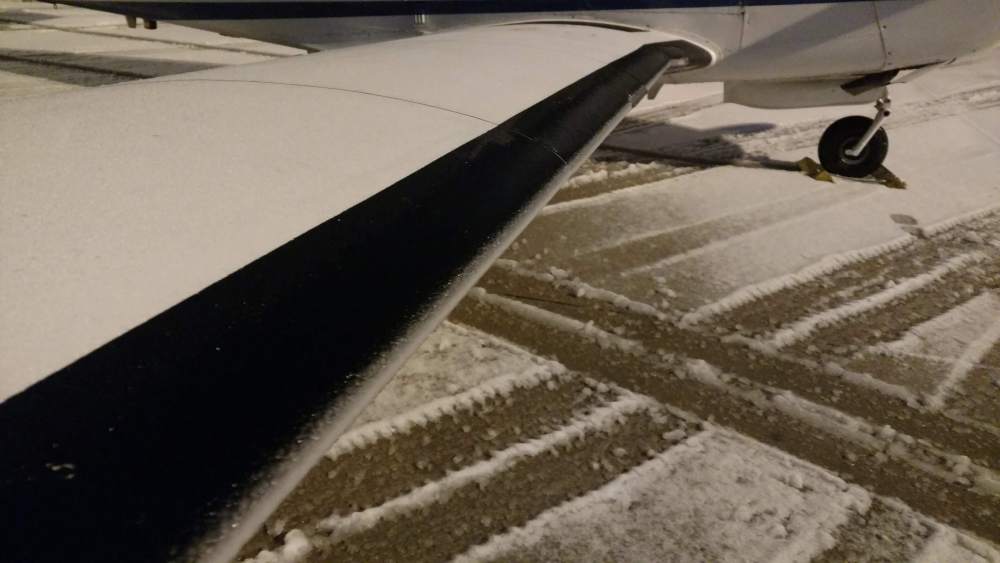
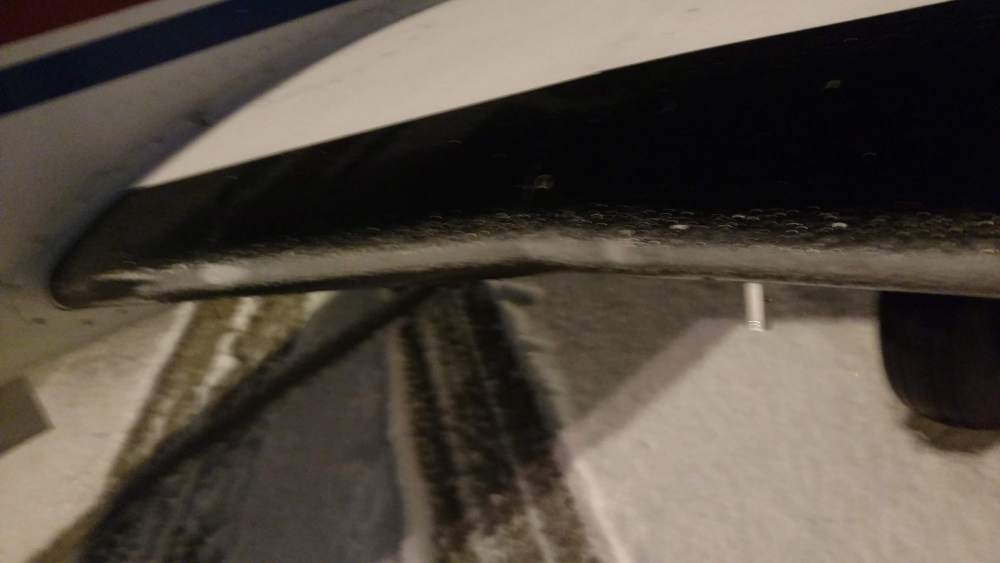
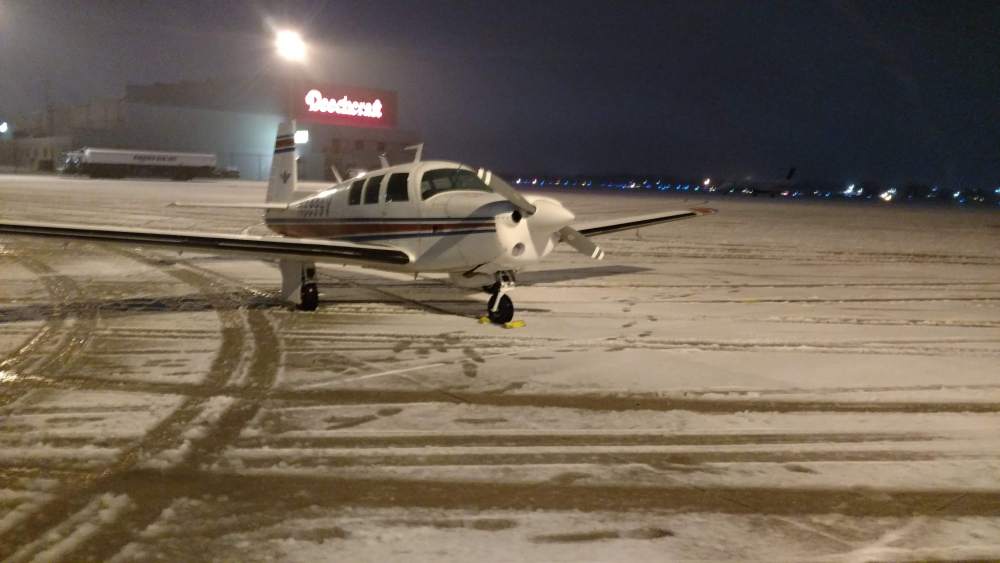
This was a particularly dark and somewhat crappy night. I had just flown the 737 in and there was no ice. Flight home at 3000... well... There was a big inversion at 4000 from the last Skew-T I could pull, but I couldn't get it to come up just before departure. The plan was to climb into the inversion. Didn't get that far. Escape route was to the south into MVFR conditions. I leveled at 2700 where the ice stopped accumulating. I debated on climbing 1000 feet into the inversion, but I didn't know for sure it was still there and I thought I would be in big trouble if it wasn't. Two observations: 1. The airplane handled fine with the 1/2" or so that accumulated. Speed is your friend in this situation. 2. I wipe the prop down with WD-40 silicone spray in the winter. There was no ice at all on the prop; take that for what it's worth. This particular night was a weird night. It was snowing lightly (I fly in snow a lot) which usually means no ice, but with the inversion, icing existed. The best advice I have is to learn the Skew-t chart intimately. Combine that with as many pilot reports as possible to get the overall picture. ALWAYS have a VIABLE escape plan! When things go south, they go south quickly and your fight or flight (no pun intended) will kick in. Decision-making on-the-fly becomes very difficult. If i never flew when there was a chance of icing, I would never fly in the winter; at least in my part of the country. Sometimes s*** happens. Look at all available information, evaluate your comfort and skill level then listen to your gut.
-
Things that make you go, "Hmmmm"
Guitarmaster replied to Guitarmaster's topic in Vintage Mooneys (pre-J models)
Thank you Clarence. The deepest groove measured with a pin gauge was .005 so we caught it in time. Presently in the process of completing SB M20-185. Sent from my Pixel 2 XL using Tapatalk -
Oil consumption versus RPM?
Guitarmaster replied to Gary0747's topic in Vintage Mooneys (pre-J models)
I think it has more to do more with internal cylinder pressure than RPM. A bit of anecdotal evidence for you. I used to treat my engine "nice." Cruise 65%, some LOP ops, lower MAP with 2450 RPM etc. I discovered my oil was getting dirty fast, I had a good amount of lead deposits in the cylinders, #3 compression was beginning to decrease (72 vs 77-78 for the rest) and I was beginning to use oil at a pretty good rate; around 1qt every 6ish hours. Obviously the engine was unhappy with me. I decided to change my M.O. when it came to engine operation. After dumping a qt of MMO in the crankcase, I ran the engine no less than 75% and 2500 RPM and 100 ROP. I left the MMO in the system for 10 hours then changed oil and ran another 25+ hours. The results were AMAZING and somewhat unexpected... The oil stayed clean. Like, read the numbers through the oil on the dipstick clean. Oil consumption went to 1qt every 16 hours. Compression on #3 came back to 77. My conclusion is this: 1. These engines like to work, much like a diesel. If you try to be too nice to it, it won't like it. 2. A happy medium between being abusive and maintaining good ICP keeps the rings seated. 3. A periodic dose of MMO seems to cheer the engine up. Side note: For a short time, I tried low RPM (2000) with high MAP. The plane was quiet and the cylinders were VERY cool. The engine used NO oil when I was operating like this so I think it lends a little proof that somewhat higher ICP may not be a bad thing. These are just my observations with my own plane.