Ragsf15e
-
Posts
6,387 -
Joined
-
Last visited
-
Days Won
33
Content Type
Profiles
Forums
Blogs
Gallery
Downloads
Events
Store
Everything posted by Ragsf15e
-
Not sure about the warning area up by NJ, but we definitely shot air to air missiles at sub and full scale drones in the warning areas in the Gulf of Mexico. Strict procedures for making sure everyone else not in the scenario was outside max range. There’s a smaller requirement for airspace when you’re shooting the air to air gun at banner targets. Bullets don’t go near as far. But there’s a lot of them… 6000 rounds per minute in general.
-
G3X Upgrade with EIS or another route.
Ragsf15e replied to Dieselsnplanes's topic in Avionics/Panel Discussion
It’s definitely worth having an autopilot, even if you just use it once in a while. Big safety improvement for high workload times. -
I really like the timing advance on mine. It’s not a huge difference, but I get a little more power out of it LOP at higher cruise altitude. The 14v SF seems to work fine, but I’m not sure I’d do the lyc branded due to fixed time and possible issues?
-
SF works great on 14v. Does the lyc version do advance timing? I thought I heard they only do fixed. Yeah if you’re a 14v, it should be fine. Good luck!
-
No, but have taught in cirrus where it was turned off through the mfd. we turned it off for steep turns, slow flight, stalls, etc. you can also hold down the disconnect switch. Personally I didn’t think it was necessary to have a switch. There weren’t that many times to turn it off and the menu/mfd was easy to get to.
-
So there’s a sniffle drain, mechanical fuel pump drain, breather tube, fuel sump drain and electric boost pump drain all under and around the nose. Definitely important to be dead sure which is which to aid troubleshooting. The actual exit points on the fuselage differ by model and year. I highly recommend tracing the line back to the origin.
-
Interesting. I guess it’s dependent on the aircraft and installation. Cirrus and Piper list it as a safety advantage since you don’t have to disconnect and start flying right at mins. Possibly their older airframes had it like cessna? The piper I fly is a 2015 g1000.
-
If it’s a few drops coming out the sniffle valve it’s fine. Tube and origin are critical here.
-
Interesting…my gfc700 in a Piper meridian g1000 doesn’t disconnect, it pitches up for the missed and then you need to select nav mode and an appropriate climb mode (instead of GA/GA) but it’s never disconnected. Cirrus does this as well….
-
The autopilot does not disengage by pushing TOGA, it just changes modes. Disengage would mean the autopilot isn’t flying the airplane, but when you say it pitches up to the FD, it’s clearly still flying. I agree the mode has changed though.
-
Even if you just get an inexpensive voltage gauge that goes into your cigarette lighter, it’s good to know the voltage. If you notice a discharge but you’re still seeing 14v, that probably means something different than discharge with 12v. You really shouldn’t see 40amps as the amperage is the amperage going to/from the battery, not the amperage running everything that’s on.
-
Not exactly sure where you’re flying but I fly a G1000 PA46T around the northwest. Even without really strong winds, I’ve seen +\-15 kts at altitude from mtn wave at 20,000’ish and a very long way from the cascades…. The rockies and sierras will do that too and it goes a long way down range. These kinds of fluctuations don’t take mtn wave sigmets or anything.
-
I see you wrote that with a wink, but it will enter the esp low airspeed mode and start pushing over the nose well before stall. It’s pretty good at keeping the airplane from stalling… don’t worry though, the pilot can still find a way!
-
Try turning off the autopilot, trimming it really well and then just holding speed (vfr). See if your altitude goes up and down with constant speed…
-
Ahh, so it looks like the esp low speed function only works if there’s an appropriate gps giving it the terrain awareness for the 200’ function. Otherwise, no low speed esp. To the OP… what gps did he have? Is the terrain database current? Maybe a config issue?
-
The problem with airplane ownership
Ragsf15e replied to N201MKTurbo's topic in Miscellaneous Aviation Talk
Nice, but they get you back with the landing fees and $6.50 / gal 100LL. -
New Engine installed - no fuel pressure.
Ragsf15e replied to Igor_U's topic in Vintage Mooneys (pre-J models)
Awesome! Glad you guys got it figured out! -
As a C owner, this caught my attention.
Ragsf15e replied to Mooneymite's topic in General Mooney Talk
If that’s the way you look at airplane ownership, it’s pretty tough to be involved at all. They don’t really appreciate (maybe in this market?), but you have to spend $10-20,000 / year just to hold the value (annual, insurance, hangar, fuel to keep it flying, etc). You’re pretty much guaranteed to be out loads of cash as an airplane owner, but sliding open the hangar door, rolling out your own airplane, and going wherever/whenever you choose defies economics. As you said, you can go all the same places with a less expensive panel, but for many of us it’s not about making it pencil out. -
The G5s is similar with its bearing pointer. No analog nav 2 is allowed. You can actually have a bearing pointer set up on vloc nav 1 showing the current vor bearing while navigating on the nav 1 gps (gns430w) with magenta cdi. However, why do you really need this if you’ve got 1 or maybe 2 waas gps? Replace the adf by typing in the adf identifier in the gps and go…
-
Aspen Max crash despite newest firmware??
Ragsf15e replied to DXB's topic in Avionics/Panel Discussion
Actually, PP with an stec TC is pretty awesome… step one, engage autopilot. Even if you only get the “straight” mode and alt hold, you’re in business. You can easily do gentle turns with the TC control knob. If you’ve never played with that mode, try it! -
I fly a PA46T with the gfc600 for work. I just turn on the full autopilot at an appropriate time after t/o. I don’t do the YD by itself on departure. Typically the AP remains engaged through the flight. However, I’ll often disconnect the autopilot during descent to enter the pattern, but I reengage just the YD. As others said, it’s nice in bumps, coordinates well and significantly dampens any tail wag (although Mooneys are pretty stable). Mine automatically disengages at 200’agl, however I try to ensure it’s off at the 500’ callout on final,
-
They don’t have Fiki models do they?
-
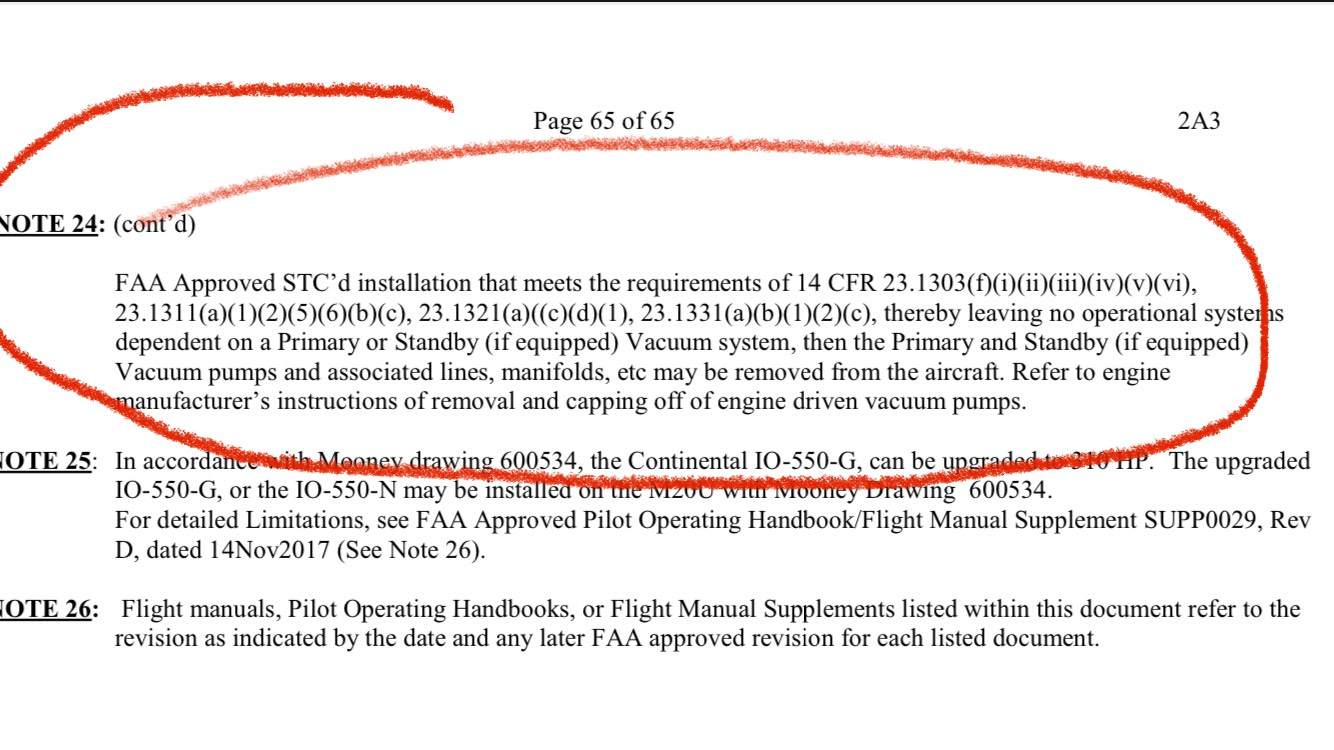
Here’s the note. The tcds you cited is from 2002, current is 2018 on the faa website.
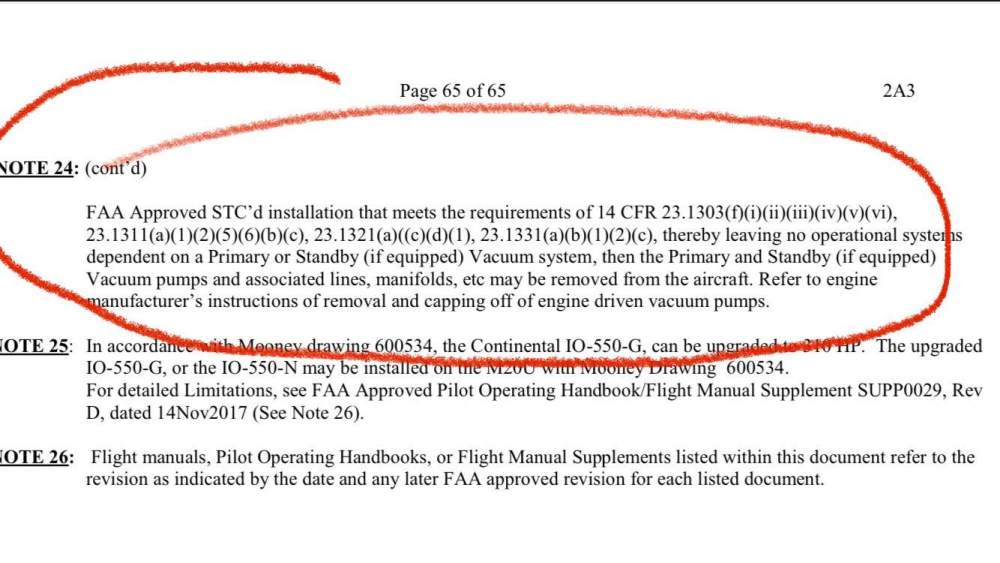
-
Except you have to read very far down in the tcds notes, the “small print”. There’s an allowance to remove the vacuum for all models equipped with appropriate certified electronic ADI systems. your link is from 2002, and potentially not current. Heres the current faa: https://rgl.faa.gov/Regulatory_and_Guidance_Library/rgMakeModel.nsf/0/6ea0f05ecca8304486258305006833cf/$FILE/2A3_Rev_58.pdf
-
Removing the Windshield mounted OAT gauge
Ragsf15e replied to redcatcher27's topic in Vintage Mooneys (pre-J models)
Generally people move the temp probes under the wing maybe 8-12 inches back from the leading edge and out a couple feet from the root. There are some convenient inspection plates. There’s also a factory location further out that was used on later models. Either way, out of the sun and away from the engine and prop wash is good.