

PT20J
-
Posts
10,393 -
Joined
-
Last visited
-
Days Won
245
Content Type
Profiles
Forums
Blogs
Gallery
Downloads
Events
Store
Everything posted by PT20J
-
I have found the trick is to find an IA that is very busy (the good ones usually are). If you can convince them you know what you are doing, it’s easy money for them to do the inspection and log entries if you do the disassembly, assembly, and servicing. My IA charges a flat $750 + hourly rate if he needs to do something extra. Many years ago, Vern Miller at Reid Hillview airport In San Jose CA used to do a lot of owner assisted work. A lot of tech execs found it therapeutic to spend a couple of days out of the rat race wrenching on their airplanes on Vern’s ramp. Some days there would be four or five of us out there working on our planes while Vern had a hangar full of planes he was maintaining. It was a good deal for all involved. Skip
-
Your empty weight seems about right. i assume the CG shown is empty CG in millimeters. If so, it seems way too far aft. Mine is 1168 for a 2900 lb. M20J. This can happen if the CG calculations are not done correctly. If you have a record of the weights for each wheel when it was weighed, I would recalculate the CG using the exact procedure in the POH.
-
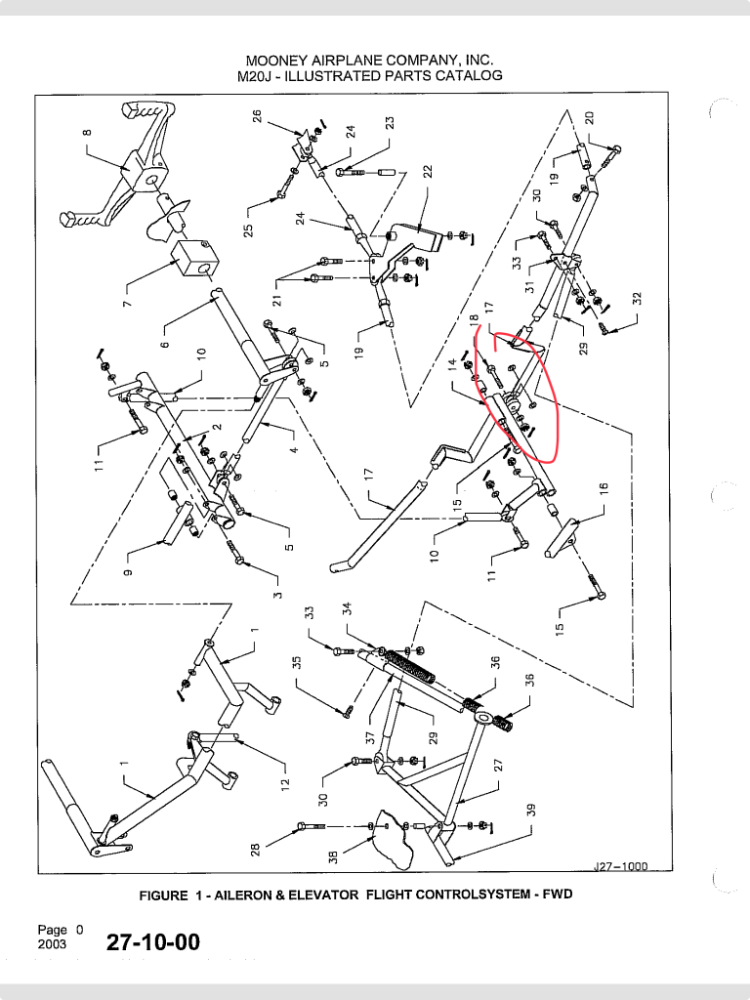
It is true, that control surfaces tend to float up. But the float is not unbounded until the control reaches the stop. As soon as the surface floats up, the pressure distribution changes creating a counteracting moment and there will be an equilibrium point where the two moments cancel and the surface will stabilize at some angle. Usually designers try to minimize this tendency. It appears that Mooney didn't do a great job at this. The hinge line for the ailerons is not set back far enough to provide good aerodynamic balance to counteract this tendency. Also the hinge moment is a function of the distance from the center of pressure on the surface to the hinge line and the Mooney ailerons, being of relatively short span and thus necessarily greater chord to get the necessary area, will have a greater hinge moment compared to say a Bonanza. Both these factors contribute to the "heaviness" of the Mooney ailerons. So, with zero aileron control deflection, I believe that the float would take most of the "slop" out of the control system. However, as soon as we deflect the ailerons, the forces change. And it is only when maneuvering (and thus deflecting ailerons) that we care about any dead zone. The change in moments with deflection arises because the down aileron has increased upward pressure and the up aileron has increased downward pressure. In fact, one of the reasons for having an aileron deflect up on one wing is to reduce the control force because of the reversal of moment direction. We are not talking about a lot of dead zone (unless the rod ends are dangerously loose) and a pilot might not even notice it because we quickly adapt to minor control system deficiencies. Anyway, an interesting experiment would be to block both ailerons in trail so that they cannot move and measure the amount of rotation of the control wheel permitted by any lost motion in the linkages on the ground. Then this could be repeated in the air in level flight and also during left and right rolls.
-
Why not team up with McFarlane? They seem keen on increasing their PMA parts business.
-

Foreflight Alternatives? Which EFB should I switch to?
PT20J replied to 0TreeLemur's topic in Avionics/Panel Discussion
Had that problem years ago when everyone copied Dennis Hayes’ smart modem. Every modem we tried to interface with used a different subset of the command set and widely different timing from command to response. -
There is also a bolt down there that can be put in backwards.
-
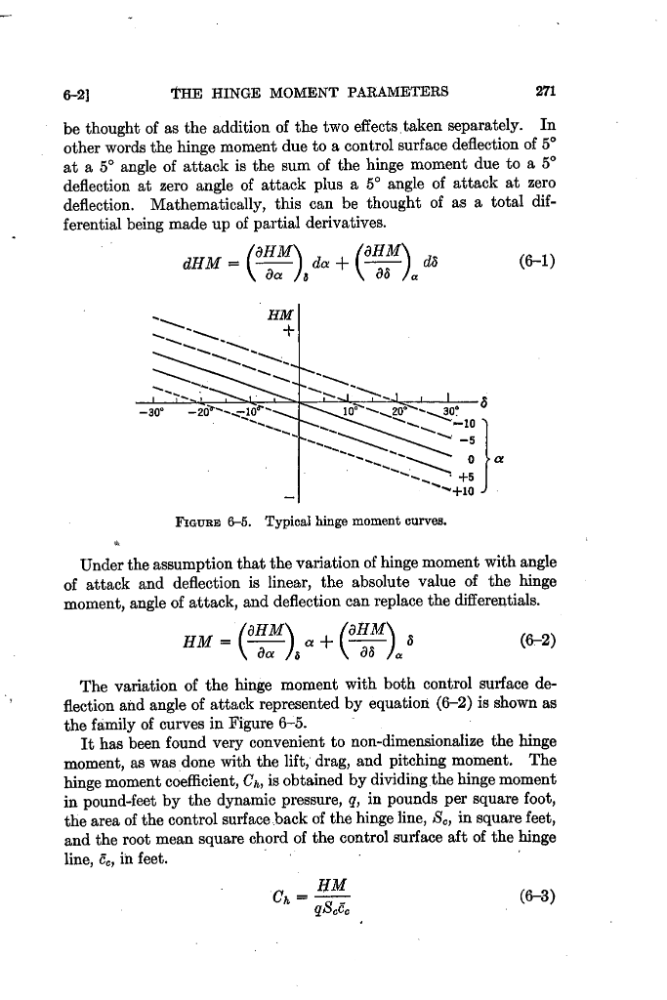
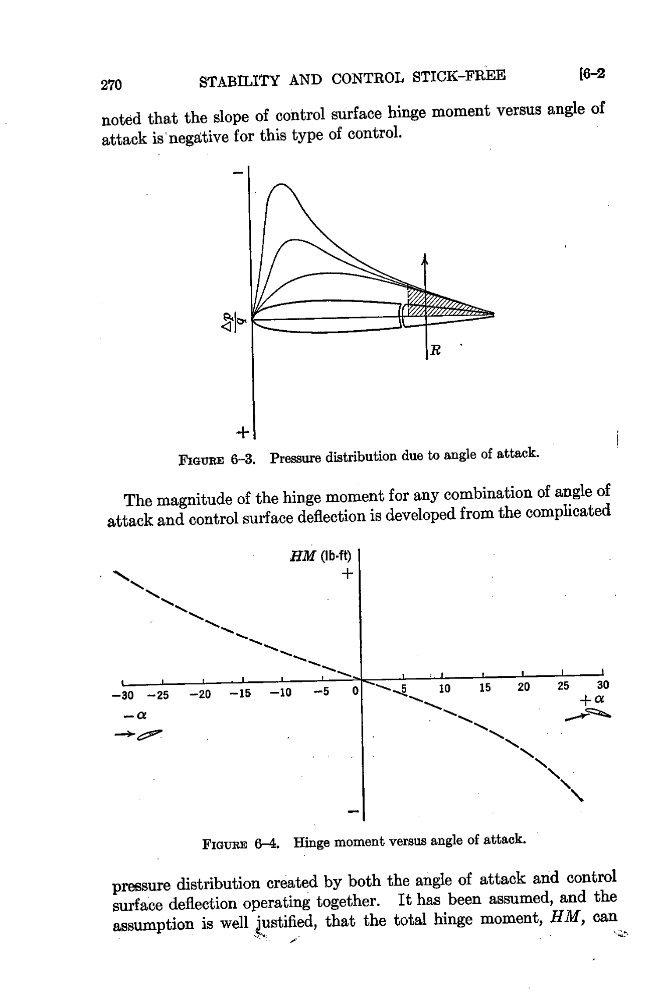
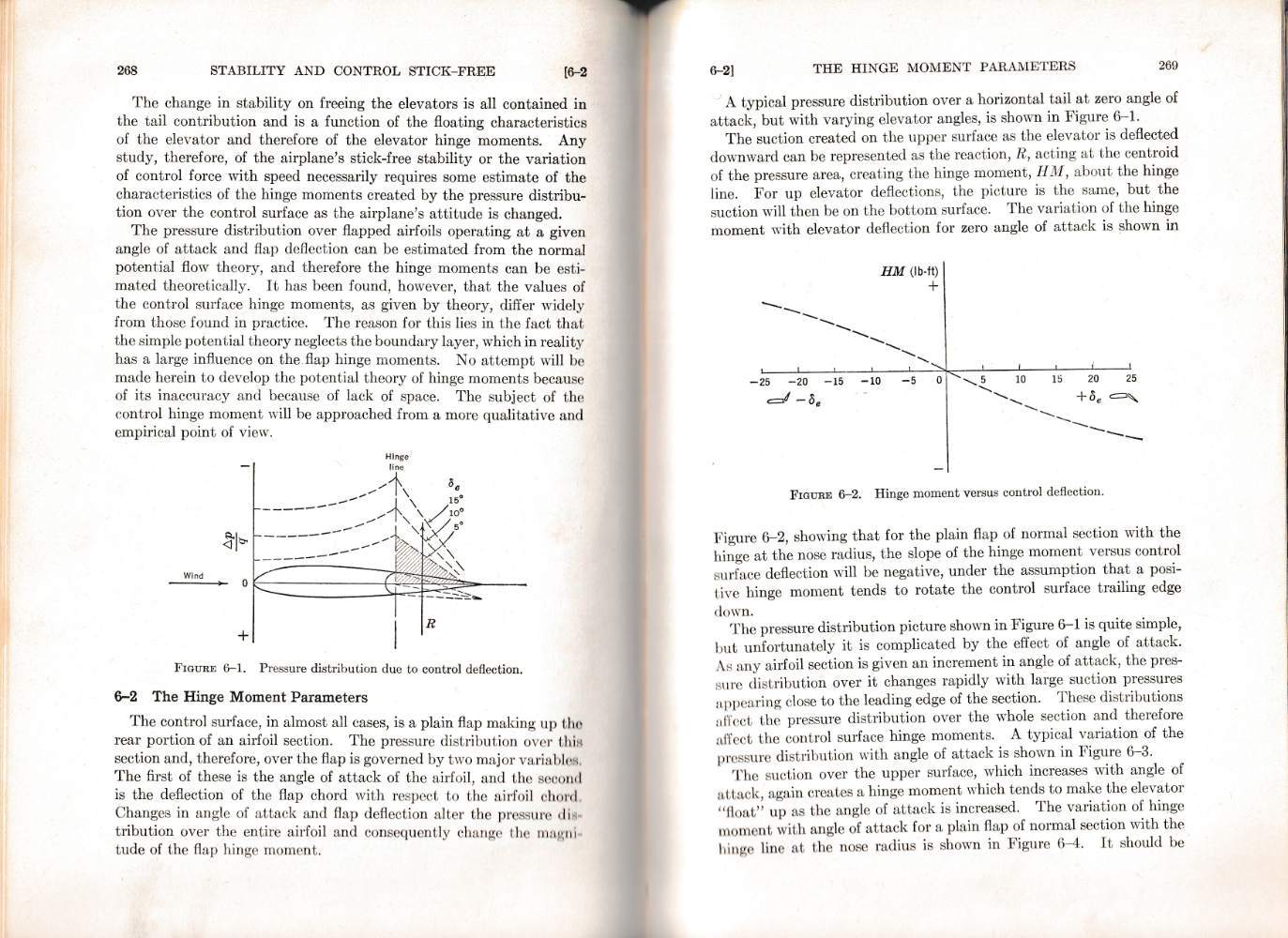
As others have noted, the lift is not evenly distributed over the wing surface area. Most of the lift is generated near the leading edge. It is common to assume that it is concentrated at the quarter chord line as predicted by thin airfoil theory. The pressure differential between the top and bottom surface of the aileron is relatively small. True, but AOA has a small effect for small angles. I’ve Included the following two pages from the text previously cited. I’ll leave it as an exercise for someone to compute the angle of attack at cruise in a Mooney
-
Foreflight Alternatives? Which EFB should I switch to?
PT20J replied to 0TreeLemur's topic in Avionics/Panel Discussion
What are measured winds? -
Foreflight Alternatives? Which EFB should I switch to?
PT20J replied to 0TreeLemur's topic in Avionics/Panel Discussion
Same with Garmin. It took a year for Garmin to fix the ADS-B bug I reported where TFRs that last more than a day are dropped after the first day, and they never did notify me. Actually, in my experience in commercial software development, this is common. Once a bug gets logged, engineering has the ball for determining the severity, and when it will get resolved and what release it goes in to. It may be months and it’s just not feasible to keep the user that reported the bug updated. -
Mine works fine. No false alarms and passes the g switch test at annual. Haven’t crash tested it, though
-
The lost motion in the various rod ends will add to create a dead zone when the control wheel is moved. The down deflected aileron has a negative hinge moment and will put the push pull tubes in compression. The up deflected aileron has a positive hinge moment and will put it's tubes in tension. From Perkins and Hage, Airplane Performance, Stability and Control:
-
This is the kind of thing that gets me in trouble all the time. Being an engineer, I think I understand stuff. The latest manual says it damages the 406 MHz transmitter. Maybe it's because the rubber duckies are tuned for the VHF communications band. Someone who really cares could call ACK and ask them. But this is Mooneyspace, so I expect that there will be several pages of speculation plus a few pages of posts about how this is a terrible design and then a few outraged folks that think they should all be recalled.
-
This is interesting. The manual (Rev 1.08) I downloaded when I purchased the airplane in 2018 with a recently installed ACK E-04 does not mention this. I just checked the current manual (Rev 1.12) and it states in the antenna installation section and in the periodic maintenance section in red bold type not to connect a non-approved antenna. I guess it is a reminder to keep documentation up to date and read it before performing even simple maintenance.
-
According to the article, the problem is that the adapter has to turn backwards a full turn to completely release the spring or the spring and/or the shaft will wear. The lightweight starters are gear driven and don’t turn backwards easily, so they wear out the starter adapters. But, I don’t have any first hand experience — I’m a Lycoming guy .
-
According to this article, it might be the Iskra starter, not the Camguard. https://www.csobeech.com/files/BOB-1015.pdf
-
There is a whole BeechTalk thread about this. Bottom line, Camguard does not contain any friction modifiers and does not affect starter adapters. Some oils are more prone to causing slippage than others, but only if the starter adapter is worn out. https://www.beechtalk.com/forums/viewtopic.php?f=37&t=79247&start=0
-
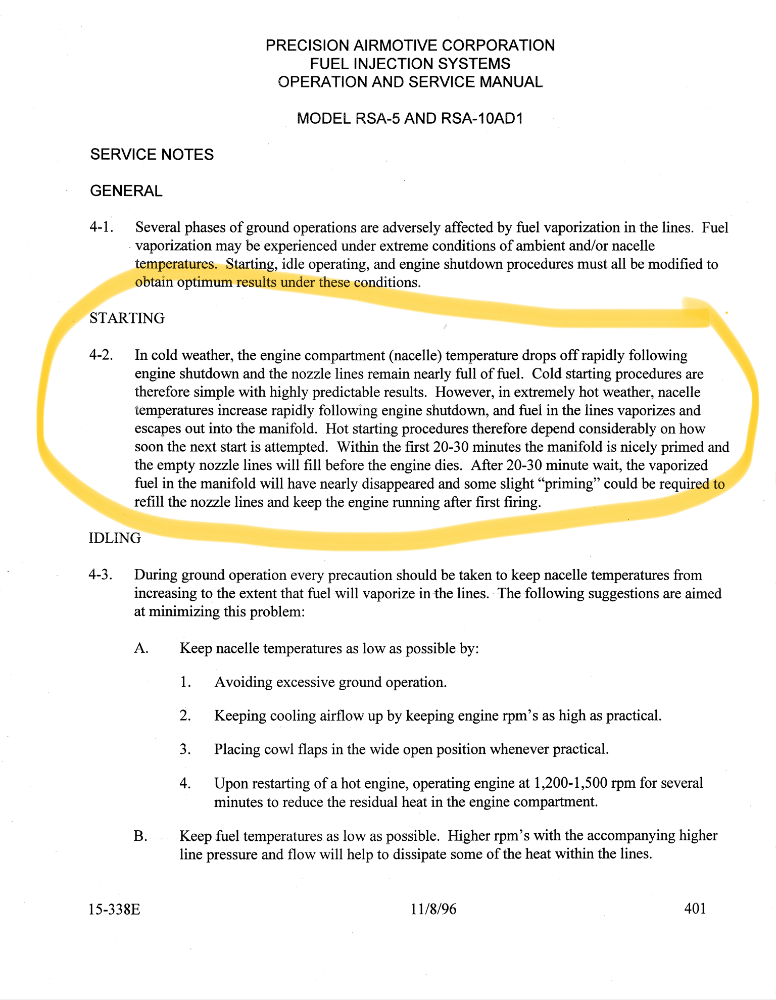
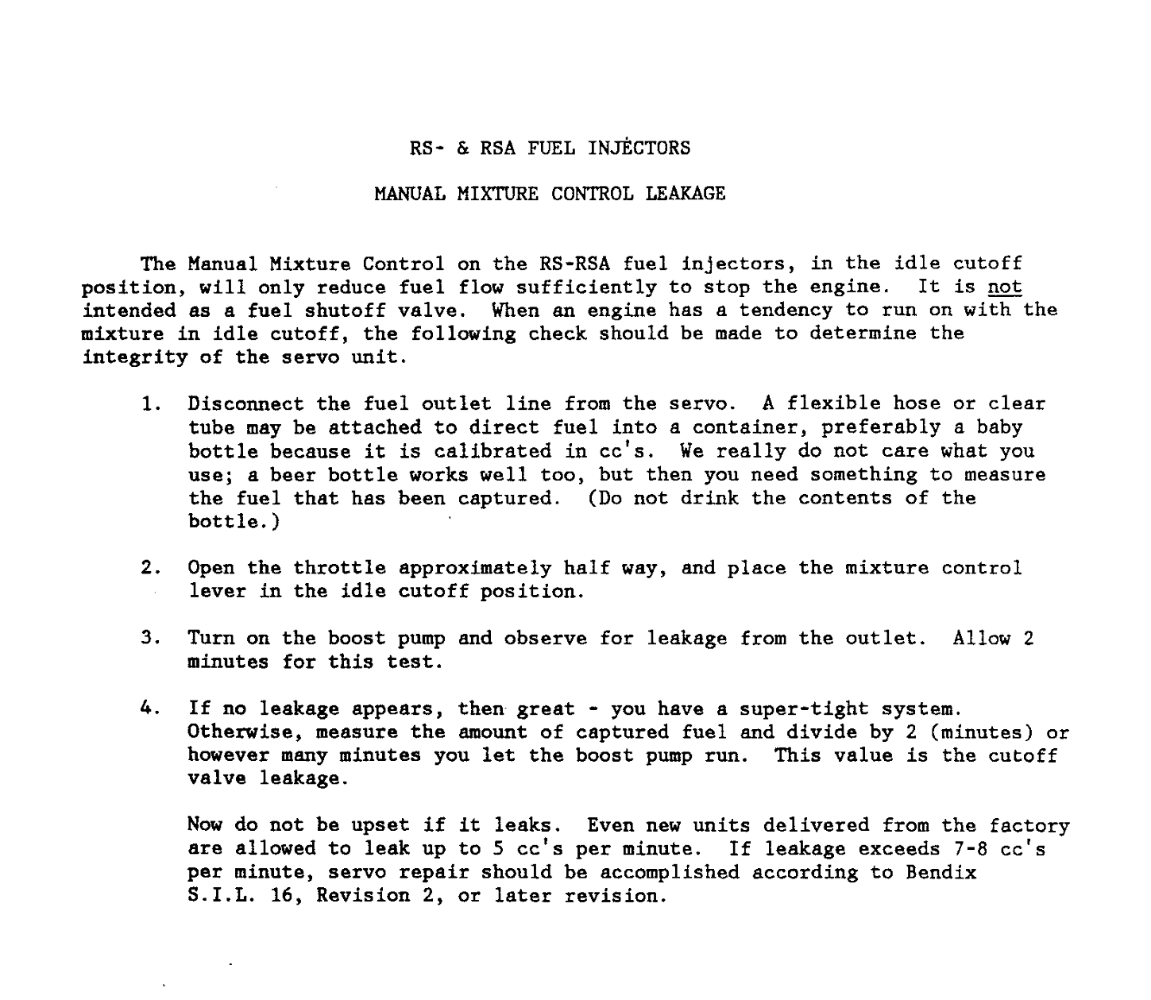
Full throttle and mixture ICO is the flooded start procedure. So, the problem is too much fuel. Assuming good mags and plugs, starting is all about getting a combustible mixture of fuel and air in the cylinders. It helps to understand what’s going on. I’ve attached the starting description by the manufacturer of the fuel injection system. The reason the procedure @SKI suggested works (usually after about half an hour when most of the fuel has vaporized from the lines) is that the heat in the engine compartment vaporizes some fuel in the line between the servo and the fuel pump. Since this fuel is trapped with no where to go, the pressure in this line increases. Opening the throttle and mixture allows this fuel, driven by the pressure in the lines, to prime the engine a bit. One variable is how tight the mixture valve is in the ICO position. The valve isn’t required to completely shut off the fuel flow and most leak a little in the ICO position. This may allow some fuel to flow through the system driven by the increasing pressure described above affecting the amount of fuel at the cylinders some time after shutdown. This might be why your engine seems to be flooded during warm starts. You can do the test described in the attached excerpt from the RSA troubleshooting manual. The procedure @Shadrach suggested works well for me. Since there is no way of knowing how much fuel remains in the lines, start out by assuming there is enough fuel to start in ICO. If not, then prime a bit. I also find that if it doesn’t start in ICO, it will usually start if I put the mixture full rich and keep cranking. I set my throttle to the point where I hear the gear warning switch click.
-
The rods are threaded and can be adjusted by loosening a locknut and turning the rod. When you remove the panel and expose them from underneath it will be easy to see how it works. The adjustment is not described in the service manual. Installing 1.5” pedal extensions doesn’t change the pedal angle, but the 3” extensions tip the pedals aft. But, since you mentioned that your master cylinders were replaced it’s likely that they were just not set correctly.
-
Maintenance records. It will save you money over time. When I flew for a Part 135 operator, we had air Hobbs. That was what was used for maintenance. They had worked it out with the FAA to use that time plus 0.05 hr. per takeoff and landing for pilot flight time. It was a seaplane operation so we generally landed pretty close to where we docked. Most airplanes have a recording tach for maintenance because that is easy to install. The Mooneys with B&D electric tachs had a meter that looks like a Hobbs but is really connected to the tach and calibrated 1:1 at 2500 rpm. Flight schools and rentals usually use a Hobbs meter connected to an oil pressure switch because that maximizes billable time. But they will invariably keep track of both "Hobbs" and "Tach" because they use the Hobbs for billing and the Tach for maintenance. When I installed my G3X, I set the hour meter to flight time. For a while, I also hand the engine time set (calibrated to 2500 rpm) and I noticed about a 8% difference. But, it depends on the ratio of ground time to flight time. I eventually eliminated the engine timer because it confused the mechanics.
-
You cannot just turn on the master -- you must also move the airplane. Most noncommercial pilots desire to maximize the flight time they can log because it affects currency and insurance and bragging rights. The airlines on the other hand desire to minimize what duty time counts as flight time because the FARs limit commercial pilot flight hours by day, month and year, and the airlines want to get as much work from their employees as possible. The FAA's interpretations are geared to preventing commercial operators from reducing flight time when the crews are actually engaged in flight duties even though the airplane may not be airborne. As a private pilot, it doesn't really matter. What is more important is the definition of time in service. You can save a lot of money by keeping the total time recorded as low as legally possible and the best way to do this is to have a recording flight time meter rather than one that records the time the engine is running.
-
FAR Part 1 Definitions: Flight time means pilot time that commences when an aircraft moves under its own power for the purpose of flight and ends when the aircraft comes to rest after landing. Time in service, with respect to maintenance time records, means the time from the moment an aircraft leaves the surface of the earth until it touches it at the next point of landing.
-
1. Remove the left exhaust cavity. 2. Check if the brake cylinder rods are adjustable (if the correct master cylinders were installed, they should be on a M20J). 3. Adjust them.
-
I used the sealant technique on two screws on bottom plates that had slight evidence of staining and it has held. I also used it on CiES fuel sender screws. 3 out of 4 senders developed seepage at one or two screws each.
-
In my panel, I installed a G3X, GFC 500, GTN 650Xi and a GNC 255 (predecessor to GNC 215). Why a second Nav/Com? If the GTN fails, the G3X GPS can be used to navigate. It’s not certified IFR, but it works fine and will get me to the IAF. I can fly to my destination or alternate and shoot a ILS. The G3X GPS will provide necessary GPS aiding to the GFC to allow a coupled ILS or VOR approach.
-
I'm not disagreeing with you, but the nutplate is a sealed type and sometimes the reason it leaks is that someone put in too long a screw. I would try something simple first since it's not a safety of flight issue and if it doesn't work, I could always do something else. I understand that a shop would want to use a method guaranteed to avoid the airplane returning for the same problem.