
Vance Harral
-
Posts
1,581 -
Joined
-
Last visited
-
Days Won
6
Content Type
Profiles
Forums
Blogs
Gallery
Downloads
Events
Store
Everything posted by Vance Harral
-
I just exchanged a few text messages with Paul, and can assure everyone here he's alive and well. I know the concern is genuine, but as many of us do from time to time, Paul's just finding an extended break away from the online lifestyle to be, and I quote, "refreshing". I'm sure he appreciates the concern.
-
Anti-chafe tape locations on an E
Vance Harral replied to lithium366's topic in Vintage Mooneys (pre-J models)
The thin Teflon tape from Aircraft Spruce has worked well for us. It's quite expensive compared to UHMW, though, so like many CBs, we tried the UHMW tape from Amazon instead. It works OK, but I wouldn't recommend it for airplanes that are actually pretty (ours is a workhorse). What we've found over time is that the Amazon stuff oxidizes, turns yellow, and (most importantly), the adhesive hardens and leaves a very tough residue behind when the tape skin eventually peels off. I haven't found any solvent that takes this hardened adhesive off, without also taking off the paint underneath it. I don't know if this is characteristic of UHMW tape in general, or a specific problem with the Amazon stuff, but I'd recommend caution. If you do use the UHMW tape, I'd recommend replacing it frequently before it oxidizes too badly. That eats up some of the savings. -
Anti-chafe tape locations on an E
Vance Harral replied to lithium366's topic in Vintage Mooneys (pre-J models)
Our F model has anti-chafe in the following locations: all around the cowl belly panel where nose gear doors touch when closed leading edge of main gear doors specific locations on flaps where they touch the trailing edge of the wing skins (this is kind of a band-aid, the trailing edge skins should probably be tweaked to eliminate the touching rear empennage, under the fairings that cover the the gap where the trim mechanism operates -
What a difference 7 years makes
Vance Harral replied to donkaye, MCFI's topic in Avionics/Panel Discussion
+1 for magnetic yoke mounts, best combination of easy/light/cheap I've seen. I prefer the Nite Ize "steelie ball" mounts over the plate-type mount linked to above (be sure you get the larger tablet size ball, not the smaller phone size). The reason is that a ball mount allows you to easily pivot the tablet a bit in flight. This turns out to be super handy for writing, and when the angle of the sun is just right to cast glare reflection in your eyes. -
What a difference 7 years makes
Vance Harral replied to donkaye, MCFI's topic in Avionics/Panel Discussion
One thing that makes this confusing is that "acquisition" is a complex concept when it comes to GPS receivers. Acquisition doesn't just mean receiving electromagnetic energy from the satellites via the antenna in the iPad/G5/whatever. That happens more or less instantly, and is a function only of the antenna itself. However, the receiver must go through a complex startup sequence once it sees electromagnetic energy, to search around a doppler-shifted frequency space, determining individual satellites' PRN codes, etc, before it can establish an initial position fix (see Wikipedia for a brief introduction). This takes a while if the receiver must perform a from-scratch search. It turns out you can speed up the process considerably if the receiver already has a general, gross idea of where it is. One way of doing that is to assume you're in about the same place, at about the same time, as when you last powered down the receiver. Most (all modern) GPS receivers have this capability, which is why your car - and airplane - get a rapid GPS fix after a brief stop at the fuel pump. If you don't drive/fly for a couple of weeks, though, acquisition time is slower. At some point during the integration of GPS into phones and tablets, somebody realized that time and location information from cell towers was a great starting point for GPS acquisition. That's what "AGPS" is: an acquisition algorithm that leverages cell tower data to achieve a rapid initial solution, even if the device has been powered down a long time, and/or moved from the location where it was powered down. All this acquisition stuff only takes place at power up. Once an initial position fix is established, the device constantly tracks the satellites it's receiving, and adjusts lock frequencies, etc as necessary. The location and time it last powered down, and whether it can see cell towers, becomes irrelevant. Well, except in the event you actually lose lock and have to start over. But that's pretty rare these days. So going back to the iPad-in-an-airplane scenario: you hop in your airplane, and power up your iPad at exactly the same time you power up your panel-mount navigator. The iPad is probably going to get an initial fix first, because it leverages AGPS; while the panel mount device has to make do with guessing it's in the same place/time it was at power-down. This arguably makes the iPad a superior device. By the time you're rolling for takeoff, though, both devices are tracking. At that point, your panel-mount navigator is an arguably better, because its antenna has a clear view of the sky, while your iPad receiver is somewhat obstructed by cabin structure. In practice, though, it hardly matters. Your panel-mount is nearly always going to get a solution before you even release the brakes to taxi (unless maybe you shut down the airplane three months ago and shipped it to the other side of the world). And as mentioned above, modern GPS antennas and receivers are so good that it hardly matters whether the antenna is in the cabin or not. -
Yellow tube -where does it connect?
Vance Harral replied to JoeM's topic in Vintage Mooneys (pre-J models)
That was my first thought as well: looks like an EI project box, including the gauge and color of wiring. Back when the UBG-16 was their top-of-the-line product, they had a bunch of add-on modules for it, that made various sensors "look like" a thermocouple output, so they could be interfaced to display (and record) things like fuel flow and pressure, manifold pressure, etc. So... I went looking on the product page for the UBG-16, and there's a "Gyro Vacuum Pressure" add-on module for it. @JoeM, does this airplane have (or did have in the past) a UBG-16 engine monitor? If so, and if the other tube of that differential pressure gizmo is connected to the gyro vacuum manifold, we may have solved the mystery. -
Yellow tube -where does it connect?
Vance Harral replied to JoeM's topic in Vintage Mooneys (pre-J models)
It's hard to say without the manuals for your specific model of autopilot, but that box and the tubing attached to it don't look like Brittain autopilot components at all. The box appears to be plastic, and the tubing appears to be clear poly-vinyl that has oxidized and tinted with age. Every Brittain component I'm familiar with has a metal case, not plastic; and the pneumatic lines in Brittain systems are opaque with bright colors (green and red for lateral, yellow and blue for vertical, orange for altitude reference), not clear. I've attached the pneumatic schematic for the Brittain B-5 autopilot in our airplane, but note that you have something different than a B-5. I don't see a data plate or sticker on this box you're asking about. If this is a certified airplane part, it should have identifying information somewhere on the case. If it doesn't, I'd bet you're looking at some sort of black/gray-market, home-made or experimental market thingie. Hard to tell what it might be intended to do. One of the lines attached to it is disconnected, as you note. Maybe that line used to connect to something else which has been removed from the aircraft. But it also may be deliberately open, intended to measure cabin altitude. There is a second line connected to the box. What does that second line connect to? Independent of that mystery, if you want to look for obvious problems in the altitude hold system, trace the orange tube I can see in your photos. One end of it should connect to an altitude hold control unit, and the other to an altitude reference chamber. Somewhere in between there should be a valve and/or solenoid that connects to the ALT HOLD button on your controller head. When altitude hold is disengaged, the altitude reference chamber is open to ambient pressure. When engaged, the valve/solenoid seals the altitude reference chamber, providing a reference pressure to the altitude control unit, which climbs or descends as necessary to make the ambient pressure the same as the pressure in the sealed box. So if your pitch control works - meaning the elevator servos are working - but altitude hold doesn't, one possible explanation is that the altitude reference chamber isn't sealing when altitude hold is engaged. This can be caused by the orange tubing getting brittle so that it doesn't make airtight connections, and/or by the O-rings in the valve/solenoid getting brittle such that they don't make a good seal when closed. It's also possible that the altitude control box itself is broken in some way. If that's the case, you're outta luck, because no qualified technicians are available to repair them. But O-rings and seals are more pedestrian work, that some A&Ps would be willing to sign off on. B5vacuum.pdf -
What a difference 7 years makes
Vance Harral replied to donkaye, MCFI's topic in Avionics/Panel Discussion
People have what I think is a mistaken impression that the GPS receiver and the cellular radio in iPads are two separate components, and that Apple chooses to remove both of them in less expensive models for marketing reasons. It's more likely they're integrated in a single IC (even though they can be independently powered on or off), and that the architecture therefore doesn't support removing one without the other. The following link claims to be a block diagram of an older model iPad. While I can't confirm it's genuine, if it is accurate, it shows the GPS receiver and cellular radio as a single unit: https://datasheetgadget.files.wordpress.com/2014/10/ipad-3.png. I don't expect anyone to take my word as gospel. Apple doesn't publicize detailed block diagrams of their hardware, and I'm just guessing. But having spent nearly three decades in the computer hardware industry, I can attest that what consumers sometimes see as a dirty, back-room sales and marketing tactic, is often just an engineering decision based on available components and practical integration constraints. I'm inclined to believe Apple doesn't offer a WiFi-only iPad with GPS simply because it's too much trouble architecturally. All modern cellular transceiver chips have integrated GPS, so you get a GPS receiver for free when you commit to cellular. Leaving that component entirely out of the design is one thing. Designing and manufacturing a variant that replaces that integrated cellular/GPS receiver with a standalone GPS chip would likely be a much bigger hassle. -
Can you provide a reference for this? Not doubting you, I'd just like to see exactly how that clause of the STC is written. Yes, the autopilot gets altitude information from the G5, so if you tell it to hold "X" feet, it's going to target X as displayed on the G5. But my guess is that any information about altitudes at which the autopilot may be engaged/must be disengaged make reference to the primary altimeter in the airplane, not the secondary altitude displayed on a G5.
-
Well, not exactly, which is probably why this isn't a big deal in practice, even though the legalities are a bit questionable. Your transponder doesn't transmit indicated altitude, it transmits pressure altitude, and then only to the nearest 100'. What ATC sees on their display is that 100' increment pressure altitude, adjusted by whatever altimeter setting the ATC display itself applies - call that their "Kollsman" setting. I don't know how ATC's pressure setting actually works - I'm sure it's more sophisticated than a single dial that applies to everything on the display. Perhaps we have a TRACON or ARTCC'er here that can elaborate. But whatever the mechanism, one assumes the "indicated" altitude they see for you would vary from your indicated altitude by a bit for that reason alone, even setting aside all the other inaccuracies in the system. If you report you're at 7000, and their display shows 7100, my understanding is they don't care. The combination of all this error, plus some wiggle room for human scan rates, means ATC separate standards are large, e.g. IFR traffic is separated by a minimum of 1000' vertically. And they're not going to question a deviation from assigned altitude or below MVA by you, until it gets to about 300' off, which is the point at which the discrepancy can't be explained away by the 100' resolution of the system, Kollsman adjustments, the accuracy variation in all the various altimeters out there etc. So... if your G5 was off by 300' or so, it might affect the system. Inaccuracies below that might be interesting to individual pilots, but not to ATC. It's entirely possible the recent update to the STC which allows the G5 to be used as an altitude encoder hasn't been fully thought through. But my guess is it's not going to be noticed in practice, until/unless some huge portion of the fleet is using the G5 as an altitude encoder.
-
You raise a good point. Garmin revises the G5 STC w/ AML installation manual frequently. Best as I can tell, the latest release of this document is revision 26, dated May, 2021: https://static.garmin.com/pumac/190-01112-10_26.pdf The verbiage about the altimeter in that document appears unchanged to me from earlier revisions. Section 1.6.1.5 makes reference to G5 air data functions that include secondary airspeed, altitude, and vertical speed. Later in the document, it says, "The installation of the G5 requires the retention of the mechanical airspeed indicator, altimeter, and vertical speed indicator." I don't find any verbiage in the document that removes this restriction when two G5s are installed. In real life, I know a lot of people are flying around referencing only their single or dual G5s, and not looking at all at the mechanical instruments that surround them. As an instructor, my stance is this: for VFR, I have no issue with it. For IFR, I have no issue with it in the enroute environment, especially when using the altitude hold function of an attached GFC500 autopilot. But when it comes to instrument approaches, missed approaches, and departure procedures, I expect pilots to use the steam gauge altimeter as the reference for minimum altitudes. My rationale for this stance is not just pedantry about the STC. It's also because, for whatever reason, every single G5 I've flown with (about half a dozen) indicates higher than the mechanical altimeter. In cases where the G5 was installed and the altimeter not adjusted by the shop, indicated altitude on the G5 runs almost 100' higher than the mechanical altimeter. In cases where the G5 has been adjusted, it still runs 30-40' higher. In these airplanes, using the G5 as a reference puts you 30-100' below the DA/MDA as indicated by the certified instrument. That's a big deal for 200' AGL minimums on an ILS or LPV approach. I don't know if there is something systematic about the G5 that causes this, or all the data points in my small sample size just happen to be on the high side. But I've watched from the right seat as an instrument student with less-than-perfect skills descended 100' past minimums on an ILS using an uncalibrated G5 as a reference. It's eye opening, and I decided at that moment I was not cool with just calling the uncertified G5 altimeter good enough.
-
Bear in mind that the G5 is not certified as a primary altimeter. The information it provides is advisory only, from a legal perspective. So the way this is "supposed" to work is that when you ask for a static system check, the shop should first test/adjust/certify the primary altimeter, i.e. the classic steam gauge. In the OP's case, sounds like this was done incorrectly, or not at all. Once that's done, the G5 altimeter can also be tested, and adjustments made to match it up with the reference standard, so the two altimeters are close. Different shops have different attitudes about this (ask me how I know). Some shops adjust the G5 as a matter of course, while others ignore it, saying, "that thing is only advisory". In the latter case, you can explicitly ask them to adjust it - for an extra fee, of course.
-
No problems with fuel leaks since the last update. The airplane went through another annual inspection this spring, and that seal looked OK, so we just re-used it. I'm wary of using replacement seals at this point, so we're going to use the existing one until/unless it fails a visual inspection. The seal in question is Mooney P/N 940057-001, LASAR lists it as their P/O #18172. It's not a "standard" part, you can't order it from Sky Geek or Spruce. These gaskets are produced by Mooney, and you have to order them through an MSC. They are of course ridiculously overpriced, I paid $44.21 when I ordered one in February 2020. I'm sure there are Mooneys out there with Duke's fuel selectors, which are flying with a black or grey-market version of this seal, that was just cut from a spare sheet of rubber. I'm even sympathetic to that, given our recent experience with the "factory approved" part. But if you want the official part, you have to order it from Mooney, through an MSC.
-
Anyone had a Garmin flat panel display fail in flight?
Vance Harral replied to PT20J's topic in Avionics/Panel Discussion
The most interesting display failure story I've heard was in the early days of the G1000, when a pilot I was talking with at a fly-in claimed the analog dimmer dial on one of their flight school's 172s failed in a way that caused both the PFD and the MFD to go to minimum brightness, which made them unreadable in daylight. No help from reversionary logic, because neither of the displays actually failed. They were just receiving a "normal" input to go to min brightness. This did not happen to me, personally, and I have no way of verifying the story is true, but it's plausible. -
PC aileron servo removal
Vance Harral replied to Cloudmirth's topic in Vintage Mooneys (pre-J models)
On our airplane, you disconnect the linkage to the aileron, fold the aileron up out of the way, and remove the mounting bolt via that access hole you're referring to. But if the hole doesn't line up with the bolt, that sounds ugly. If the access hole is only slightly mis-aligned with the mounting bolt, perhaps a crow's foot wrench might do the trick? -
A local flying club with a pair of 172s where I am an affiliated instructor requires the towbar be left attached to the airplane when parked in the hangar. This makes my standard instructional admonition that, "the towbar may only be attached to the aircraft when the other end of it is in your hand", an actual violation of club rules. Sigh. It is an unbelievably stupid practice in what is otherwise a great flying club.
-
Flap control rod found during annual
Vance Harral replied to bob865's topic in Vintage Mooneys (pre-J models)
While asymmetric flap deployment is "unlikely", it is not "impossible". That big torque tube to which the actuator attaches isn't connected directly to the flaps. Rather, the torque tube is welded to a control horn, to which yet another rod attaches, which in turn connects to a horn connected to the flaps. The rod is comprised of two rod ends held together with jam nuts. If the jam nuts, or the rod ends, or their connections to the control horns fail, you'll get asymmetric deployment. Again, this is very unlikely, but I wouldn't tell anyone there is "no possibility of asymmetric deployment".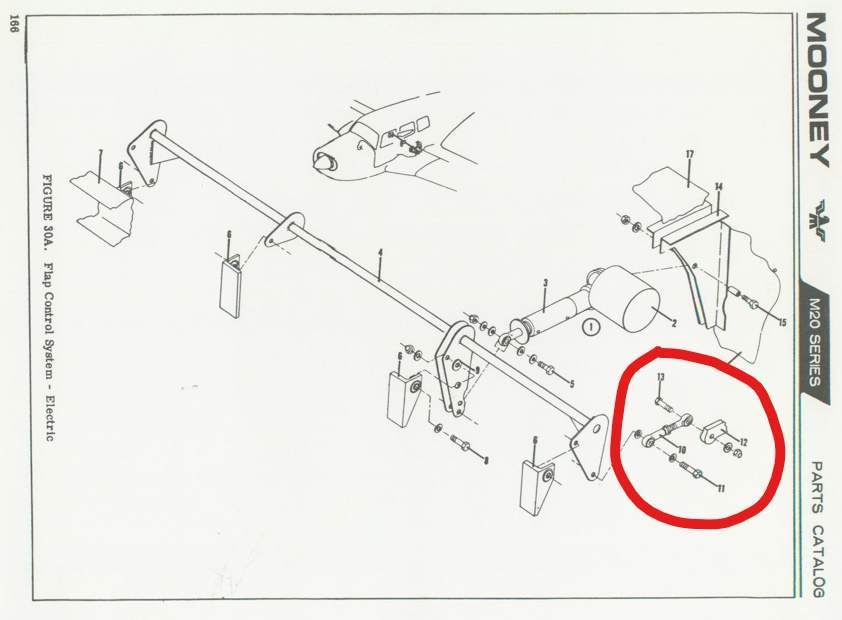
-
Our 1976 M20F has connecting rods to both elevators, so they were still doing this - for F models at least - well after 1970. I'm guessing the difference in elevator connectivity across different models has to do with changes in the elevator trim and feedback system across different models. There are a couple of old Mooneyspace threads that discuss this:
-
What’s Your Comfort Zone in Regards to Insurance Coverage?
Vance Harral replied to V1VRV2's topic in General Mooney Talk
@Parker_Woodruff is the guy to ask. I'm not sure there's a specific cutoff, but my recollection is that Parker recommends becoming more loyal to a single insurer as you progress toward septa/octagenarian status. The theory seems to be that at least some insurers will carry a loyal customer a bit past the age where they'd decline coverage on a new client. -
What’s Your Comfort Zone in Regards to Insurance Coverage?
Vance Harral replied to V1VRV2's topic in General Mooney Talk
My understanding is that's an accurate criticism in most cases of experienced pilots with lots of time in type - which is the typical Mooneyspacer. But interestingly, Avemco is often the best price for low-time pilots transitioning to new aircraft (new Mooneyspacers), and for partnerships and flying clubs (we added a low-timer to our partnership at the end of last year). They also have the best combination of price and service I've found for CFI insurance. Because of this, I've cycled in and out of Avemco policies multiple times over the last 20-ish years. One thing I respect about Avemco is, they seem pretty straightforward about what subset of the aircraft insurance business they want to be in. They are not trying to please every potential customer. Again, I've cycled in and out of Avemco vs. brokered insurance several times, and have been satisfied doing so - they always wish me well when I leave, and welcome me back when I return. I'm not yet of an age where I think I need to worry about sticking with a single insurer to avoid getting dropped based on age. But that's coming soon enough... -
What’s Your Comfort Zone in Regards to Insurance Coverage?
Vance Harral replied to V1VRV2's topic in General Mooney Talk
I suppose that may be true of some policies, but it is not true of any policy I have ever held. My current policy is with Avemco. Per https://www.avemco.com/products/owner/owner they state that, "Avemco’s policy also includes unlimited legal defense costs." One of the interesting things about Avemco is, they do no offer "smooth" liability insurance to anyone, for any reason, at any cost. They're just not in that business. One time I asked an Avemco rep why that was, and they claimed that because Avemco is well known in the industry for only providing liability policies with per-passenger sublimits, and aggressively defending those sublimits with no limit on legal defense costs, they have been extremely successful in convincing litigants to settle within the stated sublimit. That statement is just a marketing pitch, of course. I'm not trying to shill for Avemco. But again, it is not universally true that the costs of duty-to-defend are applied against the policy limits. As is always the case, read your own policy carefully. Insist on receiving a copy of the full contract, not just the summary page you receive when you get a quote. -
What’s Your Comfort Zone in Regards to Insurance Coverage?
Vance Harral replied to V1VRV2's topic in General Mooney Talk
Not yet mentioned in this thread is that when you purchase liability coverage from an insurer, you are also purchasing a "duty to defend" from them. In the event of a suit which exceeds policy limits, the insurer's internal or contracted attorneys are obligated to try to convince the injured party (or their insurer, in the case of subrogation) to settle within your policy limits. Usually this comes in the form of legal/practical threats. e.g. "You can have $100K from us right now, with no trouble. But if you want more, you'll have to fight for it in court, and ultimately walk away with even less than $100K." Reasonable people can disagree on the value of this defense by the insurance company, and I won't rehash that debate here. But it is important to understand that if you're sued for an amount that exceeds your policy limits, your insurance company doesn't get to simply say, "Oh, well, that's too bad - here's the $100K we're on the hook for, anything else is your problem". Doing so would constitute breach of contract. This duty-to-defend protection is one reason some people are comfortable accepting lower policy limits. Whether you get more/better lawyering with a higher policy limit is anybody's guess. Also worth noting that in some cases, insurers simply won't write smooth and/or high-value policies for a particular combination of aircraft and pilot(s). In those scenarios, the choices are to accept lower limits, go naked, or stop flying. Most people choose the first. -
The idea that fixed-gear and retract-with-gear-down airplanes nearly always flip on water ditchings doesn't jive with actual evidence. And even if the aircraft flips, it doesn't seem to affect survivability in a statistically significant way. https://www.aviationsafetymagazine.com/features/the-myths-of-ditching/ is a good read on this, see particularly Myth #5.
-
Pitot static cert voided after avionics mods?
Vance Harral replied to FlyingDude's topic in Avionics/Panel Discussion
Maybe there's just a misunderstanding of language here. FlyingDude originally asked, "is my 24 monthly test void?", and Shadrach references "IFR certification". But those terms are not mentioned in the actual regulation. There is not a single "24 monthly test", or "IFR certification" that can become invalid. There are instead three separate testing requirements in the regulation, involving three separate systems. Per 91.411, each static pressure system, each altimeter instrument, and each automatic pressure altitude reporting system must be tested and inspected. Per 91.411(2), opening the static system requires a re-test of the static system. I think we all agree that event doesn't trigger a required re-test of the altimeter(s) or transponder(s), but I hope we all agree it triggers a re-test of the static system, because the regulation is plain as day on that point. Per part 43 Appendix E, that static system test must be in a manner "acceptable to the administrator". My interpretation is that a simple A&P/owner-assist leak check done with something like a handheld vacuum pump, stopwatch, and VSI doesn't meet that standard. I think the standard requires specific training and equipment that the average A&P doesn't have, e.g. equipment like this. I understand others may disagree. I agree with Shadrach that the altimeter in a G5 is not a primary, certified altimeter, and does not require altimeter testing per 91.411; but that's orthogonal to the OP's question. -
Pitot static cert voided after avionics mods?
Vance Harral replied to FlyingDude's topic in Avionics/Panel Discussion
OK, I'll play. If your point is that opening the static system doesn't void the altimeter or transponder checks described in FAR 43 Appendix E paragraphs (b) and (c), sure. But it does require the static system checks described in paragraph (a), particularly clause (2). The sub-clause about part 25 certification doesn't apply to Mooneys, but one must "Perform a proof test to demonstrate the integrity of the static pressure system in a manner acceptable to the Administrator". I suppose one can envision all kinds of methods that might accomplish this, but the FAA literature - including specifically AC 43-6D - makes reference to the kind of equipment and trained personnel that only repair shops which provide full 91.411 certification have on hand. If you are proposing there is some other "proof test", that your are confident is "acceptable to the Administrator", which requires only equipment and training the average A&P has in their shop, I'm all ears. My basic point is, you can't just install a G5 or GI-275 and say, "the installer was careful when they tightened up the static system connections, and that's good enough". The static system must be tested, using equipment designed to do so.