EricJ
-
Posts
9,706 -
Joined
-
Last visited
-
Days Won
110
Content Type
Profiles
Forums
Blogs
Gallery
Downloads
Events
Store
Everything posted by EricJ
-
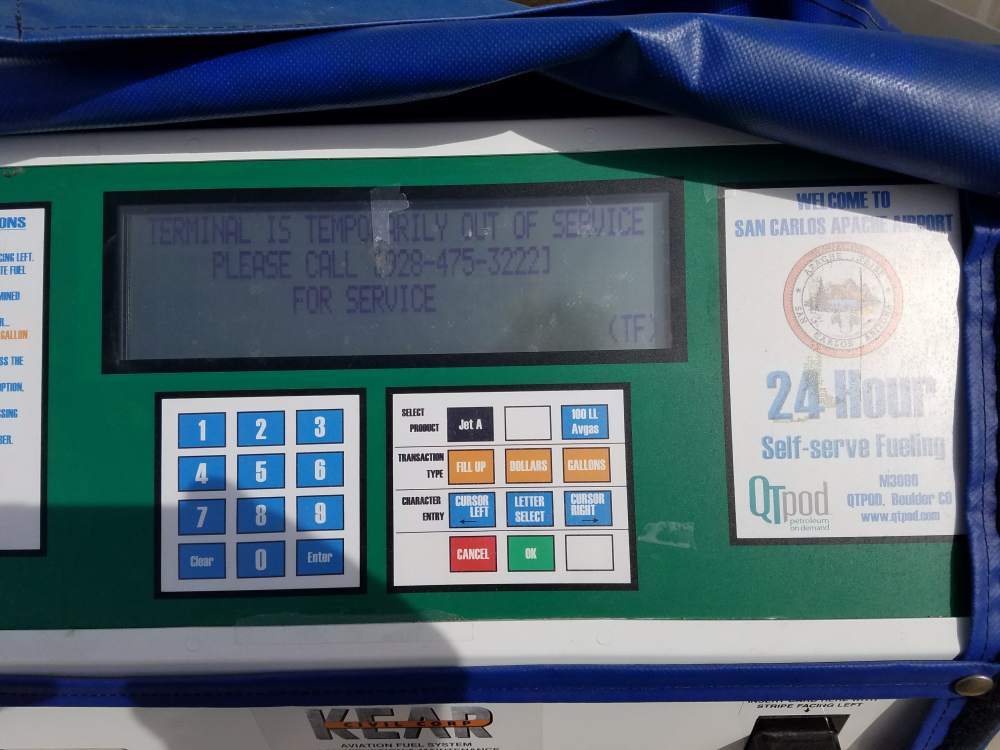
Not by the buildings, it's on the east end of the little parking pad just across from the Casino. It's not super reliable, this is the 2nd time I've gone there and it's been down.
-
I go there once in a while for cheap fuel, but sometimes this happens: After I got home I checked NOTAMs and they'd posted one that the pump was out about the time I was leaving there. I imagined this happening: Dude: There's somebody at the pump. Dude2: It doesn't work. Dude: We should post a NOTAM. Dude2: Done. Dude: He's leaving. Dude2: Musta seen the NOTAM. Dude and Dude2 high five each other.
-
I saw it, good movie. I was mostly adding to your comment addressing thekubiaks statement about slide rules. Digital computers were used quite a bit in the Apollo program, both on the ground and in the spacecraft, and on the ground in the previous programs. Since software tools weren't so great back then, a lot of hand analysis and modelling was done to figure out what software to write. I'm sure slide rules were still used a lot throughout, since the computing resources were scarce, but they did exist.
-
Yes, and the Apollo program did include on-board digital guidance computers: https://en.wikipedia.org/wiki/Apollo_Guidance_Computer You can buy a functional replica. They're pretty cool if you're that type of nerd. https://opendsky.com/
-
That'll buff out.
-
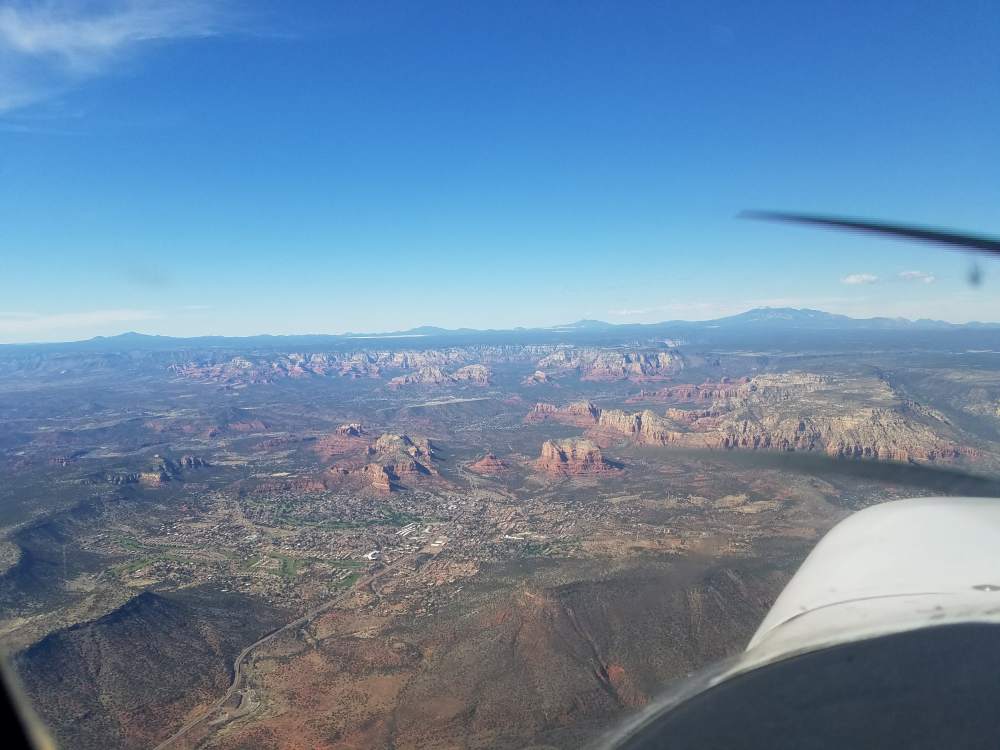
On the way to Flagstaff yesterday.
-
I did this same exercise last year and bought a 77 M20J. As previously mentioned, Bonanzas will generally be better for getting in and out of soft or unimproved fields, will have better useful load, be faster, etc. All of that comes at the cost of higher fuel consumption and maintenance costs. It's a pretty fair tradeoff, IMHO, and in my case I usually travel pretty light and like the better economy of the Mooney, so that's why I went that way. There have already been times when I would have liked to have had the Bonanza, but for the most part the Mooney suits me well. The optimal mission profiles of the two are different enough that if you have a preference in performance it should favor one or the other.
-
Are there differences in the limitations sections for J models? In the comments for the vid above somebody claims the limitations in their POH indicates aerobatics are prohibited. In mine (POH 1220 for an early J model), it just says, "Aerobatic maneuvers, including spins, are not approved." Is there a difference between "prohibited" and "not approved"?
-
When I was a lineboy a zillion years ago our ramp was PSP (pierced steel plating) on top of gravel. The gravel would work up through the holes and lay in the grooves in the plating. It was one of my many jobs to constantly walk the ramp and collect the loose gravel. My life was occasionally made miserable by the arrival of an Army Chinook or Jolly Green Giant helicopter, which would fling the gravel everywhere when they arrived or departed on the ramp. Even though it was decades ago, and as cool as they are, I still harbor much bitterness towards Chinooks for this reason. I also spent a lot of time helping to dress prop dings. They were a normal thing on that ramp. And I never saw a ding that looked anything like that one. I hope it gets sorted out satisfactorily.
-
Didn't look like it to me. I didn't see any attempt to slow or avoid. And I agree completely that the additional sensors should have sorted this out way ahead of time. Several of the locals that drive that street frequently at night say that it is very well lit, and it is very common for pedestrians to cross the street there due to the routing of the sidewalks. The camera doesn't pick up light nearly as well as a human eye, and I suspect an alert driver would probably have been able to avoid the collision (but that's just me speculating...if I get some time I may pop down there some night and see for myself).
-
There are so many of these, I wonder if there's a collection somewhere. I learned sifters, CIFFTRS: Controls - usual control check, box pattern, whatever Instruments - DG, Altimeter, AI, engine, etc., all hunky-dorry. Fuel - indicators show enough for flight, proper tank selected, boost pump, etc. Flaps - set for TO Trim - set for TO Runup - complete Seatbelts - everybody is buckled, I try to get the door and storm window with this one, too. I do like LIFT for a final check turning on the runway. There's CIGARS, GUMPS, CBGUMPS, etc., etc., etc. I'm always a little surprised that there seems to always be a new one that I hadn't heard of before. I hadn't seen LIFT before.
-
The article linked below includes video of the crash. I cut my engineering teeth on radar remote imaging and sensing before doing comm stuff, and still do a lot of embedded and control work. The UBER cars have radar and a sophisticated LIDAR system that sees 360 degrees around the car. IMHO this is a failure of the autonomous system or a demonstration that it is 100% not ready for deployment. A human driver could make this mistake, an autonomous vehicle with adequate sensors absolutely should not. http://www.fox10phoenix.com/news/arizona-news/attorney-explains-who-could-be-held-liable-in-the-fatal-self-driving-uber-crash#/
-
I'd be surprised if they're using only optical sensors. Radar and other active sensors would seem necessary to me. "THAT IS TOO MUCH VERMOUTH"
-
When my airplane was at Maxwell's last September for a tank patch I think it was $650 flat for the job.
-
Using ship's antenna for handheld?
EricJ replied to ShuRugal's topic in Vintage Mooneys (pre-J models)
This is why many VHF antennas, like TV rabbit ears, are telescoping/collapsible so that the length can be optimized, if needed, for a particular channel. -
Using ship's antenna for handheld?
EricJ replied to ShuRugal's topic in Vintage Mooneys (pre-J models)
Needs more duct tape. -
Using ship's antenna for handheld?
EricJ replied to ShuRugal's topic in Vintage Mooneys (pre-J models)
Thanks, I may have my KX99 to take apart in a month or so depending on what shakes out. Kinks and crimps, or even just sharp-ish bends, can be bad in coax. Otherwise age related issues are usually more around corrosion or dirt in connectors. Holes or frays in the shield don't help anything either. RG-400 is good stuff, so that kind of abrasion on the old stuff is as good a reason as any to replace it. -
Using ship's antenna for handheld?
EricJ replied to ShuRugal's topic in Vintage Mooneys (pre-J models)
Do you still have that? I'd love to pop it open and see if they used the pin jack insertion to isolate the ports. Meanwhile, I took a couple cable splitters and put them on my lab bench with a couple of Spectrum Analyzers and a Signal Generator. I connected the signal generator to one of the split ports to simulate transmitting with a handheld, and measured the power output at the input port (which, presumably, would go to the antenna), and the other output port, (which, presumably, would be connected to the in-panel comm receiver). The antenna output is ~3dB down from the handheld transmitter, and the in-panel comm port is 20dB down from the handheld transmitter. There are things other than typical rf splitters that can be used, but I suspect that's usually what gets plugged in. If something other than a typical splitter is used, results may vary. However, assuming a typical splitter is used, connected as above, with a handheld with a 7W output the nav/com would see 70mW (~+18.4dBm) at it's receiver input, which isn't too bad. That's not out of the realm of expectations for a receiver to be able to handle, especially when it is designed for a reasonably harsh environment that deals with lightning and another transmit antenna a few feet away, etc. Of course the bad news is that the 3dB+ loss to the antenna port means your 7W handheld is instantly turned into a 3.5W handheld, but for VHF AM LOS voice radio 3dB is really not that much, and the advantage of getting to the outside antenna rather than using the handheld antenna inside the airplane is likely greater than that. A better method might be to have a junction or a union in the coax that could be easily reached so that you can disconnect the antenna cable from the nav/com and connect it directly to the handheld. That would give you the full 7W to the external antenna. 3dB isn't that much in this application, but it's 3dB you wouldn't have otherwise and if you're on the fringe of reception it'll be noticeable. This would also avoid the 3dB loss to the in-panel nav/com with a transformer/splitter in place. My airplane goes into the shop for an avionics-ectomy next month, and I'm thinking of having them delete the KX99 (whatever it does) and just put a bracket there with a connector that I can reach and disconnect the antenna. If this is done the cables need to be clearly labelled so that you plug the handheld into the antenna and not the nav/com, or have the antenna cable loose and the nav/com cable bulkheaded on the bracket. Or something like that. Don't try this at home, YMMV, etc., etc. -
I had a bunch of issues like this when I first got my airplane. The finger filter in the fuel servo had a bunch of rust-ish crap in it that turned out to (probably) mostly have been sourced from the fuel servo itself, after it had apparently been parked with water in it for a substantial period of time. For me it ultimately wound up being fixed with a servo rebuild. Other things to check are the gascolator filter and the fuel filter at the boost pump, if there is one. If there's nothing in either of those, it may not be coming from the tank.
-
For a total CB and portable approach, a $150 Stratux with the $15 AHRS card added will drive the EFD feature in many EFB apps. <- Acronym championship submission. I keep an old cell phone in my flight bag that has a suction mount that I can put on the windscreen near the center pillar, and it makes a fine EFD using the AHRS in the Stratux and the GPS in the phone or the Stratux. Both will run on their own batteries if you set it up that way, so there is no dependence on the aircraft panel or electrical system at all. The GPS (in the Stratux or in the phone, if you don't want to spring the $35 for the USB WAAS GPS antenna for the Stratux) will provide altitude and velocity info for the display. You can totally lose the panel and electrical system and still fly and navigate in an emergency for peanuts. This is a good time to be a CB pilot.
-
Using ship's antenna for handheld?
EricJ replied to ShuRugal's topic in Vintage Mooneys (pre-J models)
The other benefit of a handheld is that if you do wind up on the ground off-airport somewhere you can walk around with it and use it outside of the airplane. A good splitter/transformer that's properly installed shouldn't present much loss in the antenna-nav/com path. It does present *some* loss compared to a direct connection, so that is a consideration for purists. I'm really curious as to the internals of the KX99 splitter that I have, since the pin jack theoretically would allow a much more efficient implementation. I'm an EE, too, and have been working in wireless comm for a few decades. Much of this stuff is so implementation specific that the experience is not always that useful. -
IO360 M20E Engine Shock Mount evaluation
EricJ replied to HRM's topic in Vintage Mooneys (pre-J models)
It's really good that you labelled the detritus. Most people are not that thorough. -
Using ship's antenna for handheld?
EricJ replied to ShuRugal's topic in Vintage Mooneys (pre-J models)
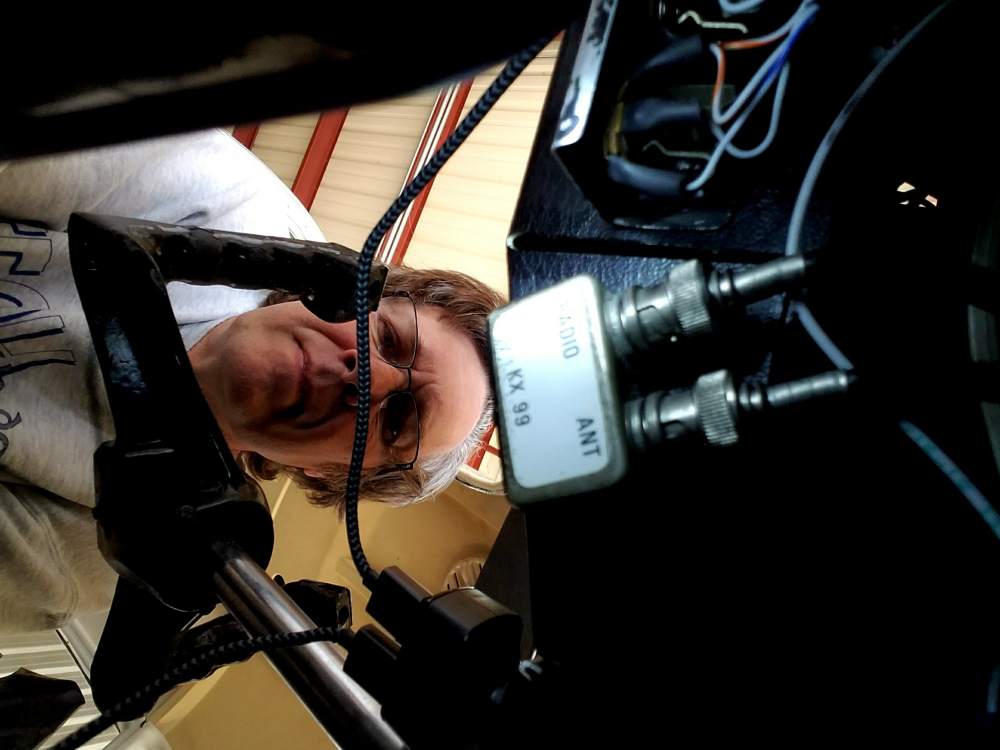
Get under the panel and see if you can sort out how the coax for the comm antenna is routed. As others have said, there may already be a transformer that allows a handheld to be connected, or a joint where the antenna could be disconnected in flight from the GNS and connected to your handheld instead. It took me a while to figure out what the jack in the pic from my airplane was for, but it's a transformer for an old KX99 handheld that allows it to be plugged in with a pin jack to the COM2 antenna. I bought a piece of coax with BNC connectors and a BNC-pin fitting and tested the receiver, and it works great. A question I've had relates to the fact that typical comm receiver input electronics are fairly sensitive and I don't know how well a nav/com com receiver is protected (outside of the internal Tx/Rx switch, which is normally in Rx mode) from excessive input power. When transmitting with the handheld I'd be worried about potentially damaging the receiver if they're connected via a simple transformer. I *think* the reason the KX99 transformer uses a pin jack is that it disconnects the in-panel receiver side when the pin is inserted. I checked this, though, with my in-panel receiver on ATIS I plugged in the jack, and while it did get noticeably weaker it didn't disconnect completely. I haven't been able to find receiver specs for typical nav/com units that shows max allowed input power. It could be that there is a lightning spec or something that provides sufficient clamping that it is a non-issue, but without knowing that I'm a bit chicken to try transmitting with the handheld plugged into the transformer unless it's actually needed. I can also reach right behind the transformer and unplug the antenna cable and plug it directly into the handheld and make it a non-issue, too. Anyway, that's the sort of thing you're looking for or could install. The below pic shows my engine instruments with the transformer and jack attached at the bottom of the panel. Took me a long time to figure out what it was. The bottom pic is me getting my phone underneath it to get a pic of it to figure out what it was.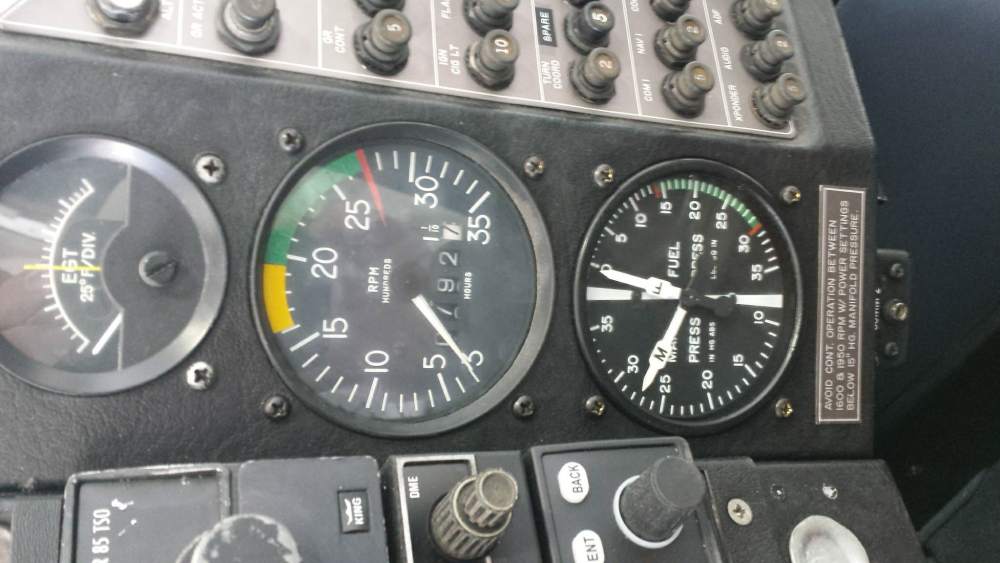
-
I had some major issues that all cleared up after a fuel servo rebuild. They sent back the old gaskets and diaphragms and it was clear that there had been water standing inside the thing for a long time at some point. Now it starts easy and runs much better.
-
Do I understand correctly that that was for 54 gal tanks? Also, can you say where this was done?