Ragsf15e
-
Posts
6,349 -
Joined
-
Last visited
-
Days Won
33
Content Type
Profiles
Forums
Blogs
Gallery
Downloads
Events
Store
Everything posted by Ragsf15e
-
Hmmm, so as of July, my awesome new 252 is a brick?! This isn’t even a Mooney issue, hopefully this insanity gets fixed!
-
Two Lessons From The DCA Crash
Ragsf15e replied to GeeBee's topic in Mooney Safety & Accident Discussion
Even if the helicopter was at 500’ instead of 200’, and assuming the crj was right on glideslope, do we really use 300’ “separation” as a standard at night on approach in busy airspace?? Seems like a recipe for many more accidents. Clearly there should be some other type of separation built in. -
Two Lessons From The DCA Crash
Ragsf15e replied to GeeBee's topic in Mooney Safety & Accident Discussion
Is TCAS turned off at some point during the approach? Say like with gear down or below a certain altitude? I would have thought the airliner would be getting a continuous RA? -
Ovation Cigarette Lighter Adapter
Ragsf15e replied to Healthpilot's topic in Modern Mooney Discussion
Fuse? -
Even when it hasa little wiggle, it shouldn’t necessarily shimmy unless the geometry isn’t right. It might just have a dead spot in the steering. There’s an sb and a Don Maxwell article about shimmy or the 8 second ride that you can search for. It’ll help you find the right geometry. Fixing the wiggle isn’t usually too hard with shims, bushings or new heim joints. It needs to be up on jacks , lay under the nose and wiggle it. You can see where it’s loose.
-
Two Lessons From The DCA Crash
Ragsf15e replied to GeeBee's topic in Mooney Safety & Accident Discussion
Yeah, I agree they might have been more distracting than useful there, but there are some dark areas (woods/river) where they were supposed to be flying at 200’ that might be tough to see without? It will be interesting to see if they were wearing them. -
Two Lessons From The DCA Crash
Ragsf15e replied to GeeBee's topic in Mooney Safety & Accident Discussion
Visual separation on nvgs is tenuous at best even in the same formation of planes flying together. You have zero depth perception until you’re within a few hundred feet (maybe a little farther for a real big plane). You just see a really bright light. Could be 1/2 mile, could be 12 miles. No way to tell. -
Issue between GI-275 ADI and HSI Compass Reading
Ragsf15e replied to Matthew P's topic in Avionics/Panel Discussion
That’s gonna take a read through the pilot’s guide. I’m sorry, I don’t have GI275s so I’m not exactly sure. I would think that they would both initialize to heading, but there is a way to use GPS track as well. I’m not sure if that indicates a problem or if it’s just set into track? -
Issue between GI-275 ADI and HSI Compass Reading
Ragsf15e replied to Matthew P's topic in Avionics/Panel Discussion
Is the hsi in track mode (bottom left corner?)? At zero airspeed, it might not have a good track (since you’re not moving), Id say it needs to be in heading mode? I think it should be in heading? Page below shows the symbol im talking about…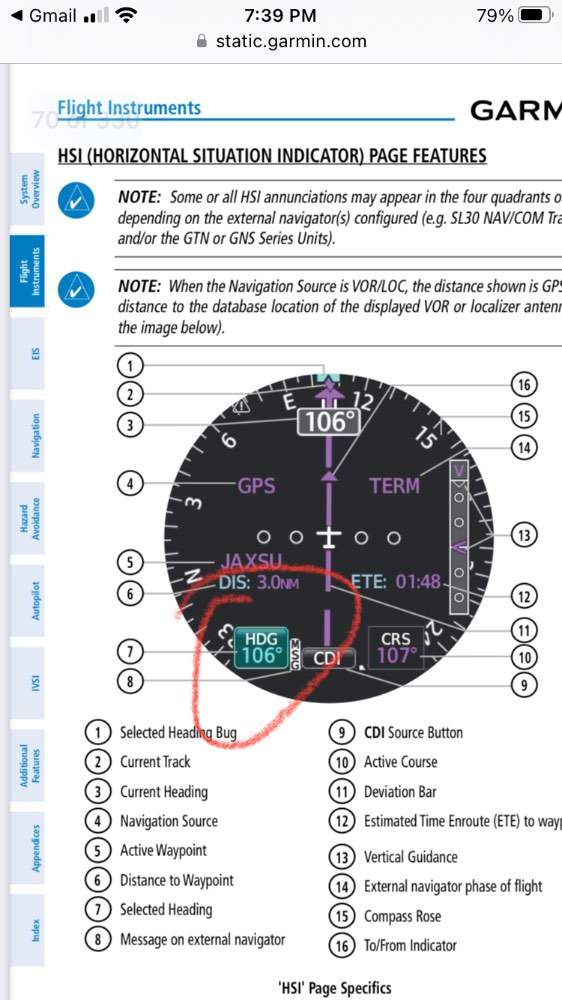
-
Crosswind component in short bodies
Ragsf15e replied to AndreiC's topic in Vintage Mooneys (pre-J models)
Honestly, I haven’t run out of rudder. But then the max x wind Ive landed in was ~25. I prefer not to get down close to the runway in a strong crosswind, find out Im out of rudder and then go around. I’m probably a little conservative but my Mooney flying is generally family trips with no set timeline, so I would consider my cargo (my family) and my selfish desire not to scare them so they’ll continue wanting to fly with me. If the wind is steady, you can probably get 30kts and land fine, but you really want to make sure you don’t have a drift (side load on the gear). -
Crosswind component in short bodies
Ragsf15e replied to AndreiC's topic in Vintage Mooneys (pre-J models)
There’s not a drift method and a crab method to the actual landing. In either case, you kill sideways drift with bank and align the wheels with your motion which is typically straight down the runway on centerline at touchdown. Rich landed on an angle across the runway (picture a pretend line pointing 45 degrees across the runway) so he turned part of the crosswind into a headwind. No matter if you crab or slip down final, you’ll land with the wing down into the wind (only enough to kill sideways drift) and opposite rudder to hold the nose straight to your line of motion (centerline for most, pretend centerline for Rich). The crab vs slip debate is more about final. On landing, youll be in a slip. You should land in this forward slip with no sideways drift and the wheels pointing straight in your line of motion. You will land on the upwind wheel first. You will have opposite rudder in (youre in a slip after all), so you will need to kill that before setting down the nose since it happens to be connected to the nw steering. When you set down the downwind wheel and the nosewheel, you lose the drift compensation and you can start to weathervane as you slow, so you need to be careful even after landing. -
Crosswind component in short bodies
Ragsf15e replied to AndreiC's topic in Vintage Mooneys (pre-J models)
@N201MKTurbo will be along shortly to tell you about landing across the runway in a 40 mile an hour crosswind. I don’t doubt him, but taxiing is gonna be real tough after that. Personally, I use about 20. 15 seems pretty easy, but around 20 it starts to get sporty. Gustiness adds to the sportiness. Part of it is dependent on how wide the runway is too. Theoretically, you should land with no sideways motion, but with that much cross wind, it’s nice to have a buffer. Also, you have to realize that it’s going to try to weathervane and/or drift once it’s on the ground. And you may need to reverse the rudder, and you have to consider how much nose wheel steering (rudder) you have in when you’re landing (and take it out in time). -
I ordered one on Airpower just to see what would happen… tgey charged my card (($830)), but obviously can’t ship it yet. They are even more expensive on Spruce and also not in stock. I wonder if Boeing/Avisail has any? I think you need an account to see.
-
Did you get this figured out? I also have the newer cowl flap motor and have the same issue (slowly creeping open in flight). Would love to know how others solved it.
-
They keep sliding the expected date to the right…
-
The M20F Performance Benchmark thread.
Ragsf15e replied to Shadrach's topic in Vintage Mooneys (pre-J models)
I respectfully disagree and suggest you do some Colorado Springs takeoffs next summer ~85 degrees and 50-100 rop. Let’s see what your temps look like around say 3000’ agl. I’m curious now. -
Replaced Starter - Invoice was WAY more than expected
Ragsf15e replied to gwav8or's topic in Vintage Mooneys (pre-J models)
The lower cowl on an F is significant. Especially if you want him to be careful with your “unobtanium” rubber intake duct. -
The M20F Performance Benchmark thread.
Ragsf15e replied to Shadrach's topic in Vintage Mooneys (pre-J models)
I guess to each their own, but my engine baffles and cooling was solid, but im pretty sure being 50-100 rop on takeoff vs ~200 rop (which is roughly where target egt puts you) will make a much more significant difference. I have flown to Mammoth last summer, Colorado recently, and routinely in the pnw. I don’t think im imagining it. -
The M20F Performance Benchmark thread.
Ragsf15e replied to Shadrach's topic in Vintage Mooneys (pre-J models)
I much prefer the target egt method vs what you describe as long as you have an engine monitor. Yes, I agree that you’ll get roughly the same power output , but if you end up leaner than you intended, you can very quickly get very hot CHTs. Slow speed, warm day, high altitude, thin cooling air, initial takeoff/climb. It’s a busy time when you don’t want to look down and deal with 450 degree chts. Target egt is a better, known setting. Yes, it doesn’t have to be perfect. -
Nose Gear Door Linkage Replacement
Ragsf15e replied to Samir13k's topic in Vintage Mooneys (pre-J models)
This is the easiest fix ever. Even if you’re not too mechanically inclined, order the heim joints, install them and have your mechanic take a look and sign it off when you’re done. Advise him first and see if he agrees. If not, find any other A&P to just look at your work and sign. Im not that great a mechanic, but I disconnect those parts (not tge ball joint part though) each annual to free the gear doors so I can access the inspection panel screws close to them. Don’t lose the tiny spacers in there! -
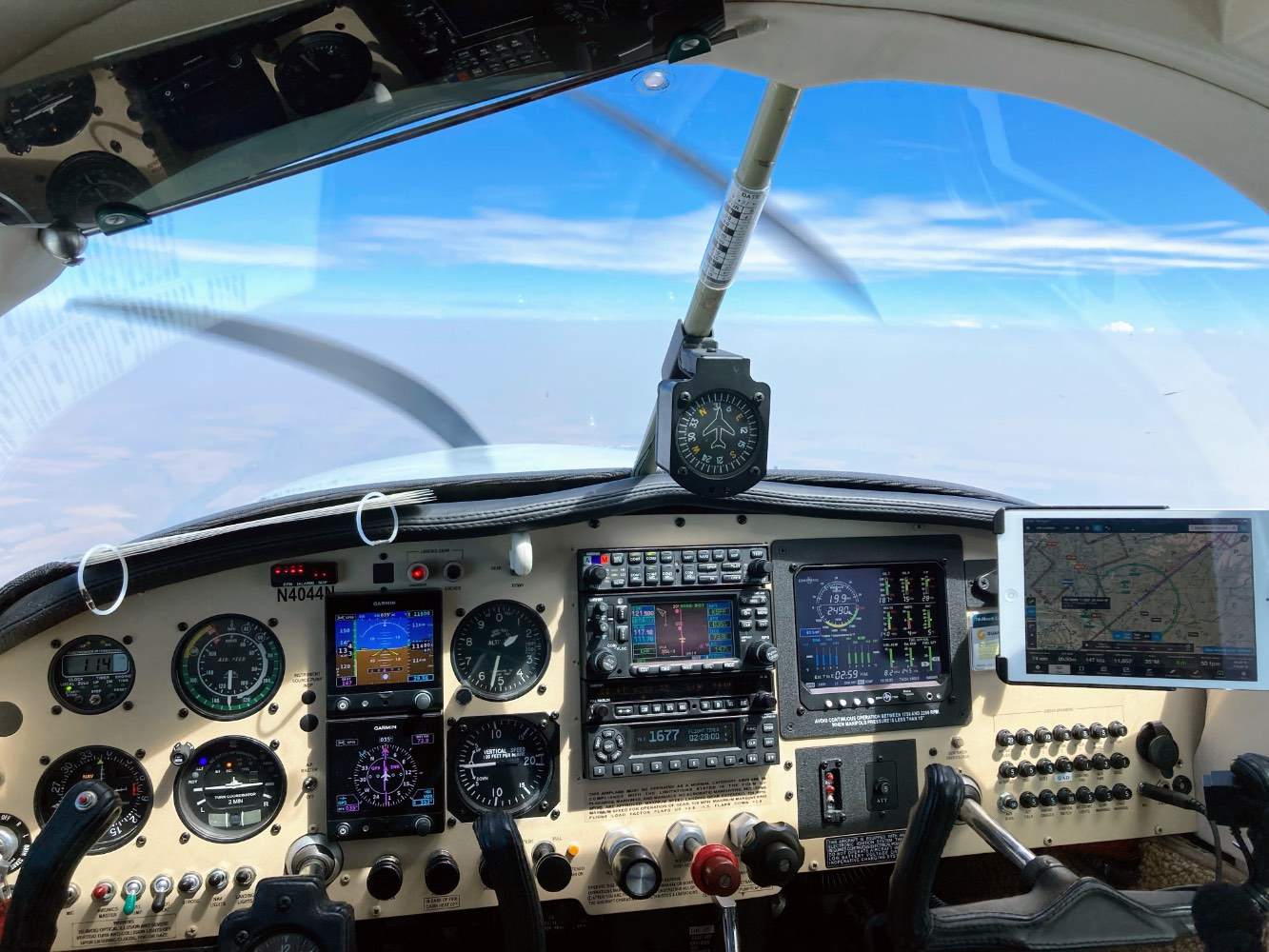
Not sure exactly why the OP did it, but I can tell you it won’t be noticeable in your scan or flying. My F had dual G5s that were offset similarly because there isn’t quite as much space directly above the yoke and that space pushes everything to the left. Anyway, it seems weird, but you don’t see it at all when you’re flying, and I’m pretty anal about that stuff.
-
Another Lead (and noise) lawsuit - KAWO Arlington, WA
Ragsf15e replied to Igor_U's topic in Miscellaneous Aviation Talk
That guy’s probably a great neighbor and a hoot at parties. -
The M20F Performance Benchmark thread.
Ragsf15e replied to Shadrach's topic in Vintage Mooneys (pre-J models)
Well, I can get close to the nerd math for you! On the back of my old checklist in the airplane theres a Koch chart. You can use that to scale your takeoff data from sea level to whatever altitude/temp combo you want. This explains it with an example. I used it to give me an idea of how much DA effect to expect and I found it reasonable but maybe slightly overestimating the effect. https://learntoflywithkris.com/koch_chart.html -
If you had someone work the cylinders on a reman as @exM20K suggested, you’d have pretty much what you planned on, and with zero time.
-
The M20F Performance Benchmark thread.
Ragsf15e replied to Shadrach's topic in Vintage Mooneys (pre-J models)
Matt, Hopefully your flight home went well! One recommendation for departing at high altitudes (ok, maybe two) 1. Only take the weight you need, so 40 gallons of fuel is much better than 64 if you’re going to make a fuel stop anyway. Weight is key. 2. During the early takeoff roll, adjust the mixture to ~1220 egt (they are all a little different, but pick one). That’s roughly your max power, climb mixture setting. If you’re leaner than that, it’s very easy to get hot CHTs very fast during takeoff and initial climb. Richer than that is less power. The F does well at Colorado altitudes, but I always tried to leave by ~11am or earlier in the summer.