

WilliamR
-
Posts
319 -
Joined
-
Last visited
-
Days Won
1
Content Type
Profiles
Forums
Blogs
Gallery
Downloads
Events
Store
Everything posted by WilliamR
-
Well, what really helped the rust propagate below the vent was the old fibrous insulation. Of course, I changed to closed cell for the whole plane after the repair was made.
-
Yeah, $100K is a lot of money. For perspective, misc. maint. is still cheaper than fuel per hour (assuming rich of peak). Hangar rent by hours flown is close behind misc. maint. Column C for 2007. 4/6/2007 Repair structural tube $ 8,662.00 6/18/2007 Trouble shoot intercomm issue $ 129.00 7/5/2007 New mic key and wiring, trouble shoot intercomm issue $ 920.20 10/5/2007 Replace avionics master, trouble shoot intercomm issue $ 678.72 10/30/2007 New Intercomm $ 464.28 10/30/2007 Intercomm replacement labor $ 384.28 Anyway, the tube repair was due to damage found just under the NACA vent just in front of the cabin door. When I had the PPI done, we pulled a few interior panels and the tubes looked really good. That and given the plane was always hangered I chose not to have the full tube inspection done per the service bulletin. The next year, the service center that was doing the annual pulled the panels and found the damage due to rust that was just beyond tolerance. I spun the wheel of chance and lost. They pulled the skin in that area and had someone weld a very long sleeve over the damaged area. They initially said the whole frame was now destroyed because of that one tube. Thankfully, I guess, they decided to play ball. The intercom issue was intermittent and the trouble shooting costs got a little higher than I wanted. Also, one shop I worked with on that was less than scrupulous. I argued, gave up and vowed never to use them again despite being right next to my hangar. Still didn't fix the problem. So happy they no longer exist. I hate shops that chuck parts at a problem. The large cost in 2012 was like death by a thousand cuts. New cylinder, two intake tubes, and other things. A plane with old systems can slowly bleed you. A trim servo for the KFC-150 autopilot here, an alternator there and things start to cost. More info than you probably wanted, but there's the story. Oh, every few years I've changed up inspectors for one reason or another. The first year they always seem to find something the previous inspector hadn't seen (look at 2012 then look at 2013). Last word here... I'm not hard on my equipment whether it be the plane or my Porsches. Old crap just breaks. My plane is 30+ years old with some things that old. I do maintain my plane to a high level; probably to the same level as most people on here but maybe better than the general Mooney population. William
-
Oh, thank you. That is very thoughtful, but I just replaced mine last summer. Hoping it lasts me just a few more years of ownership before stepping up. William
-
Built in doesn't take up precious cabin space and lasts longer. I'm big on a clean and uncluttered cabin. William
-
The 66.90 per hour is a formula based on total maintenance over the last 15 years not already accrued for (mags, engine overhaul, etc are accruals) divided by hours flown. Yes, if you multiply 66.90 by 1595 hours, you get $106M over the last 15 years. I only showed three years of maintenance, but there's much more in this model. I wish I had the time to fly 1600 hours in three years. These misc maintenance items include things like replacing a failing KI-256 (although that stupid thing seems to die so regularly, you'd think I'd keep an accrual for it), or replacing tires or brakes. If you right click over the sheets at the bottom, you can unhide all of the sheets that feed that number. Also, if you left click on cell E47 on the Ops Cost Summary sheet, you will see the entire formula and al the sheets and cells it pulls from. Hope that helps. Happy to go into any detail in the model. I analyze financials by trade, so I geek out on stuff like this. William
-
I think once the speed brake cap is painted, you will never think of it again. Look at the old speed brakes on Malibus. They sit on top of the skin but blend in nicely being the same color as the wing. William
-
Yes. They weren't there very long and he didn't fly them very long before moving to a squadron on Canton Island back flying well used P-39Ds which is what he flew before the P-70. Told me the single engine fighter guys had an easier time transitioning to multi than the multi-bomber guys transitioning to single engine fighters. William
-
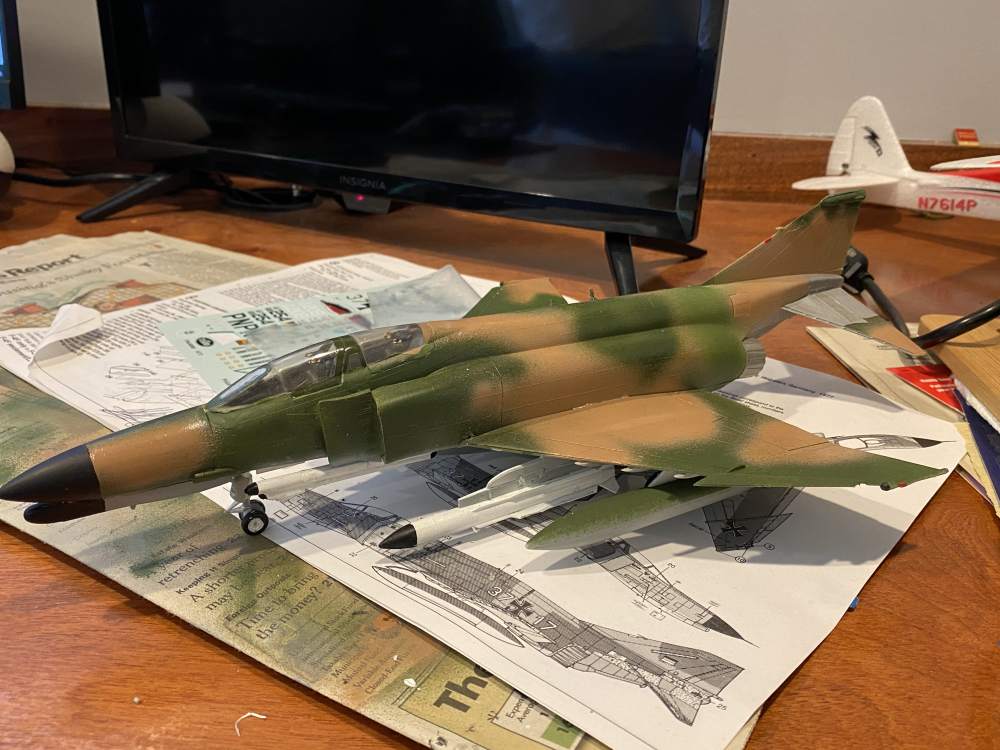
Building all the plastic models that have been sitting in my closet. The F-4 will have the same squadron insignias from when I lived on Clark AFB growing up in the 70's. First time using an airbrush. Next model will be a P-70 which is special to me. My grandfather was in the first night fighter at Henderson Field (still have the hand painted squadron insignia flight jacket, now mounted with wings, original green tinted goggles, and leather flying helmet) that flew the P-70. Also the first mutli he flew. Painting will be easy as it's all flat black except the blue formation lights. After that will be the F-15 with the same insignia from Eglin where my Dad retired in the 80's.
-
What is acceptable cht temp in summer?
WilliamR replied to Will.iam's topic in Modern Mooney Discussion
I see up to about 330-340 on the hottest cylinder on a 252 at all temps and alts. on the climb. Usually climb out at 115-120 kts indicated. FF of 22.5 is a bit light. But it should not change based on altitude assuming all else equal. William -
Attached is the model I built to capture all costs except upgrades for my 252. 15 years (1600 hours) of information summarized on the Ops Cost Summary sheet. Note, I do my own oil changes and minor work as allowed by the CFRs. Cost of parts but not labor are included in those cases. I also do not include costs associated with detailing/washing the plane. I do not abuse the engine and stay out of the red box but have had to replace cylinders (happy to show anyone 15 years of JPI downloads). I do keep the plane maintained to high standards as I work to maintain 100% dispatch reliability. So, I'm sure my costs are somewhat on the high side. Hope this helps. William AircraftStatusSheet 12-27-20.xlsx
-
Please add me to the list. Atlanta, GA based CFI/I. Among other planes, time instructing in M20C, E, F, J, K (both 231 and 252), M, R, and S. William Rutkowski
- 118 replies
-
- 3
-

-

-
- transition training
- cfi
- (and 3 more)
-
@RobertGary1Then what do you put in eApis? It asks for a sticker number. Just 9's, make one up? Btw, I don't like stickers on the outside of my plane either. I put it on the main door frame so when the door is closed you can't see it, when open it's viewable. That meets the letter of the law...must be within 18 inches of normal boarding door and visible when all doors/hatches are open. William
-
Actually, you have that a little backwards. Gate's PEG has been a material owner of Signature for some time. According to a public comment by Signature, with the go private it's expected that the PEG (Cascade) will be out. William
-
Pairing LADD with PIA should get you absolute flight anonymity from even data collectors using other means than the source FAA info. The NBAA website has some good info on that. It was a link embedded in one of the ones I referenced. I would say, the need for flight tracking anonymity for 99.99% of those on Mooneyspace pales in comparison to the needs of a large corporation, especially a private one. Providing public info or charging people to not provide public info is not anywhere near black mail or extortion. Look up those terms. If someone doesn't like the cost of flightaware's dotcom program they could always develop their own with the FAA and charge what they think is fair (free to all Mooney owners for instance). Nothing is impossible. All this hyper anonymity stuff is a bit tin foil hat. William
-
This link and it's embedded links should keep you busy for awhile. https://flttrack.fltplan.com/FltPlanInfo/DCMCallSigns.htm This link does a good job of explaining dotcom and other ways to protect aircraft privacy. Note, the link references jets and turboprops wrt the FAA LADD program. You can ignore that limitation. The FAA's LADD program is not limited to type of aircraft. Link: https://ladd.faa.gov/ A little googling will probably get you a lot more info. Attached is a screen print of my aircraft ownership from the Delaware Secretary of State (should be obvious I didn't do it for tracking reasons). You will note, for another $20 you can get more info. likely to include the formation docs which have my name all over them. I say likely, as usually for work I have my lawyers pull formation docs for me. William Division of Corporations - Filing.pdf
-
Simply doing an LLC in any state that owns your plane (car, boat, RV) isn't going to get you very much anonymity. Finding info on a secretary of state's website isn't hard. Although, sometimes they make you pay for the info. Really, to be anonymous, you have to layer the legal entities including having at least one outside the US. Having one entity in the layer that you have someone else control would be even better. That's how some very high net worth people are able to make tracking their asset ownership harder. I know one very high net worth family that wanted their aircraft no longer tracked for personal and competitive reasons (they owned a large retail company in the US that was rapidly expanding into new territories). The aircraft was simply owned by a sub of the parent company, all logos stripped off the plane, and flightaware blocked their their blocking service. Their lawyers were happy with that. For a small fee, flightaware blocks N numbers. Just fill out the form and pay your money. You can also get a dotcom N number "callsign" (different for each flight) so only the people you want tracking you can. ATC recognizes the dotcom call sign and you can program your ADSB-Out equipment to show the dotcom number assigned. Don't be classist. Anybody can do this. Not just celebrities and the uber rich. Frankly, this route is probably cheaper than going through the whole LLC machination if you just don't want someone to track your flights online. I won't even get into KYC laws in banking. So much to unpack there. I go through many hours of training every year on that topic. William
-
Two funny stories about hitting power lines. Funny because no one was hurt. First, two friends buzzed one of the pilots' house with a Stein Skybolt. Wife called the pilot after landing complaining the power went off in the neighborhood right after the last low pass. Pilots inspected the prop and found a 1" wide scape mark down the chord of one or both blades. Lucky it was a clean cut. Second, two charter pilots pick up an Aztec from the maint. shop at my home airport, 48X in SW FL. For some reason they chose to do a low pass perpendicular to the runway. Left prop caught the single wire power line that followed the road parallel to the runway. Line sprung up, wrapped around the left wing inboard of the engine, cut the leading edge of the wing and jammed the flap up. Line fortunately unwound and smacked a row of hangars. Pilots instead of going back to home drome, landed at Arcadia, FL. So excited they cheated death the pilots were kind of loud having lunch at the local Denny's talking about the experience and how they were going to explain this to their boss. The local DA and Sherriff were in the booth behind the pilots. Hearing the pilots talk about a low pass in rural FL, the Sheriff detained the pilots on the suspicion of running drugs. Not an unreasonable suspicion in that area at the time. After spending the afternoon with the Arcadia police, they had to get back to SRQ a fess up to their boss. All three pilots lucky as hell to be alive. Power lines are damn near invisible from a plane. At night I too stay a little high on the glide slope when no guidance is provided. William
-
In the past, there's also been a requirement for a minimum amount of insurance and usually presenting some basic business plan when becoming an MSC. Btw, I've also had Cole point me towards Maxwell for major work. But that was like 12 years ago, a few years after becoming an MSC. WRT DLK, I know one, if not their most, experienced Mooney specialist besides Dan, quit amicably when Dan retired and now works for my friend Dent at Phoenix Air, Kevin Southworth. W
-
Night flying with reading glasses
WilliamR replied to Nukemzzz's topic in Miscellaneous Aviation Talk
Moving into my 40's I had this problem too. Wearing full lens readers as I type this. In the plane for night flying, I use half lens readers with no/minimal frame. Works great for me. Putting full lens glasses down my nose was also less than ideal. Yes, I feel like an old fart wearing half lens glasses, but at least I can see the panel and charts at night. William -
Generally, GA is as robust as it has been over the last 20 years. I see millennials and post millennials learning to fly both as a profession and for pleasure. I also know of people who are at or near retirement learning to fly. The demographic that I see learning to fly is all over the place. Make no mistake, the numbers of people learning to fly are down over the last 50 years. That's understandable given most publications on the general cost of living show that cost of living increases have been outstripping income increases for many decades. Average 30 year old makes less than $50k pre tax. Net after tax and healthcare (assuming they get a really cheap healthcare plan) is $35k. Subtract out rent (avg. in US is $1000/mo.) and a modest car car payment, car insurance, food, and saving less than 10% of salary does not leave a lot left over. Reality is not what you see on Reality TV shows. Also, most other hobbies don't cost $10k (cost of flight training for a Private ticket) just to get in the door. Btw, how many times have I read here when someone inquires about the cost of owning a Mooney does someone respond with, "if you have to ask, you can't afford it"? Is that type of response encouraging or discouraging? Last Sat. night I was #6 for departure. Half were single pistons, half were jets. There were three piston singles behind me. Seems pretty busy to me. The airport I regularly go to an hour outside of town has a modest flight school that is busy. 3-5 planes flying at any one time. Half those students are people learning for pleasure. Seems pretty busy to me. I don't see GA dying. I see it as flat and continuing that way for the foreseeable future. Btw, isn't the Young Eagles program pretty successful/busy? Isn't that a halfway decent indicator of interest in aviation? I have only one response for anyone who blames the world's problems on millennials.....O.K. Boomer. It goes both ways. William
-
I'm sorry to everyone if I came off dramatic and condescending. I'm an I Banker and write a lot of financial analysis and read even more. The analysis was weak for lots of reasons. Btw, Signature stock (SIG.L) is relatively cheap right now. They gouge more than anyone. Their GMs are about 17%. Normalized net profit margins are around 6% (when they're profitable). I doubt a small FBO is getting that kind of profitability. William
-
That chart does not show profit margin. Based on the paragraph prior to the chart, that's gross margin. And even then they screwed up the math. Gross margin is really 18% ((Rev-COGS)/Rev.) It's not profit margin since it doesn't include any other costs (credit card fees, taxes, fuel management systems, and insurance of the fuel farm) other than cost of product (COGS). I don't think that author has any clue what margin (gross, net, EBITDA, whatever) even means in financial analysis. BTW, a GM of 18% is really not very good. 2%-5% of that will be eaten by credit card fees alone. A lot of description of general market forces and competition dynamics in that article. A+ on that. An 'F' on an actual profit analysis on fuel sales and whether FBOs even make a profit on fuel sales. Looks to be written by a high schooler. William
-
I'll echo this, there are one or two guys at ATL Tracon that can be pills, but most can be generally accommodating. The differences in vectoring depending on whether there's an east or west arrival being used are material. Tooling around the Atlanta metro area at 5-9000 really puts you in the heart of the arrivals feeding into ATL. Below 3000, not so much. Really, being at 2.4 gets you really close to ATL and keeps you from setting off RAs on every inbound Delta jet. William
-
What is the beeping coming from the overhead speaker.
WilliamR replied to Glen Davis's topic in Avionics/Panel Discussion
Other than the beeping for low throttle setting warning for gear up, it is likely to be the KFC 150 is detecting a trim system problem. The red trim light above the test button should have also illuminated (unless burned out). William -
Do I see that right? The prop is fully polished? My 252 had one of those. Pain to keep shiny but liked the look. William (my name, not just the OPs)