
Hank
-
Posts
20,358 -
Joined
-
Last visited
-
Days Won
126
Content Type
Profiles
Forums
Blogs
Gallery
Downloads
Events
Store
Everything posted by Hank
-

Need M20B Check List Similar to Checkmate Laminated
Hank replied to rockydoc's topic in General Mooney Talk
I made my own checklist by going through the Owner's Manual, abbreviating and rearranging to suit myself. It's done in Word, formatted to Landscape and I searched the pitiful help sections for printing in pamphlet mode. It folds in half nicely, and is exactly the right size to clip onto my Sporty's kneeboard. Ran each page through a cold laminator so they would still fold, and ran a quick pamphlet stitch down the seam. This gave me lots of extra space in the booklet, so I used a cover sheet, added the portion of the Performance Tables that I'm interested in, and put in as many of the standard speeds, etc., as I could track down. There's a few still missing, and obviously Va decreases with weight. Now if I could only find a decent Emergency section, the two pages in my OM are pitiful . . . My favorite is "In case of engine fire, close cabin vent" with no mention of shutting off fuel, diving to blow out the flames or pitching for best glide, Master off and prepare for an immediate landing. Let's see if a Word document will attach now. Success! A quick read through shows some additions from Bob Kromer's articles that do not reflect how I fly and need to be changed. [My cowl flaps don't move; I retard the throttle enough to get out of the automatic fuel enrichment circuit in the carb; I don't slow the prop on initial climb; etc.] Working through your Owner's Manual and typing everything in it is a very good review of your checklists and procedures, especially if you read all of the blocks of text for additional information as you type. Then just revise away to suit yourself! And don't leave out nothing important . . . . . Note that this is for my '70 C with electric gear and electric flaps, and has not been revised to show the Avionics Master Switch instead of turning each individual radio on and off. Tweak, adjust, revise, it just never ends. Mooney Checklist booklet.doc -
Nice Reagon quote, John. But, not being the bureaucratic type, how is showing my paperwork to the inspector going to "help me"???
-
Congratulations, Robert! You should get an award for endurance . . . my Private and Instrument checkrides combined weren't that long [i don't think, my logbook is at home]. Welcome to the club. Enjoy your plane, and fly safe!
-
Byron is right, small numbers are fine on our vintage aircraft. If you want to travel out of the country, just use some vinyl tape and make a 12" set, or visit your local sign shop and have vinyl numbers cut out. Personally, I think the big numbers disrupt the look of many paint jobs. Someone here has their N-number mostly transparent to the base color with light shadows, hard to see but perfectly legal, and leaves the plane looking good. Foot-tall numbers would cover up much of the attractive striping on this plane.
-
I'm not exactly in Cinci, but it's less than an hour to Lunken in my C-model, 45 minutes maybe, depending on how I get routed around the Class B. The guys here do good work on my own and several other Mooneys [C, F & J's off the top of my head]. Call it a half-hour east of Sportys [Clermont County], less in his E. Attitude Aviation is now working at both KHTW and KHTS. I always get the Maintenance phone number confused with the FBO, but I have the IA's number in my cell now to cure that. HTS is nice and long with multiple approaches; I'm based at HTW, 3000' is always more than enough.
-
CT or Central MA flight schools with Mooney rental
Hank replied to jbowne's topic in Miscellaneous Aviation Talk
True. My wife & I travel 300-400 nn in our M20C regularly. Our longest trip so far was 1320 nn each way, with sightseeing stops. If you are 5'3" to 6'7" (the range on this Board), you'll fit just fine. Fly fast. Fly efficiently. Fly Mooney! -
Introducing.......... the Standing Ovation
Hank replied to Cruiser's topic in Modern Mooney Discussion
Looks good, Tom. Glad to see you found a keeper so soon. It was nice of you to put a MooneySpace ad on both sides, too. :-) -
Lights and Parts - Inexpensive Non Certified Alternative
Hank replied to Seth's topic in Miscellaneous Aviation Talk
Do you seriously expect anyone to admit in a public forum that they use non-certified replacement parts on their certified aircraft? Personally, I just use the wonderful GE incandescent with the little stamp that triples the price while halving the life to land with. Even paid extra to get wheel bearings with the little stamp, too, although it's depressing to see the price difference at Auto Zone. -
I always clean bugs off the leading edges before putting her to sleep at night. They're easier to get off before they harden up, and a smooth, clean laminar wing flies much better. This is a warm-weather-only requirement. Sometimes I even get motivated to clean the side windows after doing the front. Now that I have a cell switch, I don't drive to the airport the day before anymore. Preflight inside a cold hangar isn't fun no matter when it is done. I do monitor snowfall so I know if I need to report early to shovel out the hangar door to reach the taxiway or not. So I guess I'm anal about putting her into the hangar ready-to-go, which keeps me from needing to go out the night before to make sure she's ready. Very little happens inside the hangar with noone around but the elves. Also, now that we have a 24-hour fuel pump, I don't need to visit during working hours to fill up either. I conduct a pre-flight before flying each day, give it a walk-around before other departures, sumping fuel when needed; I do a runup before every departure, every time.
-
Any Interest in an AC/Ice Box Product - Gauging Interest ???
Hank replied to a topic in General Mooney Talk
Add something to loop a seatbelt through. It should be cargo-hatch compatible, but I want to put it in the back seat. That's closer to me, and the wife's suitcase was specifically purchased [with tape measure in hand] to fit through the cargo hatch and stand upright in the back. Us short-bodies don't have a very large baggage area, and I routinely stack mine to the ceiling. The cooler will have to go in the back seat, or stay behind where it won't cool me . . . -
Scroll to the bottom, there's a link to the full site.
-
My Droid works well regardless, but before the Forum update I could not post. Try www.mooneyspace.com/index instead, that will skip the first screen with the pictures that often appear distorted on my desktop but not phone.
-
:"No Defects" Article in May 2013 AOPA Pilot Magazine
Hank replied to Bennett's topic in Miscellaneous Aviation Talk
I must agree. My attitude should not affect the airworthiness of my airplane. And since when, as PIC, can I not make the final call to the airworthiness of my plane? Aren't I required by the FARs to do so for every flight? This guy apparently behaved poorly, but does bad manners create an airworthiness issue? How about the chips in your leading edges from bug impacts or flying through rain? Do they make the airplane not airworthy, or as in this case, in a state of unknown airworthiness because each chip has not been inspected by an A&P/IA? Had he been less confrontational, would the "unknown airworthiness" of his plane been acceptable? Looks to me like he upset people, and they were out to get him a ny way they could. Taxiing on a taxiway, towards an active runway, with tower taxi clearance and an IFR flight plan filed, and the FAA is uncertain if he was operating his aircraft on the airport for the purposes of air navigation? Really? What does it take to "prove" that you are in a movement area for the purpose of air navigation? A bad case of FAA and Judge Advocate overreaching . . . . I understand their desire to punish the reported bad manners, but to do so like this means that all of us could face similar charges on every flight. What happens when I taxi for a VFR departure from an untowered field? Am I operating on the airport for the purpose of air navigation? Or if something happens, should I not have been operating my airplane there at all??? And is the jet hanging out beyond the line acceptable? In [vehicle] traffic court, there would be some shared responsibility for blocking the taxiway, but in this case it was all hung on the man following the approved yellow line and none on the person hanging into the traffic right-of-way. -
He apparently made it, as I never read about him anywhere. Probably need a new checklist after an hour or more in the air; hope he didn't need that page of it enroute.
-
Johnson bar - What is the normal force to operate?
Hank replied to flyingvee201's topic in Vintage Mooneys (pre-J models)
I've had the pleasure of a total electrical failure on a VOR approach [under the hood with CFII] just below the clouds. The gear was most of the way down, only took 6 or 8 cranks for it to stop. Dropped gear, hit landing light button--darkness . . . At any rate, I wait to lower the gear until after the flaps are at Takeoff; drop flaps at 115-120, retrim and hold gear up until ready to start descent, VFR or IFR. Raising the gear is quick--by my Owner's Manual, "when safely airborne and in good control." This is usually below treetop level, as I accelerate through Vx. Low airspeed = low gear motor stress =?=> long worm gear life -
Yep—I saw someone duct tape a laminated sheet of paper over a lost fuel cap one time. Anything to get home!
-
I've heard that the sample cups with plastic drain arm can leave shavings behind, creating a drip path. My sample cup has a brass arm so no issues.
-
You'll just have to sing along for them . . .
-
Any Interest in an AC/Ice Box Product - Gauging Interest ???
Hank replied to a topic in General Mooney Talk
Phillip, if you can build a cooler like you do cell switches, I'll take one. It must be back seat friendly, leaving room for a person, and actually cool the cabin while taxiing, climbing and (hopefully) shooting an approach. It's nice and cool cruising at 8-10K, but descending back into heat and humidity can be uncomfortable. -
Johnson bar - What is the normal force to operate?
Hank replied to flyingvee201's topic in Vintage Mooneys (pre-J models)
The gear should move without binding or catching, and be stiff enough that your right arm grows a couple of sizes this summer. ;-) -
Haynes-- My only concern with your story is the very limited checkout/transition training. I bought my C-model with 62 hours, and insurance required 15 hours dual with 5 hours IMC before I flew her solo. A great way to learn your plane is to visit new and different airports, and it sounds like you are well on your way to that. It's a great plane for Instrument training, too, and will easily cross multiple weather systems when traveling [even on single legs]. You're in the Chesapeake that I would prefer to be in, instead of this tiny [~1500 people] "village" on the Ohio River. Eat some fresh flounder for me . . . . .
-
Put me in the "land with Takeoff flaps" camp. I also notice taxiing in that my trim is usually very close to the Takeoff mark. When the wind is calm, I actually have trouble landing, generally too high, and need full flaps to get down and usually float and land long. My initial CFI beat into me with the Skyhawk, 10º on downwind, 20º on base, adjust as needed on final. My Owner's Manual for the Mooney says to add Takeoff flaps no later than base leg [i use downwind before dropping gear to descend], and adjust flaps as needed on final to maintain glide slope. But I rarely take any out unless I add too much on final. Our flaps are not very effective, so that doesn't happen often. Then watch your speed—80 over the numbers with the throttle not at idle is too fast and too much power for an F, although it may work well for a 231. Good luck and enjoy your new ride!
-
My C lands beautifully with Takeoff flaps, but the only F I've ever landed did much better with Full flaps. The sight picture is the same, pattern speeds are the same . . . Figure on 75 mph over the numbers at gross, then slow down 5 mph for every 300 lbs below gross you are. Solo and half tanks, shoot for no more than 70 mph over the numbers. I generally pull throttle to idle somewhere on final, once I know I can glide to the runway. Took a Piper pilot to ride recently to see how well his 6'4" body fit into a Mooney, and he commented that pulling the throttle to idle [before I cleared the trees] did nothing to my glide, but in the Cherokees he flies it makes the plane settle so he waits until he's over the runway. When I visit a nearby airport [KDWU, Ashland, KY], the pattern for 28 has base leg extending over the Ohio River and turning final, with the riverbank reappearing on short final; it is not uncommon to pull the throttle while still over the water. Mooneys are great gliders, test it out with some ground clearance sometime. Also, my stall horn squalls on landing, before the wheels squeek. If I can figure out how to post a video using my Droid tablet [that the tablet won't play! Recorded using a Sony digital camera], I have a nice landing video from the base-to-final turn to all three wheels rolling.
-
They're both pretty good! I love the AccuFlite, flew with it most of the time the first two or three years of Mooneyhood. The AccuTrack does a nice Instrument Approach plan view, and if I work the altitude part then I can land. My CFII wouldn't let me use either one in training . . . Brittain has excellent service, amazing pricing, and they may be able to help source the parts you need.

-
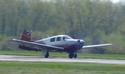
I highly recommend Plane Cover in Salisbury, MD. This is what mine looks like traveling; it's the first one. Right behind me is another Mooney with a Bruce's cover. Mine is nice and tight, the other one has elastic around the bottom and will flap in the wind. Both companies are reported to have excellent customer service.