


Fly_M20R
-
Posts
255 -
Joined
-
Last visited
-
Days Won
1
Content Type
Profiles
Forums
Blogs
Gallery
Downloads
Events
Store
Everything posted by Fly_M20R
-
The VFR GPS in the bottom GI 275 (MFD/Standby ADI) is not enabled as long the unit sees the panel mounted GPS which in my case is a 530W. The moment it does not see the panel mounted GPS it will become active and provide you with all GPS data (GS, TRK, GPS ALT, position) and allow you to go direct to a waypoint. The "direct" button is grayed out whenever it is inactive. What did your groundspeed show on your panel mounted GPS navigator?
-
What was the groundspeed indicating on your GPS navigator? Was it fluctuating a lot while tracking a constant heading or only as you turned and the wind vector changed?
-
From what you are saying, your top unit is primary ADI (PFD) and bottom unit is HSI/Standby ADI. Since the bottom unit is HSI in normal ops it should show HSI and also have and HSI Map page, in addition to also having an ADI (PFD) page. As soon as you got a red-x the bottom should have automatically reverted to ADI and not allowed you to switch to any other page. It sounds like that is what happened.
-
Not sure what you mean by "HSI backup install"
-
Your failure is certainly quite unusual. Could it be that the airspeed was coming on and off quite abruptly because of the type of cover on your pitot tube? That may have thrown off the AHRS (????) I believe Garmin is aware of your issue. Chris
-
The VFR GPS is an option for the 275. It provides a glareshield mount antenna and is powered by the backup battery of the 275 in case of panel power failure that would disable your panel mounted waas gps. It will only come active once the 275 does not see the panel GPS anymore. Chris
-
You will enjoy your new HSI!! The one request I made to Garmin re the HSI is that they also display groundspeed (GS) as one of the fields they have which is not being used at present. Should be a very easy update for them. Have you thought about installing the VFR GPS option on it? Can turn out to be quite useful in case you lost the panel GPS. Happy flying!! Chris
-
After loss of pitot input the IAS "red-x'd" on my dual GI 275 installation. I had the opportunity to test various failure considerations I had been thinking about to evaluate how the AHRS (attitude indicator) would perform. Would it "red-x", tumble or drift? The failures were equivalent of having lost alternator and battery and therefore shutting down the panel as well as causing the pitot tube to freeze in IMC. Would the GI 275 AI survive? Chris
- 19 replies
-
- 4
-

-
- ias
- attitude indicator
- (and 10 more)
-
Since my Mooney is going for an annual by the end of this month I flew up to 11,500 feet to perform "in-flight engine diagnostic tests" as recommended by Mike Busch and SavvyAviation. The tests I did were the GAMI sweep to confirm my GAMIjectors were performing as expected and also a LOP mag check to evaluate the ignition system. In the video I show part of the "sweep" and the LOP mag check and then go on to show how SavvyAviation displays the data collected by the engine analyzer. On their site one can toggle through GAMI sweep views as well as Mag check views. If you subscribe to their service they will also give you a detailed report of the findings. I also show what the report looks like. CK
-
Ovation owners. Smallest runway you will land on?
Fly_M20R replied to r0ckst4r's topic in Modern Mooney Discussion
Runway 36 is 3100 ft from threshold to first road at the Northern end which has a turnaround. It is 24 ft wide. Rwy 18 is about the same length from its displaced threshold. Plenty of runway although surrounded by trees which creat crazy up and down drafts with strong crosswinds. Rwy 18 has high trees near approach end and it slopes down. -
Ovation owners. Smallest runway you will land on?
Fly_M20R replied to r0ckst4r's topic in Modern Mooney Discussion
Consider that once you land your landing roll will be between 1300 to 1500 ft with some use of brakes for the shorter distance. You can then add any distance between the threshold and touchdown point to the landing roll. If your aimpoint is the threshold and you are approaching at 1.3 Vso (say 75 KIAS) without speed brakes you will land around 600 - 700 ft beyond the threshold. That means you should be able to land without difficulty in a runway that is less than 2500 feet and more likely 2200-2300. Key is speed control. If you approach at 80 KIAS you will find that you land on the TDZE (painted white landing spot on a runway) which is 1000 feet beyond threshold. Add 1500 feet of landing roll and you have minimum of 2500 foot runway. Using speed brakes at 1.3 Vso will get you to touch down some 300 feet beyond the threshold. Add landing roll and you should be able to land in 1600 - 1800 feet. I find it difficult to control speed at slower than 75 without speed brakes. Even keeping approach speed nailed at 75 is a bit difficult without speed brakes because of the lower power setting in that configuration unless you are doing a flat approach. To check out my landing distance today I was at 2800 lbs landing weight and approached at 74-75 KIAS with speed brakes on a 3 degree slope (after RNAV approach) and stopped after 1600 feet of runway. Touched down in ~300 feet (per Google maps measurements). CK -
Ovation owners. Smallest runway you will land on?
Fly_M20R replied to r0ckst4r's topic in Modern Mooney Discussion
Ovations don't have cowl flaps. The cowling is tight with superb baffling and air flow design. Two small openings up front for air intake and air exits through openings around exhausts on both sides. The low drag cowling makes it a bit more difficult to control speed on final since it is much lower drag than other Mooneys, including Bravos. Speed brakes become useful in shorter field landings. -
Thank you for sharing the new installation picture! Enjoy your flight!
-
Easiest would be a toggle switch as per Stan's panel picture.
-
I checked with my shop and estimated at most 3 hrs of labor to install. Could be closer to 2 if there are no "surprises".
-
Flyboy is on it!! In an analog HSI one has to manually change the CRS at each new course annunciated by the GPS navigator (530 in my case). With the GI 275 HSI the 530 will command the course change to the 275 and it will do it for you. If on autopilot the autopilot will then follow the new course if on NAV, GPSS, or APR modes.
-
To change the course on the HSI or HSI Map all you have to do is tap on the CRS field and it becomes the active field for changes done by the small knob. To return to the HDG default you either tap the HDG field after changing the CRS or wait for a time out (20 sec?) to go back to default. On the ADI the default is barometric pressure. To change the altitude bug tap on the ALT field. You can also change the HDG field on the ADI by tapping on it.
-
GI 275 software 2.32. upgrade installed and showing very easy access to the GPSS vs HDG toggle function for the Autopilot. It is now in the first menu level rather than three levels deep. I did not install the alternative option which is a physical panel switch since I wanted to try the software option first. Since the software option works quite well I do not think I will be installing the switch. Need to make more flights in IMC and busy ATC with interspersed deviations to make final assessment. However, based on this flight it appears I will stay with the software option. There were no glitches whatsoever. Easy to toggle even in busy ATC airspace. GI 275 performed excellently as in the past including an RNAV approach. Very happy with the change!!!
-
If I have two AHRS can I get rid of my vacuum system?
Fly_M20R replied to RobertGary1's topic in General Mooney Talk
Here is a very short video on how the primary ADI powers the GMU11 and what happens if the primary ADI is off and the MFD/Standby ADI is on. -
If I have two AHRS can I get rid of my vacuum system?
Fly_M20R replied to RobertGary1's topic in General Mooney Talk
Crazy enough the only scenario which I did not try is the one where having lost air data (pitot input) I did not eliminate all GPS signals (530 and internal VFR GPS) in addition to the magnetometer. I had thought about it but unfortunately overlooked it completely. I know how to set that up if I get another pitot failure. I have a very strong feeling that at that point I will have a RED-X over the attitude indicator. I did not have an AHRS failure when in addition to not having pitot input I eliminated all GPS sources but continued to have magnetometer. In my test the AI stayed alive without air data (pitot) or GPS as long as it had HDG. Go figure!! -
If I have two AHRS can I get rid of my vacuum system?
Fly_M20R replied to RobertGary1's topic in General Mooney Talk
I have simulated electrical failure of the avionics connected to my GI275's by turning them off and they worked very well, in spite of having no pitot input. I have the video that hope to have finished editing soon and will post when done. I did share pictures of the scenarios I set up. I found that the attitude indicator in the FS210 AHRS is a bit off in my plane and shows slight left bank (about 3 deg) and slight down pitch (about 2.5 deg) on my Garmin Pilot app and which I have not been able to correct through the app on my iPad. However, since it also shows GPS altitude and GS as well as VSI as long as the GPS navigator is alive it should be flyable with some mental correction. If not flyable then can go to the Navigation split screen to show analog equivalents of ASI, ALT, VSI, HSI. Since the FS210 gets its inputs from the GPS navigator (GNS, GTN, etc) once those go out because of electrical failure the FS210 would become useless and not be powered itself. At that point I would rely on my iPad's internal GPS and use the Map page with Navigation split screen if for some crazy reason I also lost BOTH GI 275's. Regarding pitot and static inputs to the GI 275's, the tubing goes directly into the GI 275's without any electrical "analog to digital converter" in between. The conversion gets done inside the 275's with its own battery power. Therefore you would not lose ASI or ALT (or VSI) unless you had an iced up pitot and static ports. If you have an iced up static port you can engage the ALT STATIC source. With iced up pitot you may not have valid IAS and it would be flagged as such as in the pictures I showed. You would still have TRK info from the backup VFR GPS of the GI 275. The VFR GPS antenna is an option which I HIGHLY RECOMMEND having installed and connected to the backup ADI since it would be your only GPS TRK source in case you had a full electrical failure. I recommend GMU11 connected to the Primary ADI and VFR GPS to the MFD (or HSI) Standby ADI. Failure of electrical system does not shut off the TC in the 275 since it is powered by its own internal backup battery. If you were to lose either IAS or internal GPS TRK then you would lose Standard Rate turn bugs as well as TAS calculation but NOT bank. Since I have eliminated my six-pack and replaced with the dual 275's without adding an additional backup electrical AI with own battery, I would eventually have to depend on my iPad GPS and its Navigation split screen to get me out of trouble if both 275's were to shut off. If the iPad fails, I have the same app on my phone and another iPad. How likely is that to happen for both GI 275's to fail in addition to full electrical failure? Extremely unlikely. Lightning? The GI 275's are designed with strong lightning protection and would very very likely not be affected in spite of the rest of the avionics going out. I am aware that we all have our personal limits and levels of comfort and many on the forum will have very different views. For me, after flying 90+ hours with the 275's and having done several LIFR approaches as well as quite a few hrs of IMC I am very confident of their robustness. -
If I have two AHRS can I get rid of my vacuum system?
Fly_M20R replied to RobertGary1's topic in General Mooney Talk
I do not know what the G5 does regarding powering the GMU11. However, the GI275 does power the GMU11 even from its own internal battery if the master switch is off as you can see from this picture. Master switch is off and turned on the primary ADI with its internal battery. The GMU11 is connected to the primary ADI and heading comes up once the AHRS has aligned.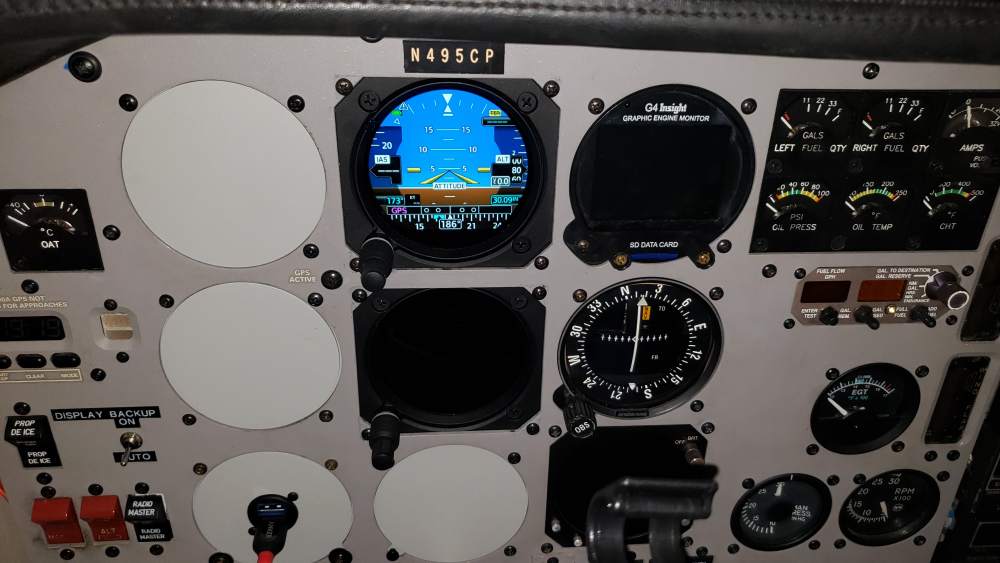
-
If I have two AHRS can I get rid of my vacuum system?
Fly_M20R replied to RobertGary1's topic in General Mooney Talk
Great insight! Chris -
If I have two AHRS can I get rid of my vacuum system?
Fly_M20R replied to RobertGary1's topic in General Mooney Talk
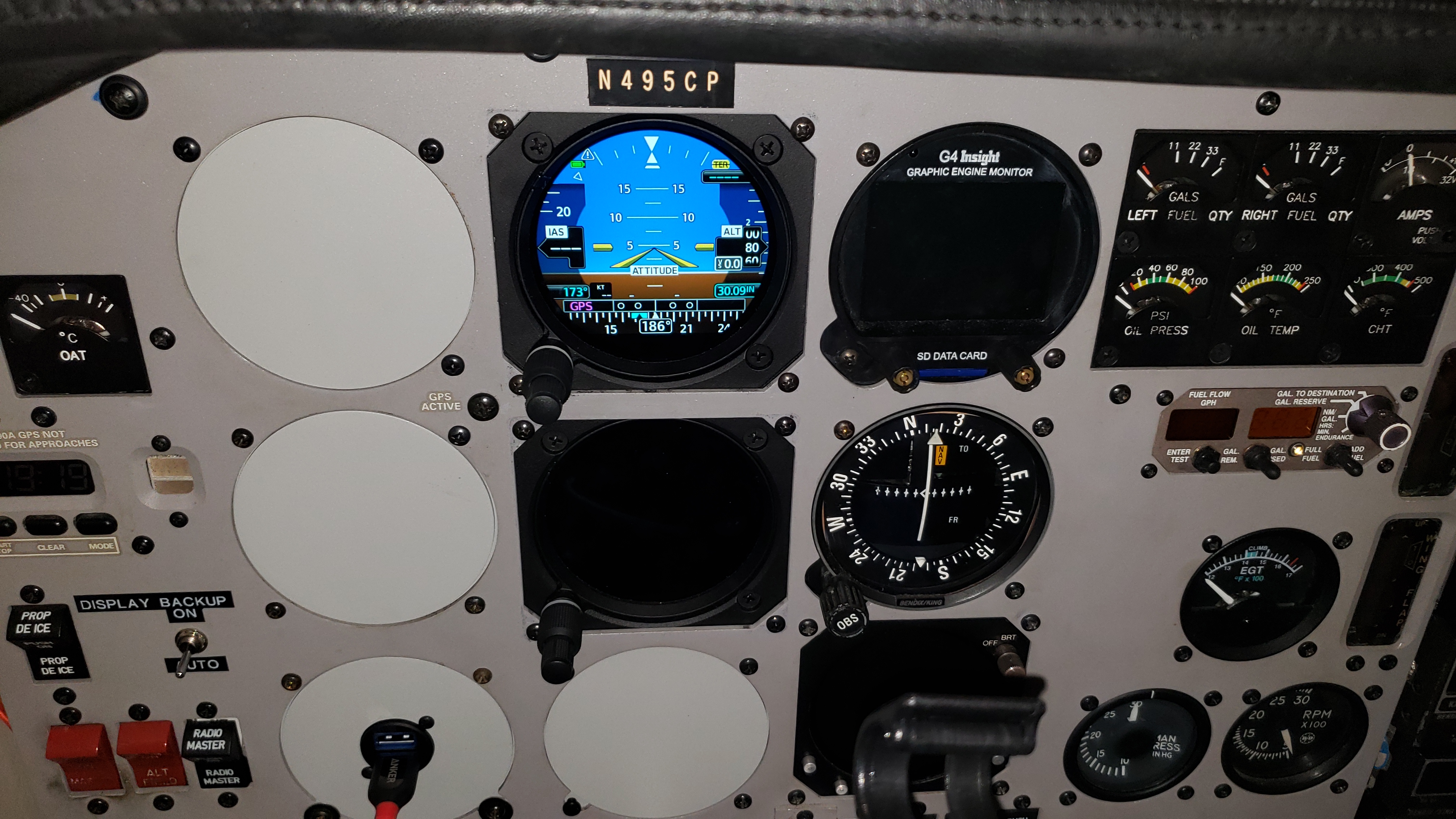
I have some selected frames from the video I am editing of the flight where I had no pitot input into the 275's: 1) No IAS, with GPS ground speed and TRK input from 530W and having both 275's on. Climbing to 5500 ft. Both working perfectly. MFD/Standby ADI unit went to Standby ADI and unable to change to other pages 2) Turning level at 5500 ft with 530W on and autopilot engaged in HDG and ALT hold modes. No issues whatsoever. 3). In Standard rate turn with 530W off and GS being provided by now active VFR GPS of bottom Standby ADI 275 unit. In this case both have the GMU11 magnetometer provided by the top 275 ADI and GS by bottom VFR GPS. Stayed in turn attitude for 2 full coordinated turns without issues 4) In standard rate turn with 530W and PFD (ADI unit) off. Bottom Standby ADI unit has own VFR GPS active but no GMU11 magnetometer HDG input that goes through top unit. Note that now the heading strip reads TRK and not HDG. GS still available. In this case although there were no obvious issues with the bank or slip/skid bug the pitch did vary from above horizon to below horizon even if I stayed at the same altitude. It means that the AHRS unit does need GMU11 input to correct for gyro drift which was more obvious in pitch than bank. 5) In standard rate turn with 530W and MFD/Standby ADI off. By turning the MFD/Standby ADI off it eliminated the VFR GPS and therefore the ADI had no GPS TRK or GS input. It only had the magnetometer (GMU11) for HDG. In this case it worked perfectly. My conclusion is that the AHRS works much better with magnetometer rather than GPS TRK. It does not seem to need speed input. I hope to have the video out "soon"... Chris275Climbingto5500.thumb.jpg.0c3b287c26a76c44d1beb70ff49dd539.jpg)
275Turning5500APengaged.thumb.jpg.b273c7438eae1b161f6096427da99832.jpg)
275NO530stdrateturn.thumb.jpg.adf4593aee3cdbd2dbdfdaa5cae5606f.jpg)
275No530NoPFDStdRtTurn.thumb.jpg.013c90810e4491409ea9379d22596d43.jpg)
275No530NoMFDStdrtturn.thumb.jpg.26d79fd503fd8a371640fc553c943c6a.jpg)

275Climbingto5500.jpg.ceb3070bf183410cec1ecaa36cab9039.jpg)
275Turning5500APengaged.jpg.c606c08f099d2f169041bef9ae2cf5f8.jpg)
275NO530stdrateturn.jpg.9d8accccbb4cf936d1abfe4f4edc89f3.jpg)
275No530NoPFDStdRtTurn.jpg.e1b5b449f555a4501963d3b1ec0cc8f7.jpg)
275No530NoMFDStdrtturn.jpg.ff910fbab47365a4ea4356bfd33ee353.jpg)