201er
-
Posts
5,054 -
Joined
-
Last visited
-
Days Won
69
Content Type
Profiles
Forums
Blogs
Gallery
Downloads
Events
Store
Everything posted by 201er
-
Minimum Cloud Ceiling to Launch VFR for Aerial IFR Pick Up (poll)
201er replied to 201er's topic in General Mooney Talk
The question is to establish what ceiling would you refuse to launch into even under the most favorable "other considerations". It is understood that it may be higher but not lower depending on other factors. -
Minimum Cloud Ceiling to Launch VFR for Aerial IFR Pick Up (poll)
201er replied to 201er's topic in General Mooney Talk
For me, the lowest I would consider is 1500ft ceiling so I could fly a normal traffic pattern under VFR. Also, I need at least 1000ft of ground clearance (inevitably there may be a congested town near an airport) and around most airports, class E goes down to 700, so in order to fly at 1000ft, clouds can’t be below 1500. So, at a minimum, I’d like to be able to circle the airport by a few miles at 1000 AGL to try to pick up IFR, and if the clearance cannot be obtained, return for a normal VFR landing. -
With an indefinite/infinite delay to get an IFR clearance on the ground, what is the lowest cloud ceiling (with no restrictions to visibility) you would takeoff off with VFR to pick up IFR in the air? Assuming mild but not perfectly flat terrain, no other weather factors. So, understandably with more factors this number may be higher. But, with optimal conditions what is the lowest ceiling you’d ever consider taking off for the purpose of becoming IFR in the air?
-
Rght out of the gate? Seriously???
201er replied to Freddb34's topic in Vintage Mooneys (pre-J models)
The DTSB final report is out https://data.thedtsb.org/accident/mooney-m20e-n79338/ Dan Gryder concluded his exhaustive investigation and determined that the probable probable cause is pilot caused stall and absolutely not a fuel problem. -
Pardon my ignorance on the matter, but how in the world would hub caps improve speed in cruise with retracted landing gear?? Looks like they might improve speed with gear down which is actually undesirable.
-
-
Mooney 201 lands on high power lines in MD
201er replied to ArtVandelay's topic in Mooney Safety & Accident Discussion
-
Bryan Turner released a new dating app for pilots only but if you watch all the way, you may realize why you’re ineligible.
- 10 replies
-
- 11
-

-

-
If old man Jose were still around, he’d tell you extended range fuel tanks and a piss hose. It’s nice to have the plane be faster, but let’s face it, unless you fly 10 hours straight or fly hundreds of hours a year, how much time are you really saving with a few knots difference?
-
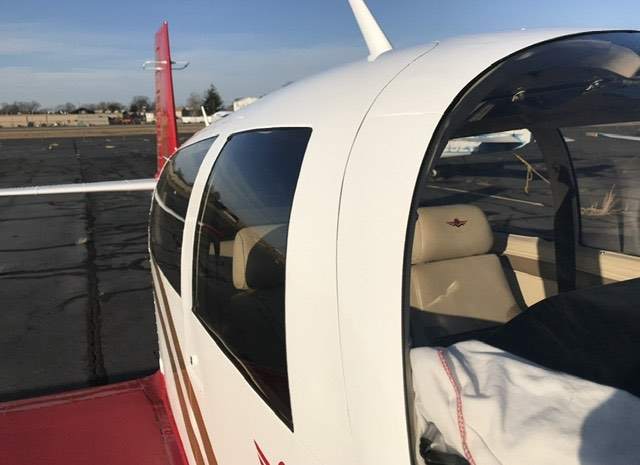
Look at the smooth transition from the front frame to the door on the pics after paint and body work.
-
It wasn’t the windshield itself but the new cap strip. The last time the windshield was redone by a prior owner, they reused the cap strip but it was bent out of shape and sticking up a bit. Redoing the windshield this time, had a new cap strip flush riveted and blended in. Door jam was straightened and improved. Added the forward facing door pin mod from later years to improve door staying flush when closed. Added step fairing around the round step tube. Replaced and reinforced cowling. Aileron, elevator, and rudder gap seals. ELT antenna moved under dorsal fin. Composite inner gear doors and careful gear door rigging. A pillar body work. Smooth new paint brings it all together. Before After



-
How often is it that insurance companies are paying anything but the max limit for passenger death or injury? What about spouse, kids, parents, relatives? Are they all covered as passengers? Is the pilot-owner a passenger if someone else is acting as PIC under the open pilot clause with the owner on board?
-
Do you extend gear or flaps first for landing? Do you use any other slowdown devices like prop or spoilers and in what order?
-
Really lucky. Sounds like he wasn't far from being another door pop stall fatality statistic.
-
Open Door In Flight training?
201er replied to wombat's topic in Mooney Safety & Accident Discussion
91.3 Responsibility and authority of the pilot in command. (a) The pilot in command of an aircraft is directly responsible for, and is the final authority as to, the operation of that aircraft. -
Do you retract gear or flaps first at PPP during go-arounds in Mooneys?
-
Same day as the Mooney Summit?
-
https://data.ntsb.gov/carol-repgen/api/Aviation/ReportMain/GenerateNewestReport/90817/pdf https://data.ntsb.gov/Docket?ProjectID=90817 http://www.kathrynsreport.com/2017/05/mooney-m20f-executive-21-n66bb-fatal.html
-
Retract Gear or Flaps First in a Go Around ?
201er replied to donkaye, MCFI's topic in Modern Mooney Discussion
A more accurate test would be to takeoff with full flaps and gear down. On one flight, retract the flaps fully while leaving the gear down, on the second retract flaps to takeoff while leaving the gear down, and on the third retract the gear while leaving the flaps full. Rotate and climb at the same typical speed. Note the altitude when crossing the end of the runway. This would be way more realistic because after all the goal in a go-around is to get away from the ground as soon as possible, particularly on a short runway, and not about speed. -
Retract Gear or Flaps First in a Go Around ?
201er replied to donkaye, MCFI's topic in Modern Mooney Discussion
I think this is a flawed experiment because the speed at which it was done is not representative of the speed in the initial moments of a go-around. At go around speeds you are likely dealing with a greater amount of induced drag caused by the change in wing camber because of the flaps in addition to the parasitic drag. Or perhaps it’s just the conclusion that is flawed. If parasitic drag between wing flap or gear retraction at higher speeds is determined to be comparable, then it is best to retract flaps first because they will have a greater contribution of total drag at lower speed when you factor in higher induced drag in addition to the parasitic. Plus flaps first is a better habit if ever switching to most other airplanes. -
Jose Monroy spoke rather fondly of his piss hose that poured out a venturi underneath the fuselage all over the underside of the plane.
-
-
To avoid running it dry inadvertently during a more critical phase of flight
-
Neither a turkey nor a buzzard. Looks like a Black Vulture. And a costly repair.
-
After a fuel stop enroute to Florida, 10 gallons in I switched tanks and a few seconds after the switch the engine started to stumble. The fuel pressure gauge dropped so I immediately turned on the boost pump. The stumbling continued and fuel flow was erratic. I enriched the LOP mixture because the engine doesn’t like to relight LOP. Eventually normal function resumed. On the previous flight on the way to the fuel stop, I inadvertently deliberately ran a tank dry. Running the tank dry was deliberate but the moment it happened was a bit unexpected. I was about 10 minutes from beginning my descent and expected to switch the tank at that point before it ran completely dry. When there isn’t a lot of gas remaining, I want to arrive with everything being usable. What made it worse was my passenger flipping out over it which startled me much worse than the tank running dry. I immediately reached for the fuel selector and flipped to the other tank and turned the boost pump on. Anyway, the surprising thing was the engine stumble after refueling. Well duh, there was still air in the line from running dry on the prior flight. I’ve always been taught not to switch tanks right before taking off or critical phases. And this was a very good reminder why! So, just a reminder that you can have some engine stumble not only when running a tank dry but also on the subsequent flight when you switch to the previously dry tank.