David Lloyd
-
Posts
1,170 -
Joined
-
Last visited
Content Type
Profiles
Forums
Blogs
Gallery
Downloads
Events
Store
Everything posted by David Lloyd
-
My old carpet was held down with sheet metal screws. I replaced the carpet with Airtex, their directions say glue it down. I went to Lowe's and bought 3M Velco, many widths and strengths available. Works great.
-

How do you keep hangar doors clean of spiders?
David Lloyd replied to rbridges's topic in Miscellaneous Aviation Talk
A friend told me he use Bayer insect control (in a blue plastic bottle with a sprayer head) available a Home Depot. Supposed to work for 6 months but after 3 or 4 months the spiders would come back. First couple months after spraying, there would be nothing crawling. -
Feedback before I send the deposit
David Lloyd replied to NJMac's topic in Avionics/Panel Discussion
Big question, would you expect to see your approach plates on the 750 or would you use an iPad? My personal experience with the charts shown on the panel first on Dynon Skyview, later on a GTN750, was the fine print was just a little too small. I always wound up with either paper or iFly GPS and now an iPad with Garmin Pilot. If you are going iPad no matter what, a 650 will do almost as much as a 750. One or the other. Through sometime in August, Garmin still has their GI-275 bundle pricing, about $500 off. In addition, their synthetic vision is only $500 right now. Yes, I know, small screen but a few small things it allows makes it attractive for just a few more bucks. The promo price brings it with $2k of the G5s with much more capability. ADI Primary and MFD Primary/ADI standby, both with battery and ADAHRS will do a heck of a lot more than the G5s. As Lance said, the EIS is a wash pricewise with the 930. Watch a couple of Chris Koppel's (Fly_M20R) videos on the GI-275 combo paired with a G500 autopilot. These things were made for each other. If you get either a 650 or 750 and already have a GTX375, that covers ADSB in/out, transponder, two very capable GPS navigators, one VOR receiver, one ILS receiver, and one com. Do you really need a second nav receiver? I suspect my one will only be used for practice. Tune it to a station and see if it works. So, my second is a PS Engineering PAR200B. Com radio and audio panel in the same box. Well actually the radio itself is remote mounted but tuned on the audio panel. I'd vote for that versus a GNC225 and PMA450B. -
Eric, what's for breakfast in Star?
-
Just donated. A month or two later than appropriate. Every day I learn something useful from MooneySpace!
-
Elevator rigging 69 M20-C issue
David Lloyd replied to Rob K.'s topic in Vintage Mooneys (pre-J models)
Rob is in the Ft. Pierce, FL area. Where can he take his plane to get it adjusted properly? -
Not a 90 mile commute but another benefit to knowing your airplane is being able to buy the majority of your fuel at the less expensive pump. For years my average leg was 2 1/2 hours. Fuel at my airport was always less than where I went. Oh dark thirty on Monday morning I would top the tanks with cheap fuel(?) prior to departure. Depending on the forecast at home, I would order only the amount expensive fuel that would leave me with an hour of fuel arriving home. That typically worked out to $20-$30 savings every week. Year after year. Okay, a few times every year I would top the tanks away due to iffy weather at home. Always be safe. Know your plane.
-
Fat Albert 65 M20E 4900 TTAF 1000 SMOH 55000
David Lloyd replied to Alan Fox's topic in Aircraft Classifieds
My lines are installed in front like the blue plane. Looked thru the 1/2" pile of STC instructions for windshield, tips, gap seals, hinge covers, etc. that came with my plane. The only LASAR instruction not there, so can't say for sure. I think routing around the back with the caliper moved forward would require longer hoses. -
Fat Albert 65 M20E 4900 TTAF 1000 SMOH 55000
David Lloyd replied to Alan Fox's topic in Aircraft Classifieds
Gee, it's been about 40 years. Think the directions just said to reroute the original hoses. But going around the front of the swing arm keeps the hose away from spinning parts and the length works out properly. Did another fitting have to be used at the caliper? Don't remember, lost in time. -
Fat Albert 65 M20E 4900 TTAF 1000 SMOH 55000
David Lloyd replied to Alan Fox's topic in Aircraft Classifieds
Yes, the calipers are reversed, now at the lower front. -
Two years ago, my Airtex carpet did not quite fit. Over a weekend I emailed about what to do and Dodd Stretch the owner phoned me from his home on Saturday afternoon. "Just mark it or cut it as you want, return and we will rebind the edges." He also said he has more Mooney carpet patterns than any other plane. No two are a like is just a slight exaggeration. My 1975 C carpets are shaped a lot different from yours. Back when it was almost new, I did an Airtex carpet in a 1965 C. I seemed to remember a piece of carpet to enclose the nose wheel well. Could those extra pieces be related to that?
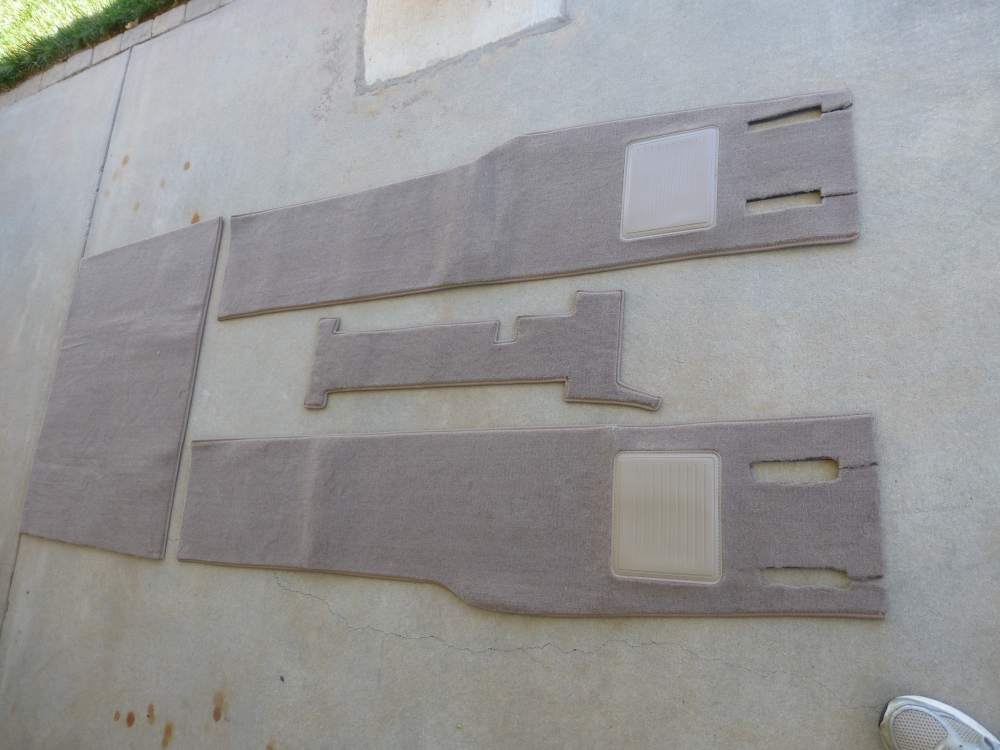
-
A couple years after my engine was overhauled, cylinders were pulled off and sent to Sal's for some reason. When reinstalled, they picked up a number from the work order and entered it as the TSMOH. I see what they did. Don't know why it was never caught. About 250 hours, not in my favor. Cars, trucks, airplanes have come and gone over the years with no fanfare. The Bonanza I had for almost 24 years was different. I flew it to New Orleans for the new owner on the condition the take me to Jackson, MS to meet with a customer. I caught the airlines home. One last trip in the Bo, told the buyer and his CFI everything I could think of, bought their lunch in Jackson and went back to the airport. I couldn't go into the FBO, I couldn't take one last look. That would have been too tough. Said goodbye, put my head down, looked at my feet and walked to the airline terminal to get my rental car. No, it wasn't a happy day, there were far too many great memories, friends, places, deeds involved with that airplane.
-
Know your airplane. I see you have a K, a turbocharged Continental engine. It is different from the carbed Lycoming in my C. Being turbocharged, it will restart after running a tank dry significantly different at FL240 versus 7000, and different from non-turbocharged engines even at 7000. Part of the certification process requires a non-turbocharged engine to restart by only introduction of fuel in some period of time, I seem to remember 10 seconds. Turbocharged, it was something like 30 seconds, but there may have been some altitude restrictions to go along with that. It may not start at high altitude and require a descent to a lower altitude. My C, I recently ran a tank dry both to observe fuel pressure indications, restarting when the tank was changed, what the tank indication would be when empty, how accurate was the fuel flow gauge and how many gallons would be required to fill that tank. In level fight, as the tank neared empty, the fuel pressure dropped from 4 psi to near 0 psi. I stepped on the rudder pedal to slosh the remaining fuel toward the fuel pickup and the pressure came back to 4 psi for 10 or 15 seconds and began dropping again. At that point I turned on the electric pump and a little more pressure on that rudder and the pressure came up to 6 psi over the next minute it began dropping again. I released all the rudder pressure and the engine quit within a few seconds. Pulled the throttle and prop back some, switched tanks and about the same time there was a fuel pressure indication, the engine was running. Fuel pressure took about 10 seconds to stabilize. Every bit of that including pressure indications were expected. The fuel gauge for that tank read 0. At the self-service fuel pump, that tank took 27.6 gallons, the O&N bladder is placarded 27.4 gallons useable. Supposedly there is 1.25 gallons unuseable fuel per tank. Maybe with full rudder I could have used half of that, maybe one day. My fuel totalizer showed almost 29 gallons used, about the error I had already figured, something I need to adjust one day. Okay, nothing unexpected here. I spent a lot of time in a F33A Bonanza with a fuel injected Continental engine, an IO-520, later an IO-550. I did similar to above with the Bo, ran the 40 gallon tank dry several times. The tanks were placarded as 37 gallons useable. In level and smooth flight, each time a tank was run dry, right or left, it would require 40.1 to 40.4 gallons to fill. I did not play with the rudder, ball was in the center. Differing from the carbed engine that gave an indication of running out of fuel, in the Bo as soon as the fuel pressure gauge dropped any at all, before I could reach the electric fuel pump switch the engine was windmilling. That quick. I've read that other people have seen the fuel pressure drop and catch it before it quits. Not my experience. Pulled the throttle and prop back some, switched tanks, richened the mixture a little and within a few seconds the engine was running. The reason for pulling the throttle and prop back some prior to switching tanks, is the engine might start making a bunch of power suddenly and will overrev before the prop governor can react. Pull 'em back so that won't happen. The OP was looking for a technique that would have the majority of fuel in one tank for landing. We flew to see the wife's parents in New Mexico several dozen times. Trying for only one fuel stop, my goal was the same: land with a good amount of fuel in one tank, didn't matter about the other. For a long trip in the Bo, I would always depart on the right tank, use 10 gallons, switch and use 20 gallons from the left, switch back to the right and run it down to the bottom, switch back to the right which now had 17 gallons "useable" and land on that tank. Wife saw what I was doing at some point, watching the fuel pressure with hand on the selector and told me in that voice (you know it) "You better not run a tank dry with me in this airplane." Never did with her in the plane, a side benefit to knowing your airplane. I used that tank switching strategy in that airplane for thousands of hours, including shorter trips. I always knew where my fuel was. In my C, a similar strategy will be adopted for a long range trip. Maybe 10 from the left, 15 from the right, left tank to the bottom, land on the right. Figure out a strategy and write it down. Follow it. If you don't want to try running a tank dry, go a low as you care or dare. How many gallons remained? What did the tank gauge indicate? How did that match with your fuel flow totalizer? Know the answer to these questions before trying to stretch your range on a long distance trip.
-
I've also got a 1975 M20, pretty sure it will be my last airplane. Enjoy!
-
Engine miss every 15-20 min; Surefly or FF?
David Lloyd replied to Peter Rejto's topic in Modern Mooney Discussion
Safety wire, locktite, lock nuts, torque wrenches and torque screwdrivers all to keep stuff under the cowling from backing off. Yet the mag cap screws, nothing special and airplanes aren't falling out of the sky left and right. I think once I had a magneto with one of those screws missing. Same cap and screw arrangement on Slick, Bendix and Surefly. Never actually seen anyone torque these screws with any measuring device. Don't think they were tight at first and won't happen again. -
If you had asked about a dual 275 install, I and others would have had some input. Since labor for remove of the HSI, AI, remotes, wiring, pitot-static is all lumped together, my invoice won't give you what you want. About $13.5 for both in South Carolina.
-
1977 Mooney . How do you switch tanks in flight?
David Lloyd replied to Don M's topic in Miscellaneous Aviation Talk
When I bought this Mooney two years ago, first time I tried the swap tank in flight, what the heck? Can't reach the selector! Don't remember that being a problem 35 years ago. Strained to get it, then found the red plastic tee handle. If you make your own, just remember to have the notch and tee aligned so it is easy to tell the selector is turned all the way right or left. Anyone with a C and worried about running one tank dry ought to purposely try it sometime and see how easily and quickly the engine restarts. Don't try it at 500' off the departure end of the runway. -
Someone just posted on Beechtalk both a KI209A and KI206 for sale. EDIT: Nope, priced right and sold in 30 minutes.
-
The hangar Bill had, the cover was about 8k, and would last only a few years without repair. Hail, falling tree limbs were hard on it. Another there at Wilgrove, vandals cut an opening at the rear and stole a lawn mower (?!). Steel support structure was pricey too. Over a 20 year period, the Port-A-Port hangars would be more cost efficient.
-
Garmin bundle pricing on GI-275
David Lloyd replied to Mark89114's topic in Avionics/Panel Discussion
Garmin just released the new software to move the GPSS selection up to the top of the menu tree. On the attitude indicator, push the button or swipe the face to get the menu and there it is. Or you can have a switch installed; either, not both. They also have a new transponder page for the MFD. Will work with "compatible transponders such as the GTC345, 345R, and 45R." Hoping it means compatible such as the GNX375. Bundle pricing is good thru end of this week, I think. -
Did the same as Jim above with my Mooney. Also in the RV. No one has accidently pushed it yet.
-
Sometimes a cam can be reground. That one is toast.
-
Yes, something similar for the 275/165/375/60-2 combination. I've always been a listmaker/listfollower. It's just a matter of making a list, trying it out, adjusting the list and then running thru it a couple times. I've never had GPSS before so there will be a checklist or two involving that also.
-
I have the original Stec pilot guide from 1990, when it was installed, matches the current offering on their website. It tells in detail how to fly an ILS, only mentions GPS and LORAN as capabilities, no detail. When it was written, I don't think an LPV approach was even a dream. Yes I am good with using pushing the buttons at the appropriate time, getting vectors for an ILS, following the heading bug, and intercepting the localizer, then the glideslope. But using GPSS or just GPS to the approach course and then switching the nav source to ILS, well that is something they didn't foresee. I'll work it out with a little trial and error in clear air. A lot of us that upgrade one piece of equipment or another, frequently from different manufactures need to find out how each piece interfaces with others. Don's question illustrates the problem, how is this used with that when doing whatever, and Don is as or more knowledgeable than about anyone here. How does a new display or navigator work with an old autopilot or a new one is something that needs to be sorted thru before an approach in the murk.
-
Don, I don't have an answer for you, but it is a great question causing a lot of thought. I am picking up my airplane in another week or so with two new GI-275 to replace the failing vacuum AI and the King HSI with sticky flags. Existing avionics are a GNX375, KX165 with GS, and Stec 60-2. I will be making a list of various scenarios to figure out what happens when. Does the GPSS drop out when vectors for the approach is activated? Do I press the HDG and NAV buttons on the 60-2 before or after? If GPSS was used before the approach, will it become active again when unsuspending the procedure at the MAP? If doing an ILS with the 165 as the nav source, going missed, do I switch the source back to GPS? Geez, I'm gonna have a 10 or 12 item list to figure out. Better to find out now, in nice weather. Thanks.