atpdave
-
Posts
53 -
Joined
-
Last visited
Content Type
Profiles
Forums
Blogs
Gallery
Downloads
Events
Store
Everything posted by atpdave
-
This is one of the “best” thread hijacks I’ve ever seen.
-
What fuel flow are you seeing with takeoff power setting? Assuming 280hp (full throttle, full rich, 2500 rpm at sea level), in my experience if it's less than about 23.5 GPH (per Mooney) it's set too low. CMI says 22.5 max but that's a little low, my guess is to make fuel consumption numbers look better (see Continental M-16 and Mooney MAN161). If you can lean it out in cruise and get significantly lower CHTs with smooth operation then it's likely a fuel setup problem. Previous owners of my plane were based in Glenwood Springs CO at 5916 MSL, and the logs indicate that they had been messing with the fuel flow, maybe to lean it out at idle. I'm based in Santa Fe NM at 6349 MSL and never saw max power CHTs above 400 around here, but in Texas that first summer they got up to 430-440 full rich, which got my immediate attention. I never saw numbers like you're seeing. The first shop that did the fuel pressure/flow setup for me still set it low, but it was an improvement. When Maxwell did the 310 hp upgrade they got it right IMO and there's plenty of fuel now to keep CHTs comfortably lower during takeoff and climb-out from sea level. In cruise I operate LOP and my CHTs are between 270 and 330 with cyl. 5 always hottest. If you do buy the plane and find you need to adjust the fuel pressure/flow, I suggest you employ someone who is very familiar with the Continental/Mooney-specific fuel setup procedure.
-
I still believe airworthiness inspections should be good for 24 months instead of 12. It’s not reasonable for a plane to be out of service for a month or more every year.
-

Starter Adapter now, new airplane is snakebit!
atpdave replied to Ragsf15e's topic in General Mooney Talk
I had my adapter overhauled earlier this year when it quit cranking the engine on battery power. Luckily a GPU was available, the engine started with the higher voltage, and away to the shop I went. I replaced the Iskra starter with an overhauled Energizer at the same time. Before it gave out, I had noticed the engine was becoming harder to start but didn't know why (I didn't notice that the engine had been cranking more slowly during start). The engine spins super fast now and it starts immediately, within one revolution. Hot starts are much easier too. This problem had been slowly getting worse over time, reminding me of the story about how to boil a frog. -
All non sequiturs. The point is this - I've been safety pilot many times, and it has never occurred to me to disable an aircraft system while performing that role. It's not training, although I have the initials to do it if asked. You sound pretty sure of yourself, but if your friend had reported what you did to the feds, you wouldn't have a leg to stand on.
-
Ovation Cigarette Lighter Adapter
atpdave replied to Healthpilot's topic in Modern Mooney Discussion
The cigarette lighter socket in your plane (SN 29-0464) is connected with a 16GA wire to a voltage converter (output voltage 13.7-13.9VDC 5A) mounted on the tailcone bulkhead. The 5A inline fuse for the converter is attached to battery relay 2. It should have a label (if it hasn't fallen off) that says VOLT CONV or something like that. If the fuse isn't blown then the converter is probably fried. The good news is they can be found online for cheap, even on eBay. Search for Transelectric SM2412-5. I think these things were used on golf carts. -
Last year I had this happen after the plane came out of an annual airworthiness inspection. Previously the mag drop was 20ish both mags. Had the timing checked and one mag was set 20d btdc and the other was at 24, both out of spec. Had the mags retimed to 22 and the problem went away.
-
I'm pretty sure it's impossible for Lm/n to be 5 inches greater than Lm/r. I have a page for the nose gear steering adjustment from the a M20K SMM, not an M20J, but I think it's the same. It says that the nose wheel axle centerline should be no more than 0.06 inches forward of the trunnion leading edge, measured with a plumb line. It's interesting that the difference in your diagram is exactly 5 inches, the same number as the trunnion distance from the reference datum. Measuring Lm/n is easy. Measuring Lm/r requires that a plumb line be dropped from the trunnion centerline. If we assume that Lm/n was accurately measured and Lm/r was not measured and is off by approximately five inches, your actual CG would be somewhere around 44 inches aft of the reference datum. I suggest that Lm/r and Lm/n be re-checked. Pages from MAN134 SMM M20K.pdf
-
Valid props for STC SA02193CH (310 hp) on Eagle
atpdave replied to htbnjb's topic in Modern Mooney Discussion
I didn’t make that very clear. I was referring to McFarlane, who I think bought Flight Resource. Here’s a link to the STC. -
Valid props for STC SA02193CH (310 hp) on Eagle
atpdave replied to htbnjb's topic in Modern Mooney Discussion
Here's what McFarlane/Flight-Resource (STC holder for MT prop for Mooney) says (I have highlighted):
-
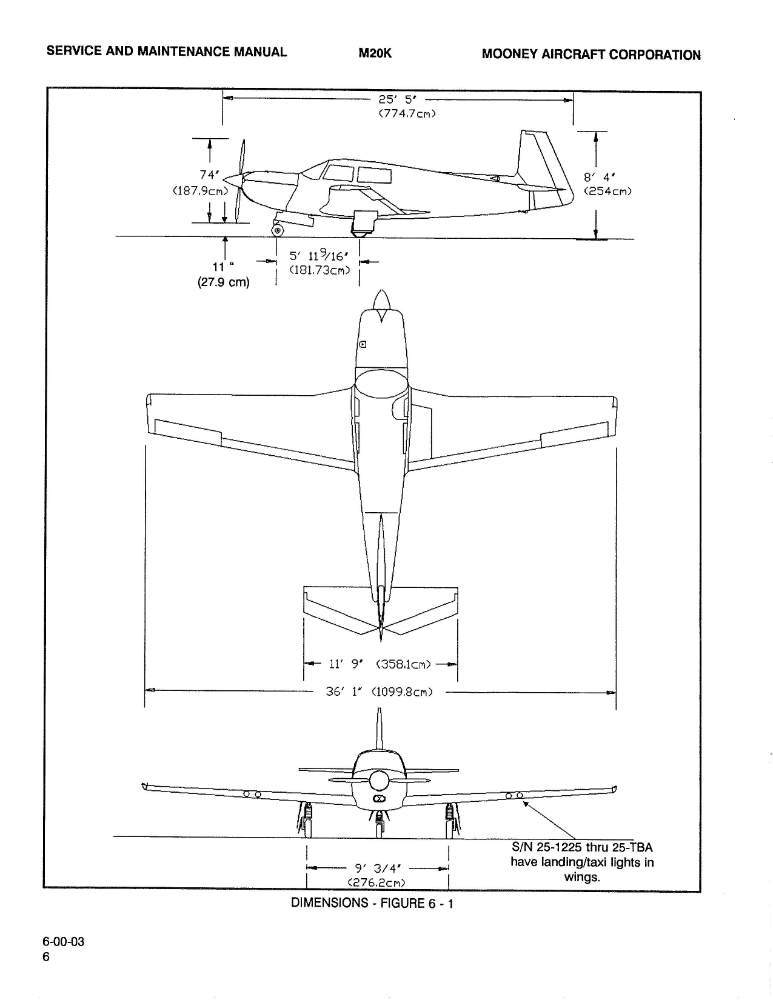
Yes. The slight difference is mostly due to the trunnion radius. Compare how the plumb lines are set in the SMM (weighing vs. rigging). I wonder why the distance between nose and main axles in @Marc_B's W&B is 2.3 inches less than that shown in the M20K dimensions figure I attached.
-
@druidjaidan, in the W&B sheet you show in the third post, I think all the arms are about 10 inches too far forward. Just looking at dimensions, weighing and gear rigging info in the SMM, they should be around -5.3 from the zero datum for the nose and +66.3 for the mains. Assuming the weights (and my calculations and assumptions) are accurate, the CG for your plane should be around 41.5 (no fuel) and 42.8 (full fuel).
-
ELT Battery (am I getting ripped off?)
atpdave replied to TigerMooney's topic in Modern Mooney Discussion
Here's one that I know of personally, December 1981. Steve Smart was an acquaintance of mine. He became a preacher after that. No flight plan was filed and no one knew they were missing. -
I had this done recently. Attached (hopefully) are the takeoff and climb charts from the POH supplement. I still cruise at 2400 rpm as before although could do 2550 post-mod. Pages from POH Supplement-2.pdf
-
I think having airworthiness inspections valid for 24 months might be a good solution.
-
Falcon Crest shows 1 in stock in San Antonio TX. http://www.falconcrestaviation.com
-
LED Replacement for Whelen Model #70303 Light
atpdave replied to StevenL757's topic in Avionics / Parts Classifieds
I want to thank James @OSUAV8TER for seeing this project through. The original halogen design was defective at best and it’s great that WAT, with James’ effort, developed this huge improvement for our benefit. Now to replace the wingtip lenses, melted by a previous owner, at $362 apiece (sigh…). -
Because I had nothing better to do today I looked at the electrical schematic diagram for your plane. It looks like you have a four conductor shielded cable running from the nav/strobe switches through some connectors to the strobe power supplies and nav lights in the tips and tail. This is sufficient to wire the new lighting. The red wire is for nav, black is ground, yellow is strobe, and green is spare (please confirm this in your plane). If you are only replacing the wingtip lights and keeping the tail incandescent/strobe, the GEAR DOWN annunciator will dim properly with the nav light switch. If you are replacing the tail nav/strobe with LED you will need to wire a relay or other device to the GEAR DOWN return line in the annunciator or else live with a permanently dimmed and unreadable in daylight GEAR DOWN light, not a good thing IMO. You can wire the new lights using the red, black and yellow wires but the strobes will not be sync’d. You can use the green wire to sync the strobes but that would require jumpering them together in a connector behind the panel. I have no idea of the difficulty of doing that.
-
I have 0401.37 and I am using 8GB Sandisk SD cards in the bottom slots. I’m also using a 32GB Sandisk SD card in the MFD top slot for flight logging (overkill for sure) and it works fine. All are standard FAT32 format. Earlier software was much more picky about SD card formatting but 0401.37 seems much improved in that respect.
-
I answered your question already, earlier in this topic. I included some other relevant info so maybe you didn’t see it. The answer to your question above is yes. Someone knows. I know that it does not, as I stated earlier.
-
There is no nav light circuit in the tailcone, just strobe power. I replaced my wing nav/strobes with the 650Es together with the 500, which freed up wiring to/from the old failed (removed from bulkhead) wing strobe power supply, which were then used for nav light power and strobe sync. (I kept the wing aft position lights as incandescent, allowing proper dimming of the GEAR DOWN annunciator light. Lots of aft position lighting now.) It sounds like you still have the old wing lights. I don’t think it would be worth the effort to splice into the wing light wiring under the cabin and run tailcone wiring just for a redundant position light.
-
I replaced mine when the strobe power supply quit. Whelen used to repair them relatively inexpensively but they don’t anymore. LEDs weren’t much more expensive than a new power supply, and I wasn’t going to go back with old technology. I ran new tail wiring essentially as you had described and had it inspected and signed off, probably saved a few hours labor charge for that.
-
I think M20R SNs before 29-0475 had inline fuse holders, not CBs for this. Look for a black inline fuse holder wired to the corresponding battery relay.
-
I experienced the GPSS fail when I bought my 2005 Ovation2. I think the baud rate on an RS232 output from the GIA63 to the S-TEC 55x was set wrong, probably happened when the GTX345R was installed for ADS-B. I think it defaults to an incorrect setting. When I did the WAAS upgrade it had to be reset again with the GIA63W. Paul Maxwell knows all about the GPSS fail. The first time he told the seller's agent how to fix it over the phone and the second time he reset it as part of the WAAS install. I don't know if the ILS deviation is a different problem or not. I don't recall that happening.
-
Dim light indication in Annunciator Panel for "Gear Down"
atpdave replied to M20TN_Driver's topic in Acclaim Owners
When I converted my Ovation2 to LED nav lights I left the A508-28 incandescent bulbs in the aft tip positions so the dimming function would still work. I think the cold resistance of those 2 bulbs in parallel is less than 2 ohms. The GEAR DOWN annunciator brightens/dims properly. If I need a replacement bulb and can't get one I would probably install a relay, and I would also like to know what kind WAT/Mooney would specify.