PeteMc
-
Posts
2,063 -
Joined
-
Last visited
Content Type
Profiles
Forums
Blogs
Gallery
Downloads
Events
Store
Everything posted by PeteMc
-

Who locks their controls like this?
PeteMc replied to Derrickearly's topic in Vintage Mooneys (pre-J models)
I was always taught the method where the seatbelt goes through one horn of the yoke. So (the way I do it) the yoke is fully deflected to the right. Might have to try your way to see which is more secure and if I can tell if there is any more or less pressure on the yoke. -
HA! I had actually gone to their website before I posted that just to make sure they hadn't expanded. The page I got only talked about props! (Can't keep my foot out of my mouth even when I try !!!! )
-
Hartzell Props?? I'm curious why a prop company would weigh into the proper operation of an engine and turbo?
-
Congratz @SCPDaddy !!! After some time with your local CFI and some time on your own in your new Mooney, then consider the Mooney Pilot Proficiency Program. Even though I had a fair number of hours when I bought my Mooney and did my initial Insurance Required hours and Flight Reviews, IPCs, etc, with a very knowledgeable Mooney owner/CFII, I still learned a LOT going to a PPP a year or so after I started flying a Mooney. Probably the easiest way to see when future PPPs are happening are at this site: https://www.mooneypilots.org/mapa-events
-
I lean to peak or maybe even a little on the lean side of peak. The reasoning to go as lean as possible is that you can never Take Off while still lean because the engine will not produce TO power. And it takes only a couple of minutes to damage an engine if you go full power and are lean. Winter Ops I'll lean twice. First time the engine may run al little rough until it gets warmer. So I'll lean and then get the ATIS, etc. Then before taxi I'll fully lean. Summer Ops you can pretty much full lean shortly after the engine starts. On Mag Check sometimes I'll need to enrich a bit, but I don't go rich. You'll see a significant larger drop in RPM. So feel free to check it a few times rich and leaned so you get used to the numbers. (Don't lean at Mag Check RPMs! That's too close to TO power where you could potentially attempt a TO while not full rich. Lean at/near idle.) Take Off Procedure for me varies with the length of the runway. Long runways (where I'm based) I'll add some power and start to roll (taxi) down the runway while I twist in the mixture, then full power. Short runways breaks stay on and I'll add some power (less than my long runway technique), then twist in the mixture. I never shove in the mixture. I have 0 knowledge/proof that it would foul a plug doing that, but I don't want to find out. Early on when I first got my plane and was reading everything I could on engine care I saw one common thread that a lot of people were saying.... Don't do anything fast unless you have to. So even my practice missed approaches, go-arounds, stalls, etc. I'm a lot slower with the Throttle than I would be in a real situation. I figure the same holds true for the Mixture. (Yes, I've had to do it for real and being slow in training does not affect how I slam everything in if needed.)
-
Extra prime? I was advised by my mechanic back when they did the SB to use MUCH LESS prime since fuel was going into all of the cylinders. He also mentioned that the Prime button and the High Boost now did the same thing. My priming is basically the same as @81X though I may only wait 10-20 seconds vs a full 30. Also agree with leaning as much as possible. Note for those that only lean a little.... Aggressive leaning will prevent you from every taking off while still lean. The engine just will not produce TO power if fully leaned for idle power. You can still taxi, but engine just won't go full throttle.
-
Great Wx... Expecting Great Performance... Except!
PeteMc replied to PeteMc's topic in Miscellaneous Aviation Talk
I've had it worse in the past, so I think they're now at least going through with a straight blade vs angled to pile it up even higher. There was a little over 2 ft there and you can't see it in the pics but there are various places there are high piles of snow. But do agree with you on doing a better job. We've brought up a few times about using a Front Loader so the snow berm would be a lot smaller. -
Sure would have been fun to go flying today.... Stuff on the Pilot side was very wind blown and felt like lifting concrete. Finally got it all cleared, but I was wiped by then.
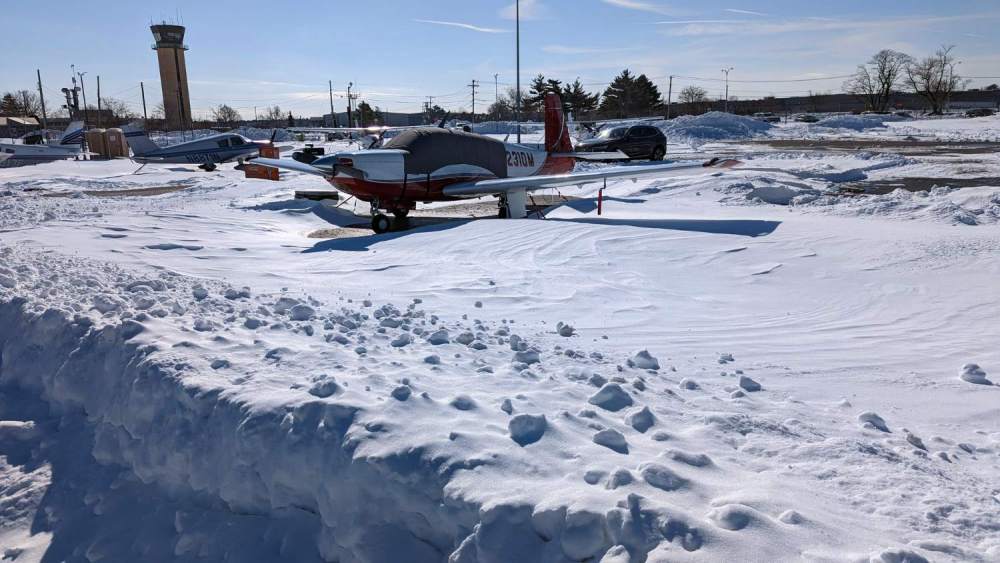
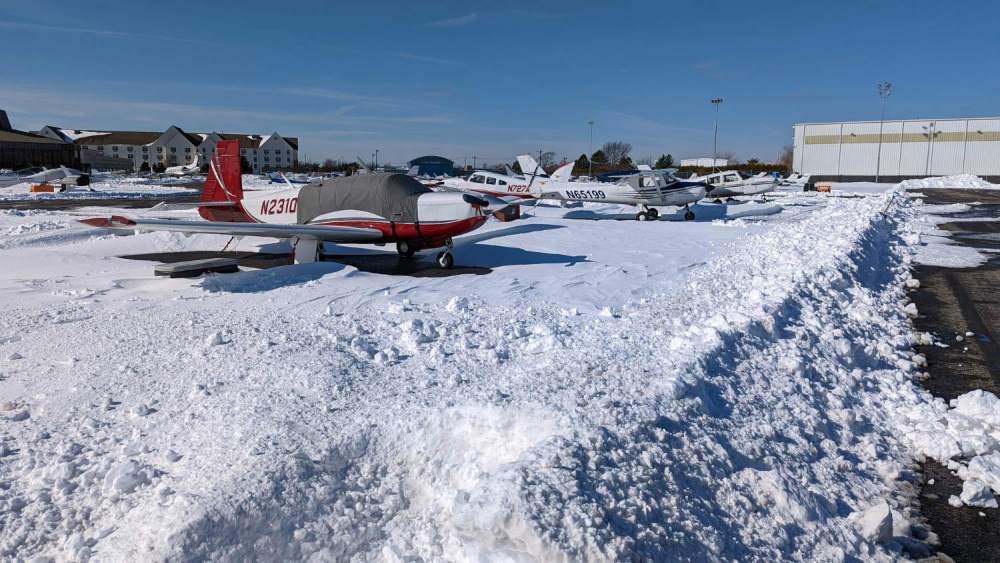
-
Requesting PIREP Mooney Service Center Eastern PA or NJ
PeteMc replied to HIghpockets's topic in General Mooney Talk
Highly recommend Air Mods at Robbinsville, NJ. Technically Trenton-Robbinsville Airport N87 when you go to look it up. They're a MSC and listed on Mooney's site. Talk to Dave Mathiesen 609-259-6877 or 609-259-2400 -
Pending the size of the Doc, correct. But also pending the quality of the graphics and how they were inserted into the Word document, that can be an issue. And this, of course, assumes the original is even a Word Doc. Although Print and Graphics are not my primary business, I've been involved with graphics people for decades and have been called into service when things have gone wacky on large events many a time....
-
Actually, what's even better is to go through and grab the Key Numbers and other gotta-have info from the Binder and put all that info in a Word Doc with big print. Then when you've got a great Info Doc for your plane, make a PDF of it to import into WingX. Side Note: For the Doc I created and imported into FF I started the name with an "_" (underscore) to put it towards the top of the list. Same for my "_ Emergency Check List" but note the two space after the underscore to make sure it is AT the top of the list. I have a quick reference so I don't have to go digging into the Documents, but on a l long flight it there just to review. Or if another pilot was with me and something did happen they can find it easily to start going down the list on my 2nd iPad.
-
Weeellll.... Maybe not 15 minutes. I've got an electronic copy of my manual so I can look things up while sitting here at the computer and with me when I fly. Some of the graphics and equations didn't come across very well. I've never bothered to fix them because I've always had the binder to refer to if needed. Now with the original file that went to the printer and possibly some of the original graphics, I could easily come up with a clean electronic version to give back to the PPP folks. ADDED: Actually it's been a few years since I've been to a PPP, so the print and graphics quality of the binder may have improved. So it may be possible to turn the latest version into a searchable electronic document with chapter links in a relatively short time.
-
And why does it need to be "younger" folk??? (No offense to you wipper-snappers... )
-
So I'm again back to now knowing something I should have known all along... OR.. Oh wait! I just forgot, yeah that's it!!! I did find a number of articles that debunk logging SIC, but then I also found a number of articles that also talk about logging SIC and why. And a lot of those were in publications I try to read.... So I'll chock it up to just being set in my ways and probably originally leaned you should log PIC. Getting comfortable with always doing it the same way "just because" can really bite you in the A** sometimes!
-
Wait... You're going from a 1933 interpretation? Then you *may* not be correct. I thought you were talking about something in the last few years that changed things. I believe a later interpretation confirmed you should not log SIC based on "Single Pilot Certification" of the aircraft. Which is why I've never heard of logging SIC in a Mooney or any GA plane flying Part 91. I'll try to do some digging, but maybe someone else here can cite where they said not to log SIC. I know that everything I've read about Safety PIC always states PIC and says not SIC, but the ones that might reference the FAA interpretation may not be easily accessible online.
-
As I understand it, with the heater left on (assuming it is the type that can be), then all is good. But if you heat, allow to cool, heat, allow to cool, etc. Then the moist air gets pulled back into the engine. And the cycle of heating and cooling may not get all the moisture out since it takes a while for the "always on" type heaters to actually warm the engine. I'll defer to any mechanics or others in the know on this, but that's how it was explained to me. I'm assuming the same would be true for the cabin. And in both cases, I'm not sure what the advantage is for heating and then allowing to cool. Other big issue about heating the cabin is that apparently some people use their propane engine heater to warm up the cabin. That's not a good idea because of all the moisture in propane heat. It's not an issue for the engine where the outsides of the engine are fine in the rain, etc. And as the engine warms it's not going to suck in any of the moist air. But if you just dump a lot of moisture into the cabin, especially if you're trying to warm up the front where the pilot is, then you can be dumping a lot of moisture up under the dash where all your expensive electronics are. Again, no expert. But this is what I've read or been told over the years.
-
I think I'd shy away from a daily timer turning on for a while and then turning off. I think there would be a issue with moisture and the engine heats and cools, probably worse then if the engine was at ambient temperature all the time. How many Amps does your heater pull, I'd just leave it on during the cold months if you have no way to turn it on the evening before you're going to fly. For being able to turn it On the night before... How many hangars near you? Maybe you can find a number of other people that are willing to share the cost of an Internet connection. Have it installed in your hangar or in the office if the hangar has one and then (preferably) run lines to each hangar of the people paying for the service. I'd stay away from WiFi if possible unless everyone chips in. Otherwise you'll find yourself paying for the Internet and other's just passing on the WiFi PW.
-
I didn't realize this had been made an option until @midlifeflyer pointed it out. (Out of curiosity I still want to go back and see when it changed.) But this gives me the option to go be a Safety Pilot for someone, maybe in airspace I'm not familiar with, and not be PIC. Sure, someone is going to come knocking on my door if something does happen. But I'm in a better position if I am not PIC. I could see this as possibly being a big advantage for those that actually fly for a living. Accepting to be Co-PIC for their newly minted best friend may put them in a tough spot. Still wouldn't be great for them as the "Safety Pilot" but they still were not PIC. And then there's the brain twister in how you could get 4 PICs at once in a Mooney. But those regs have changed (or so I was told).
-
Not sure if you meant earliest or latest, but I did find the interpretation and learned something new. However... your statement that they log SIC is just as incorrect as my statement. Incorrect in that it did not include both the PIC and SIC options. The interpretation does say the Safety Pilot may log SIC. However, it also says IF the two pilots agree before the flight that the Safety Pilot will be the PIC during the time the flying pilot is under the Hood, then the Safety Pilot may log PIC time. No change in the interpretation that has been around for a long time that I and a lot of other people were referring to. Kind of interesting that they changed the interpretation. Back in the day I remember reading that you could not log SIC because that had to do with flying and aircraft that required two crew members unrelated to flying under the hood. Be it the certification, type of flight or whatever, they distinguished Safety Pilots as a different type of required crew member. But then I know of a famous writer pilot (ATP) that always left his pilots certificate and medical with (someone... FBO?, FAA friend?) if he just was going along for the ride on a GA flight so that he could never be considered the PIC or Crew Member.
-
Nooooo...... Read all the referenced out there and the FAA Legal Office Interpretations. If we're talking basic GA the Safety Pilot logs PIC you do NOT log SIC. Different animal.
-
I've got the whole system. It was working when I pulled it, but could take to get check.
-
I used Prestige in VT (basically Canada). I've used Ed's Aircraft in the past for some touch up stuff. Also great by tough schedule, at least when I called.
-
When you do bite the bullet, be sure to go ALL IN... If there's something you think you want and are hedging on doing it later, Do It Now. You can really cut down on the installation costs if everything is already torn open. And be sure to add the (semi) little things like new antenna cable, panel lighting (what items do you still need post lights for), etc.
-
GI275s really and can give you the best of both worlds. Maybe just put in two as you AI and HSI, you can actually make them look like the old style. then start looking at the different options and switching them to different screens in the various stages of flight. Once you get use to them, decide if you want to switch up to a single bigger screen. If you do, one of the 275s becomes your backup and you can decide if you want to keep the second one or sell it. For the GPS, GTN750 is a nice box and works well with the 275s. But if you don't want that size map, consider the GTN650 which is the same box with a smaller screen.
-
Dumb Question Time re Walk Around and Pitot Tube?
PeteMc replied to GeneralT001's topic in General Mooney Talk
The unobstructed part is just that there's nothing that's blown on there or obvious insect activity. Probably more for when there hasn't been a Pitot Cover put on. So after breakfast of lunch on the return flight... And I totally agree with @carusoam on the Pilot Window. Been doing that for years and is a great way to turn everything off after you've turn on ALL the lights and Pitot Heat to check them. Granted much less battery drain now with all LEDs. Additional note not for the pre-flight, but for the final walk-away at the end of the day and I guess really for just before the push-back, I never turn Off the Beacon. This way you will know if you left the Master ON.