

DXB
-
Posts
3,613 -
Joined
-
Last visited
-
Days Won
14
Content Type
Profiles
Forums
Blogs
Gallery
Downloads
Events
Store
Everything posted by DXB
-
Little known Lockheed Skunkworks-Mooney collaboration, used for surveillance flights in Cold War era. Way more efficient than U2 or SR71. Tru fact.
-
Good guidance here - also don't forget your insurance likely covers this. At least it did for my hangar vs. elevator trailing edge misadventure. My gasp and subsequent self-flagellation were probably pretty similar to yours.
-
I've been using the Donaldson filter over the Brackett for the last few years - supposedly it provides comparable filtration but less flow restriction than the Brackett (no clue if that claim is true). Maintenance is a snap though relative to the Challenger/K&N though - just blow it out with shop air once a year, replace at 500 hours. The Bracket filter elements are dirt cheap to replace annually ($10); the Donaldson is considerably more (~120 if I recall) even if you account for lack of need for annual replacement.
-
Actually McFarlane now stocks all three cables mixture and prop cables PMA'd (previously they only had the mixture I think). I recently bought the mixture and prop and had my throttle done a few years back. Agree that original throttle cable must get replaced.
-

Near Miss With Ground Vehicles at KCRS
DXB replied to alextstone's topic in Mooney Safety & Accident Discussion
Thanks for sharing your experience so we all can learn. Ignore the inevitable troll or two who surface when you do so - it's better than average here by internet standards. I would add #5 and #6 to the list (but not necessarily to the NASA report ) 5. Despite many controllers being excellent and helpful, I should never assume that ATC has my back, even when I'm in trouble. 6. The FAA should address a NOTAM system that is completely FUBAR and in desperate need of modernization. -
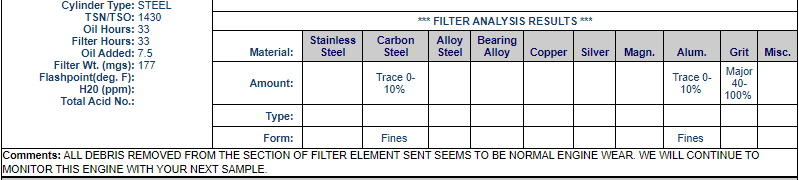
So - I'm not big on oil analysis (a rant for another thread) but I'm dutiful in cutting out and carefully examining my filter element every time and scoping my cylinders ~50 hours. It's an O360-A1D with 22 years and ~1430 hrs SMOH, flown >100hrs/year in the last 7 years since I became owner. I run Phillips XC 20/50 with Camguard year round. After a previous oil change at 45 hours, I saw a few tiny silver flakes (maybe 5-10) that didn't stick to a magnet and were rock hard to the touch. I wasn't too concerned. I recently did the next oil change after 33 hours - I saw maybe 30-50 very similar looking flakes (tiny, silver, nonferrous, rock hard) and got more perturbed. I figured I had a broken ring or piston pin cap issue maybe. I sent the filter for electron microscopy at AvLabs and was surprised to get back this reassuring sounding report. But what is "major grit" in this context?? Only change I've made is that I've added 1 quart of MMO to my oil 1 hr or so before my last two changes. I wonder if the solvent has shaken loose some sludge but but I wouldn't expect 50 rock hard particles to make it into the filter.
-
Dumb Question Time re Walk Around and Pitot Tube?
DXB replied to GeneralT001's topic in General Mooney Talk
Best way is leave open pilot window open, then during walk around briefly flip master on, and turn on pitot heat through the window, flip stall tab to make it moves freely and make sure horn sounds, touch pitot tube momentarily to make sure getting warm, then immediately turn everything off. -
Silicone plugs are more comfortable but objectively attenuates worse than foam.
-
It’s tough for me to reconcile my subjective experience with those who say the foam plugs provide equivalent or better sound attenuation. If I could figure out how to replicate it, I might switch back - Halos are more comfortable on your head. Last night I flew with my A20s for maybe the third time - I’m still freaked out by how quiet it is in comparison. Maybe it’s the design quality of that particular headset model- I’m not sure. Regardless, I can leave the volume much lower and ATC is much clearer. I have noticeably less noise-induced fatigue in the air and at the end of a long flight. I do see the point someone made about losing engine noise information. It’s nearly silent at idle, and at takeoff power, it sounds no louder than my car accelerating - no more cranking up the radio volume when I take the runway. Last night, I chopped power way back when approaching home because I was late on descending - the sudden silence startled me for a split second because I thought my engine quit. I guess my brain is getting used to the new normal of a high end ANR set after 7 years flying with a foam plug set. I wish I had just started with my current set - my prior devotion to the lightness of the foam plugs probably cost me some hearing.
-
M20E - How to get hydraulic flap control cable out?
DXB replied to Oliver's topic in Vintage Mooneys (pre-J models)
My cable snapped at the attachment point to the lever. Passing the new wire from the belly side by the flap pump is the only way. It is not easy to pass without getting stuck. Lube it up thoroughly - we used motor oil. Taking out some of the anchor points for the sheath was needed to change its shape enough to pass the wire. I don't think there was an easy trick to attach new cable to the lever - access was a bitch. My A&P spent about 2 hours on his back contorting his hands to do it. After that, reattaching to flap pump is easy. I strongly suggest just changing the wire, not the whole sheath. -
Gotta admit, when I first saw this video, I was obtuse enough not to jump to the conclusion that the whole thing is a farce. I'd never heard of the guy before that, but he just fit cleanly into my mental picture of a dumb, douchey millennial who was lucky enough to get a PPL. In my mind, it seemed perfectly routine for such an individual to (1) spread a friend's ashes on Youtube (2) try to monetize it with ad revenue (3) get in real trouble while doing it (4) not have the intelligence or airmanship to avail ample time and good landing options (5) fly around with a parachute for that reason (6) be self-absorbed enough in an emergency to whip out a selfie stick moments after jumping (7) think first of retrieving cool video footage from his ruined plane after getting down. The fact that the event is completely staged makes the video perfectly emblematic of the decadence of internet culture in our time. A thousand years from now, anthropologists and historians will show the Trevor Jacobs video in college seminars when talking about the fall of our civilization. I hope he serves prison time, but even then, he will have met his goal of being immortalized, much like Caligula was for the Romans .
-
Engine Monitors, JPI-900 VS EI CGR 30P On 65 M20C?
DXB replied to Michael Saathoff's topic in Vintage Mooneys (pre-J models)
First of all, great idea to put in an engine monitor - I feel it's had a significant safety dividend and made engine diagnostics much easier. I've had a JPI EDM900 replacing all my factory gauges since 2016. It's a good unit but took some time and quite a bit of hassle to get it sorted to the point of being free of bugs and reliable, even though it was put in by an experienced and competent installer. JPI customer service is subpar, and so that exacerbated the issue significantly. With the EI CGR 30P, it can't replace everything in one unit - you end up short one item - e.g. the fuel gauges. Options are a different digital fuel gauge vs a setup with 2 CGR 30Ps. EI's quality is very good, and their customer support is supposedly stellar - If I had to do again, I'd go with EI for customer support alone, even if I paid substantially more. 3 suggestions: - Consider keeping your analog RPM and MP gauges - I wish I had. I know from personal experience that a malfunction in power setting detection is very disconcerting. But disconnect the fuel pressure side of the MP gauge - that's driven by a fuel line that comes into the cockpit all the way up to the gauge itself - Whichever unit you choose, install it on the LEFT side of your panel. I promise you have enough room to do so. You will thank me later.... - The install is a good time to modernize your fuel senders (CiES digital) if you are inclined to do so. -
Formula is complex but rough estimate is $4 per 1000 views. At ~900,000 views so far, that puts him at ~$3600. Probably not a winning financial proposition, particularly if it leads to criminal charges, which seems possible. He should have left the comments section on - that way at least being a vitriol magnet would bring in a few bucks
-
Tubes are not for wax - they are to drain fluid in the middle ear (behind eardrum) and relieve the deforming negative pressure on the drum due to a malfunctioning eustachian tube, which can lead to other long term problems. Issue is very common in young children, and most grow out of it. It's quite risky to instill water in the ear canal if you have a tube in place - chronic middle ear infection is almost inevitable. Also excess moist wax production in a younger person (not my issue) is a different problem than impaction of dry wax plus excess exfoliated skin (called keratosis obdurans when its mostly skin in context of chronic dermatitis). Either can be exacerbated by foam plugs. Instilling mineral oil, not water, in the canal at least monthly is the best preventive measure here, though I haven't had the issue recur since quitting using the plugs. The standard drugstore wax removal product is Debrox - a mix of peroxide and mineral oil. It is fairly effective but inadequate for a really bad impaction. Another step is flushing with warm water as you say - works best when someone else does it with a wide tip syringe, but this carries some risks if you are prone to external ear infection, and its a big no no with an eardrum perforation or a tube in the drum, as I note above. The best is getting it meticulously cleaned out with delicate instruments under an ear microscope. There are now some interesting consumer products that try to offer the same thing - I have not tried but it looks interesting and will probably buy one if the issue comes up again. There is some safety concern here in unskilled hands, so I can't recommend for everyone without trying. https://www.axelglade.com/products/spade?variant=35309422182557¤cy=USD&utm_medium=product_sync&utm_source=google&utm_content=sag_organic&utm_campaign=sag_organic&utm_source=google_ads&utm_medium=14582429442&utm_name=126644129493&utm_content=544624212166&keyword=&gclid=CjwKCAiAlfqOBhAeEiwAYi43F4jckatdguircuml-O7jjsRkZbuYRyL8ve9rROpmw9Vh0qUU4bvnYBoCDCoQAvD_BwE
-
Need advice / sharing my concerns with someone
DXB replied to redbaron1982's topic in General Mooney Talk
To be clear, I've no beef at all with Flightlevel as an fbo chain - my fbo experiences at Cape May, Block Island, and Newport have all been good or excellent. The fbo and "MSC" at Norwood, not so much - I now land in Bedford exclusively when going to Boston. But yes, that shop does appear owned by the chain, so that would take it out of the shop's hands - which could be a good or bad thing.... -
Need advice / sharing my concerns with someone
DXB replied to redbaron1982's topic in General Mooney Talk
I couldn't agree more on the first point - I wish someone had taught me that back when I was a wet behind the ears 70 hour pilot and buying my Mooney - I would do a much better job managing the prebuy if I bought another plane now. Unlike an annual, there is no objective standard for what a prebuy entails, and so what it becomes ultimately falls on the buyer's shoulders. A good shop would of course educate the inexperienced buyer and act in their best interest, but I wouldn't count on it. Many shops may merely produce a pretty report but gloss over key issues like this in the actual inspection. Regarding an attorney, it might be worth figuring out exactly the severity of the issue and the cost of remediation before finding a lawyer. Multiple other corrosion spots may be lurking undiscovered, or alternately the corrosion may be isolated and not as severe as represented. Once you lawyer up, something tells me that this particular shop owner, who is a bit of a magnet for dissatisfaction and drama, is going to dig heels and fight rather than seek the path of least resistance even if its in his own interest. That mess hardly seems worth the trouble if the issue turns out to be minor. It may still be a strong consideration at the other end of the spectrum if the plane is totaled by corrosion. At the end of the day, the OP wants a Mooney to fly, not a bunch of legal drama. *EDIT - just saw the new pixs posted above. That looks pretty obvious (and also pretty terrible to my untrained eye) -
First time I declared an emergency…
DXB replied to Candy man's topic in Mooney Safety & Accident Discussion
Surefly runs directly off the battery, not the master relay. -
What can be said after reading this?
DXB replied to cliffy's topic in Mooney Safety & Accident Discussion
-
A little envious here. I'll save my pix until someone starts a "show us your butt-ugly engine compartment" thread . My 53 year old doghouse is not an aesthetic masterpiece.
-
First time I declared an emergency…
DXB replied to Candy man's topic in Mooney Safety & Accident Discussion
Can't fault you for any decisions here. Like you I wouldn't have declared an emergency in easy VFR conditions. I would cancel IFR, stay on flight following, and let ATC know immediately. Their declaring an emergency for you while you're in clear weather seems a little silly. Turning master off and on is no big deal here. One can also cycle the alt field (if you have a split master) as one step short of that and cycle the alternator breaker. Handheld is a great idea, along with adaptor for headset and an extra battery pack for it to keep in your bag. After a similar experience, I've gone so far as to have a connection for my handheld put into my panel to connect it to ship's antenna for much better transmission and reception. If weather was easy, I'd probably to continue to my destination or wherever it seemed easiest to get it fixed nearby, assuming I could get in without being too disruptive or deal with complex airspace after my radio died. In my case, I was also in easy weather but making my first flight into a DC SFRA FRZ airport - I really didn't want to deal with the risk of lost coms there, so I just put it down at the large nontowered airport directly that was under me in NJ when it happened and took a very expensive Uber to the nearest train station to get to my meeting in DC. -
Need advice / sharing my concerns with someone
DXB replied to redbaron1982's topic in General Mooney Talk
While it gives me pause to sling mud at any aviation business, I think you may benefit from settling your tab and getting away from that particular shop as quickly as you can, even if it requires a ferry permit. PM me if you want to discuss further. Though inspecting the area of concern should be high on the list of priorities for a prebuy, there's little upside in your going after them in this situation. Even if their assessment turns out to be spot on, you will want the repair done by someone else. FWIW, thoughts on Airmods in Robbinsville NJ on this forum have been mixed, but they do have deep experience with Mooney structural repair work. -
Routine prolonged use of foam plugs also can cause ear wax impaction problems, which affect hearing and are a huge nuisance. People become more prone to this issue as they get older, when their protective wax can become less moist and more solid and mixed with dry skin debris. I never had an issue when I was flying for a couple hours occasionally, but then I got older and the problem reared its ugly head last summer on a long trip with daily flying for a week. Attempts to clear the impaction with q tips or any other instrumentation can make matters much worse, including leading to serious infections in the ear canal skin that are very painful can spread to the surrounding bone. Anyone who has ever had an excruciating otitis externa is willing to do anything to avoid that happening again. Bony ear canal skin is the thinnest and most delicate in the body - there is no soft tissue cushioning under it - it's just a thin epithelial layer applied directly to the hard bone, and so any pressure easily damages that skin and compromises its critical barrier function. The deep insertion of a foam plug needed to provide good sound attenuation can be quite abrasive to the skin if not done carefully, and even then the plug still compresses the loose layer of protective wax and can strip it upon removal. Compacting the wax and pushing it further into the canal also disrupts the natural, gradual self-cleaning wax flow to the outside of the ear and can cause it to build up to the point of obstruction - which is a miserable experience if you've had it. I just switched from Clarity Alofts I used for the last 8 years to Bose A20s. ANR's objectively superior attenuation of the piston single cockpit noise profile relative to foam plugs matches my subjective experience with the A20s. An added benefit is that I don't have to crank the volume nearly as much to hear ATC clearly - together I hope these features will help slow the sadly inevitable progression of my hearing loss and tinnitus. Causing less ear canal problems is an added bonus, and so the benefits outweigh the increase in discomfort related weight and clamping pressure in my opinion.
-
yes that's true good point - the data display may not be granular enough to capture passing though peak EGT
-
This leaves me confused - bear with me if I'm reading it entirely wrong and I have a misconception that needs to be corrected. The segment from ~2:15-2:30 is when you have reduced fuel flow (~8gph), but at least 3 of 4 EGTs are above the previous baseline, suggesting you're still ROP. What doesn't make sense to me is that 3 CHTs drop during that segment, which shouldn't happen until you're pretty far LOP. What am I missing?