
Rick Junkin
-
Posts
1,407 -
Joined
-
Last visited
-
Days Won
7
Content Type
Profiles
Forums
Blogs
Gallery
Downloads
Events
Store
Everything posted by Rick Junkin
-
 Folks, here's the link to make hotel reservations for the Mooney Summit at the block rate of $159+tax per night at the Courtyard Tampa Downtown. This is the same link that was included at the bottom of your Mooney Summit Registration confirmation email you received when you registered. This rate will be available until midnight EDT on 8/17/22. Book your group rate for Mooney Summit You can also call 1-888-236-2427 and reference the Mooney Summit to get the block rate. Please let me know if you have any problems with making your reservation and we'll get you squared away. Cheers, Rick
 -
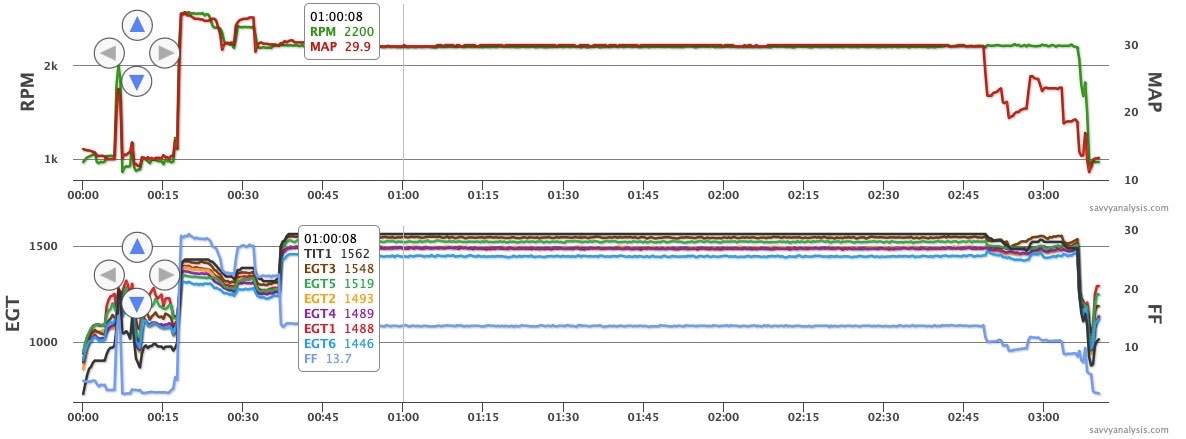
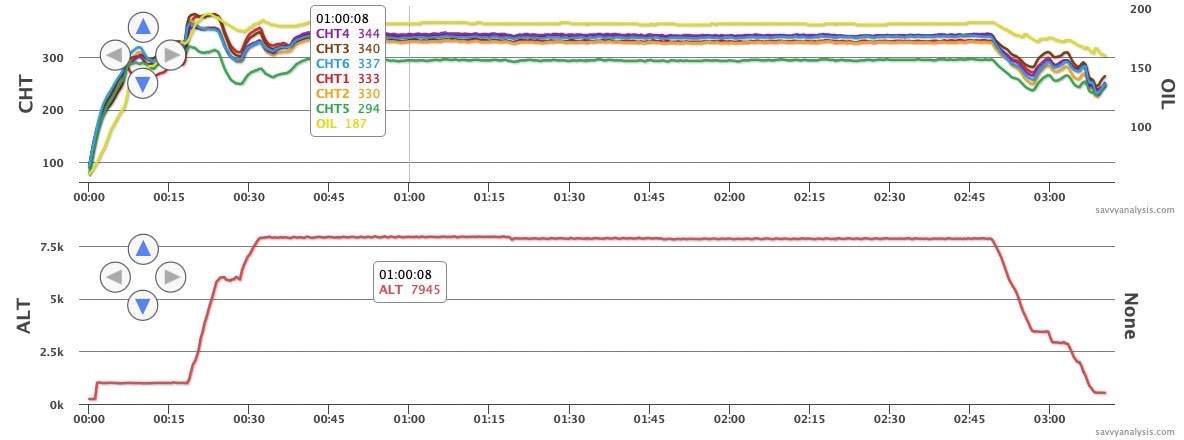
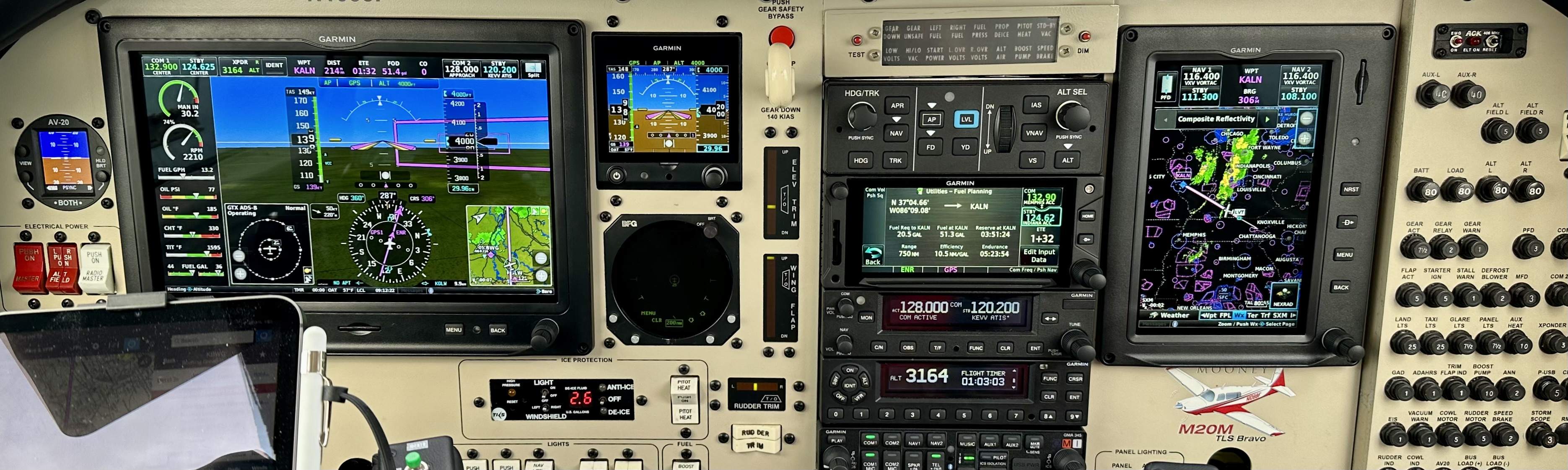
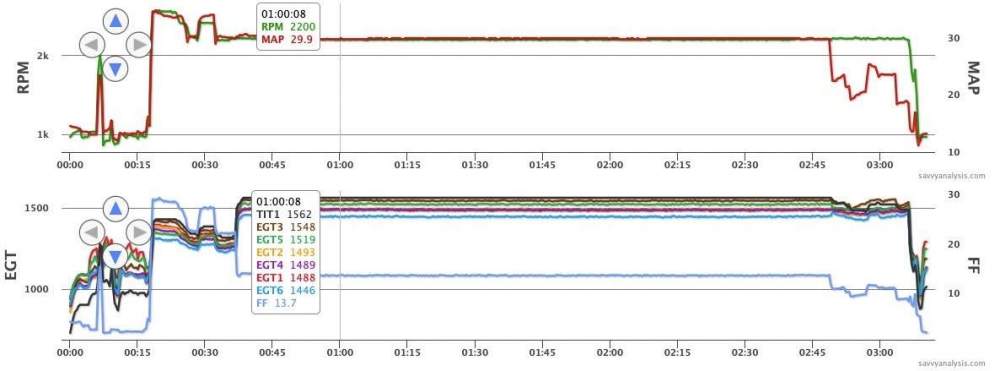
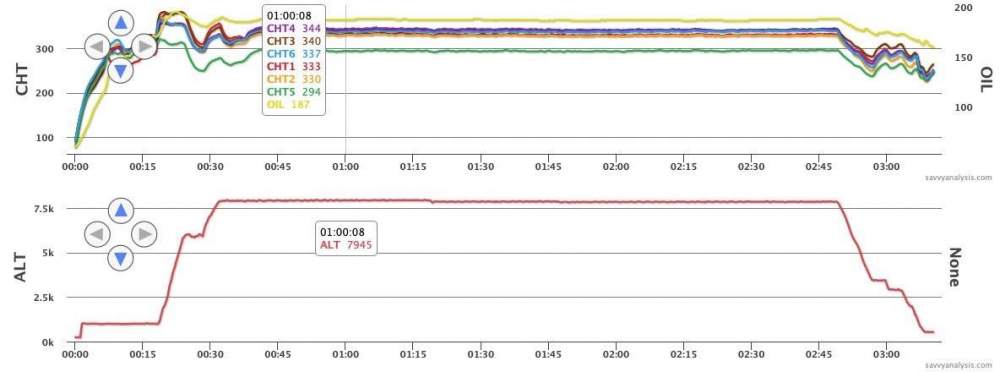
I'm one of the Savvy clients Paul @kortopates is referring to. I posted this in another thread but repeating here for convenience. Here's some JPI 830 data from my flight from Gatlinburg to Alton IL yesterday that shows some real numbers for a Bravo running 30/2200, 13.7gph and 40 degrees LOP TIT at 8,000 feet. This power setting consistently yields an indicated airspeed of 143kts which gives me 180KTAS+/- in the mid to upper teens but the westerly winds at altitude yesterday were horrendous so I settled for 160KTAS at 8K. My #5 CHT is from a ring probe and reads 50 degrees lower than the OEM gauge, so add 50 to the #5 CHT value. For reference I have GAMIs with a spread of 0.3gph at peak, Tempest fine wires (URHB32S) and a dynamically balanced prop/engine. This power setting is very smooth, much quieter and I believe less fatiguing. I'm meticulous with my maintenance and so far it is really paying off for me. I'll add that I do the big mixture pull straight to my LOP fuel flow (13.7gph on my TIO-540-AF1B at 30/2200) and cross check the TIT and CHTs once they settle out and adjust as desired from there. It's one of the recommended techniques to get to LOP quickly and to use it you'll need to determine what that FF number is for your preferred power settings. Also I let the engine "rest" at 30/2200 with full rich mixture and cowl flaps open for about 5 minutes after a long climb before I go LOP. If I don't do this and immediately go LOP I get fuel pressure fluctuations at the lower fuel flow rate, presumably due to percolation in the fuel lines from the heat generated at climb power. On a hot day I will also run the fuel pump for that five minutes to keep the pressure up and assist the cooling process If I want to find out exactly where I'm running with regards to peak TIT and also crosscheck the individual EGTs I enrich the mixture from the LOP side back to peak, and then dial the mixture back to LOP. That keeps me away from the high ICP zone. I do the peak check occasionally just to have another crosscheck that nothing has changed with the way my engine is running and to confirm I'm still where I think I am on the LOP curve both with TIT and individual EGTs. Cheers, Rick
-
AGL send off extravaganza 7/23/2022 11amET-2pm at MRN
Rick Junkin replied to eman1200's topic in General Mooney Talk
@eman1200 I just saw this - count me and Glennie IN! Long range forecast looks good, hope it holds. Cheers, Rick -
New owner ... Breather Tube & Gascolator Questions
Rick Junkin replied to PhateX1337's topic in Mooney Bravo Owners
Welcome to Bravo ownership! 1. Yes, that is the breather tube. For what it's worth I changed from inserting my Engine Saver at the breather tube to inserting it into the oil fill tube by drilling a hole for the Engine Saver tube in a silicone stopper that fits snugly into the oil fill tube. Much easier to use and you don't have to worry about the foam on the Engine Saver tube coming apart in the breather tube. 2. Probably just the seals but you won't know for sure until you open it up and look. Definitely something you want to get remedied sooner rather than later as it will only get worse. Cheers, Rick -
Greetings all! Today is your last opportunity to register for the Mooney Summit at the discounted registration fee of $99. At 12AM tomorrow, Saturday the 9th of July, the discount period ends and the registration fee becomes $149. At the bottom of your registration confirmation email you will find a link to the discounted block of hotel rooms at the Courtyard Tampa Downtown, a short walk from our seminar venue at the Tampa Theatre. You can register HERE For complete details on this year's Summit visit us at the Mooney Summit web page. We're looking forward to seeing you there! Cheers, Rick
-
EXTENDED!! Discounted registration extended through July 8th
Rick Junkin replied to Rick Junkin's topic in Mooney Summit
I'm sorry Roy, I owe you $50. Thanks for bringing this to my attention! I've fixed the registration page to extend the discount through tomorrow. Cheers, Rick -
We’ve extended the discounted registration for this years Mooney Summit through July 8th. If you’re planning to attend and haven’t registered yet, now is the time! The discounted registration fee of $99 will end on July 8th, increasing to $149 on July 9th. Find all of the latest details on www.mooneysummit.com, or go directly to the registration page here https://mooneysummit.regfox.com/mooney-summit-viii We have a great program this year and we’re looking forward to seeing everyone in Tampa in September! Cheers, Rick
- 3 replies
-
- 1
-

-
- summit
- registration
- (and 2 more)
-
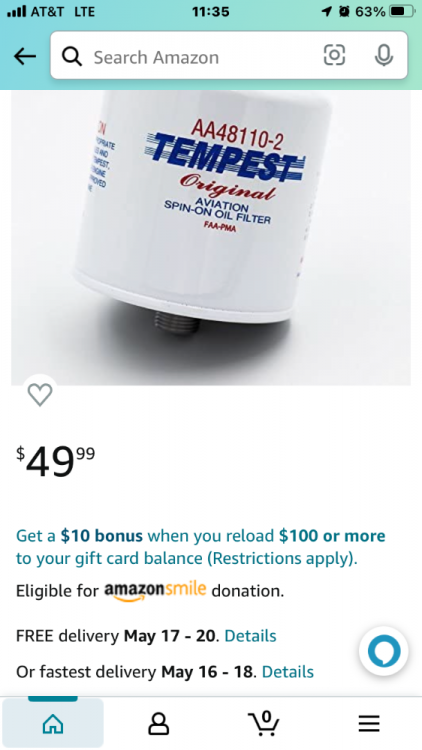
Closing the loop on my original post - The box of six AA48110-2 filters I ordered from Spruce on 5/8/22 shipped on 6/24/22, and at the original price of $159.14 for the 6-pack. I see Spruce now has the individual filters listed at $31.43 but the 6 pack still at $159.14, however no stock for the singles until 7/21/22 and no stock for the 6-packs until 6/30/22. Cheers, Rick
-
My apologies if this is an obvious question, but have you confirmed the sensor is actually bad? There is a known issue with the connectors between the sensor and the cockpit gauge. You can try cleaning the contacts but the recommended solution is to replace the connection. Cheers, Rick BENZ AIRBORNE-KULITE TRANSDUCER.pdf
-
Since we're reviving old discussions I'd like to add this bit of info on ways to make Mooney production viable. I'm working with a client in his DA40 NG, a 160hp liquid cooled turbo diesel powered DA40. From an engine operation perspective it's like driving a car. Turn the key, the engine starts, move the single power lever to where you need it to be, measured in % load on the engine. No mixture control, no prop control, those are controlled by redundant Electronic Engine Control Units. Which means no need to monitor/control EGT or CHT as those are monitored and controlled by the EECUs. EGT and CHT aren't even displayed in the cockpit. You set the desired % power and monitor the RPM for overspeed. While this makes teaching a primary flight student a bit of a challenge with regards to learning the ins and outs of mixture and prop control for the purposes of passing his written and practical oral exams, it makes a huge difference in ownership and operation by eliminating many of the fine detail skills we have to develop for priming, cold starts, hot starts, leaning, temperature management, you name it. All of the PITA stuff associated with managing our non-EECU controlled engines. Like build time reductions, we've talked diesel engine options before. But now that I've been exposed to an airplane with one I am a huge fan. Marketing seems to be everything in the contemporary aviation market. If a Mooney could be powered by an essentially care-free EECU controlled diesel it could be spun into a good marketing campaign. Unfortunately cockpit access ease and useful load will still be a competitive disadvantage, and then there's the 'chute thing. If I can identify a suitable turbo diesel maybe I'll take my Bravo experimental and play. Sure I could pursue an EECU controlled gas engine but I believe diesel has a better chance of surviving the current fuel politics. Cheers, Rick
-
I'm very sad to hear of this tragedy. I've notified @mike_elliott and we would appreciate PMs from those with information on how to contact the pilot's surviving family to offer assistance from the Bill Gilliland Foundation.
-
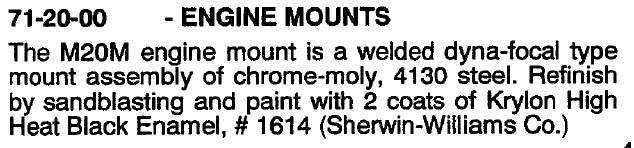
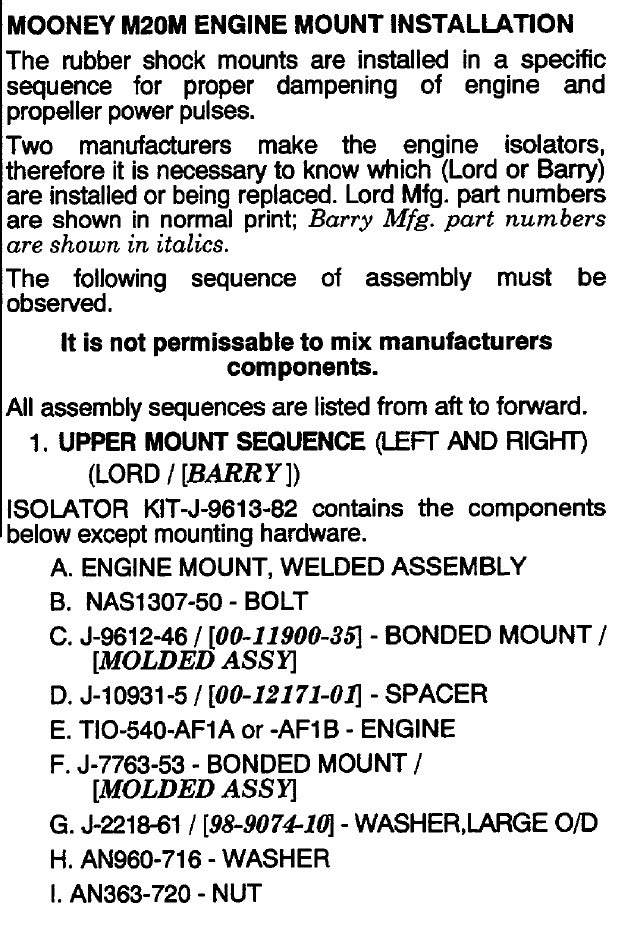
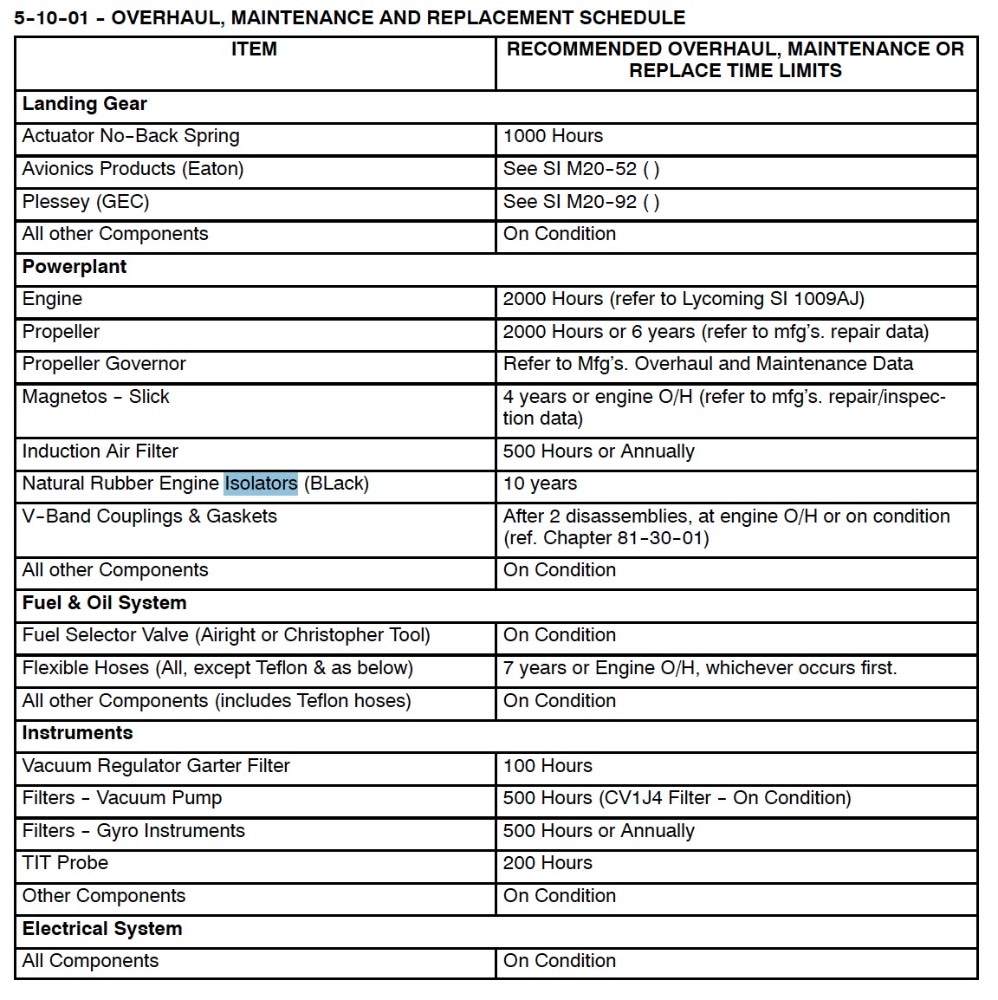
Here's an excerpt from the original TLS Service Manual, section 71-20-00, pertaining to the engine mount isolators. Summary is Barry mounts were not used in production (this detail is included in the updated service manual for the M20M DX/GX) but Lord or Barry isolators can be used as long as you don't mix components from both manufacturers. I clipped the original service manual because it contains the Barry component part numbers in italics. The Barry components are referenced in the updated manual but for some reason the italicized component part numbers fell out of the update and aren't in the text. J-9613-82 is the Lord kit number, J-9613-82HA is the Barry kit number. You need 4 of these kits for a complete installation. Here's a portion of the recommended Overhaul and Replacement Schedule showing engine isolator replacement recommended at 10 years. Keep in mind these are recommendations, not requirements. Cheers, Rick
.jpg.724d6496f6b13826b95637c0bf7d8eb3.jpg)
-
Uh oh, I guess I missed that. I had Barry isolators J-9613-82HA BARRY MOUNT installed on my Bravo last December. I'll look for it, but can you @Steve Dawson point me to the references you're using? I thought I had done my research and determined these were what I needed but I'm open to education. thanks in advance! Cheers, Rick
-
I was AOG with a suspected fuel pump issue (turned out to be a rookie error involving vapor lock) and was quoted $2,800 for a new pump if I recall correctly. That was 6 years ago. Go with @LANCECASPER's recommendation. Cheers, Rick
-
I sent out emails today to everyone who has an outstanding voucher for registration fees paid for the previous two cancelled Summits. We need everyone to fill out a new registration for this year's Summit to facilitate our event accounting. Carrying over registrations from two previous years just became too cumbersome and labor intensive. Thanks for your understanding. We're hoping folks will register sooner rather than later to help us determine if a temporary tower at KTPF will be useful for the event. The local Airport Authority and ATC has offered that up as an added safety measure if it looks like the traffic volume will be there. I completely understand the desire to wait until closer to the event to assess if you're going to make it, and expect y'all will do what's best for you. That's what this event is all about; making good decisions based on good assessments. We're also looking for folks who are interested in helping carry on the Mooney Summit mission to Better the Breed. This will be the eighth Mooney Summit and the Board of Directors would like to see some new faces with new ideas to keep the Summit relevant to our flying and social needs and wants. Please let me or @mike_elliott know if you'd like to help out in any capacity. There's always lots to do! Cheers, Rick
-
@David Lloyd I'd be happy to hop over the hills and carry him up to MRN. I need to stop in for a visit with Lynn and Ron at AGL anyway, it would be no trouble to go another 60 miles or so first. Let me know if there are no better offers and we can make a plan. Cheers, Rick
-
@A64Pilot The accident report link in Don's first post should answer most of your questions.
-
Greetings all, this is a reminder that registration is open for Mooney Summit VIII, September 18 - 19, 2022! The discounted early registration fee of $99 ends on June 30th. Full price fee starting July 1st is $149. Register here. A link to our discounted block of hotel rooms will be provided with your registration confirmation email. We will base the event at Peter O. Knight Airport (KTPF) in Tampa FL. Airport Day is Sunday the 18th, and stage seminars will be held Monday the 19th followed by the presentation dinner Monday evening. We have secured a unique venue for this year’s event that we think you’ll enjoy. Take a look! We have opted for a two day format this year featuring presentations organized in a “PAVE” theme that will appeal to all, as well as Mooney-specific presentations on operations and maintenance. I’m really looking forward to seeing everyone again as we hear from some of the best in aviation, socialize and share our collective experiences in pursuit of “Bettering the Breed”. Best regards, Rick
-
Here's the Mike Busch article on red box/red fin and LOP leaning technique. https://resources.savvyaviation.com/wp-content/uploads/articles_eaa/EAA_2012-12_red-box-red-fin.pdf He gives his recommended techniques and references to use for running LOP. Its from the horse's mouth so you can make your own informed assessment. Some are fans, some are not. I'll add that I do the big mixture pull straight to my LOP fuel flow (13.8gph on my TIO-540-AF1B at 30/2200) and cross check the TIT and CHTs once they settle out and adjust as desired from there. It's one of the recommended techniques to get to LOP quickly and to use it you'll need to determine what that FF number is for your preferred power settings. If I want to find out where I'm running with regards to peak TIT and also crosscheck the individual EGTs I enrich the mixture from the LOP side back to peak, and then dial the mixture back to LOP. That keeps me away from the high ICP zone. I do the peak check occasionally just to have another crosscheck that nothing has changed with the way my engine is running and to confirm I'm still where I think I am on the LOP curve both with TIT and individual EGTs. Cheers, Rick
-
I think its the same place as on my Bravo - on bottom of the engine mount near the firewall just outside the nose gear door on the pilot's side. Sorry I don't have a picture. What you'll see is an open tube sticking straight down right at the bottom of the fuselage. You'll need one of these jack points to insert into that open tube. https://www.aircraftspruce.com/catalog/topages/jackpointsmooney.php Cheers, Rick
-
I completely agree. The research I've done and the empirical data/evidence I have from my own 400 hours operating LOP on my Bravo show that the engine runs clean and cool. My oil consumption is exceptional at 1 quart per 20 hours on a 1000 hour engine with 500 hour cylinders, and my filter inspections and oil analysis results are also excellent. I do a borescope inspection when I check the plugs every other oil change and everything is quite clean with all the exhaust valves looking like well baked pizzas. I don't fly LOP expressly to save gas, I do it to keep my engine healthy. Of course that also means keeping close tabs on the health of the ignition and fuel delivery systems. At the speeds we're flying the differential between my LOP and ROP indicated airspeeds (143 vs 152) is about 6%, which amounts to about 12 minutes on a 3.5 hour trip. That's hardly a sacrifice from my perspective. For reference I fly 2200/30 at 13.8gph 40 degrees LOP for 143KIAS and 16.5gph 100 degrees ROP for 152KIAS. 95% of the time I fly LOP. @A64Pilot made the point that fuel consumption at a given airspeed ROP or LOP will be almost identical, and I agree. I don't have the data in front of me to compare the CHTs so I'll look into that. Having said all that, the original post from @GaryP1007 was asking to hear from the proponents of ROP. I can advocate in that direction as well for a given set of circumstances. But for the kind of flying I do (conservative power, upper teens, long distance) LOP works quite well for me and my engine. If I were to have a need to go faster at higher power I would consider ROP for occasional operations. Cheers, Rick
-
If you’ve flown through Star Wars Canyon any time in recent years you’re most likely on “film” - you just may not know about it. There are almost always photographers on the ridge. An F/A-18 crashed there a few years ago and IIRC the military bases in the area put the kabash on making the run except for specific preplanned and approved test activities. I don’t know if that’s still the case. Those kinds of local restrictions seem to come and go. Bottom line is it’s always been sort of a “shine your ass” event that was acceptable in the big scheme of things until some pilot got too aggressive and hit the dirt/rocks while trying to give someone that up-close-and-personal video/photo op that would give the pilot bragging rights when it was posted online or better yet, showed up in a magazine. Then local leadership had to do something in the name of flight safety which was usually “stay out of the Canyon” for awhile. As for doing it in a Mooney? The questions of “can” and “should” yield different answers for me. Cheers, Rick
-
I think you missed this line in the original post. Cheers, Rick
-
YIKES!
-
Cylinder Wear/Oil Leak during Bravo Prebuy
Rick Junkin replied to Starlifter27's topic in Mooney Bravo Owners
The repair history and current condition do not sound/look normal to me, but I'm not familiar with the specifics of what was happening with the aircraft produced in 2005 (mine is an '89). I'm curious what caused the cylinder issues early on, and how the current owner was running the engine. If he was running it in "full fire breathing dragon mode" as @carusoam would say, meaning consistently at 34/2400 for max performance in cruise, that could possibly explain the cylinder and valve life issues. #1 and #3 are definitely in trouble. It may not be too late to save them by lapping in place, but I wouldn't bet on it. 800 hours over 17 years is enough to make me go "hmmm...." but if as you say the airplane was flown regularly over that period, 4 or 5 hours a month, I'd be less concerned. Still, with all of that cylinder work I would want to know more about operation technique and specific issues that may have plagued that vintage of the TIO-540-AF1B. That said my cylinders were overhauled and flow balanced by the previous owner about 370 hours ago and all still have nice symmetrical exhaust valves and the engine only burns about a quart every 25 hours. My oil consumption is NOT normal, most Bravos appear to be more in the 10 hour/quart neighborhood. But I also run an extremely conservative 30/2200 in cruise, LOP at 13.8gph. Let's see what other Bravo folks have to say about their experience with exhaust valves and cylinders in general. I'm thinking you'll want to ask the current owner some questions about how he ran the engine. I'm assuming this is a one-owner airplane. Cheers, Rick