

PLN_FXR
-
Posts
43 -
Joined
-
Last visited
Content Type
Profiles
Forums
Blogs
Gallery
Downloads
Events
Store
Everything posted by PLN_FXR
-
I'm not sure about aircraft oils, but formulation changes in automotive oils have caused problems with "old technology"i.e., non-roller cam equipped classic cars. Federal mandates caused the zinc to be reduced/removed, leaving the cams susceptible to premature wear. Perhaps the same mandates have been applied to aviation oils?
-
I won't get into the Phillips vs Aeroshell debate at this time, but following overhauls I generally run my customer's aircraft +/-10 hours on Mineral Oil, then change to Ashless Dispersant. There is no sludge build-up in that amount of time, and the rings will have set in properly (generally, they will seat in less than an hour). I would not try to break in an engine on, for example, 15W50 Aeroshell, as the semi-synthetic formulation doesn't lend well to rings seating properly.
-
Do you have electric gear or a Johnson Bar? I'm not sure they all went electric, and some of the manual systems have been converted - either way, you can simulate gear up without jacking ... but if your technician wasn't familiar with the warning horn, please be careful allowing him/her to mess with your landing gear system. A question for those using the Sonalert beepers - do you find them adequately loud? Perhaps I've simply lost that range of my hearing , but I find their electronic beeps get lost in background noise pretty easily - especially when they are tucked up under the panel or on the firewall.
-

Which Motor Do I have in my M30B? O360 AIA or 0360 AID
PLN_FXR replied to rockydoc's topic in Vintage Mooneys (pre-J models)
The shower of sparks generally gives a better start, but if your battery is dead it is almost impossible to hand prop (not that any Mooney is easy to hand prop, as they are so low to the ground). Impulse couplings are subject to wear and failure (but so are starting vibrators). In general - it depends on your preference, as both systems work fine. -
Are these what you're looking for? http://www.aircraft-spruce.com/catalog/elpages/clite.php Several suppliers carry them, and you can trim them to a more pleasing (and less obtrusive) shape.
-
IA's reliance on prior inspections
PLN_FXR replied to DonMuncy's topic in Miscellaneous Aviation Talk
Sign it off something like this: "Complied with AD XXXX-XX-XX by [visual inspection or similar] per [para (a) and SBXXX or similar]. Inspection constitutes terminating action "or" reinspection due at tach XXXX.X." In other words, state WHAT you did, HOW you did it, and what further action is due, if any. A simple "complied with AD XXXX-XX-XX doesn't mean a damn thing if the AD listed several varying courses of action. Complied with what? The inspection portion? The terminating action? Required parts changes? Para A & B, but not C? Take, for example, the Aileron Link AD on many Mooney aircraft. If an IA signs it off simply as "Complied with AD 98-24-11", what was accomplished? Were the links inspected and no cracks found, necessitating a reinspection per M20-264 within 100 hours, or were they replaced with the reinforced links constituting terminating action? -
IA's reliance on prior inspections
PLN_FXR replied to DonMuncy's topic in Miscellaneous Aviation Talk
It would be great if all AD's offered terminating action, but many do not. It would also be great when records are signed off if the person doing the signoff would state "exactly" what they did. As an I.A., it is very frustrating first time I'm going through an airplane, and the signoffs state "All AD's complied with" or "Complied with AD such & such". Unless I know what they did, I will not sign off the inspection without verifying compliance with or accomplishing the AD. As noted in threads above, I have disassembled numerous engines for overhaul that have had the oil pump AD signed off as "complied with", yet they have had aluminum/steel or sintered iron impellers installed. (As an aside, I have never seen an aluminum/steel impeller that caused any trouble ... can't same the same for the sintered iron ones.) As an owner/operator, the FAA holds you responsible for AD compliance ... but they will still violate the A&P/IA who missed an AD (they are equal-opportunity when it comes to issuing violations). I'll get off my soapbox, but there are good, conscientious A&P/IA,s and there are those who will sell you a signoff. There are also owners that maintain their aircraft scrupulously, and those that have an Annual Inspection accomplished every three or four years. -
The 55 Baron is a nice machine; I never found the Barons (either the 55's or the 58's) to be as fast as the book says they are, but that's true across almost all aircraft. For dependable all-weather personal business transportation, it's hard to beat a Baron in the light twin category. Enjoy!
-
Tips for upholstering the interior panels??
PLN_FXR replied to Dcflyn's topic in Vintage Mooneys (pre-J models)
3M makes several different spray adhesives, if you're using one specifically for the materials it should be ok. However ... I have found many of the spray adhesives will release when they get hot, and sunshine/Texas/summer heat would certainly apply for you. I'd guess in your case you didn't allow the adhesive to cure adequately before joining the parts; another issue is allowing the foam adhesive to totally cure (for a day or more) prior to applying the vinyl, as the vinyl will prevent the adhesive beneath from gassing/curing. Good luck! -
Mark - How was the original break-in flight flown (what power settings, how much ground-run time prior to flight, etc)? Was the oil cooler overhauled or replaced at overhaul? Were new oil cooler hoses fabricated and installed and, if so, were they verified clear prior to installation? I'm trying to determine if your rings seated properly (the engine cannot cool itself until this happens) and to look for obvious issues. Back in the late 70's I operated 201PZ and it's been too long for me to recall the cowl flaps, but I don't remember them being just open or closed ... but memories can play tricks .
-
The Bonanza does have room for a hat, but no place for your legs. Give me a Mooney over a Baron or Bonanza any day for a long-distance flight, and not simply because I like Mooneys better or because they are more efficient. They are simply more comfortable!
-
Ground run up to prevent corrosion
PLN_FXR replied to N601RX's topic in Vintage Mooneys (pre-J models)
Please be careful when doing extended ground runs. The cowling and baffling are almost always inadequate to provide proper airflow for cylinder cooling, and you'll develop hot spots that are likely much more hazardous to your engine than leaving her sit would be. Also - regarding cold air not containing moisture - we had 21 degrees F below zero here this morning, yet I had to scrape frost off my windows prior to driving to work ... frost which condensed from moisture in the air. No doubt, internal engine corrosion is nasty. That being said, I have seen many engines that fly less than 20 hours for several years in a row make it to TBO and beyond (I wouldn't live long enough to see TBO on an engine that flew less than 20 hours every year). -
Burnt wiring is due to an overload condition (unlikely) or a loose connection (arcing). Good luck!
-
In the cold weather, you can cover the entire oil cooler with a piece of aluminum or aluminum tape, leaving a hole in the center about the size of a silver dollar (+/-1.5" to 2" diameter). This will have to be removed when ambient temperatures exceed 50 degrees F or when your oil temps start getting high. Please ensure you adequately preheat the engine prior to start - this doesn't mean a quick 15 minutes preheat; adequate preheating will take an hour or more. Be sure you do fly after preheating, or moisture will re-condense as the engine cools. Please do not do your ground runs with cowl flaps closed. Although this will warm the oil more quickly, it will not allow adequate cooling for the cylinders - they need all the airflow they can get during ground operations. I flew an M20J for hundreds of hours out of TVF in northwestern Minnesota, where -50 was unusual but not unheard of, and -20's were "just another day". Keep 'em flying!
-
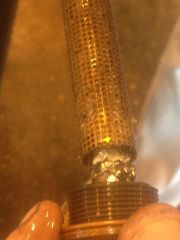 This looks expensive ... assuming the suction screen has been cleaned regularly, and this isn't left over from a previous altercation of some type.
 -
A "J" (201) is a wonderful airplane - will you be traveling with your bride alone, or do you have additional passengers (children/whomever)? I applaud your reaching out to area owners and hope you have a great chance to follow-up!
-
Again, welcome! As a newcomer myself, it is great to see an active site. I had C150 and Stinson 108 time when I started flying a J-model in 1977 - but the aircraft handled so well the transition was an easy one. Enjoy!
-
Andy - lots of decent responses above. I believe you'll have your best success with 1/2 flaps prior to FAF inbound, dropping the gear at FAF. Be wary of bringing flaps in late in the approach, as any tendency to balloon will put you right back into the low overcast. Mooneys land great with 1/2 flaps anyway - short, mid, or long-body. There are always exceptions, though - so you're doing it right, experimenting with different configurations. For example, you don't want the gear hanging out longer than necessary in heavy icing conditions. (One would question the wisdom of an approach to minimums in heavy ice, but on occasion the weather forecasts are WAY off base, and one has to do what they have to do.)