
Gary0747
-
Posts
506 -
Joined
-
Last visited
Content Type
Profiles
Forums
Blogs
Gallery
Downloads
Events
Store
Everything posted by Gary0747
-
In reading several of the old threads I see that a number of people have had problems at times that have even required sending their EDM900 units back to the factory. This being a primary instrument also means their aircraft is out of service. I am debating the merits of making the leap all the way to the EDM900 when the EDM830 has almost all the functions and is not a required for flight instrument. I have a working reliable set of primary gauges and am not in a bind for panel space now. It almost seems like the EDM830 is the safest way to go, plus it is almost half the price. I would appreciate any experienced advice?
-
True airspeed not what book says
Gary0747 replied to Supercop0184's topic in Vintage Mooneys (pre-J models)
On the IO360 the timing was 25 deg btc back when the books were made. Lycoming got nervous about detonation and reduced the timing several degrees. They may have done this on the 0360 also. I asked the Lycoming rep once how they could still say these were 200 hp engines. He said the stated numbers are only accurate to within 5 percent. -
AD 77-17-04 Control Wheel Inspection
Gary0747 replied to Dreamlifter's topic in Vintage Mooneys (pre-J models)
I obtained the heavy wall shaft for the pilot side that is not subject to the AD years ago. I still need the one for the copilot side to get clear of the AD. Seems ridiculous since very little time is spent flying from that side. If anybody knows a source for the heavy shafts now,please let me know. -
I never realized this but the link said the drain could be locked open? Anybody ever do this?
-
1967 M20F POH missing Primary Instrument List?
Gary0747 replied to Gary0747's topic in Vintage Mooneys (pre-J models)
Good reference. I assume it applies to all CAR 3 aircraft too even going way back in time? But I do not see Fuel Pressure on this list? So can we assume since Fuel Pressure is not listed in my 67 POH that it is not Primary and not required for flight? Fuel Pressure is listed as required and is a primary in the 1968 M20F POH starting with serial # 680001. -
1967 M20F POH missing Primary Instrument List?
Gary0747 replied to Gary0747's topic in Vintage Mooneys (pre-J models)
Igor, that makes sense but aren’t fuel tank levels also considered primary with out limits? -
1967 M20F POH missing Primary Instrument List?
Gary0747 replied to Gary0747's topic in Vintage Mooneys (pre-J models)
Good points Carusoam. The only reason I am even asking the question goes back to the JPI900 vs EI CGR 30 P debate. The EI CGR 30P has a limit on the number of Primary instruments that is one or two instruments short of what the 1968 M20F POH lists as required. This necessitates the purchase of a second EI instrument. There is plenty of room on the first instrument for all the instruments on the first EI CGR30P if they are considered non primary. One of the list members Margrauder) with an M20F has installed a CGR 30P but was not able to get rid of his original six pack gauges yet until he installs another instrument. If he has the same 67 POH as I then he might not have to do this. -
1967 M20F POH missing Primary Instrument List?
Gary0747 replied to Gary0747's topic in Vintage Mooneys (pre-J models)
The folks who have installed the JPI 900 or EI 30P have had to furnish copies of the parts of their POH that define Primary Instruments plus other data from the POH that defines primary instrument marking limits. My manual has the marking info but nothing to say a meter is Primary and required for flight. Not sure if what I am seeing is unique to just 67F or if earlier C,D,E models have this same issue. -
1967 M20F POH missing Primary Instrument List?
Gary0747 replied to Gary0747's topic in Vintage Mooneys (pre-J models)
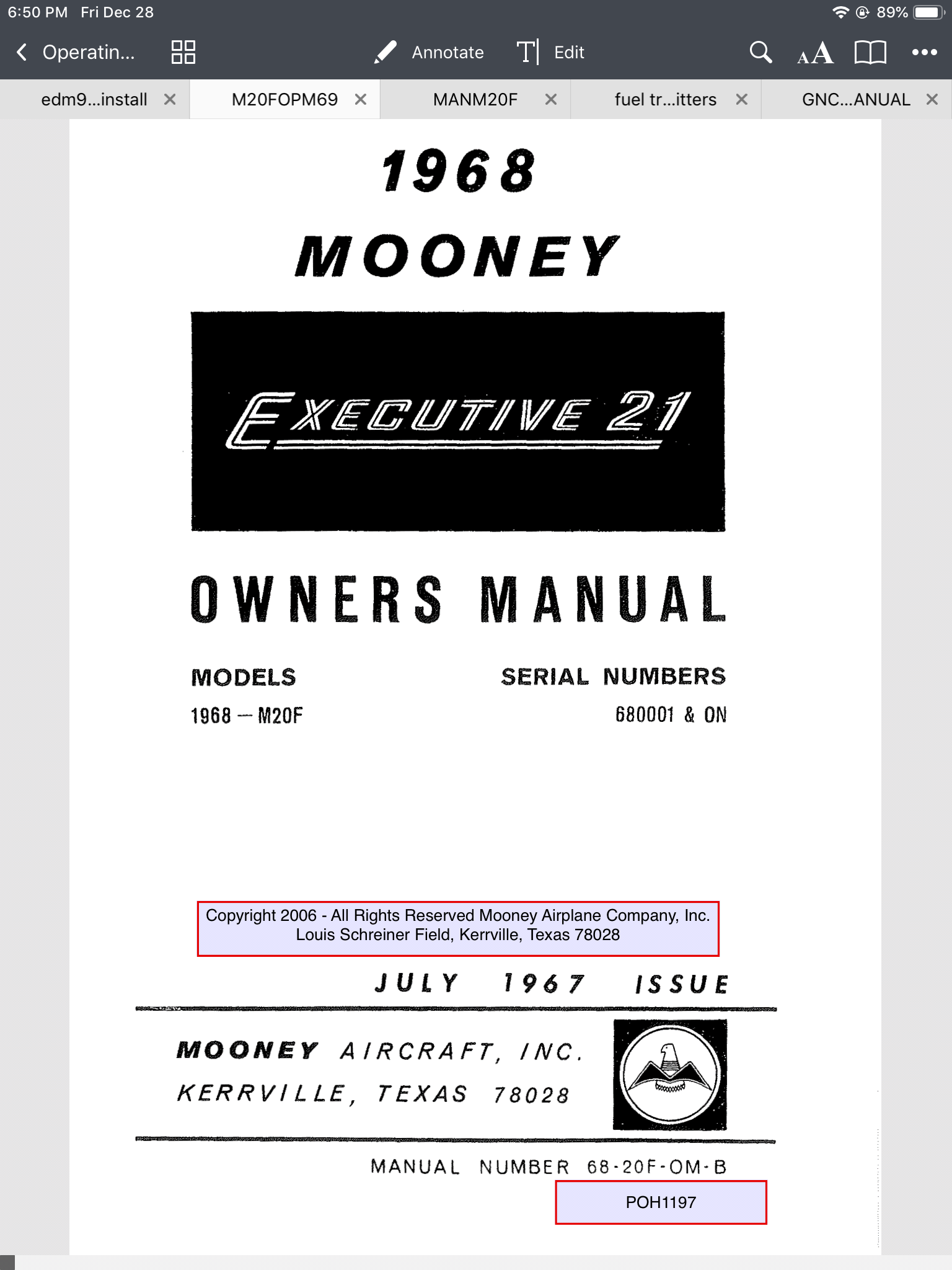
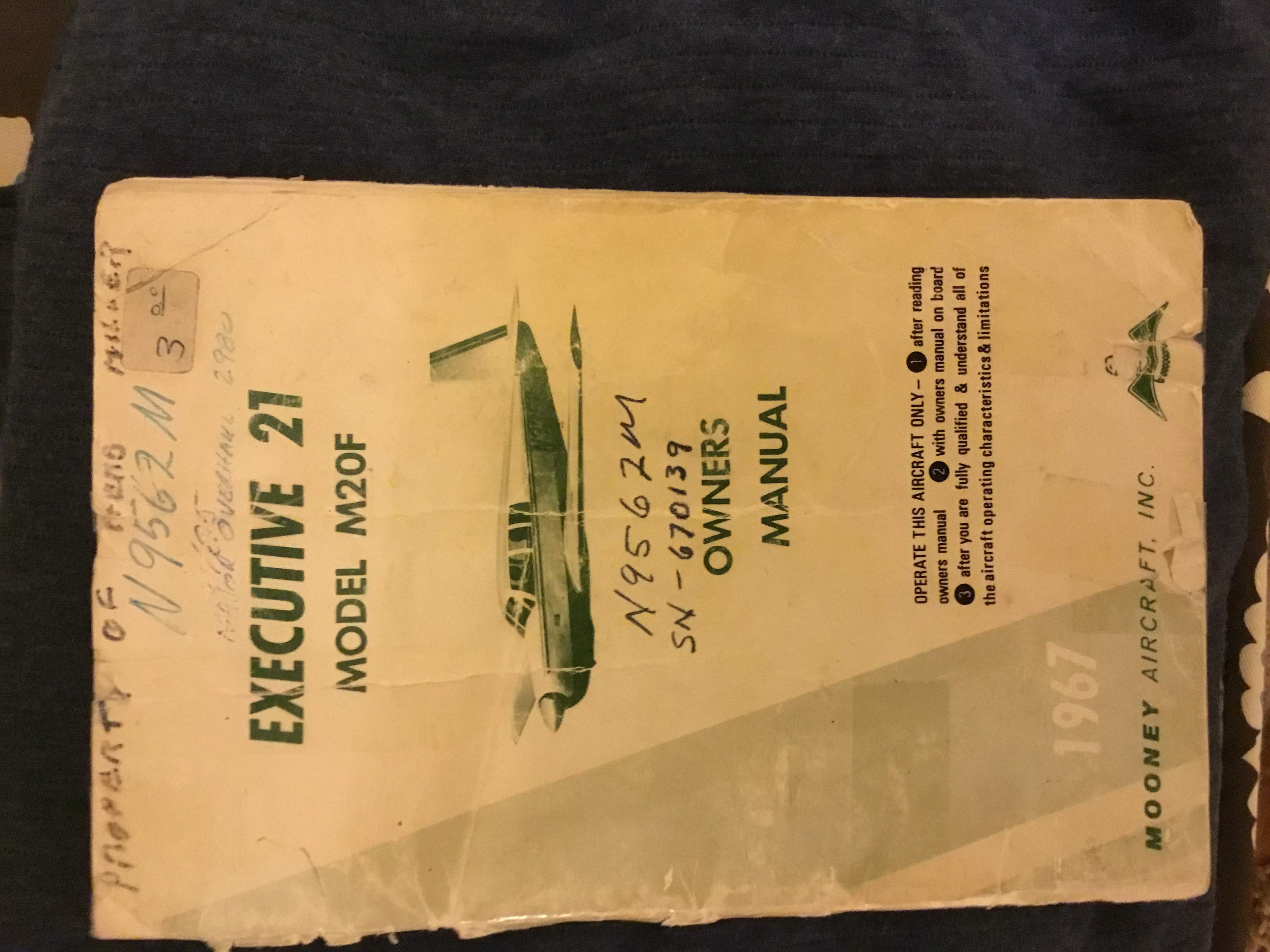
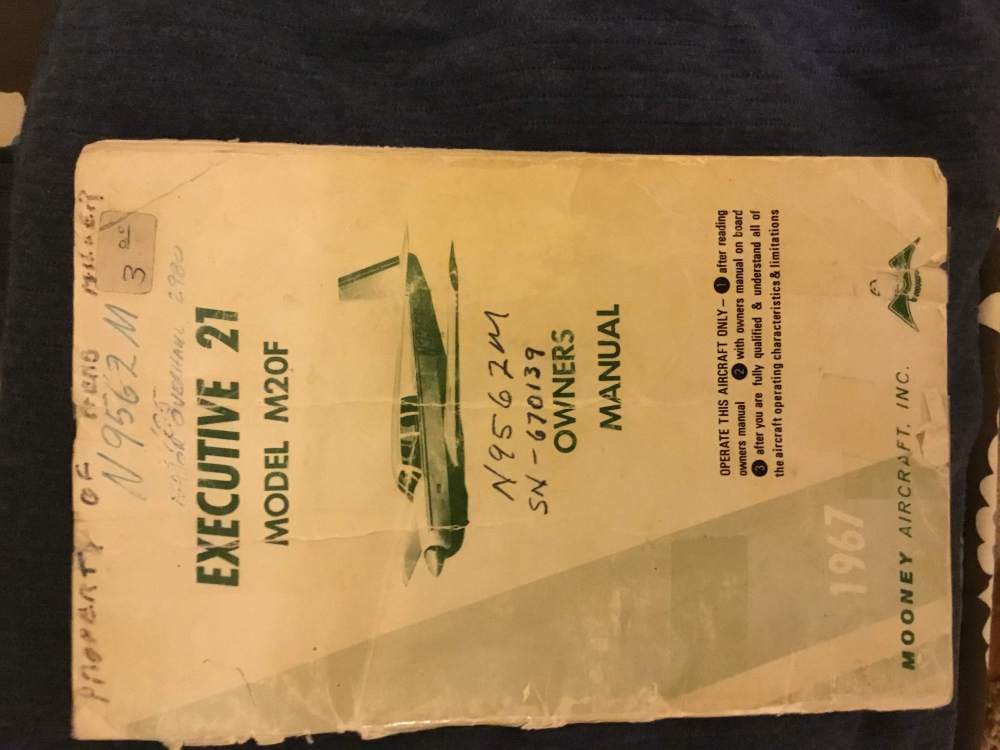
This first image is the owners manual for M20F that applies to serial 680001 and on. It contains MEL and primary instruments. My 67F is serial 670139 and the first manual does not technically apply. It was delivered with this second image operating manual which looks like the 1968 manual but does not contain MEL or Primarly instrument listings.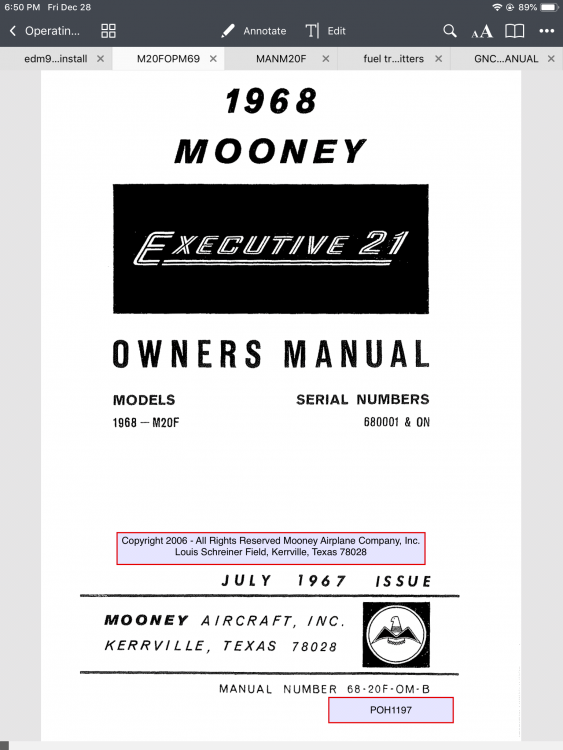
-
Not sure if anyone else has noticed this but the original POH for the 67F contains no reference to any required primary meters or instruments. The 1968F manual starting with serial 680001 was revised and issued in July 1967 does contain this list. Looks like an oversight but there is a whole series of 1967F serial numbers covered by the original POH. Does this mean none of my instruments are technically Primary and required?
-
Some use silica gel but some use the chloride salts mentioned which are easier regenerated since there is no thermal degradation issues like silica gel has. Silica gel should be fine to use but avoid the salts.
-
I would never use one of these systems if the desiccant they used contained magnesium or calcium chloride salts. Several even commercial systems have attempted to use these materials. It is possible to create very fine particulate chloride salts that you do not want inside your engine. Very corrosive.
-
PC Valve cutout retainer tool PMA/TSO
Gary0747 replied to TheTurtle's topic in Vintage Mooneys (pre-J models)
The only way I know how to trim my Mooney once flying and as load shifts with fuel burn is the PC system. The Mooney Miser did sell a mechanical trim system years ago but I have seen few Mooneys with it. -
Removing the fuel drain is one of the least fun and messy things I would like to avoid until there is minimum fuel in the tank to spill. Old time mechanics would tie a rag around their wrist to minimize fuel running down their arms. Fuel also tends to spread out over the bottom of the wing and drip off at distant points. Anybody who can do this with out spilling or getting a wet arm is good. It is slow but an 1/8 inch piano wire cut to the right length to fit between the bottom of a gas can and the quick drain with a slight bow to tension the quick drain open will drain the last amount of gas. Put a funnel in the gas can with the wire through it and little is spilled. This is a good technique for maybe the last gallon but getting from 8 gallons to the one is the hard part for me since you can not even see the gas from the cap once below 8 gallons.
-
Does anybody have any good tools or tricks for emptying tanks especially the 64 gal models? The last 8 gallons after the level gets below the rib next the cap are the most difficult. I am not a big fan of flying untill the engine stumbles or quits.
-
PC Valve cutout retainer tool PMA/TSO
Gary0747 replied to TheTurtle's topic in Vintage Mooneys (pre-J models)
Paul did a nice video years ago for MAPA on rigging including a test flight. I think my copy was on video tape and probably long since disintegrated. Mooneys are not the most laterally stable aircraft out there especially if loading is not balanced or if airplane is slightly out of rig which many are. I think the wing leveler was implemented to help fix some of this. There was even some talk years ago that Mooney was using the wing leveler as part of certification. I do not think this is true but am not certain. In any case Mooney did use the wing leveler a lot in its original advertising touting the fact that a VFR pilot could use it if caught on top of a cloud deck for an emergency let down. And that an IFR pilot who got disorented simply had to release the yoke. I think it was and is a strong selling point. I will never fly IFR with mine INOP. -
PC Valve cutout retainer tool PMA/TSO
Gary0747 replied to TheTurtle's topic in Vintage Mooneys (pre-J models)
I have over 2,000 hours in this F and the only time I have ever disabled it with rubber bands is when doing the Paul Lowen rigging checks. -
PC Valve cutout retainer tool PMA/TSO
Gary0747 replied to TheTurtle's topic in Vintage Mooneys (pre-J models)
What I have never understood is why one would want to make a bypass of the system for anything longer than making a turn or two? Unless the system is not working properly. -
PC Valve cutout retainer tool PMA/TSO
Gary0747 replied to TheTurtle's topic in Vintage Mooneys (pre-J models)
Get an old small tire bicycle tube and cut as many rubber bands of any thickness you want. -
Studying all the old posts on the senders. Apparently a couple of posters got the resistive senders to work with the JPI 900? Although another person concluded they would not work and switched but had to send his unit back to JPI for reconfiguration? The CEIS senders apparently allow 1 gal or less accuracy. What kind of accuracy are people seeing with the original resistive senders?
-
I just got a quote from Scott. $1740. Seems to have gone up pretty dramatically.
-
Interior panel clips- a good alternative?
Gary0747 replied to Prior owner's topic in Vintage Mooneys (pre-J models)
Plastic push pin fasteners. The come in black or white. -
Paul: That would be my first choice reading all the favorable comments. I think CEIS originally had a price of $250 but their website now shows the price at $495 each. I assume it still requires 4 senders?
-
I bet the bounce maybe caused by a worn resistor or dirty resistor wiper. Has anybody ever had theirs cleaned and repaired? It looks like around 2 AMUs for new ones.
-
Did your readings bounce around in the air on the original meters?