Ragsf15e
-
Posts
6,394 -
Joined
-
Last visited
-
Days Won
33
Content Type
Profiles
Forums
Blogs
Gallery
Downloads
Events
Store
Everything posted by Ragsf15e
-
ADS-B and GPS Panel Upgrade Advice - 1970 M20E
Ragsf15e replied to SkyTrekker's topic in Avionics/Panel Discussion
Even my old GNS 430 provides a lateral guidance needle on a curved path. If I load an approach with an arc, the gps will provide updated cdi information to the hsi as you arc and steer right around the arc. I bet it would work just fine on the final portion of the arcing approach, but I agree it might not be technically legal. -
One other tip since you’re going to Tonapah... the Nellis range is very busy. It’s where the USAF does Red Flag. There’s lots of restricted airspace. If you call up Nellis approach they will tell you if the MOA is hot. It’s legal to go through obviously, but probably not smart. On the weekend I’ve had good luck going right through on the edge of Area 51. Keep an eye out for the aliens, dummy Russian missiles, and Iraqi airfields... If you’re down that way, are you going through Grand Canyon? Got the Grand Canyon special map? It shows the vfr routes, frequencies and rules through Grand Canyon. It’s really awesome to fly over.
-
I use to live in Mammoth and have flown out of there many times - mostly with my dad in an old -172. Don’t plan on departing after about 11am due to density altitude and wind. Honestly, I’d try to arrive in the morning as well since it occasionally gets windy in the afternoon. Hot and breezy in the afternoon/evening, so morning is probably the best bet. Approach and departure maneuvering room is plentiful. Won’t even be an issue. I live in Spokane now and our local rule of thumb is to be on the ground by noon in the summer due to turbulence and density altitude. I highly recommend reduced fuel load on the higher departures. Your runways are plenty long but climb will be anemic with high mountains all around.
-
Similar to the switch contacts, circuit breaker for the VR. Mine developed a low voltage situation over a couple years as the resistance increased. Tried several expensive things before finally measuring the voltage drop across the circuit breaker and replacing it for$20 /Spruce. Fixed it. Similar to the switch as mentioned above, you should be able to measure voltage drop across it. Zephtronics has a troubleshooting guide on their website. It’s not super easy to follow, but not terrible either.
-
ADS-B and GPS Panel Upgrade Advice - 1970 M20E
Ragsf15e replied to SkyTrekker's topic in Avionics/Panel Discussion
I saw that one too but it’s from 1998 and the rules have been updated a couple times. Honestly, it’s probably debatable on the approach Cheesehead showed. The AIM says you can use GPS to fly a DME arc but you need to at least monitor the navaid that provides “lateral guidance” on final. Generally this refers to vor or adf. You fly the approach using gps but monitor vor because it provides lateral guidance. GPS sub for DME is usually ok to use in all segments as it isn’t lateral guidance. On his approach, is the dme lateral guidance?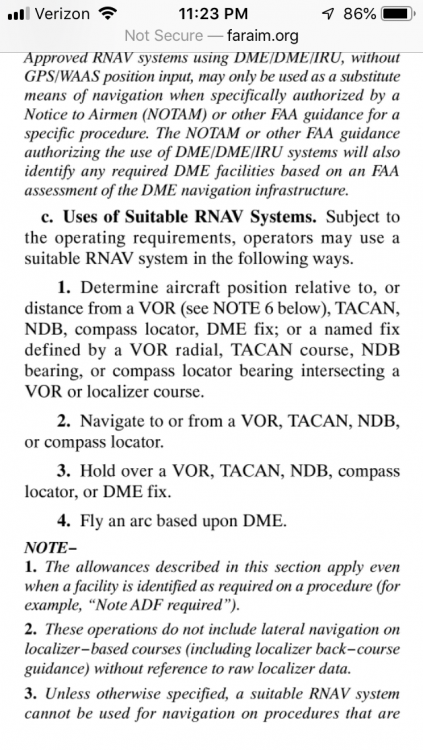
-
ADS-B and GPS Panel Upgrade Advice - 1970 M20E
Ragsf15e replied to SkyTrekker's topic in Avionics/Panel Discussion
Well now that’s a cool approach! Arc to final? Nice! However, I think you can still use GPS to fly that arc in lieu of DME. I’ll try to dig up the exact wording from the AIM, but I’m pretty sure you can always substitute GPS for DME - even inside the FAF it’s ok. Let’s find the AIM wording. -
Agreed!
-
Yep there are definitely airplanes above 250 below 10,000’, but I doubt you’ll find a controller telling someone to do it because they know they are recorded. “Best Forward Speed” and “Speed Restrictions Deleted” both mean the pilot still has to follow the speed regs. Dont think you’ll hear “descend and maintain 8,000 feet and 300 knots.” Except in Europe where that’s legal.
-
Usually I agree with you, but in this case I think you’re mistaken. It’s true aircraft that require higher speeds for operating safety are exempted (the F-15E I flew climbed out at 330-350 knots), but can you show me where the “administrator” grants ATC the ability to clear airplanes to violate 250kts below 10,000’? The “administrator” exemption is generally in writing for airshows. There is an AIM section and a legal interpretation that say ATC can’t exempt you from regulations. Now, are there some exemptions in the regulations? Yep. 200kts below class B can be waived by atc, that’s in the reg. Aircraft requiring 250+ below 10,000. That’s in the reg. When ATC says “speed restrictions deleted” they are referring to a published arrival or departure. The pilot is expected to still follow regulatory guidance.
-
I think you misheard him then or didn’t know what altitude the 777 was. The speeds are regulatory and they can’t clear you to break a reg. Hemispheric altitudes are only recommended, so fair game. Above 10,000’, they definitely assign airspeed above 250kts. Chapter 4-4-1(a) of the Aeronautical Information Manual "an ATC clearance 'is not authorization for a pilot to deviate from any rule, regulation, or minimum altitude.'"
-
No, they can’t clear you to violate a regulation: 2. "Maintain maximum (or best) forward speed" means the maximum or best forward legal speed. ATC does not have the authority to lift the 250 kias below 10,000 feet speed restriction [91.117(a)]. You cannot be cleared to violate a regulation, and you cannot accept such a clearance.
-
I’m not defending it and I generally don’t like showoffs but I’m also a firm believer in our rights/privileges as pilots... it’s kind of like the Navy regulations, if it doesn’t say you can’t do it, you’re probably not gonna get in trouble for it. Unfortunately I was in the USAF and we inverted that rule to our own detriment. More clearly - nothing specifically say you can’t do it. You can try to apply “reckless” or other regulations but none are Specific to a low pass.
-
If it makes you feel any better, I was looking into the G3X (instead of G5), and they have a similar restriction on a single nav input if they are interfaced with a nonGarmin autopilot. I’m sure there’s a reason for these limitations, but I have no idea what it is.
-
Nearly Gave up General Aviation Flying After this Incident
Ragsf15e replied to Mooney_Allegro's topic in General Mooney Talk
Definitely agree! Add a couple more easy/inexpensive things... recurrent training, flying often, checklist discipline, and thinking through (chairfly) critical phases of flight. We could all use work on some of these. Won’t stop every accident, but every little bit helps! -
Nearly Gave up General Aviation Flying After this Incident
Ragsf15e replied to Mooney_Allegro's topic in General Mooney Talk
As retired USAF I agree with the foreign object damage acronym... but it’s tough to have 23 gallons of Foreign Object Damage! -
Is there a circuit breaker anywhere in this mix? They wear out and only show the problem under load by dropping voltage and eventually popping. I don’t have the diagram in front of me, but are You sure the starter solenoid is getting good power from the switch through your starter circuit breaker? Circuit breaker would account for this being only under load and sometimes working.
-
1100 miles?! 7 hours?? You have bigger fuel tanks and bladders than me!
-
Nearly Gave up General Aviation Flying After this Incident
Ragsf15e replied to Mooney_Allegro's topic in General Mooney Talk
Fuel Over Destination. It isn’t perfect, as it’s computed at your current fuel flow and ground speed (so sometimes negative in the climb) but it’s a good check at level off and in cruise. More meaningful to me than the range ring for my fuel checking. -
Nearly Gave up General Aviation Flying After this Incident
Ragsf15e replied to Mooney_Allegro's topic in General Mooney Talk
So this is not a Mooney... unless we finally got that PT6 STC, but 3 different airplanes I’ve flown with G1000 all had FOD. I don’t think it would have done you anymore good than the range ring but it’s my technique as the range ring is a bit too fluid for me.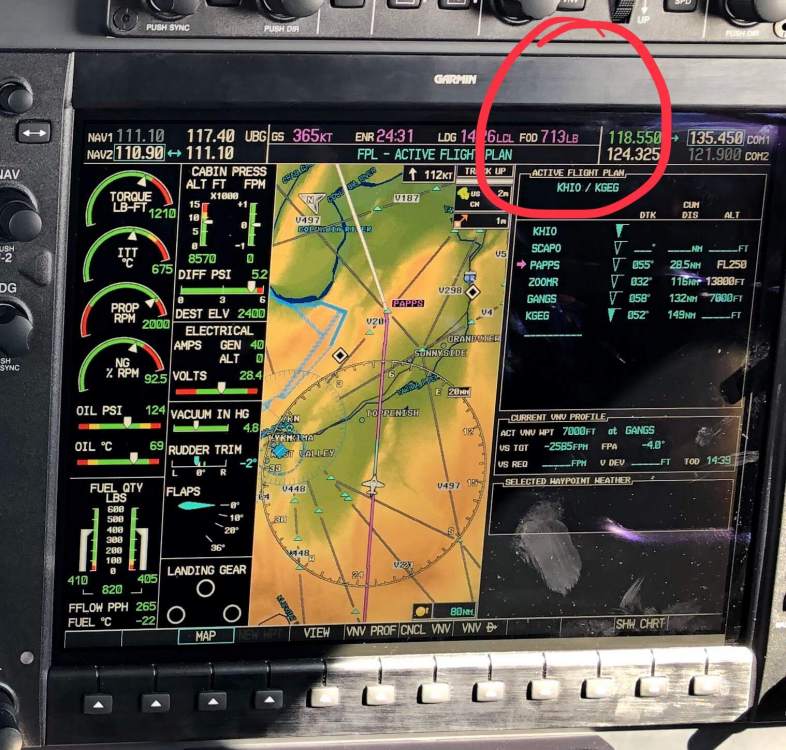
-
Nearly Gave up General Aviation Flying After this Incident
Ragsf15e replied to Mooney_Allegro's topic in General Mooney Talk
Definitely sucks to think about what could have happened. I clearly remember flying over the Sierras with my dad when I was ~10 and him tapping the fuel gauges a lot. Finally he decided to land halfway between Mammoth and Camarillo, only a 2 hour flight?! When we stepped out of the fuel injected sky hawk, fuel was still dripping out of the cowl. Quickly found several injectors that weren’t even finger tight. 2nd flight after annual. How did that airplane get us over the mountains?! How did it not burn? Fast forward to my M20F. Within the first few weeks, blue streaks on the cowl. Opened it up to find a loose injector and fuel goo all down the exhaust pipes. Scary. You can’t catch every leak. No way. But your nose is a good indicator. Knowing your systems is also good. I have very accurate JPI gauges with relatively accurate senders that I double check at each fillup. Separately, the JPI uses fuel flow to compute fuel used and fuel remaining - which is only accurate if set correctly at the start. If the gauges and the computed fuels don’t match, find out why. If the gauges/computed remaining doesn’t match your plan, find out why. On the G1000, the range ring is nice, but put FOD (Fuel over destination) up on the mfd. It is computed from the starting fuel you set and from FF. It’s a really quick way to compare your plan to what’s actually happening. Compare that to your tank gauges as a final sanity check. Did the airplane really have 20 gallons remaining as the gauges indicated? -
If you want to do anything to your avionics, do it now! It gets much tougher to access without taking apart the whole panel.
-
I only have an F model, so lower hull value ($75k), but similar experience to you (less hours, but lots). Mine is $1000. Initial checkout with Mooney instructor, no other initial requirements. Spending some time with a knowledgeable Mooney person is real beneficial.
-
Interesting. I’m sure that works for you, but my experience is 5 nm per 1000’ is pretty good, so I’d use 50nm do descend 10k. Say cruising at 11,000’, pattern altitude at 1,000’. I’d leave full cruise power, wot, 2500 rpm and just trim down to 500fpm or slightly more. That’s close to Vne. I’d continue to check my descent math on the way down in case I need to adjust. Say at 6,000 to go, 4000 to go, etc.
-
What they said. I have an F with no speedbrakes. Cruise power, trim forward for 500-700 fpm descent. I use 5 miles per thousand feet to descend. Level off at pattern altitude, pull power to ~15” and drop gear abeam landing point. If you get behind on descent, pull to 15” earlier. I do try to prevent going all the way to idle, trying to use 15” as a minimum until the flare. You will definitely be in the yellow, maybe close to Vne, so needs to be relatively smooth.
-
ADS-B and GPS Panel Upgrade Advice - 1970 M20E
Ragsf15e replied to SkyTrekker's topic in Avionics/Panel Discussion
Definitely agree. No DME required if you’re using an IFR gps. Any approach that is /DME and is loaded in the gps database can just be flown using the gps for DME. In fact, you can use gps to substitute for DME to navigate to other fixes as well as long as they are in the database. You can actually use your ifr gps for primary guidance on all your approaches all the way to the final approach fix. From the FAF to the MAP, you need to use a localizer based navaid as primary lateral guidance if on an ils or loc approach. If on a vor you can continue to use gps, but just monitor the vor lateral guidance. In either case, you continue to use your ifr gps for DME. You won’t need the DME at all. Now that doesn’t mean it’s free to take out or worth taking out, but in the end, you won’t need it.