
midlifeflyer
-
Posts
4,431 -
Joined
-
Last visited
-
Days Won
18
Content Type
Profiles
Forums
Blogs
Gallery
Downloads
Events
Store
Everything posted by midlifeflyer
-
I'll only be around for the morning (and probably doing a volunteer hour at the AOPA legal service plan both) but I will try to stop by.
-
Yes and no. First, this isn't brain surgery. If you normally don't lean for takeoff at altitudes below a certain level, say below 3000 D-Alt, then you know you have quite a bit of leeway in terms of what is optimum. Second, there is a bit more of a tendency for aircraft to overheat at higher density altitudes, perhaps because so much less power is being used to preform the same task - just like the proverbial 90-lb weakling will sweat more moving a boulber than a football linebacker. And, as we know, one of the things fuel does is help cool the engine. So, it's pretty common at high density altitudes to lean for an approximation of best power (using various techniques based on the experience level of the pilot with high density altitudes and the equipment) and then enrichen a bit more for better engine cooling.
-
Another technique is to do a modified soft field takeoff, get the airplane into the air early, put the nose down and accelerate in ground effect until reaching climb speed
-
One gets used to it.
-
So sorry I'll have to miss this one. We'll be out of the country.
-
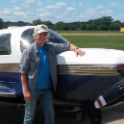 I've managed to fly at least one variant most 4-place tricycle gear unpressurized single engine pistons. I'd really like a chance to fly one of the super-fast turbine ones like the TBM.
 -
I think you are very effectively describing what many see as the difference between the "convenience" of a TnG to allow one to perform multiple landing and takeoff "maneuvers" in a shorter period of time.
-
I guess it depends on what one defines as a "maneuver." I'm not at all against touch & goes but I don't consider not coming to a full stop or taxiing off a runway important enough for that name.
-
Yes. Foreflight is alive and well in iOS 8. Did a 5.2 hour IFR flight last week including an approach. All without a hitch.
-
It's the famous level of business sense shown through the years by aviation businesses. You know, the folks at the flight training/aircraft sales FBO who ignore the stranger who walks in until she gets fed up, hops in her Mercedes, and goes to the wharf to buy a boat and take boating lessons? They also have posted email addresses they never respond to. There are, of course, FBOs who do reply to emails. I frequent them all they time and they, almost without exception, provide good service.
-
There are features of XM weather not in ADS-B that pilots rely on bu,t ultimately both are strategic and not tactical when properly used, so I don't see the benefit of the costs for the extra features. I stopped using XM weather a few years ago but kept my Garmin 396 just in case I felt a need to re-up. When I bought a Stratus last year, I sold the 396. But that's just me.
-
They do. In the ones I've seen, FBO ground leases include the obligation to maintain ramp areas at their own expense. And, depending on the airport, the ground lease cost can be very expensive. And in others, the FBO is actually a sub tenant of someone else who has the ground lease from the airport. I'm also not sure what "competition" will do. I suspect most airports with a single FBO only have enough traffic to justify one. Where airport use supports the imposition of fees, the competition I've seen is mostly about the amount and what the FBO will seem a waiver. And in terms of the fees themselves, sometimes the landing fee (or a substantial part of it) is imposed by the airport and just collected by the FBO. None of us like being overcharged.
-
No. The response will be to go-around. And I will guarantee that not one person on MooneySpace who is against touch and goes would agree with the unable statement. Is the issue in this thread semantics? You and some others seem to equate TnGs with go-arounds. They are not the same. Making a normal landing, stabilizing the rollout, reconfiguring the airplane for takeoff, and then making a normal takeoff, is not the quasi-emergency procedure described in the POH, the PTS, the FAR, and a variety of other FAA publications as a go-around. I do TnGs and I practice go-arounds (I am not part of the religious dispute here). Even in the post-touchdown go-around scenario, they are different. I can actually turn around your example and make it even sillier. After ATC instructs the go-around due to the disabled aircraft, will your response be to leisurely continue the rollout, reconfigure the aircraft for takeoff, and crash into the other aircraft, because the "guys on MooneySpace" think that's how to do a go-around? Of course not.
-
Others will simply respond that a touch and go is not a go-around. Yes, definitely. Go-arounds should be practiced. I doubt anyone disagrees with that.
-
I'm sure those threads did not involve super pilots who never make such simple mistakes.
-
Even without the retractable gear issue, the desirability and value of touch & goes has been the subject of disagreement for a long time. There was an AOPA Instructor forum/survey done a few years ago on the subject with the range of opinions similar to those expressed here. (I'm mostly surprised at the consistency of my own opinion on the subject. I was looking for a link to the AOPA instructor forum but instead found a usenet post I made 13 years ago that said pretty much the same thing I said here. Don't know if that's good or bad )
-
The theory is pretty simple: The risk of doing it wrong outweighs the benefit. A touch & go is just a convenience so you don't have to come to a full stop and/or taxi back when practicing landings. It doesn't really have any other purpose (except maybe showing you can divide attention while rolling down a runway). A touch and go is not a go-around; although it looks like one form of a go-around - one that takes place after touchdown - it's done differently and has an entirely different purpose (unless, of course you treat all touch & goes as emergency maneuver practice and don't reconfigure the airplane until after you take off again) But like so many other things in aviation, risk/benefit becomes a personal choice. BTW, I once handled the case of a touch & go gear-up, Two pilots, complex transition training, CFI on board on the lookout for mistakes. And no, I'm not "against" them.
-
The M20J is less adamant about it, referring to a similar procedure as "ONE SUGGESTED METHOD." And of course, what works for one airplane type would not necessarily work as well - or at all - for another.
-
That's almost as big a religious dispute as crab & kick vs slip I was taught the common less flap in a crosswind mantra in my early flight training. No way would I even consider a full flap landing in a strong crosswind! Then came a day in my CFI training when we were going up in a C152 with the winds at or exceeding the 15 KT demonstrated crosswind component. My instructor asked how I would land; I explained the known dangers of full flaps. "Ok." he said, "let's do some full flap landings." Pretty much a non-event. The anti-flap point of view is primarily based on the concept of more effective control surfaces at a marginally higher airspeed. The pro-flap point of view is primarily based on the rollout where, in case of a mishap, slower is better. I think , like C&K vs slip, it's more a question of individual technique than whether one is better than the other.
-
From the M20J POH: //WlARNlNG// ///////// Takeoff manauvers, prolonged sideslips or steep descents when the selected fuel tank contains less than 8 gallons (48.0 Ibs., 30.3 liters, 8.7 IMP. Gal.) of fuel have not been demonstrated and may cause loss of power I
-
My theory on teaching and doing crosswind landings is in my FAQ at http://midlifeflight.com/flying-faq/faq-takeoffs-and-landings/
-
My theory has always been that the max demonstrated crosswind component is a combination of marketing and safety. The manufacturer decides what components to test and, based on the test pilot recommendations, selects one. The test pilots are quite capable of exceeding it and probably have during testing.
-
There are, of course, ways to do it, although I think trying to insert a bunch of cycles into a flight plan is way too much work. One can always select the VOR as a waypoint and use OBS mode to select the inbound course. If it's a distance hold, just move to HDG mode early and input the intercept. You know, the way we used to do it with VOR and DME? But that's very different than the creation of a hold that can be automatically flown as one can with the 80/480. Edit: Guess I missed kortopates' post and duplicated it.

-
Ultimately there is a practical aircraft limitation beyond our comfort levels. If the wind can cause you to drift across the runway while longitudinally aligned despite full aileron into the wind, you've pretty much reached the end of the aircraft's ability to land in it without breaking something.
-
If you're asking how much additional power is being used by tracking in addition to using moving map capability, probably not that much. All that should be happening from an app standpoint is logging information that's already there in a simple text file. That's pretty minor in relation to all the other functions taking place live.