dkkim73
-
Posts
1,216 -
Joined
-
Last visited
-
Days Won
7
Content Type
Profiles
Forums
Blogs
Gallery
Downloads
Events
Store
Everything posted by dkkim73
-
LOL, exactly so. I think she liked the idea of my flying the plane by myself (and with an instructor) for a while. We flew together back in the day, incl. in C-182 in the mountains when our son was very small, but nothing recently. I picked a very smooth, beautiful day, and we got back before the convection moved in. And, to clarify, the airplane is a thoughtful investment to improve commuting ability, not a toy. Really. Pinky swear. I tell you, truly. * (*bridge for sale in classifieds)
-

Very Odd Cessna 206 crash
dkkim73 replied to Shadrach's topic in Mooney Safety & Accident Discussion
I re-watched that movie with my kids a few years ago; want them to be familiar with cultural canon. Great film, even funnier in this cautious age. -
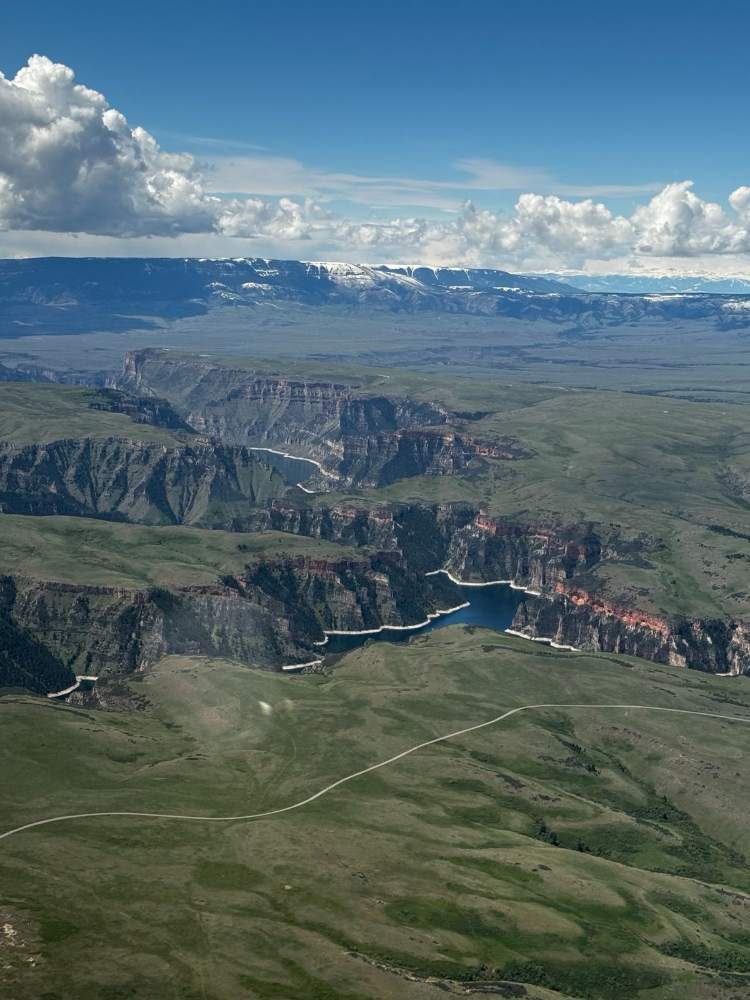
Over Big Horn Canyon dam and national recreation area, SE of Billings (great local sight seeing route on the way to Cody WY). My wife's first flight in the new plane:
- 177 replies
-
- 12
-

-
Hi there,
Saw you posted a comment on lack of tie-downs at KEAT.
I'm looking at maybe flying to Wenatchee later this summer with my daughter (to meet on the ground for an extended family get-together in Leavenworth).
Any tips on flying to the region? I did a bunch of primary training at KBFI, with a few forays to near west-side mountains (Ranger Creek, and one small field for mtn. training I can't recall), but no real Cascade turbo experience.
Trip would be from KBIL, so a stop maybe at KMSO or my 2nd home KHRF for fuel, vs. somewhere in Idaho or near Spokane.
Any advice appreciated,
David
PS. I had a converging course yesterday with a Blackhawk over a wilderness canyon area. No radio contact, ended up climbing and turning toward him. After the fact (debriefed on Flysto) I realize I should have done what you said, just turn decisively toward the tail. The climb helped but blinded me briefly.
- Show previous comments 3 more
-
David,
I’d definitely ask the FBO about hangers before showing up if you think you might want one. They may advertise that, but it’s no telling if there’s one available and what the cost might be. I generally do not use a hanger away from home out here, but I have a nice cover for the airplane. we usually do not get big thunderstorms with any kind of damaging winds or hail out here and you can usually see what’s coming from the weather forecast. I usually feel fine leaving mine outside at my destination for a few days with the cover.
you will be right on the edge of the Cascade mountains there, so it’s scenic even before you takeoff. You can go a little bit north and see Lake Roosevelt and the grand Coulee Dam, you can do a low approach or land at 3W7, which is down in a lake made from the Columbia river, or you could just fly down the edge of the cascades over Leavenworth and see some awesome sites. The high mountains and Lakes are pretty close to Leavenworth. 3W7 is fun (maybe not for introductory flights for family) because it is a very small unattended airport down inside a canyon. It’s a very wide canyon though so it’s easy. You can park, walk across the runway and start fishing on the lake. There are two camp sites for fly-in camping there.
If you really want scenic, fly down to 21W. Don’t land (it’s a little more technical), but just circle around and then go back. You will see amazing views of Mt Rainier. Even if you go circle around glacier Peak, which is 50 miles north west of Leavenworth, you will still see Mount Rainier the whole time. I usually cross the Cascades at 10,500 or 11,500, so if you go over the middle of them to either of those two mountains, be prepared to go pretty high. if you are doing an introductory flight for someone, I definitely recommend going on a cool clear morning so it will be nice and smooth. We don’t usually get bad turbulence on the cascades like the Rockies or the Sierras, but it does get bumpier later in the afternoon on a warm day.
It should be an awesome trip! Have fun, Drew -
Drew,
Thanks for the quick response! Those sound like great ideas. Was just looking things up in Airnav and Foreflight and checking out the terrain... looks like a lot of ways to string that together depending on who's the passenger.
Funny, I do remember Ranger Creek (21W) from years ago. Went there in the later phases of training with my instructor in a Skyhawk. Wouldn't be too psyched to land there in a long-body

Your point about the covers is a good one, esp. in cases where I can't score a hangar. You have any advice on choosing covers?
I just saw how close Grand Coulee was to the Okanagan MOA. I did get to go out there a few times for some LOWAT... good memories.
Best,
DAvid
-
Ahh, that was probably some awesome lowat up there! I was stationed at mtn home afb in Idaho for my first assignment and that was pretty fun as well!
My plane came with a nice Bruce’s cover and it’s been great. Here’s a few people with other types:
-
What items live in your baggage compartment?
dkkim73 replied to 201er's topic in General Mooney Talk
That is a great idea. I'm trying to figure out when to add Cam Guard and how much, on the fly. Your solution is better. (Vest comment also noted, was my first reaction on a thread a few months ago, and Junkman sent me info on his load-out. You... it's almost like you've thought about being forced down before... ;)) -
Very Odd Cessna 206 crash
dkkim73 replied to Shadrach's topic in Mooney Safety & Accident Discussion
I was just watching "Masters of The Air" last night, including a scene with a high-speed, low-altitude bailout from a P-51 (one of the Redtail characters). It got me thinking about manual egress from GA planes, specifically the Mooney. At the risk of thread-jacking, is anyone aware of a bailout from the M20 airframe? I imagine if you thought it was even possible, you would want a helmet to not get whacked by one of the stabs. -
I think there are some attorneys on MS who might have more understanding than I can generate here... I guess if you aren't giving any consideration away then you haven't bought anything (and I generally subscribe to your point "if you're not paying you are the product"). OTOH Savvy is gaining value from this sharing of data, which, as it is portrayed, is monetized in *anonymous* ways. So the idea that data tied to your specific identity is being given for money, in ways that might be contra to you as a party in a different deal, seems different. Clear as mud, I've made it. I hope we hear back from Paul's inquiries.
-
Anyone know which is the correct software version to edit legacy G1000 checklists? https://www8.garmin.com/support/download_details.jsp?id=5075 https://www8.garmin.com/support/download_details.jsp?id=12032 This first link is Dec 2010 and makes a cryptic comment about display software versions. Thanks! D
-
I wonder if the deeper problem is the conflict of interest (or dual agency) situation that Savvy gets into when the Seller and Buyer are both paying for services. It's not practical for an expert to "forget" what he or she knows about an aircraft just because the logs aren't mentioned. And any organization has a limited # of experts. It's as was mentioned above regarding conflict checks with attorneys. Solutions would be to avoid dual-agency, or have both parties sign a form accepting it (as IIRC can be done with realty agents?). While I imagine most sellers understand the view of technical due diligence, the other side of the coin is having the Buyer critique every time you pick your nose... Kind of like some people with cars "there's a paint chip, I want $1000 off the price". In any case, I really don't want my info shared without my prior approval, either, for any number of sane privacy-default reasons. And we haven't even talked about the discrimination insurance companies can inflict with data harvesting. Think healthcare. AFAIK Savvy is not dealing with them as they are GA owner/operator-focused. But it could be coming "get a discount [ie. be able to afford insurance] if you agree to disclose". Anyhow, I hope this will drive some clarification of policies. I really like the service and am generally a supporter of the kind of positive entrepreneurial small business that Mike Busch represents. DK
-
Probably the best idea... might be worth checking your software revision on the G1000 and downloading a matching guide from Garmin. BTW anyone know how to order printed copies?
-
I believe the behavior of the G1000 when the go-around button has pressed has changed over time. This is from comparing references and (IIRC) Max Trescott's book. Looking at the Pilot's Guide Mooney M20M/M20R/M20TN/M20U/M20V 190-00647-04 Rev. B "This manual reflects the operation of System Software version 0401.35 or later for the Mooney. ", I see: excerpt of page 484: Note this is with the GFC700.
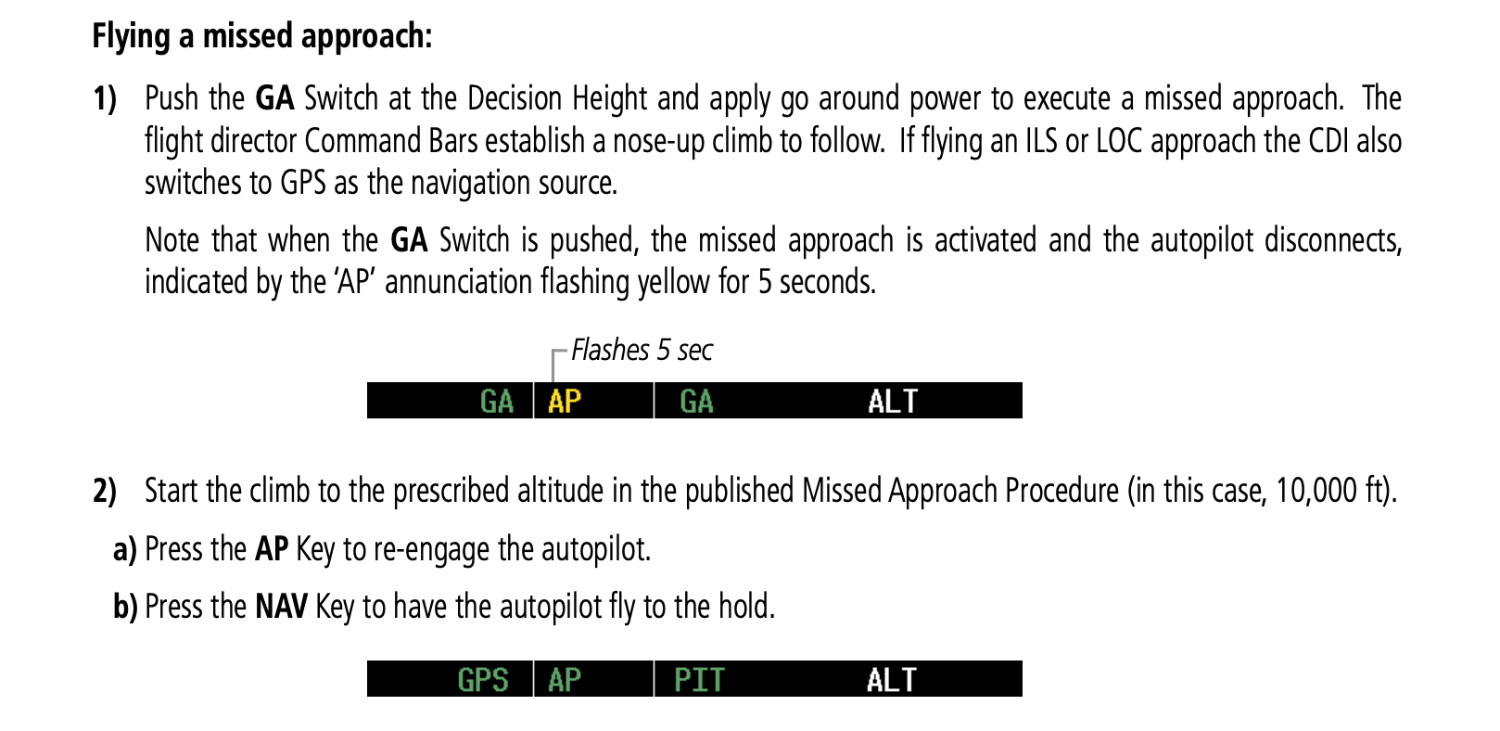
-
Hello all, This question applies to legacy G1000's, one of which is in my plane. SiriusXM offers several tiers of weather product, adding additional elements for more money: Legacy: https://www.siriusxm.com/content/dam/sxm-com/pdf/aviation/XMWX_Aviation.pdf New versions: https://www.siriusxm.com/aviation/packages I just had a trial subscription finish, and am looking at continuing (given the granularity and shorter latency of updates vs. FIS-B/ADS-B). Has anyone recently taken a look at this question and, more specifically, whether all the features are displayed and used by the G1000? Software version is 0401-37 with the corresponding GTX345R upgrades, done by Mooney at annual. The G1000 can hide some things a menu or two down, and I'm not sure I've seen or properly looked for all the displayable items. Certainly the basic NEXRAD works well AFAICT and the lighting is selectable (though I haven't been near any recently). Any tips appreciated, DK
-
This is worth reiterating, with all the black crepe that we're hanging. I still have to pinch myself sometimes in the plane. Fast, capable, and a real IFR machine. FIKI is worth a lot IMHO though that brings some significant risk management. The density of airspace around DC would scare me, but I'll let people who know weigh in. There are a couple people here who commute significant distances for real into that.
-
That maneuver *definitely* works. A significant mechanism is increased "recruitment" of the alveoli, the little air sacs where "the magic (of gas exchange) happens". They are collapsed but open up when you pressure-breathe yourself as above, and when you breath more deeply, particularly at the lung bases. Unsure how much the absolute pressure increase helps in terms of partial pressure driving gas exchange (given the limited pressures we can generate with our chest esp. during inspiration, would have to look it up) but it certainly doesn't hurt. I have used the above to "get by" in terms of avoiding mild hypoxia at bordlerline altitudes when we brought the wrong cannulas on a demo flight. A pressure-demand or other positive pressure system helps with the above by delivering external boost. E.g. the common narrow panel military regulators. Another important practical physio point to digest: as you climb, the partial pressure of CO2 decreases along with O2, and the lesser absolute value of CO2 will decrease respiratory drive. So you just won't breath as often. So a very basic thing to do is remember to breath more regularly than you feel compelled to, and a bit more deeply. If you do both of the above, you can boost your effective oxygenation by a surprising amount at middling altitudes. HTH
-
Will do. I'm also going to wear it around a bit, and probably overnight, to see what kind of gaps or vulnerabilities it might have. Have been waiting for a good wearable before going higher than 17k. I'll probably try popping a bit higher on the Eastbound leg of my next commute. ETA: the auto on/off when you wear it or take it off is surprisingly helpful.
-
Oxygen for small animals in flight?
dkkim73 replied to dkkim73's topic in Miscellaneous Aviation Talk
Ha. Well... it's a combination of (benign) behavioral experiments and rat-interest on my daughter's part. They're really quite interesting and personable creatures. Just happened that the reputable breeder was a full day's car travel away. Was looking to solve the problem with airpower (if I can find a cavalry hat I'll shout "air mobile!"). Unfortunately in a part of the state with high minimum altitudes... I realized quickly it would be more complicated than the more common Fido Problem. Interesting discussion, though. -
That's a great tip. I'd kept the cord underneath thinking about its winding around the spinner, but your idea is better. Mine also have little flags visible from the cockpit.
-
I just received my Wellue pulse-ox ring. In the first 20 minutes, very impressed. Seems to maintain a signal and report well. Have trialed some other options. Have been waiting for this, and some test flights with my current "baseline" oxygen rig, before I venture into mask altitudes. A simply finger backup is also good. I would respectfully recommend *not* relying entirely on subjective criteria. D ETA: and yes, take opportunities for physio (chamber) flights to experience symptoms, or ROBD (reduced-oxygen breathing devices) if you can't get to a chamber. And remember to allow for changes in age and your physiologic "journey" as well.
-
@Jetpilot86 summed up perfectly what I was going to convey in other, less experienced, words. Everything happens faster and balancing short final transitions, cross-winds, etc, without carrying extra energy is a new realm. You can't just "put it" somewhere different in parameter-space quickly like you can a trainer. As far as the truck comment further above, the plane is very stable. Positive-feeling. Which is good for IFR. Just feels not as much like a T182, leave alone a Super Decathlon, as you might want at other times. And for IFR, going fast, takes a lot more attention to hand-fly and keep the #s on target (my experience). D (using Acclaim experience as indicative of Bravo handling @donkaye is the Bravo Whisperer)
-
Maybe Foreflight has an easy function "Send to ASRS Report". Prefill all the stuff to make it quicker. Interestingly the FlySto service has all sorts of flags, "turned on AP too low", "exceeded max MAP" etc.
-
Recommendations on a pre-Mooney first plane?
dkkim73 replied to BlueSky247's topic in General Mooney Talk
Might also want to look at PIC (professional instrument courses), with the traveling instructor intensive approach. I found their manual very helpful, though I didn't use them for instruction. Would definitely recommend lead-turning the ground work, eg do IFR ground school in it's entirety before starting. -
FWIW Mooney told me that, after installing a few, they realized it took longer. That said, as is pointed out above, there are a few details. D
-
My MicroKit unit took 12 hrs at Mooney. Might be on the high side. Though they'd done a few. That said, it was installed in an inboard wing port, tied to the GIA #2 for GPS and GIA #1 for gear indication, height calibrated, etc. Everything was solid and carefully documented, on a separate breaker and wired into the audio system on the prior ADF channel, with labels. etc. Parts cost about $27. Performance was as expected right away. Enabed the lower altitude call-outs (2', 1', etc). It has been bomb-proof over the last (nearly 50) hrs. I'm very happy I got it and find it very helpful for SA, esp. for new airports and at night. Support was prompt and low-drag. I imagine it could be installed for less. OTOH a zero-labor install of anything would worry me. And I personally don't want to rely on BT, WiFi, sympathetic vibrations in the ether, or other methods for notification. my 2 cents DK
-
Recommendations on a pre-Mooney first plane?
dkkim73 replied to BlueSky247's topic in General Mooney Talk
This has been my experience. Even with good advice and good-to-excellent mechanics, there is a period when you need to get the airplane dialed in. And yes, the mechanics disagree frequently, leaving you to use your intuition and comb the networks (human and digital) for advice. For me, it's worth it to get something familiar and trustworthy for my mission and beyond. For starting out... I don't know. Lots of good arguments above. Busting out an instrument rating with a good instructor (worry more about your own formation, habits and the "Law of Primacy" than equipment, maybe) will pay dividends down the road. The Warrior/Archer is a bombproof approach to basic IFR training. I would argue the utility of *any* Mooney is much greater with an instrument rating. I flew 1.9 the other day, 0.2-0.3 actual IMC, but the flight was made possible by the rating (and TKS but that's another story). DK -
@Danb Happy to hear this. It is very easy to go technically NORDO for a single call (get the ATIS, juggle volumes, switch headsets etc). If it gets to a point where you can discuss openly, would be instructional to hear. Glad I don't fly near the SFRA. Be well, David