
Mooneymite
-
Posts
4,495 -
Joined
-
Last visited
-
Days Won
58
Content Type
Profiles
Forums
Blogs
Gallery
Downloads
Events
Store
Everything posted by Mooneymite
-
Correct. "Not empty" does not equate to "full". As long as they don't sit dry for prolonged periods, they'll be fine. I think the bladders have been around since before 1990 and there a virtually no reports of deterioration. Certainly all those owners are not keeping their tanks full all those years.
-

CHEETAH VS BO; MOONEY WATCHES IN HORROR...
Mooneymite replied to DCarlton's topic in General Mooney Talk
I have zero Gruman Tiger/Traveler experience. Do you think the pilot could have overcome the loss of brakes with hard rudder and a blast of power? A blast of power with a loss of brakes would be a gutsy move, but could that have possibly turned the Gruman away from the parked planes? -
Fuel, fire, or air...the trinity of engine starting. The O-360 is not prone to hot starting issues. If the prop turns, and you have fuel and air, I'd suspect the shower of sparks first. Pretty easy to check.
-
M20C crack found during annual. Worried.
Mooneymite replied to MCDsiena's topic in Vintage Mooneys (pre-J models)
Same with gear retraction. Lower airload=lower stress. -
Senate Measure Would Link FBO Pricing To Airport Grants https://www.ainonline.com/aviation-news/business-aviation/2023-06-28/senate-measure-would-link-fbo-pricing-airport-grants?utm_hsid=28755669&_hsmi=264357913&_hsenc=p2ANqtz--Kt4CsT0mHyKeHIHKHnElqcl_49YknDcgywuhA0X_bNTr0iW7zBJk0mtG1n9OGhzI7uj2bQFB88jaYxo51HrE2lrrgxA In a move that continues an ongoing dispute between pilots and FBOs and airports, the Senate has included a provision in its version of the comprehensive FAA reauthorization bill that would tie pricing and disclosures for fuel and other services to Airport Improvement Program fund grant assurances. The Aircraft Owners and Pilots Association (AOPA) has long pushed for full disclosure of FBO pricing and has contended actions taken by FBOs on that front have not gone far enough. Further, AOPA has urged Congress to mandate airports to provide ramp space for aircraft that do not need services without having to pay FBO fees. Earlier this month, Sen. Ted Budd (R-North Carolina.) introduced a bill—the General Aviation Airport Access Act (S.1847)—that would essentially accomplish that. The bill would permit the airport to charge a fee for the use of a transient apron but require FBOs and airports to provide free access between the apron and the outside perimeter. AOPA indicated that some 600 organizations backed the measure. “Addressing this issue is long overdue, it’s more than fair, and it’s the right thing to do,” said AOPA president Mark Baker. FBOs and airports, however, have argued that a blanket mandate would not work at all airports and that it does not take into account insurance and other expenses FBOs must pay to accommodate transient aircraft should operators need to use their space. The Senate provision does not go as far as to require mandatory transient ramp space—however, talks of such an amendment have been floated. It does, however, call for FBOs that operate facilities at three or more public-use airports where fuel, parking, and other services are offered to general aviation aircraft to publicly disclose all prices and fees in an “open and conspicuous manner,” including at the point of purchase, in print, and on the internet. This covers all retail, discounted, or other prices and whether they are accepted as payment in full. Along with disclosure, the provision says, “the airport owner or operator will not impose unreasonable fees for transient aircraft parking that exceed the airport’s cost to operate and maintain the area where such transient aircraft may park.” The National Air Transportation Association has expressed opposition to the language and said it was working with a bipartisan group of Senators to offer an amendment that would strike the language from the FAA bill. Separately, the measure addresses fuel availability, calling for the airport owner to make all types of fuel available to general aviation aircraft that was available during 2022 until the earlier of either Dec. 31, 2030, or when a drop-in replacement for 100-octane low-lead aviation gas is widely available. These requirements would be tied into airport grant assurances. Spanning more than 450 pages, the Senate’s FAA Reauthorization Act of 2023 would authorize the agency’s programs for five years and cover a host of measures designed to address a range of safety, modernization, workforce, and other issues. The Senate Commerce Committee had scheduled consideration for this month but that has been pushed off until after the Fourth of July break after a dispute arose over whether to include a measure to count some simulator time toward the requisite 1,500 flight hours for pilots on Part 121 scheduled carriers. While the bill touches upon many of the similar themes as the House bills, the two FAA reauthorization bills have numerous differences. The FBO provision is not included in the House bill.
-
Oh, great! Another nail in the general aviation coffin. Interesting that one of the endorsements is from the manager of the HTO airport....certainly one of the most hostile airports to GA. Unfortunately, I can see this being very popular with many county airport boards.
-
Wasn't there a regulation that said, "Log what you need, fly what you want?" I'm sure I read that somewhere.
-
Towering CU can be quite benign down low, but once they build up through the freezing level....watch out. That's when you can get some really bad conditions.
-
Ha! This reminds me when half the 727 fleet had autoland and the other half did not, the (allegedly) famous logbook write up/sign off seen more than once. Pilot write up: Autoland lands hard. Maintenance sign off: Autoland not installed. This would lead one to believe that landing off of a coupled ILS is survivable even without autoland.
-
I'm not saying how I happen to know this, but for someone who made more than half his Mooney landings, on grass....it is very poor conditioning for proper braking on asphalt!
-
No problem...just ask your lead flight attendant. They know everything.
-
P&P article on insurance denials for older pilots
Mooneymite replied to toto's topic in Miscellaneous Aviation Talk
Well, above 18,000'....aren't they kind of in class A airspace? -
P&P article on insurance denials for older pilots
Mooneymite replied to toto's topic in Miscellaneous Aviation Talk
It gets murkier if one looks at the differences in part 91, part 135 and part 121 O2 mask requirements.....apparently, the human body reacts differently to oxygen deprivation depending on which FAR he is operating under. The sherpas that march briskly up mount Everest without oxygen apparently operate under a special set of rules. -
P&P article on insurance denials for older pilots
Mooneymite replied to toto's topic in Miscellaneous Aviation Talk
We can rant and rave about the unfairness of insurance rates for older pilots, or we can use insurance statistics to evaluate if it's time to hang up our headsets and take up golf. When our engines are high-time, we pay attention to their symptoms. When we are out of time, maybe we should pay attention to our insurance underwriters? -
Any Mooney pilot who claims, "I've never had carb ice in my Mooney" should always add the word, "yet".
-
There seems to be a perception that carbureted Mooneys are immune to carburetor ice. This was in today's "Flying Lessons", an excellent weekly newsletter even if it is written by a Bonanza guy: " Debrief Readers write about past FLYING LESSONS Reader/instructor Sam Dawson writes about last week’s LESSONS on the use of carburetor heat: Another great issue. I have one thing to add about carb ice. There is a myth that certain airframes and engines are not susceptible to carb ice. This could not be farther from the truth and the NTSB files are full of Piper accidents, often fatal, where carb ice is the suspected cause. NASA did a study in the 1970s and concluded, "As no practical or statistical significance exists between the major manufacturers of either airframes or engines, no distinction between makes was carried through the subsequent analysis. These results contradict informal reports that specific manufacturers produced designs more or less prone to carburetor ice difficulties." (NASA CR-143835, "A Study of Carburetor/Induction System Icing in General Aviation Accidents"). The NTSB came to the same conclusion and, in a Safety Recommendation dated January 8, 1990, recommended that the FAA mandate that aircraft flight manuals and pilot operating handbooks of carbureted equipped airplanes be amended to require the use of full carb heat in the descent and before landing checklists. This was not done, probably due to liability issues, so the Piper manuals still state that "Carburetor heat should not be applied unless there is an indication of carburetor icing..." The problem with this, as pointed out by NASA and the NTSB, is that on approach most pilots will not recognize the build up of carb ice until it is too late- when they apply power due to being low or during a go around. At this point it is usually too late to apply carb heat and the outcome is a forgone conclusion. Again, one need only Google "Piper carb ice accidents" and a number of them come up. This is one of those cases where blindly following the POH/AFM can be deadly. Unless a pilot has checked the Carb Ice Probability Chart and knows for sure that there is no chance of carb ice, I would highly recommend using carb heat at low power settings, no matter the make and model of the airframe and engine. I would add that my one carb ice encounter was in a big bore Continental, in the summer, in New Mexico. After a long descent the engine ran rough as I applied power. I immediately went through the partial engine failure flow (air, fuel, spark), and carb heat, after initial roughness, cleared it up. Thank you, Sam. A more recent NTSB Safety Alert adds: According to NTSB aircraft accident data, from 2000 to 2011, carburetor icing was a cause or factor in about 250 accidents. On average, carburetor icing causes or contributes to two fatal accidents per year. Accident evidence shows that some pilots: Do not recognize weather conditions favorable to carburetor icing and inaccurately believe that carburetor icing is only a cold- or wet-weather problem. Have not used the carburetor heat according to the aircraft’s approved procedures to prevent carburetor ice formation. Do not recognize and promptly act upon the signs of carburetor icing. The FAA chimes in with Advisory Circular 20-113, “Pilot Precautions and Procedures to be Taken in Preventing Aircraft Reciprocating Engine Induction System and Fuel System Icing Problems,” which notes: “…regularly use [carburetor] heat under conditions known to be conducive to [carb] icing….” “When the relative humidity is above 50 percent and the temperature is below 70°F [21°C], apply carburetor heat briefly immediately before takeoff, particularly with float-type carburetors, to remove any ice that may have accumulated during taxi and runup.” “Conduct takeoff without carburetor heat, unless extreme intake icing conditions are present.” “With instrumentation such as carburetor or mixture temperature gauges, partial heat should be used to keep the intake temperature in a safe range. Without such instrumentation, full heat should be used intermittently as considered necessary.” “If induction system ice is suspected of causing a power loss, apply full heat or alternate air. Do not disturb the throttle until improvement is noted. Expect a further power loss momentarily and then a rise in power as the ice is melted.” “If the ice persists after a period with full heat, gradually advance the throttle to full power and climb at the maximum rate available to produce as much heat as possible. Leaning with the mixture control will generally increase the heat but should be used with caution as it may kill the engine under circumstances in which a restart is impossible.” " https://mastery-flight-training.com/
-
'69 M20C Panel Light Controller/Dimmer
Mooneymite replied to Cloudmirth's topic in Vintage Mooneys (pre-J models)
If it is the dimmer as was in my '74 C, there is a (very expensive) fuse that is quite easily blown. Are you sure it's a heart attack and not just a synapse? -
The Navy prepares nuggets to hit the boat on land based runways. FCLP...field carrier landing practice. It seems to be a good program.
-
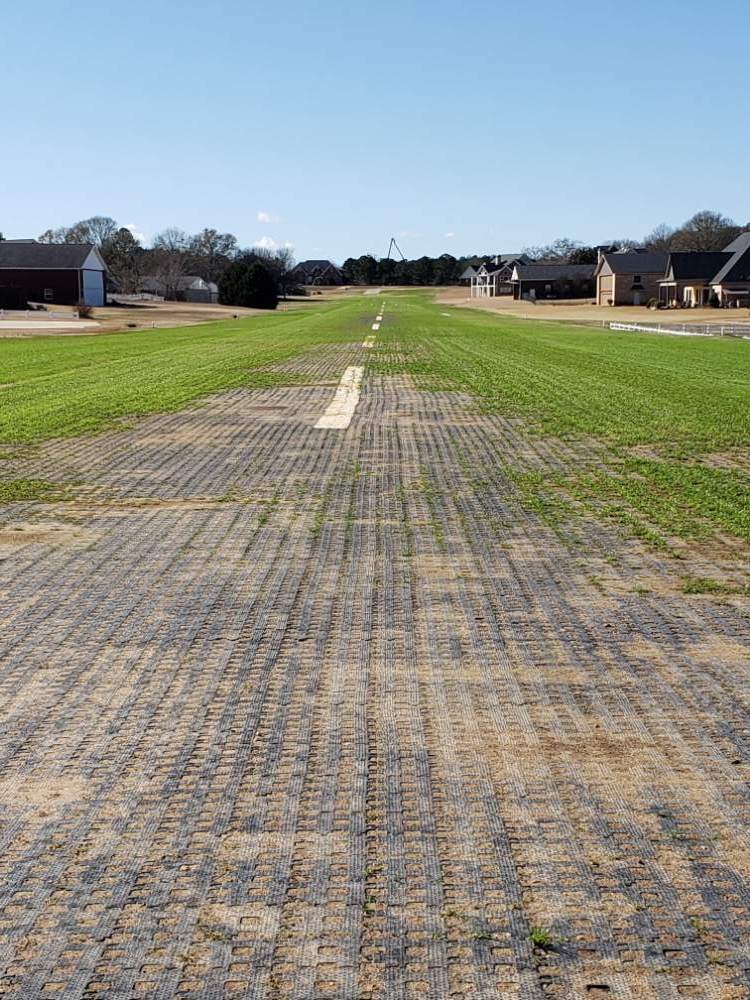
The Runmat comes in interlocking sheets. The blocks are available in black, or white, so we just interlock white blocks to make up the various runway markings. Think Lego.
-
Put this in the search bar on Google maps and go to satelite view: 33.364433, -84.168571
-
It is Atlanta. Bermuda and Zoysia turn brown all winter long. We over-seed the runway with winter rye....so, it's "mo-green". Our runway is 100% genuine home-grown Georgia clay, but after years of aeration to encourage the grass, it gets soggy after a rain. The markings are molded into the sheets of Runmat. While a clearly marked centerline may be an oddity on a grass runway, it is helpful because the Runmat does not cover the entire 150' width of the runway.
-
When did they raise the requirement to 10%?
-
We started to do Perfo which is manufactured in GB, but due to complications with importation, we went with Runmat...made in the US. We've been using the PERFO test section for almost two years and the runmat for about 6 months. So far, no issues. We'll know more in 25 years. Braking action was an unknown, but no one has reported any issues. So far no issues.
-
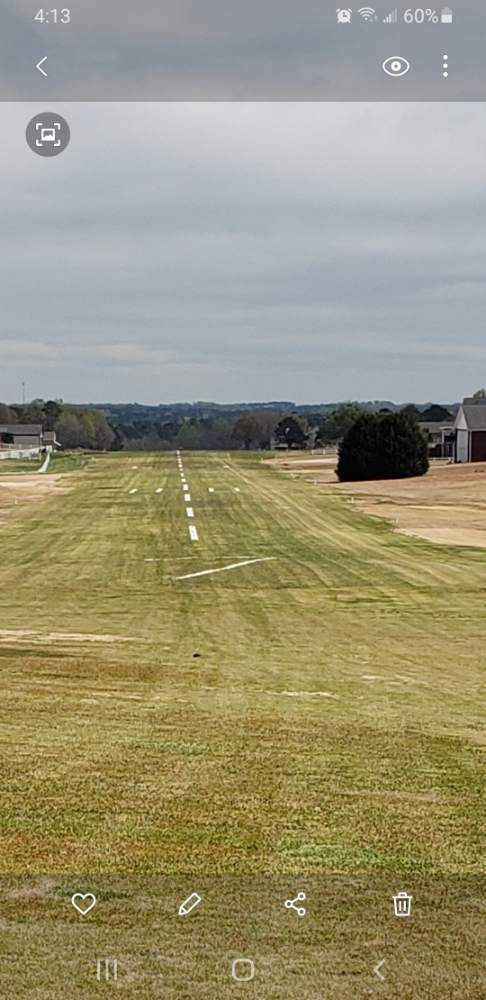
This is what it looks like after a few weeks (View from overrun looking down Rwy 07)
-
Our neighborhood has been installing a plastic overlay on our turf runway to ensure it is useable after heavy rains This is what it looks like prior to grass growing up through it. (View from midfield looking west down Rwy 25)