
Shadrach
-
Posts
12,239 -
Joined
-
Last visited
-
Days Won
170
Content Type
Profiles
Forums
Blogs
Gallery
Downloads
Events
Store
Everything posted by Shadrach
-
Does your premium ever remain UNCHANGED the next year? Premiums go up and down every year based on the number of factors including claims made by the insured. The smart question would be did your premium go up appreciably at renewal after the claim? I can tell you that my premium actually went down slightly at renewal after my bird strike claim. Did it go down because I had a bird strike? Hell no, it went down because renewal coincided with a softening of the insurance market and the birdstrike didn’t count against me.
-
There’s so much advice in this thread on the ins and outs of insurance but I’m not sure that it’s based on expertise. There is a good chance that the shop that scratched this plane has a hangar keeper’s policy. If they do, this is a covered loss. The scratch happened whale the aircraft was under the shops care, custody and control (CCC). If the owner submits the damage to their hull insurer, the hull carrier will likely subrogate against the shop (unless the claim is so small that it’s not worth the effort). In terms of rate increase, probably a good idea to talk to your underwriter. I've had two small claims in nearly 30 years of flying. A bird strike and a ground incident; both were under 5K and neither caused a notable increase if any in premium at renewal.
-
A not in motion claim that is someone else’s fault should not raise your premiums.
-

Mooney Aircraft Accident Nampa, ID
Shadrach replied to 65MooneyPilot's topic in Mooney Safety & Accident Discussion
The most practical set-up in the Mooney cabin inertia reel for pilot and fixed for copilot. A reel on the copilot’s side inhibits ingress an egress for rear passengers. -
Mooney Aircraft Accident Nampa, ID
Shadrach replied to 65MooneyPilot's topic in Mooney Safety & Accident Discussion
My sea level EGTs are high 1100s to low 1200s depending on the conditions. Though they have trended upward as the servo has aged. When I last had it overhauled (15ish years ago), I asked the overhauler to set it as rich as possible within spec; this yielded EGTs just under 1200 on all but one cylinder. All cylinders @ 250°-275° ROP at full rich. I wouldn’t change anything about how it’s set up. -
Mooney Aircraft Accident Nampa, ID
Shadrach replied to 65MooneyPilot's topic in Mooney Safety & Accident Discussion
Completely agree that target EGT is the best approach. I’m of the opinion that an EGT of 1200°-1250° is a more ideal target for an IO360 with an 8.7 to 1 C/R. -
Mooney Aircraft Accident Nampa, ID
Shadrach replied to 65MooneyPilot's topic in Mooney Safety & Accident Discussion
You may be doing yourself a disservice with the above technique. Depending on DA, the spectrum of mixture settings where an IO360 begins to run rough varies considerably with available MP. In my experience these engines can run smoothly as far as 100LOP or more at lower DAs to 40ish LOP above 10K. Depending on what a “smidge” is, it’s conceivable that your technique might result in a take off mixture setting on the lean side of peak. -
You can get new superior cylinders for sure. Overhauled cases are available last I checked. Mine has already been overhauled and strengthened in areas prone to failure.
-
That argument reads very well and translates well into the automotive world. If you have a specific make of automobile, there is economy for sure in having it maintained by a shop that specializes in that make. The reason that argument falls apart in the Aviation world is because your average make specific, specialty, Auto repair shop deals with a far larger scope of designs, systems, configurations and tooling than an aviation power plant specialist would encounter servicing all of the piston, recip, engines in the GA Fleet. Roll the dice indeed. There’s no getting away from it… However to my way of thinking, the measure of a business doesn’t end with the quality of their product; indeed that’s just the beginning. How they stand by that product, when things go sideways is important to me. In my experience, if there is a problem, I would much rather call the guy who built the engine or the guy who hired the guy who built the engine than call a customer service line. In my experience a shop that has a reputation in the local maintenance community we’ll go to great lengths to maintain that reputation. I am grateful to have two reputable engine builders in my area, one of which will pick an engine up personally from the customer’s shop or hangar.
-
https://www.savvyaviation.com/wp-content/uploads/articles_eaa/EAA_2010-02_engine-tbo-a-myth.pdf it’s definitely older data, but I doubt the trend has changed.
-
Why anybody would risk buying a factory engine from either brand when they have a reputable engine builder within driving distance is beyond me. The economics simply don’t make sense when coupled with the increase in risk, poor factory warranty and questionable service. Factory “zero time” is a marketing ploy for the uninformed. If you have an existing engine with a known and proven history of reliability, why on earth would you give up those parts for unknown parts? Why on earth would you tear down an engine that is functioning well with a history of good service in favor of an unknown?

-
Unfortunate incident with the AOPA sweepstakes Husky
Shadrach replied to Shadrach's topic in General Mooney Talk
In case there was any doubt as to the veracity of the shoelace story… I’m not sure this reads much better? I can’t imagine landing a plane with my foot off the rudder.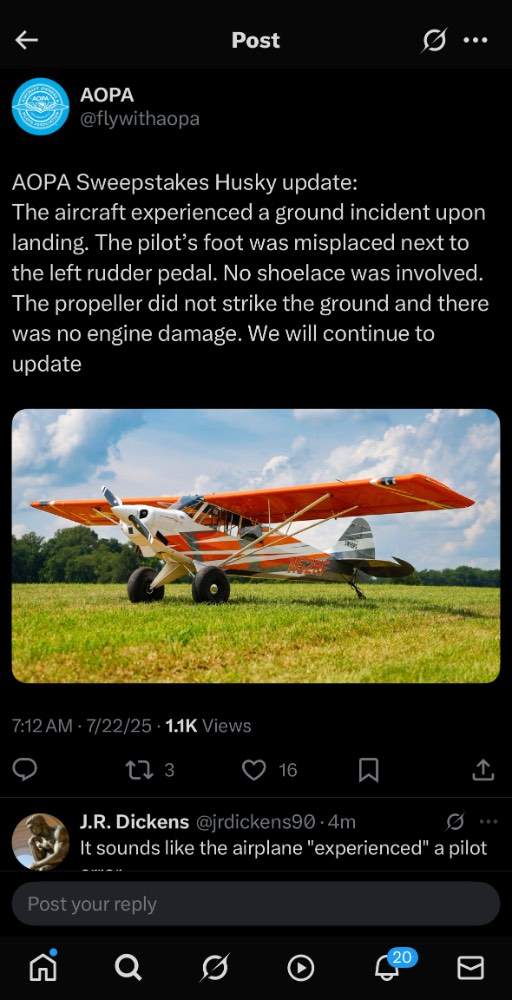
-
Unfortunate incident with the AOPA sweepstakes Husky
Shadrach replied to Shadrach's topic in General Mooney Talk
I’m not disagreeing with you, but I will say that I unintentionally raised the tail on a Decathlon trying to stop short to make a Taxi way in the first few hours that I started flying it solo. It’s surprised me…I got off the brakes right away, and the tail came down fairly hard. That was my first “let’s not do that again“ moment in a Taildragger. -
RAM AIR DOOR CABLE ATTACHMENT - HARDWARE ?
Shadrach replied to DCarlton's topic in Vintage Mooneys (pre-J models)
Carl, I will take a picture of mine when I return from vacation. It’ll probably be a week before I get to the airport. There is no eyelet. The nut locks the cable to the arm coming off the door shaft. There should be a clamp[s] that hold the cable sheath in place. it’s not a sophisticated set up but it works well once properly rigged. -
Unfortunate incident with the AOPA sweepstakes Husky
Shadrach replied to Shadrach's topic in General Mooney Talk
True. I don’t feel compelled to fly barefoot in the Mooney. It’s a pussy cat to land compared to the Decathlon. I often go bare foot in taildraggers not because I’m worried about rudder inputs but because I’m less likely to inadvertently drag a brake in bare feet. -
Unfortunate incident with the AOPA sweepstakes Husky
Shadrach replied to Shadrach's topic in General Mooney Talk
Side pocket is rigid so flip flops wedge in tightly… Front seat in Decathlon has two positions forward and aft. Once you’re belted into the five point harness, you’re not moving and neither is the seat. -
Unfortunate incident with the AOPA sweepstakes Husky
Shadrach replied to Shadrach's topic in General Mooney Talk
Likely the case. Maybe the FAA will incorporate knot tying into the 709 ride requirements… There but by the grace of god go I… -
Help diagnose high EGT & high CHT
Shadrach replied to skydvrboy's topic in Engine Monitor Discussion
A few things stick out here. 1) your IO360 behaves differently than those I have flown. With few exceptions, EGT #3 typically peaks first and #2 peaks last. #3 CHT is usually the hottest or nearly the hottest. 2) Did you try a mag check at cruise power? 1550 is on the high side for a normally aspirated IO360. I would rule out an intermittent ignition issue first. I’ve had plugs that drop out at 2300rpm but perform normally during runup. -
Unfortunate incident with the AOPA sweepstakes Husky
Shadrach replied to Shadrach's topic in General Mooney Talk
Flip flops fit nicely in the door pocket of the Decathlon. I had got a flat last month at MTN. I wonder how I would have faired on landing if it held air for take off and deflated in flight. I think the wheel fairing would have suffered.

-
Unfortunate incident with the AOPA sweepstakes Husky
Shadrach replied to Shadrach's topic in General Mooney Talk
I don’t know what happened here, but it seems unlikely that you’d rip a gear leg off at taxi speed. I shoot for <10kts when taxing a a tail dragger. -
Unfortunate incident with the AOPA sweepstakes Husky
Shadrach replied to Shadrach's topic in General Mooney Talk
You do, it’s just that it usually comes from the horse’s mouth! I don’t know about your airport, but at mine there is no shortage of pilots that are willing tell you all about their heroism in overcoming challenging situations. -
Unfortunate incident with the AOPA sweepstakes Husky
Shadrach replied to Shadrach's topic in General Mooney Talk
“Shoelaces”…. They’ll get you every time. -

-
There’s a lot of that going on here, but it takes decades to build those kind relationships (I know firsthand). It would be cool to create a regulatory pathway to making it more accessible.
-
I’ve always thought this aspect of airworthiness a bit ironic. It’s akin to saying: You’re responsible for the performance of this system and ensuring its continued performance, just don’t touch it… Of course, responsibility for airworthiness has to be assigned to someone and it’s hardly realistic to ask a mechanic her last saw the plane seven months ago during an annual inspection to take responsibility for its current day condition. I think enabling owners to be more involved in the maintenance of their aircraft would likely increase safety by reducing the prevalence of unauthorized maintenance.