
Shadrach
-
Posts
12,199 -
Joined
-
Last visited
-
Days Won
170
Content Type
Profiles
Forums
Blogs
Gallery
Downloads
Events
Store
Everything posted by Shadrach
-
I have CAD drawings of the gear rigging tools. If anyone wants them, PM me.
-

Hot cylinder solutions needed
Shadrach replied to Greg Ellis's topic in Vintage Mooneys (pre-J models)
I have recently started flying a 63C and it runs while it runs hotter than My F model, it runs runs very reasonable in cruise. I lean for the setting that yields the most even CHTs The above probe is installed I/A/W the manufacturer's instructions. When properly installed, the piggy back probe will still read lower than the bayonet probe but in my experience the delta is 10% or less. Without the fire sleeve correctly installed, I suspect the delta in temperature readings is much larger. -
M20C high CHTs during TO/Climb
Shadrach replied to Phil123's topic in Vintage Mooneys (pre-J models)
As previously mentioned, the optional 20° timing is only available for the injected, angle valve engines. I am not sure why retarding the timing would help with engine start. If the lag angle is properly set, the mag should fire at 0° degrees during the start up no matter whether the mag is timed to 20° or 25°. -
Fouled Plug, bad wire, or bad mag?
Shadrach replied to NickM20F's topic in Vintage Mooneys (pre-J models)
Just another data point: Lycoming IO360A1A running Tempest plugs with massive electrodes Easy to start hot or cold. Service life exceeds 500hrs with regular rotation Will run far leaner than operationally practicable. -
1961 M20B - Things to know before buying?
Shadrach replied to JackPlek's topic in General Mooney Talk
If you have a family, it really is worth it to hold out for an M20F. The space and the extra useful load will be worth it. The short bodies max out at 2575lbs, the F is 2740lbs. The delta in useful load is usually in excess of 100lbs. -
1961 M20B - Things to know before buying?
Shadrach replied to JackPlek's topic in General Mooney Talk
1) What is a minimal IFR rating? and 2) Is an IFR rating really useless without an LPV capable GPS? Are the approach pickings that slim in your neck of the woods? Most of the airports on the eastern seaboard that you’d want to use in inclement weather have an ILS/loc or a VOR approach or both. -
Fouled Plug, bad wire, or bad mag?
Shadrach replied to NickM20F's topic in Vintage Mooneys (pre-J models)
Your engine is an outlier among the injected, angle valve, Lycomings. Most will run far leaner than is needed before the onset of roughness. My stock IO360A1A will run > 100° LOP, depending on manifold pressure. Down low at high MP it starts run rough around 100° LOP, above 10K it starts to get rough around 45° LOP. -
Fouled Plug, bad wire, or bad mag?
Shadrach replied to NickM20F's topic in Vintage Mooneys (pre-J models)
So if you found out your engine was making metal and it had 150hrs on the ignition system would you replace it all with the overhaul? What would you call an engine overhauled to new mechanical limits with 150hr ignition components? -
Good to see that there are more and more alternatives to the companies that were part of the Hartzell roll up.
-
I would get quotes from both of these companies: https://planexhaust.com https://aircraftexhaust.net
-
Spatial Interiors vs AirTek Interiors
Shadrach replied to brantv's topic in Vintage Mooneys (pre-J models)
You’re not really comparing apples to apples. Airtex offers replacement carpeting and seat upholstery for most GA aircraft. Jaeger Aviation (Bruce Jaeger) is a Mooney specific shop that has developed interior pieces specifically designed to maximize cabin space for the M20 airframe. Both are a good choice, but my guess is that the Jaeger interior is the more refined and expensive option. -
Exhaust leak at ball joint
Shadrach replied to M20C Driver's topic in Vintage Mooneys (pre-J models)
Your picture is not very helpful at highlighting the problem you’ve described. I can’t tell if I am looking at the spring tensioned nut and bolt for the ball joint of an exhaust header on a Hanlan and Wilson exhaust system or the tail pipe ball joint coming off the the muffler on the Mooney exhaust system (both H&C and Mooney systems were fitted to C models). I assume the out of focus orange shape in the background is scat tube. Do you have an image that is more zoomed out? Below is the list of repairs that a pilot is authorized to perform on an aircraft operated under Part 91. 14 CFR Part 43 appendix A (c) Preventive maintenance. Preventive maintenance is limited to the following work, provided it does not involve complex assembly operations: (1) Removal, installation, and repair of landing gear tires. (2) Replacing elastic shock absorber cords on landing gear. (3) Servicing landing gear shock struts by adding oil, air, or both. (4) Servicing landing gear wheel bearings, such as cleaning and greasing. (5) Replacing defective safety wiring or cotter keys. (6) Lubrication not requiring disassembly other than removal of nonstructural items such as cover plates, cowlings, and fairings. (7) Making simple fabric patches not requiring rib stitching or the removal of structural parts or control surfaces. In the case of balloons, the making of small fabric repairs to envelopes (as defined in, and in accordance with, the balloon manufacturers' instructions) not requiring load tape repair or replacement. (8) Replenishing hydraulic fluid in the hydraulic reservoir. (9) Refinishing decorative coating of fuselage, balloon baskets, wings tail group surfaces (excluding balanced control surfaces), fairings, cowlings, landing gear, cabin, or cockpit interior when removal or disassembly of any primary structure or operating system is not required. (10) Applying preservative or protective material to components where no disassembly of any primary structure or operating system is involved and where such coating is not prohibited or is not contrary to good practices. (11) Repairing upholstery and decorative furnishings of the cabin, cockpit, or balloon basket interior when the repairing does not require disassembly of any primary structure or operating system or interfere with an operating system or affect the primary structure of the aircraft. (12) Making small simple repairs to fairings, nonstructural cover plates, cowlings, and small patches and reinforcements not changing the contour so as to interfere with proper air flow. (13) Replacing side windows where that work does not interfere with the structure or any operating system such as controls, electrical equipment, etc. (14) Replacing safety belts. (15) Replacing seats or seat parts with replacement parts approved for the aircraft, not involving disassembly of any primary structure or operating system. (16) Trouble shooting and repairing broken circuits in landing light wiring circuits. (17) Replacing bulbs, reflectors, and lenses of position and landing lights. (18) Replacing wheels and skis where no weight and balance computation is involved. (19) Replacing any cowling not requiring removal of the propeller or disconnection of flight controls. (20) Replacing or cleaning spark plugs and setting of spark plug gap clearance. (21) Replacing any hose connection except hydraulic connections. (22) Replacing prefabricated fuel lines. (23) Cleaning or replacing fuel and oil strainers or filter elements. (24) Replacing and servicing batteries. (25) Cleaning of balloon burner pilot and main nozzles in accordance with the balloon manufacturer's instructions. (26) Replacement or adjustment of nonstructural standard fasteners incidental to operations. (27) The interchange of balloon baskets and burners on envelopes when the basket or burner is designated as interchangeable in the balloon type certificate data and the baskets and burners are specifically designed for quick removal and installation. (28) The installations of anti-misfueling devices to reduce the diameter of fuel tank filler openings provided the specific device has been made a part of the aircraft type certificiate data by the aircraft manufacturer, the aircraft manufacturer has provided FAA-approved instructions for installation of the specific device, and installation does not involve the disassembly of the existing tank filler opening. (29) Removing, checking, and replacing magnetic chip detectors. (30) The inspection and maintenance tasks prescribed and specifically identified as preventive maintenance in a primary category aircraft type certificate or supplemental type certificate holder's approved special inspection and preventive maintenance program when accomplished on a primary category aircraft provided: (i) They are performed by the holder of at least a private pilot certificate issued under part 61 of this chapter who is the registered owner (including co-owners) of the affected aircraft and who holds a certificate of competency for the affected aircraft (1) issued by the holder of the production certificate for that primary category aircraft that has a special training program approved under § 21.24 of this subchapter; or (2) issued by another entity that has a course approved by the Administrator; and (ii) The inspections and maintenance tasks are performed in accordance with instructions contained by the special inspection and preventive maintenance program approved as part of the aircraft's type design or supplemental type design. (31) Removing and replacing self-contained, front instrument panel-mounted navigation and communication devices that employ tray-mounted connectors that connect the unit when the unit is installed into the instrument panel, (excluding automatic flight control systems, transponders, and microwave frequency distance measuring equipment (DME)). The approved unit must be designed to be readily and repeatedly removed and replaced, and pertinent instructions must be provided. Prior to the unit's intended use, and operational check must be performed in accordance with the applicable sections of part 91 of this chapter. -
Brittian O-rings? PC yoke plunger
Shadrach replied to MB65E's topic in Vintage Mooneys (pre-J models)
I did some digging and from what I’ve read, Parker lists N0674-70 as meeting the specs for both MIL-G-21569 amd MIL-P-82745. Ask if it can be certified for both. -
Brittian O-rings? PC yoke plunger
Shadrach replied to MB65E's topic in Vintage Mooneys (pre-J models)
I would be interested in a few as well. -
98 Mooney Ovation - Pushrod Tube Oil Leak.... Not Good
Shadrach replied to Dustoff49's topic in Modern Mooney Discussion
It’s not codified in the regs (thankfully) but by returning the aircraft to service with his signature he is deeming the aircraft airworthy. Mistakes happen and things are missed whether work is being performed by mechanic or under supervision. Negligently returning an unairworthy aircraft to service as airworthy could be cause for an investigation and major administrative action. I have seen a few suspensions over the years for careless behavior. -
98 Mooney Ovation - Pushrod Tube Oil Leak.... Not Good
Shadrach replied to Dustoff49's topic in Modern Mooney Discussion
You’re over complicating it. From a logbook signature perspective, a supervised, non-A&P is the same thing as an A&P. The signature returning the aircraft to service is the A&P’s whether he personally completed the work or supervised a non-A&P’s completion of the work. The A&P‘s signature in the logbook is supposed to signify that the work was completed I/A/W AC 43.13. If said A&P signed off work as airworthy and it was not then he has opened himself up to liability whether he did the work or someone else did it under his “supervision”. -
That seems to be true based on what I have seen. There is an insurer that only sells direct with a reputation for continued renewals for established accounts, regardless of age. However, if you’re over 80 and you have an in motion claim, I think your chances of renewal after are greatly diminished, regardless of loyalty.
-
I know there’s a lot to read below. The TLDR version is that I think you’re oversimplifying the dynamic and mechanical aspects of how a constant speed propeller system works (not uncommon, by the way). In simple terms there are three things that limit maximum RPM: 1) Power (torque, or lack thereof to be more precise) 2) The fine pitch stop in the propeller hub 3) The propeller governor During a static RPM test with the prop full forward, the blades should be against the fine pitch stop. The propeller governor should be completely off-line (min oil pressure to the hub) with the spring holding the blades against the fine pitch stop. This is why the engine does not go to redline during a static RPM test; for all intents and purposes, the propeller is a fixed pitch, climb prop, during the test. Max static RPM should be slightly less than redline (~2% less is typical). This demonstrates that the prop blades are against the fine pitch stop, if they weren’t, the governor would allow the pitch to go finer and the engine to achieve redline during the static RPM test. A propeller with the governor and fine pitch stop set correctly will typically not go to max RPM during a static test. Back to @MikeOH’s comment with regards to takeoff RPM. If he is seeing 2700 RPM during takeoff, the propeller is either being limited to 2700 RPM by the fine pitch stop in the hub or by the prop governor increasing pitch to prevent overspeed. In either case, that would indicate that his engine is making full rated power or as near enough to full rated power as makes no difference. Perhaps I am wrong, but I inferred from your post that you believe that the governor can somehow allow the propeller pitch to become finer and finer to allow a sick engine to make max RPM. This is simply not true as it is constrained by the fine pitch stop in the propeller hub. The governor simply provides an opposing force (oil pressure) to a strong spring in the hub that pushes the blades towards fine pitch. When the engine is running and an RPM is set via the propeller control, the oil pressure from the governor and the spring in the hub provide counteracting forces that seek a blade pitch that maintains the desired RPM. Max pressure from the governor will move the blades against the course pitch stop. Minimum pressure from the governor allows the spring to move the blades to the fine pitch stop. In short, the prop governor will limit a strong engine to 2700 RPM on a cold, high pressure, day when it’s able to make more than 100% power. But it cannot do much of anything to allow a diminished engine to achieve max RPM. If you have a detailed explanation that counters what I’ve written above, I’d love to read it.
-
Are you at the same company or do you have a broker trying to find you the lowest bidder?
-
Really? So you don’t get asked these questions at renewal?

-
If the propeller and governor are correctly set up. Seeing less than 2700rpm on takeoff off would indicate that the engine is not making full power. There are alternative scenarios where a healthy engine might not make rated RPM or a sick engine might make full RPM, but all of those scenarios would require that the propeller and or governor be mis-adjusted. So the short answer is that if @MikeOH’s airplane makes full rated RPM, during takeoff, at sea level on a standard day, than he is in all likelihood making full power.
-
Mooney M20F Partial Gear Retraction
Shadrach replied to Eli Greene's topic in Vintage Mooneys (pre-J models)
Doe the vintage electric gear birds have a squat switch? It’s conceivable that cold, compressed, shock discs are allowing the gear to squat and trigger the switch during the transition thereby stopping the retraction. -
Next time you’re in the Mid Atlantic let me know and we’ll line them up. I flew back from Cape Cod week before last into a 35kt headwind in the C at 4,500’. The IO definitely has better fuel specifics at low altitude and opening the ram air is good for an additional 25-30° on the lean side for low altitude ops. At 106-110kts across the ground, the extra 10-12knots would have been nice, if only for psychological reasons. On the upside I was routed direct JFK at 4,500’ and got some nice pics of Kennedy at sunset and then over what was once Floyd Bennett Field (worth a google for those unfamiliar). Sunset over JFK Remnants of Floyd Bennett Field

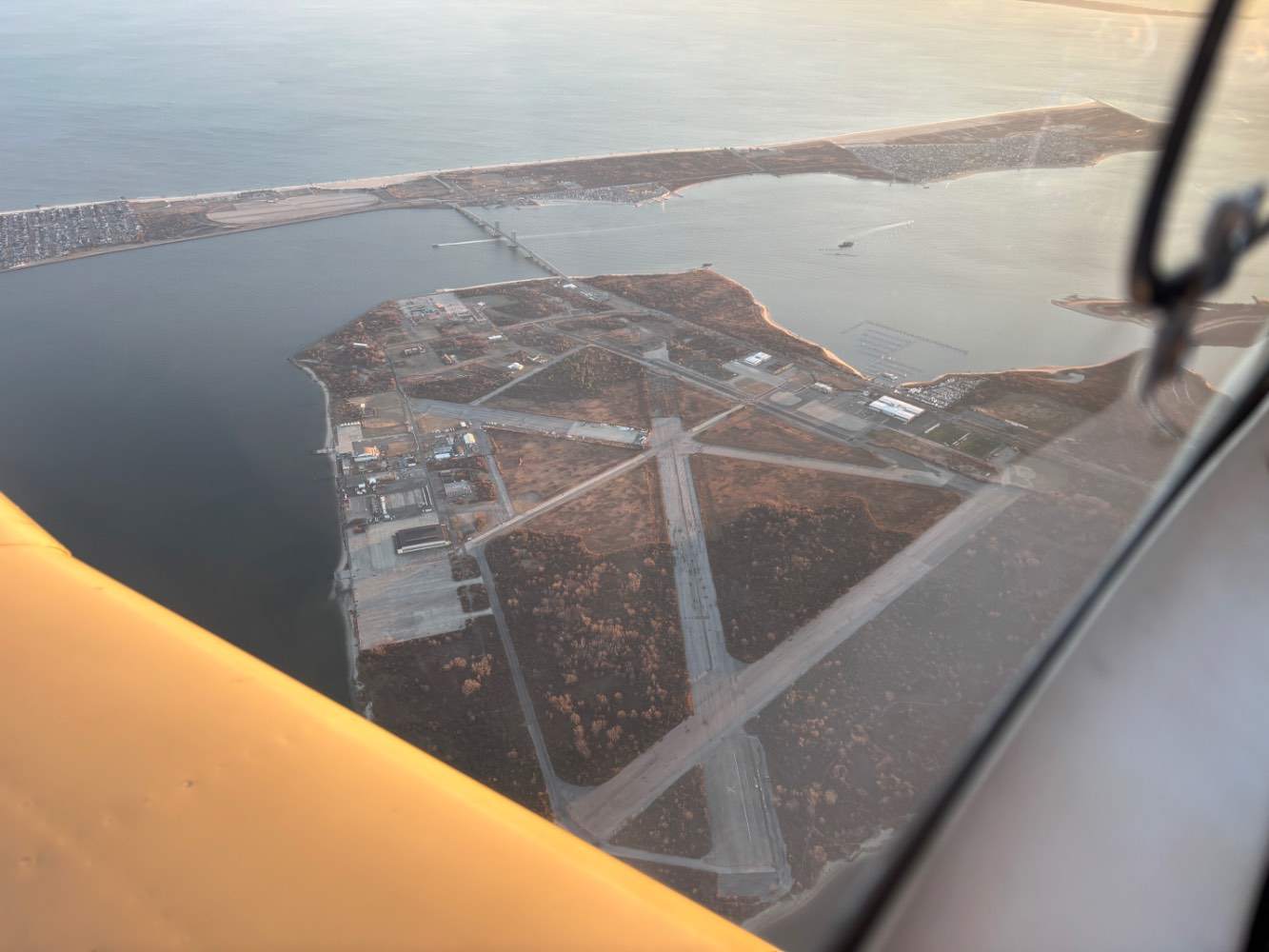
-
Fly them both. There are noticeable performance disparities among like models let alone different models. I have flown both a 1963 C model and a 1967 F model in the last 30 days on 600nm plus round trips. I much prefer the IO to O. The F model runs much cooler, climbs significantly stronger and is about 10kts faster. My F model punches above its weight for a stock F (150kts+) and the stock C model that I fly is a 140+ knot bird. I climb at 26” and 2600rpm in the C model because that’s how the owner wants it flown and it seems to produce reasonable temps (just under 400), but it does not keep up with the F in climb and is consistently 60 to 70° hotter on CHT‘s. The F simply feels more eager on the runway and in the climb. I don’t suspect that you’ll see a huge difference on paper in terms of cruise speed. I know from flying formation with this C model that my F will walk away from it at altitude. Several times, I throttled back to allow him to get a mile or so ahead of me and then throttle back up and jogged by. We both flew hurricane relief together. On a 300 nautical mile flight he took off two minutes ahead of me. I passed him in the climb about six minutes later as we climbed through 6,500. I landed about 18 minutes ahead of him at our destination. These are just two data points though. The delta between other airplanes may be different. It’s important to flight test any bird that you’re going to buy. There are lots of Lycomings flying around with spalled cams unbeknownst to their owners. All of the above being said, all of the four-cylinder Mooneys are excellent airplanes that out perform their competition. You really can’t go wrong with any of them as long as you get a thorough pre-buy before purchase.
-
Yes, aviation underwriters have been collecting data for the last five decades. Underwriting is not completely data driven though, if it was, insurance companies wouldn’t need underwriters. There’s definitely a general correlation between age and mishaps. My anecdotal experience with gear up claims suggests that they can happen to pilots of any age. However, when a pilot has two gear ups inside of five years, they are usually in the 75 + age range.