

Rustler
-
Posts
294 -
Joined
-
Last visited
Content Type
Profiles
Forums
Blogs
Gallery
Downloads
Events
Store
Everything posted by Rustler
-
Eric, Sounds about right to me. Last year I got a 1979 J with less time for mid $80s. Randy in Nevada N4569H
-
Here is the answer I got from Southwesr Aviation, Inc., a Mooney center in San Marcos, TX. Russell said that they had an STC to manufacture and fit new wingtips to the M20J. They were made of Fiberglass or a similar composite. They had a wind storm in San Marcos that severely damaged a number of hangars, Russell's included. That damage included the machine that formed the wingtips. Soon after, they were going to repair the machine when the manufacturer of the resin in California indicated that the state of California had made them change the formulation of the resin because of a possible carcinogen being present in the mix. They recalled the resin and sent Southwest Texas Aviation a replacement batch, changed imperceptibly. In strides the FAA (remember them, the guys who're here to help?) soon thereafter and say, "What's in the can?" Russell relays the story. The FAA says, "Well, you're going to have to re-apply for the STC since you've changed formulas." Ah, kind reader, if only you could have heard Russell's reply. . . . . I've begged, pleaded, cried, threatened, and tried bribery, but they just aren't being made any longer. Russell has one, but he's not sure where that one is. LASAR apparently isn't going to have any, either. The only thing I might suggest is to keep an eye out at salvage yards. If you find a supply, by all means let me know.
-
You're right, Dave. It is your position relative to the instrument panel when you're pulled up all the way. Not only is headroom a problem, but that position makes it very difficult to operate the control wheel properly; your ability to pull back on the yoke is severely limited. Ditto the comment on the aluminum chart holder. Being 3" back makes a world of difference.
-
Bruce-- I just looked through my paperwork and couldn't find that we did a 337 for the installation of the 3" pedal extensions. We did a logbook entry, however. I'll look again for a 337, but I don't think one exists.
-
The MT 3-blade costs about 10.5-11 AMU, plus installation.
-
Thanks, Craig, for a site that is always interesting, sometimes funny, and more useful than I ever thought it would be. Thanks, also, go to the folks who answer questions politely and seriously and are never too good to share their experiences with a newbie or a prospective Mooney owner. Pretty classy bunch!
-
I installed my MT composite last month and wouldn't ever go back. It is lighter than a 2-blade, runs so smoothly you almost don't know it is there, and I get better climb. I live at 7100 MSL, and it works great at that altitude and higher.
-
Dave-- I've got 3" extensions in my J--put them in when I purchased it-- and couldn't fly nearly so comfortably as I do without them. As I get older and shorter, I suspect I'll be even happier that I installed them. They make braking easier and allow you to get back a little from the instrument panel in cruise.
-
Have you checked the overhead-light switch to make sure it isn't on? It is very difficult to see if the interior lights are on in the daylight. I had a passenger accidentally turn mine on, and, of course, the battery went south.
-
You do not have to "twist" the throttle all the time. Exactly as the mixture and prop controls, the vernier throttle has a center button which, when depressed, allows you to use the control exactly like it was "straight-through", rather than vernier.
-
Bodie-- This past summer, when I replaced my engine with a Western Skyways overhauled unit, it came with about 0.75 hours on it from the company. I ran straight mineral for another 5 hours, running at low altitudes and 75% power. By that time, oil consumption had stabilized and I changed to Phillips. The engine now has 60+ hours on it and the oil remains stable at a bit over 6 quarts, and the color is good throughout the 25-30 hours I run it before changing. I'm running 20W50 during the winter. I strongly suspect that the rings had seated almost completely at the overhaulers. It never really ate oil.
-
Leigh-- I had the same dilema as you this past summer when I did a Western Skyways overhaul. After lengthy discussions and study, I opted for new Lycomings. It came down to the fact that I flew often enough that the steel cylinders (non-chrome) would not be a problem rusting. If you envision long periods of engine inactivity, I'd consider the chromed cylinders. I was concerned about the very thing you are: how many hours on a rebuilt cylinder?
-
What an adventure! You have no idea--I know you think you do--what things you'll do and places you'll go with that aitplane. Congratulations and God speed!
-
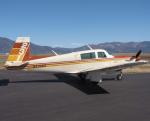
It'is the new scimitar design. (See pic below) Living in Taos, NM, I park at 7100' msl, so I regularly fly at 10,000' + and can't tell you too much about performance in the 5,000' range. As I said, on my return trip a little over a week ago, I was truing at 150 k, but the headwinds were so strong, I can't call that a fair representation. I intend to do the standard square pattern one day to see what I'm getting. The climb is better, but the biggest difference I noticed was the smoothness.

-
Ben-- Your Medco key has a code attached to it that Medco will use to duplicate it. Somewhere in your logs should be an entry indicating the installation of the lock and the code that goes with it. Why not go the entire Medco route? Install Medcos on the cockpit and baggage compartment doors and establish a single supplier for your keys.
-
Docket-- Yes. It has a wood core (laminated beech at the root and laminated spruce for the remainder of the blade) and is then wrapped with Kevlar, fiberglass, or similar material.
-
The MT 3-blade prop has been installed on my '80 M20J, and I have flown a little over 5.5 hours behind it. It has been a positive experience in all respects. The prop was removed not because of a prop strike but because it sustained a rather large nick shortly after the engine was overhauled. My A&P/AI was not convinced it could be overhauled successfully. The nick had been filed out, but I didn't relish the idea of that tip coming off in flight. Saturday I flew from San Marcos, TX, KHYI, to Taos, NM, KSKX, in very windy conditions--at one point 55 k directly on the nose. As a result, I can't give you a reasonable report on cruise performance, other than to say that throughout the flight I was calculating TAS of 150 k, almost exactly what I had with the 2-blade. Climb performance is enhanced. At departure, the temperature was 47 F, no wind, and I was looking at 1200 fpm at 95 knots indicated. This is perhaps 150-200 fpm more than I experienced previously. The airplane just feels more aggressive and powerful. Cruise is where the most difference is noticed. It is considerably smoother. I jokingly said one could place a quarter on edge on the glare shield and it wouldn't fall over. A stretch, yes, but not by much. With this prop as it came from the factory, the engine runs much smoother than either my former Cheetah did with a dynamically balanced prop or the Mooney did with the balanced prop that we removed to install the MT. This translates into much less body fatigue over a long flight like Saturday's. The noise level seems to be lower. I have not run pre/post dB or Sone comparisons, but I did not experience as much cabin noise as I did before. I wear an ANR headset that is very effective, so I can't analyze the noise reduction. It was more comfortable to me. Was it slower to respond to pitch-change input? Not that I noticed. On runup, the time it took to cycle the prop seemed the same as it always has. In flight, it is very responsive. I don't make radical changes in pitch, so I can't comment on that situation. My A&P/AI said I had a surprise coming the first time I stood outside and heard the airplane taxi. He says it sounds like a small turbine. We'll see. In the long haul, I think the prop has several advantages. First, it is about 9# lighter than the existing 2-blade, which translates into more engine power going to the prop and less of a stress being placed on the front crank bearings. It also helps reduce forward CG. It is field repairable, including repairing tips in the event of a prop strike, in multiple locations across the country. The vibration-dampening effects of the spruce and beech used in its construction have to be beneficial to the engine. The prop hub is a thing of beauty and guaranteed forever. Was it expensive? Yes. But since I had to do it anyway, and no insurance was involved, I figured I'd bite the bullet. Judging from this early experience, I'd do exactly the same thing given the same circumstances. Would I just remove an existing 2-blade and install the MT? I'd have to think long and hard about that.
-
Holy smokes, folks! I hope, in this day of every man for himself, we all recognize what we've seen here. Mitch gets my good guy award for the week.
-
Todd-- While a prop strike or other sudden stopage is always a suspicion, it may not always be the reason for a prop replacement. I am just finishing installation of an MT 3-blade on my '80 J because of a rather sizeable chunk of propeller taken out by a rock last summer. It was flyable, but I had pretty mich lost confidence in it, and my A&P/AI wasn't sure that it would be overhaulable. Rather than worry about it, on goes the 3-blade. About weight, here's what I found in my research. The Hartzell 3-blade weight about 71# and the McCauley about 72#. If I remember correctly, the prop that came on the plane weighs in the vicinity of 56#. There may be the cause for your W&B being so far forward. A principal reason why I opted for the MT 3-blade is that it is about 9# lighter than the original 2-blade that came on the airplane.
-
Buster-- I'll probably get my butt handed to me, but here're my thoughts on your condition (note, I didn't say dilema). Condition 1: You sell the house in time to finance the aircraft. Answer is obvious. Condition 2: You can't sell the house but have another home to pay for. Answer is that you're stressed to some degree, but it isn't impossible. Condition 3: You can't sell the house, must pay on the new one, and must service a loan on THE ONE. Answer is that you're angry about not selling the house, angry about having to pay for the new house and the old house, and you have an airplane that you love but are truly stressed (to the point of not being able to service the loan) about. Pretty easy decision. Don't commit to the airplane until it is comfortable to pay for it. There is no perfect airplane, only a perfect airplane for the conditions in which you find yourself. Nothing could be worse than flying an airplane, wondering every hour if you might have to give it up. It is not the same thing as having a mortgage that strains you a little each month but ultimately is doable. Flying that airplane should be an exhilerating experience in freedom, not one that imprisons you financially.
-
Buster-- When I had my engine overhauled last summer, it was for exactly the reason Cruiser brings up: peace of mind that you know your engine is done exactly the way you want it. He's also correct in that the runout-engined airplane isn't always the least expensive. When I did mine, my A&P/IA and I decided from the outset to do a firewall forward overhaul; it was more expensive, but I know that everything is like I want it and that practically everything up front is new. Somewhere here on the site is the series of posts relative to that experience. My overhaul was done by Western Skyways and I couldn't have been more pleased with the product and the service. They offered an added benefit because I wanted to have an engine with two, separate magnetos, and this meant that they would build the engine while I was still flying, then take mine in trade. The kicker here was that they did not hit me with a core-difference charge, whereas most shops quoted me $3000 for that. Any MSC can work with you, which should make the overhaul easier to take. I'd count on at least 8 weeks, although that might be conservative.
-
Yep. Came in the e-mail today. It wasn't really too much of a survey but obviously will be used as a tool for them to sell their services.
-

Anyone using a Lasar electronic ignition?
Rustler replied to Kwixdraw's topic in Modern Mooney Discussion
If you look at the threads Engine Overhaul/Exchange and The Saga Continues, found on page 2 of the Modern Mooney listings, you can see my experience with the engine. There were a lot of good suggestions/questions on those exchanges. I thought I also asked about the LASAR ignition system (electronic ignition?) some time ago but cannot find the thread. -
Anyone using a Lasar electronic ignition?
Rustler replied to Kwixdraw's topic in Modern Mooney Discussion
Kwixdraw-- The conversion from an A3B6D to A3B6 does not require an STC. I did that exact thing this past summer, using Western Skyways. They did not charge me a core-differential charge, and, because we did not send my old engine back until the new one arrived, I had more flying time. The engine now has 50+/- hours on it and is perfect. Don't know about the LASAR ignition. -
sixsixX The 1980 J that I have owned since October '08 has the Century 41 in it, and it is a stellar performer. I drive it with a 430W and a Century GPSS and couldn't be happier with the system. It is smooth, flies a true course and doesn't require any re-sets after initializing. After installing the GPSS, we could not get a glideslope intercept and sent it to Century. Thety fixed it in a timely manner and charged me, I think, ~$200. The addition of the GPSS is one of the best things you can do if you want to fly regularly with the autopilot and make GPS approaches; Century makes one specifically for this autopilot.
