
Scottknoll
-
Posts
123 -
Joined
-
Last visited
Content Type
Profiles
Forums
Blogs
Gallery
Downloads
Events
Store
Everything posted by Scottknoll
-
Thanks. It’s a different part number, but I sent the ebay listing to him.
-
I have a friend with an aircraft in the avionics shop (Garmin Dealer) for some other work. The shop has a base model GI275 that he decided to possibly install at the last minute as a primary engine monitor. The trouble is they cannot source a GEA24 for the install. Looking for anyone that has a lead on one he can get fairly soon as the airplane is in the shop and opened up now. He is specifically looking for part number 010-01042-11. He has been calling around to other shops with no luck, and we all know how far behind Garmin is right now. Any help is appreciated.
-
Aspen/KFC150 AP AHRS Fail Light
Scottknoll replied to Scottknoll's topic in Modern Mooney Discussion
Thanks guys. That all makes sense. I tried turning EFIS (Aspen) switch on after start and leaving the radio master off (To keep KFC150 off). Waited until Aspen was fully aligned, then turned the KFC150 on. That worked much better. The light will actually go out prior to pressing the KFC150 self test. I think the problem was just powering everything up at the same time. Makes sense that the autopilot should not engage with the light on. I’m not 100% sure that is what it was doing. I was focused on resetting breakers. Now that I’ve nailed down the required power up sequence, I’ll try a few scenarios engaging the autopilot before the light goes out. We bought the airplane equipped this way, and have been thinking about a G500Txi/GI275/GFC500. Maybe I’m looking for reasons to pull the trigger [emoji4] -
Aspen/KFC150 AP AHRS Fail Light
Scottknoll replied to Scottknoll's topic in Modern Mooney Discussion
Thanks. Will try that today. I figured it must be something in the startup sequence, since it is resettable by pulling CBs. The autopilot does pass the self-test, and will actually engage and track heading bug on the ground. But the AP AHRS FAIL light remains illuminated, and no flight director is displayed. I didn't think the autopilot would engage with the AP AHRS Fail light illuminated. -
I've been trying to understand why I inconsistently get an AP AHRS light on startup. After powering up Aspen and Avionics, the AP AHRS Fail light stays illuminated. This inhibits the Flight Director on the Aspen. I've tried waiting until the Aspen is fully aligned before pressing the KFC150 test button. The only thing that has worked has been pulling the AP AHRS and AP circuit breakers. But even then it sometimes takes a few cycles to get the light to go out and the flight director to display. I'm open to ideas. Of course I took it to the local avionics shop and it would not replicate for them.
-
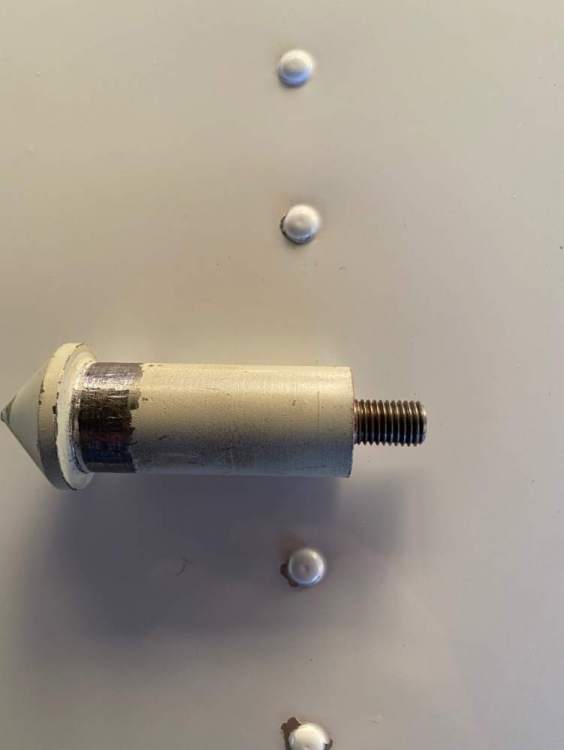
Yes, it’s threaded. Here’s a picture of just the jack point. Wings are the same, but shorter.
-
Hopefully this picture is worth a thousand words.
-
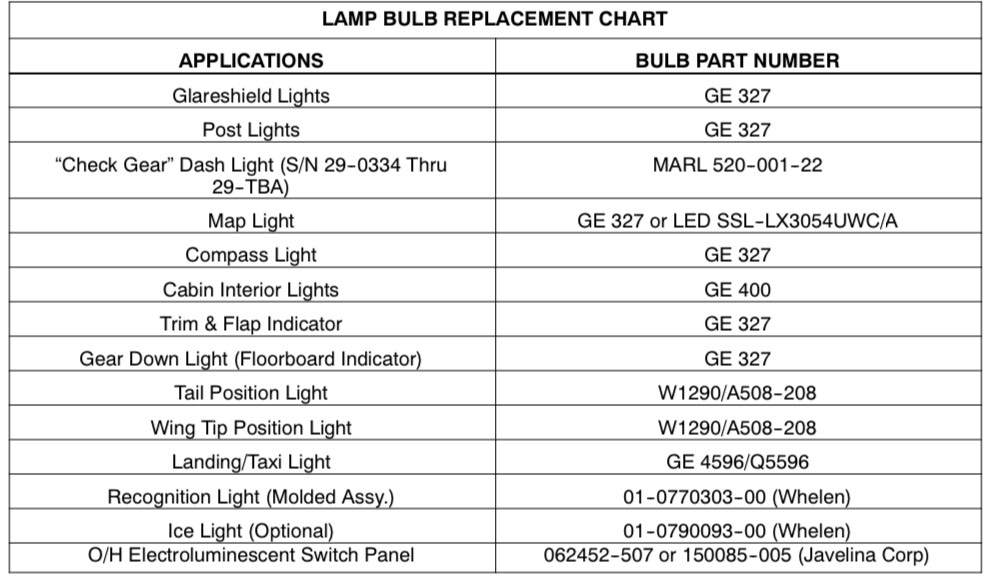
M20R MM list of interior bulbs. But it doesn’t show baggage light. I’ve changed it before and the baggage bulb is much larger than the overhead interior bulbs. I can’t find the bulb number at the moment though.
-
That was me, but it’s a different part number I believe. Mine were mounted in the tail (Ovation). We went all led when the tail strobe bulb burned out. Worth the effort & money, did it with my A&P, learned a lot. They are heavy boxes.
-
FS: Whelen Strobe Power Supply (2)
Scottknoll replied to Scottknoll's topic in Avionics / Parts Classifieds
$100 each if anyone needs either of these. -
Interesting, I can’t find either tail number when I’m using mine. Here is another foreflight operator and I can’t find either tail number for them either. https://flightaware.com/live/flight/FFL543/history/20211211/2110Z/KFNL/KEDC I’m curious, because I have my real tail number blocked through LADD, and I’ve never been able to find my actual tail number. The crowdsourced ADSB sites always show the false N number that I was given by the FAA. If you’ve got an example, I’d be interested to see it. My transponder only broadcasts the false N number, and the real N number is blocked at the FAA level. I was under the assumption that only the FAA knew the two were linked. [emoji2369]
-
https://foreflight.com/support/call-signs/ https://www.faa.gov/nextgen/equipadsb/privacy/ I did this program if anyone is interested. Didn’t really need it, but it was a fun project. They essentially assign you an unused tail number which you program into your transponder, along with a foreflight callsign. Anyone using an ADS-B receiver sees your alternate tail number instead of your real tail number. An added bonus is that I can give my foreflight callsign to whoever I want to actually be able to track me. It’s only good for domestic flights, but switching back and forth only takes a few min to swap settings in the GTX345. I know someone could probably figure it out and link my foreflight callsign to my real tail number, but it’s better than nothing.
-
Are the CAS messages able to replace the Mooney annunciator panel? Or is the annunciator panel part of the TCDS and thus required to stay?
-
Thanks for all the info. I didn’t know there was a set screw. Flew today and after landing it actually showed a little more than full… Guess I didn’t shake it hard enough. My landing must have taken care of that [emoji16] I did notice it takes a while for the fluid to make it all the way to the tank, seems to be about 5 feet of hose. When getting close to where I calculated full, I went 1 quart at a time. Only lost about 8oz into a bucket, worth it to know it’s full. Put it in a spray bottle for future use on a frosty morning. Thanks everyone!
-
Hoping to get some advice on filling the TKS tank on our Ovation. Pre-inviting [mention]CAV Ice [/mention] to my question. Today, I added 2.5 gallons, bringing the gauge to 4.0 indicated. Reading the Fluid Indicator Calibration for ground attitude, I calculated that we had an actual quantity of about 4.8. I decided to add an additional 1.5 gallons to fill the tank to 6.3 gallons. The gauge never indicated more than 4.1 as I was adding this last bit. Just as I was finishing the final quart or so of the 1.5 gallons, it start coming out of the overflow. So I think my math was relatively close, and at least I know it is full. My question is, why wouldn’t my gauge go beyond 4.1 gallons? Based on the chart, I think I should see 5.8 gallons on the ground when I have between 5.7 & 6.3 actual gallons in the tank. Is there a calibration procedure? I did try power cycling the system. It boots up at 0 and counts up to 4.1. I also tried the scientific process of shaking the fuselage to see if the floats were stuck.
-
Curious how close the reweigh is to the math? I know 135 requires it every 3 years, so a fed somewhere thought it was worth someone else’s expense… Not advocating one way or the other. I’m just not aware of any actual data showing the difference between the calculations and a proper scale weight after X number of years. Personally, I avoid the scale. I already know I take in more calories than I use. Don’t need a scale tell me that. Lol
-
MAPA Pilot Proficiency Program - Wichita - PIREP
Scottknoll replied to hubcap's topic in General Mooney Talk
I was at this PPP as well. IMHO this is hands down the best Mooney training you can get, very professionally run by highly experienced Mooney instructors. Reminds me of my experiences at FlightSafety/CAE. Meeting other owners of the same type is fantastic as well. Mark and I realized after parking next to each other, that we nearly bought each other’s Mooney a few years earlier! Small world. I learned more on my preflight at that event than I did during my entire insurance checkout flight when we bought our airplane. Fly safe and keep learning! -
I have a placard listed in the limitations section showing 170 pounds on each rear seat back. Page 2-12. Although I believe this limitation is when the seats are set up for cargo, with seat backs folded down.
-
I’m told fashioning a pipe to go under and around the standpipe to let the air escape speeds up the process. I have not tried this, YMMV. There is also a drawing & AFM supplement available from Mooney to put an official hole in the top of the standpipe, also to allow air to escape, legally. IIRC, it’s 51 gallons per side. AFM Supplement is available on the Mooney website for more info.
-
That makes perfect sense, I missed the fact that it was part of a sub-item in the limitations section. Was just reading it as a straight limitation. For the M20M through M20V, looks like page 6 & 7. Item 10g applies to alternators. At some point I’ll learn to pay attention to the details. As always, thanks for the quick answer!
-
My Ovation FIKI TKS AFMS limitations section requires dual alternators. I agree with the logic discussed so far. I just can’t imagine I can’t fly day vfr just like a non-fiki aircraft if my standby alternator is inop. But I don’t see a clearly legal path to do so. Btw, the airplane was delivered from the factory like this. The AFM Kinds of Operation Equipment List shows 1 alternator required, and the requirement for the second alternator is listed in the limitations of the TKS AFM supplement.
-
Will an Ovation fit my mission?
Scottknoll replied to MooneyTime's topic in Modern Mooney Discussion
Yes, we just got ours done a few months ago. It’s about a 20amu adventure, and worth every penny. Cold and light, I’m off the ground in ~800’ and climbing at 1700FPM 120-130knots. Heavy is about 75% of that. We’ll see how the summer goes, but I’d imagine it’ll be good there too. Makes the “impossible turn” a little more possible. You do lose 7% glide. I can share AFM supplements. PM me you’re email if you’re interested. Plenty of threads here regarding the upgrade. I’ve read them all [emoji23] ~15amu for new top prop w/tks kit ~5amu to Mooney for a piece of paper [emoji849] You’ll also need to send prop gov out for T20 upgrade to allow 2700RPM. Fuel flows need adjusted as well. STC SA03024CH for Hartzell Prop (7498) STC SA02193CH for HP change to 310 3 prop choices: 7498: thinner, think I gained a few cruise knots 7693: more repairable Composite: much more expensive -
I used E&E aviation. Maxwell had seen the plane a few months ago and had a good report as well, otherwise I would have used them. I never met Raymond at E&E, but he gave good, honest feedback. E&E’s website states that they are a “mobile aircraft services company”. So maybe they would come to the airplane. I think Maxwell is about an hour in a Mooney from Houston. Some good ideas here too. https://mooneyspace.com/topic/31299-mooney-a-and-p-in-houston-texas/
-
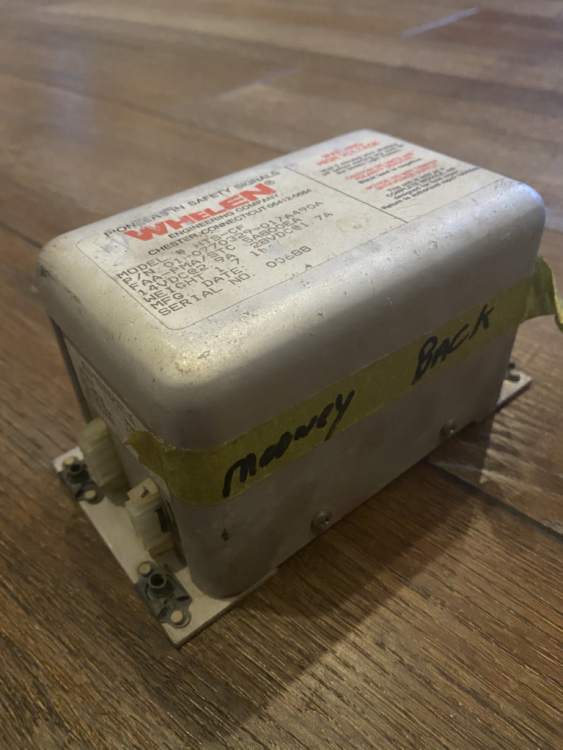
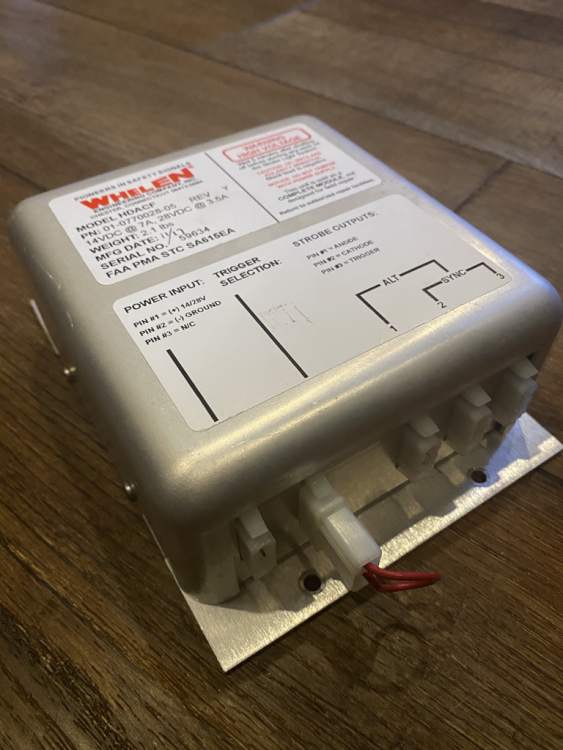
Removed for LED conversion, tested working prior to removal. Two different power supplies available. Model: HDACF Part Number: 01-0770028-05 Installed new in March, 2018 $400 ($819 new from aircraft spruce) Model: HTS-CF Part Number: 01-0770329-01 Original from Mooney, removed from 1997 Ovation. $300 ($776 new from aircraft spruce)
-
Funny you mention that. Just heard from the MSC, and they are pretty positive that’s how it happened. They said a run up with the top cowl removed will allow lower cowl to ride up. We are going to have it repaired, and monitor for further contact.