.jpg.9b6518df3df7e9cc0e169994d778304a.jpg)
Ricky_231
-
Posts
245 -
Joined
-
Last visited
Content Type
Profiles
Forums
Blogs
Gallery
Downloads
Events
Store
Everything posted by Ricky_231
-
so who can make this happen?
-
As the new owner of a K model (6 months, 100 hours) I believe this would be of great value.
-
Great list! My one addition to the "joy of flying" category would be Stefan Drury's channel https://www.youtube.com/channel/UCG1HLA8IEqZ09_C_7u5tUjQ - Cirrus pilot in Australia (sometimes UK). He's planning a trip around the world right now. Easy to watch
-
Flew without the watch and everything was fine. I have a backup flux gate on my plane (not sure why, but it's there), so I can switch between the 2 to check whether they're consistent, and they are. So I guess as long as I verify on the ground that the card is aligned with the compass (without wearing the watch), then I can trust the HSI later in the air.
-
me too - but i noticed small fluctuations even from a distance. anyway, I flew without it today, and everything worked perfectly. so i guess I'll be retiring the apple watch as a flight companion.
-
ah, the century HSI doesn't "snap" in place once it's slaved. instead it'll slowly sync up (i think it's one degree every 30 seconds or something like that). So you can (and sometimes need to) adjust it even while slaved - just because it could take several minutes to get there on its own. to be fair, most times, by the time I hit the run up area, it's completely synced up and ready to go. sometimes it isn't, then you have to adjust the card once - then it'll keep synced.
-
But regardless of what you have onboard, if you check your HSI in straight level flight and it's off wouldn't you adjust it? and then try and figure out why, but first of all, make sure that the instrument you're relying on to fly a heading is consistent with the magnetic compass (that should, in theory, be the most reliable source of that information in the cockpit).
-

Odd ATC interaction. Real emergency?
Ricky_231 replied to DXB's topic in Mooney Safety & Accident Discussion
I found the below in the comments section of the video. Apparently it was a CFI with a student. Can't say for sure whether any of it's true or not, but sounds plausible. Also clearly someone has a beef with that controller :-) "I am the pilot’s close friend and I thought it would be prudent to give some context on this video since it seems to be very much left out... First, the pilot who I will not name is an excellent, experienced pilot. I own an aircraft and he goes up with me often. We also work together at a local flight school. He’s a CFI/CFII/MEI and was on a training flight with a student when the event occurred. It’s important to know that the weather in Hawaii is very unique. You can get a weather briefing and it ends up completely different once you are in the air. Hawai’i has its famous towering cumulous clouds and that’s what he most likely encountered. Weather in Hawaii develops FAST, and often doesn’t show on ADSB or ATC radar because it doesn’t always have precipitation associated with it. All resources were actively in use on the flight by way of an iPad, stratus receiver & flight service / ATC. It’s also important to note how dark the pacific ocean is at night - you can’t see a thing - complete darkness. Like being in outer space. You can’t see anything and that includes clouds. Upon takeoff, again on an IFR flight plan at night, he encountered an extreme downdraft that violently thrust his left wing down over 50°. Immediately he countered with full right aileron in order to stabilize the aircraft. Even with full power and full opposite aileron he was not able to overcome the descending spiral that was created and declared his emergency per his training. He was not descending in a spiral by choice and was doing everything in his power to keep himself and his student alive. He didn’t have time to talk to ATC, yet somehow - being a professional pilot - he still managed to get a few calls in to try and fix the dire situation they faced. In terms of calling the visual approach. Hawai’i is very dark. He had just departed the airport and knew below 3000ft that he could attempt a visual approach. Knowing this and that the approach end of PHOG is notorious for incredibly violent winds, he didn’t want to jeopardize himself or his passengers life by crossing all the way over the island to intercept the approach in the event more of the same cloud buildups existed. He he had the beacon in sight and called it, but then again the clouds that you cannot see again appeared and blocked his view after being cleared for the visual. He was very clear about this with the controller. Also, the light rain and turbulence were what he experienced after the event, not during it. In terms of the attitude of the controller, I will not comment on it. I think it speaks for itself. I will say, though that I have personally filed numerous complaints about this controllers behavior in the past and I know many pilots in Hawai’i have a really hard time with him on a daily basis. Every time he comes on the radio you let out a sigh and say “oh great... here we go with this guy.” It’s not right. The majority of the controllers at HCF are excellent professionals and he does not represent them well. The irony is that I had the EXACT same thing happen to me the day before during day IFR conditions off the coast of Lanai with the same controller. I regained control after a brief course departure and asked for an immediate descent to get out of IMC because I knew it ended about 1000 feet below me where smoother air persisted. Because I was unable to control my altitude in severe turbulence I really had no choice in the matter. I asked for lower and he actually denied it even though I explained my situation to him very very clearly. Another controller, probably a supervisor, intervened and asked if I was declaring an emergency. I told her only if that other controller continues to act that way and doesn’t help me immediately I would have to. She immediately vectored me away from terrain and allowed me lower and boom problem solved about 20 seconds later. It’s shocking that I almost had to declare simply because the attitude of the controller prevented me from getting to a place that allowed me to fly safer. Unreal. I think it’s incredible that my friend was able to land both himself and his student safely during this event. I’m positive that in the same circumstances a less professional and less experienced pilot would have not lived through this." -
Century 41 with century NSD360A slaved HSI. The NSD360 doesn't have a fast slave function on startup - so you need to set it to the compass before going. Then it'll self adjust (SLOWLY). I might have, once or twice on a VFR flight, taken off without setting the card and then had to adjust it in flight. As a result of having made that mistake before, I always double check the HSI when I'm level. Most of the time it's perfectly aligned. Sometimes it isn't - and I (erroneously) attributed the error to maybe my not checking or aligning the HSI perfectly on the ground (like I said, it's 5-10 degrees off). So I'd slap myself on the back of the head, and adjust the card while thinking "I'm sure I checked... but here's the evidence you didn't". In hindsight, I now realize all these times the HSI was a little off, was during longer cruise legs, and I believe it had to do with me and big idiot hand on the dash and the mother of all electromagnets on my wrist apparently.
-
nope - nylon sports band. and my watch is the cheap aluminum case version - not the stainless steel one. my guess is that it's the all the radios built in on it - bluetooth, wifi, cellular, NFC, and maybe the battery itself.
-
It does - I tested it on a friend's plane on Saturday. In flight.
-
I believe so. I'll try doing that next time.
-
I'd be interested to know the results. My watch is the cellular/SIM equipped version - not sure that has anything to do with it, but to keep it "scientific" :-)
-
Yeah I had noticed it with my phone and I keep it far away. But it's not as strong as with the watch - I can pull up my phone and move it around near my face and it won't do anything to the compass.
-
I guess I shouldn't be surprised - yet here we are. Often when in cruise, long straight leg, autopilot ON, I'll rest my left hand on the dashboard. I'm tall, and there aren't that many places to rest your arm in the cockpit. I few times I've noticed that my HSI is a little off (+/- 10 degrees) in straight level flight when compared to the compass. So I'll adjust it. Today, after ATC called me out because I was off course (they'd given me a heading), I spent a good 5 minutes fighting the HSI - I'd adjust it, and 10 seconds later it'd be 10 deg off. I'd adjust it again, and it'd be off again. Then I saw it. Every time I adjusted the HSI, I had my hand down, on my lap/yoke as I leaned forward to read the compass. Once adjusted, I'd put my hand back on the dash. And every time I did that, the compass would swing10 degrees or so. So I brought my hand closer to the compass: enjoy the video. The effect is so strong that even sitting back, with my hand close to my chest, moving my arm up and down will swing the compass. I guess I'll go back to my mechanical watches when flying. IMG_3246.MOV
-
First close looks at an M20J in the DC area
Ricky_231 replied to melvin's topic in General Mooney Talk
I own a K based in JYO. I believe the interior dimensions are the same or very close. -
Too conservative or correct decision?
Ricky_231 replied to Yooper Rocketman's topic in Miscellaneous Aviation Talk
I was just watching a video on youtube of a guy in a carbon cub being thrown around like crazy on Monday near the mountains in California. I know it's not the same, but didn't look like it was going to be pleasant for anyone, even on a slightly heavier bird. And I know it's cliché, but I firmly believe the old adage "better to be on the ground wishing you were in the air, than being in the air wishing you were on the ground" ALWAYS applies. -
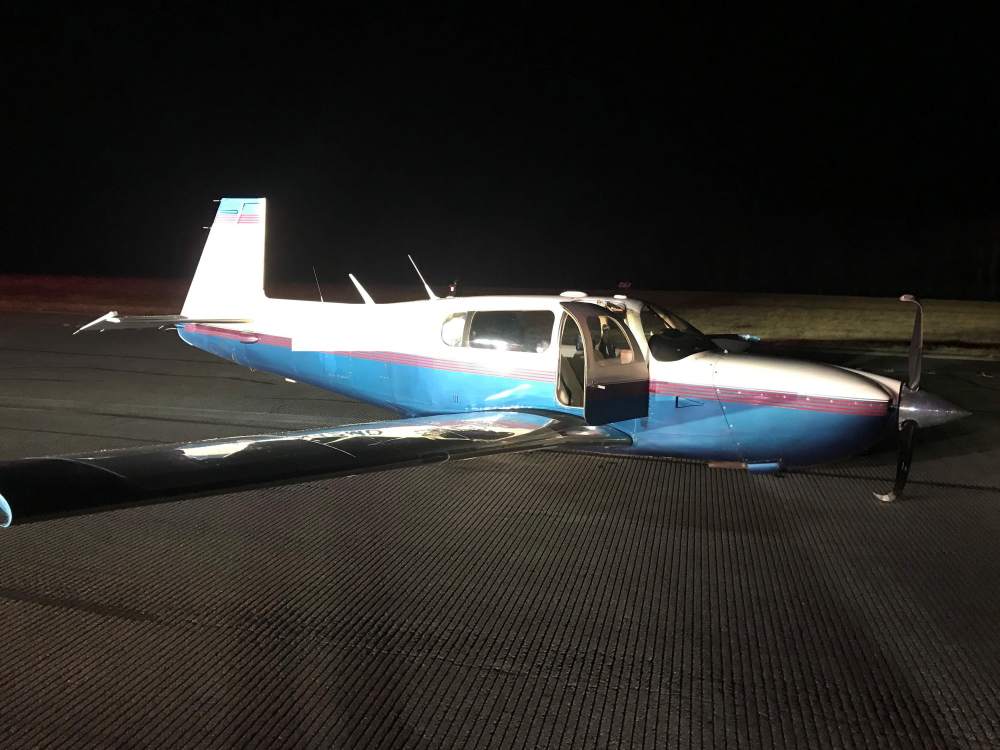
Yep - Ovation. My buddy and I were on the ramp about to taxi out to the runway when we saw it touchdown and the fireworks that ensued. We ran out to the plane to check on the pilot, and he and his passenger were already out of the plane. Everyone was alright. Pilot told us he had gear down and indicating and that it collapsed on touchdown. I left the airport at around 8:30p and they were still trying to figure out how to move it. Last I heard was someone was going to bring a crane and 2 flatbeds to pick it up from the runway.
-
I bought one of those stickers the day I bought the mooney - because it's always there, at one point it's like it isn't there at all. Then I put it on the side window, so it'd be right there when I turned base. The obvious flaw there is on straight-in or instrument approaches, or right traffic patterns. I also have a little lady (I call her Judith) that yells "Gear down! Gear down! Gear down!" anytime my MP drops below a certain point (can't figure out whether it's 18" or 16") and I'm low and/or slow - like I said, it was already installed and I'm not sure what else triggers it (I should find the manual and read it). It's pretty effective because she won't shut up until I bring the gear down and it's right there in my ear whereas the gear down beep gets drowned among all the other noises the plane is making as you configure it for final approach. Lastly - as many have said, 99% of the time I put the gear down to slow the plane down to Vfe.
-
well - after reading this thread beginning to end I became completely paranoid, as you do, and immediately purchased a sensorcon detector from amazon to replace my ASA dot. then I went flying to today and I'm happy to report that, over 4 flights, I got 10-11ppm on initial climb (to 3000ft) and 0-1ppm in cruise with heater on, both floor as well as windshield defrost. now the detector lives in the plane. i'll still keep the dot (i have 3 years worth of them) as backup - but glad to have a reliable and more accurate safety device on board.
-
yeah - it hadn't occurred to me that I could be flying level in an updraft - that'd explain the faster than expected airspeed. As for geographical features, that stretch of land is fairly flat - couple of hills here and there but the main ridge was way off to my right. But I guess when winds are strong enough even slight terrain effects will be amplified at lower altitudes.
-
1. Ball was centered. Yaw trim = my foot. I was on HDG mode precisely because NAV wasn't handling the crosswind too well - it started dancing around the magenta line, so I switched to HDG, crabbed it where it needed to be and went on my merry way, which is why after a little while I had to correct. 2. Ah, I saw something like that happen a long time ago, trying to land on a mountain top in a 172 - huge updraft right before the threshold, pointed the nose down, IAS shot up way more than I was expecting but VS didn't budge (yep, I went around and tried again now taking that into account)
-
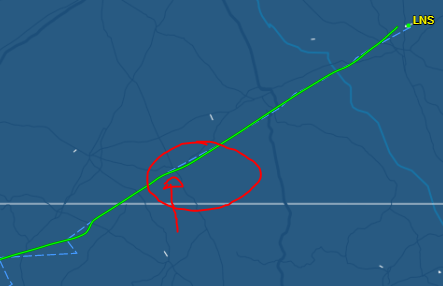
So here's a question for the group - when flying through strong headwinds (50+ knots), have you noticed an impact on INDICATED airspeed? I know the theory, but here's what happened to me just this last Monday: I was flying back from LNS to JYO after having my comm 2 repaired. I was at 6000ft with 60-70 knot winds coming at me from a ~20-30 degree angle, so not too bad. IAS was showing 155 knots, TAS about 165 kn (a little faster than I expected that low, but paid no attention to it, was busy talking to ATC and testing the repaired radio). Then, I had to turn ~10-15 degrees into the wind to stay on course (had the AP in HDG mode and got blown off course a little bit). As soon as I turned into the wind I saw GS decrease by about 10 knots (expected) but I also saw IAS decrease by a good 10-15 knots (now indicating the ~155 knots TAS I expected). I wasn't too fazed by it - I imagine strong winds at an angle hitting the pitot tube might mess with the flow a bit and affect the reading - but I had never seen it like that. I immediately started checking everything else (MP, RPM, all switches and knobs) but it was all normal. Got home, did a little math and GS was what it should've been - so there it is. Comments? Below is the flight aware track - the arrow shows where I turned to correct course.
-
good call. but maybe I need a set of other basic operations on the backside of this page. things like how to tune in a frequency (if ATC gives you one over guard), how to ident, how to read fuel quantity, current altitude etc. i believe a lot of this will she'll learn as we fly more and more often, but in a pinch, might be good to have a quick reference card
-
Makes sense - although I'd still think "engage a/p" first, then go about trying to pry me from the yoke. I'm 200lbs and she's under 150 - that way at least she'll get some help from Otto who'll be fighting me as well. One thing I do is I never take off the shoulder harness - and I keep it tight enough so it'd be very hard for me to slump over the controls just in case. At any rate - I'll add some language around that. Better safe than sorry, right? I think we can probably make it to Rochester in September - it's a shame we missed FDK last year. It's so close to us. I'm also going to check if there's anything of the sort at SunNFun