201er
-
Posts
5,061 -
Joined
-
Last visited
-
Days Won
69
Content Type
Profiles
Forums
Blogs
Gallery
Downloads
Events
Store
Everything posted by 201er
-
I didn’t like the choices of the poll. Anything measured in nautical miles or hundreds of feet is hardly a “close call”. 3nm is about the farthest you can even spot GA traffic as a dot. 1nm you can tell if they’re a high wing or low wing. It’s somewhere between reading the N number and 1nm that qualifies as a close call but it’s hard to put a measurement on it.
-
Would new paint increase my cruise speed?
201er replied to mooneyflyfast's topic in Modern Mooney Discussion
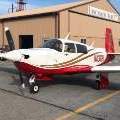
Mine picked up about 8 knots after new paint. However, it was a combination of new windows, body filler, badly damaged paint on leading edges before, and other pre-paint maintenance that happened in conjunction. The windshield cap strip was wavy and sticking up. Put on a new one when the windshield was replaced. Got the A pillar flush with the door. Had the windows, gear doors, and a bunch of prep work done by Byron @jetdriven So it’s not just the paint but all the things you get taken care of when doing paint. But in the end, I go a noticeable 5-8 knots. Since paint I typically cruise 155ktas while before it was about 148-150. I now have to reduce to 21 squared on downwind to get below gear speed while before it was 22. Doesn’t just look faster -
Do skydivers have radios? Do drones have radios? Do birds have radios? No amount of radios can guarantee everyone is on the same frequency, with their volume up, with their radio operable, actually listening, actually comprehending, actually knowing their location, actually conveying the right information, not being blocked by another transmission, etc… See and avoid is something everyone has, comes for free, and works virtually every time. That is why it is mandated while radios are not. § 91.113(b) General. When weather conditions permit, regardless of whether an operation is conducted under instrument flight rules or visual flight rules, vigilance shall be maintained by each person operating an aircraft so as to see and avoid other aircraft. 91.111 Operating near other aircraft. (a) No person may operate an aircraft so close to another aircraft as to create a collision hazard.
-
I’ve filed NASA reports for most of the more alarming ones.
-
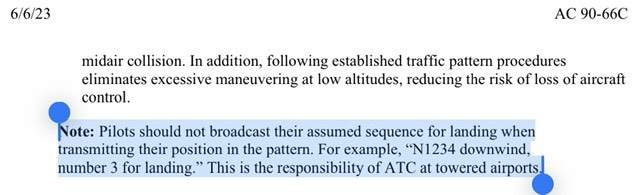
Here’s one unapproved CTAF communication I consider beneficial. AC90-66C says not to say your sequence. I sometimes say it and I particularly appreciate it when others do because it verifies to me they know they are behind me. It’s way more freaky when someone behind makes all their calls without a single mention of me. Makes me wonder if they have their volume down or missed all my calls. Especially if they are calling base immediately after I do. I’ll say something like “Mooney left base 36 number 2 behind the Cessna” Hearing “Bonanza left downwind 36 number 3 behind the Mooney” gives me some assurance the guy behind sees me or is at least aware that I was forced to fly my base a million miles out because of the slow poke ahead of me and isn’t going to cut base leg inside of me! And it helps to know he understands to turn behind a Mononey rather than turn base as soon as he sees the Cessna on final. So I’m not really sure why the AC is against it or what argument (other than congestion) there is not to mention position. But, I find it useful and less stressful when it is acknowledged.
-
Basically I won’t deliberately launch or land with a discernible tailwind. I voted 4 knots but it could just as well be 2 or 3. If the windsock is more than drooped down for calm wind, if the AWOS is reporting a direction and strength, if I know the winds aloft are from the same direction and also a tailwind, I would rather just taxi to the proper runway. Wind calm but with the sock pointing tailwind is the one I wouldn’t taxi to the other end for or when the sock is slowly bouncing around different directions. Once the wind is enough to be clear where it coming from, I’d rather taxi and takeoff into the wind. Just a 4 knot tailwind is 8 knots higher ground speed compared to landing the other way! Even if not dangerous, that’s more wear on tires, brakes, and landing gear. But we also don’t get much practice or experience with tailwinds so it’s another risk factor. Doing a go-around with a tailwind can be quite hazardous. The wind reported on the ground might be a slight tailwind but in the air, the obstacles can be coming up quick with stronger winds.
-
How much tailwind are you willing to accept in a Mooney for takeoff and for landing? Let's say you are parked at one end where a tailwind takeoff or landing is super close but would require a long taxi to the other end for a headwind. I understand runway length, airport elevation, crosswind component, gusts, and other factors can come into play. But strictly speaking for a direct steady tailwind at a moderate length runway with moderate departure obstacles, how much tailwind would you accept to avoid a long taxi to the other end?
-
By that logic, just announce that your downwind, base, and final to the big black runway with white lines that you're not presently on lest you confuse someone
-
I still don’t understand on the persistence of calling it anything but the runway number you’d been calling it all throughout the pattern. To make a point, suppose I landed at KCHD when the tower is closed, I would announce as follows: “Chandler traffic, Mooney N123 clear of 22 left at Lima, taxiing across 22 right Chandler.” ”Chandler traffic, Mooney N123 clear of 22 right at Lima, taxiing Alpha Mike to the pump, Chandler”

-
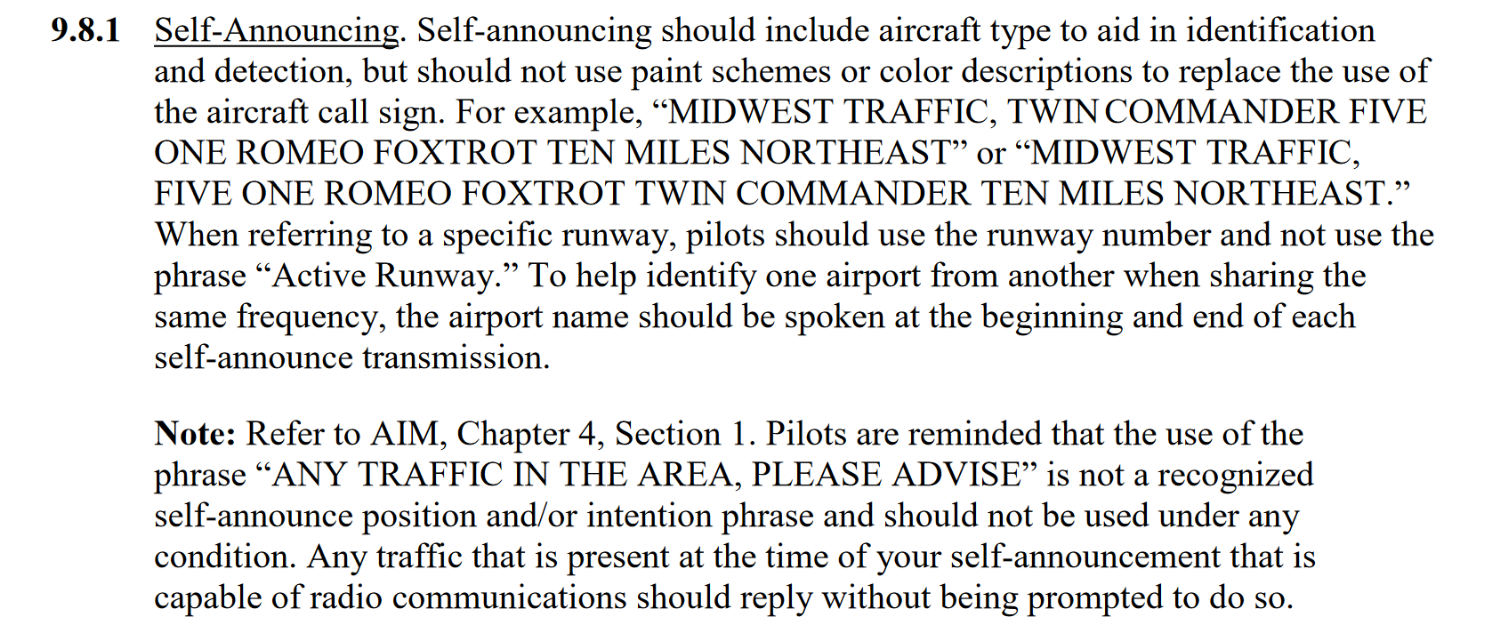
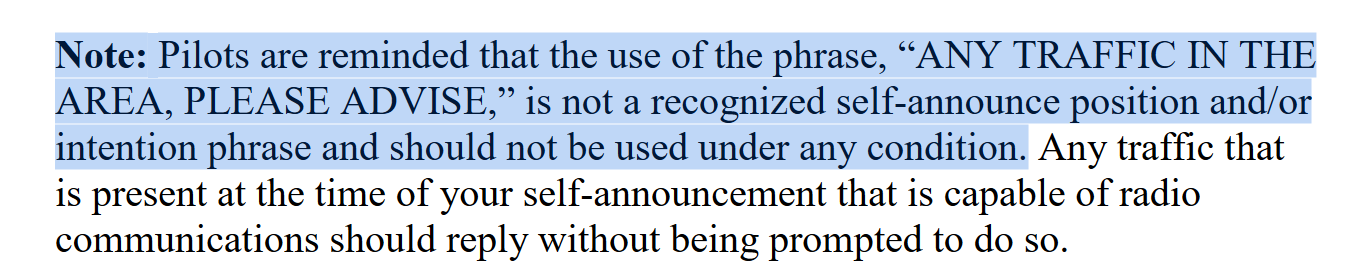
In the newest revision of AC90-66C, they still haven't changed their stance on "active runway" or "any traffic please advise"
-
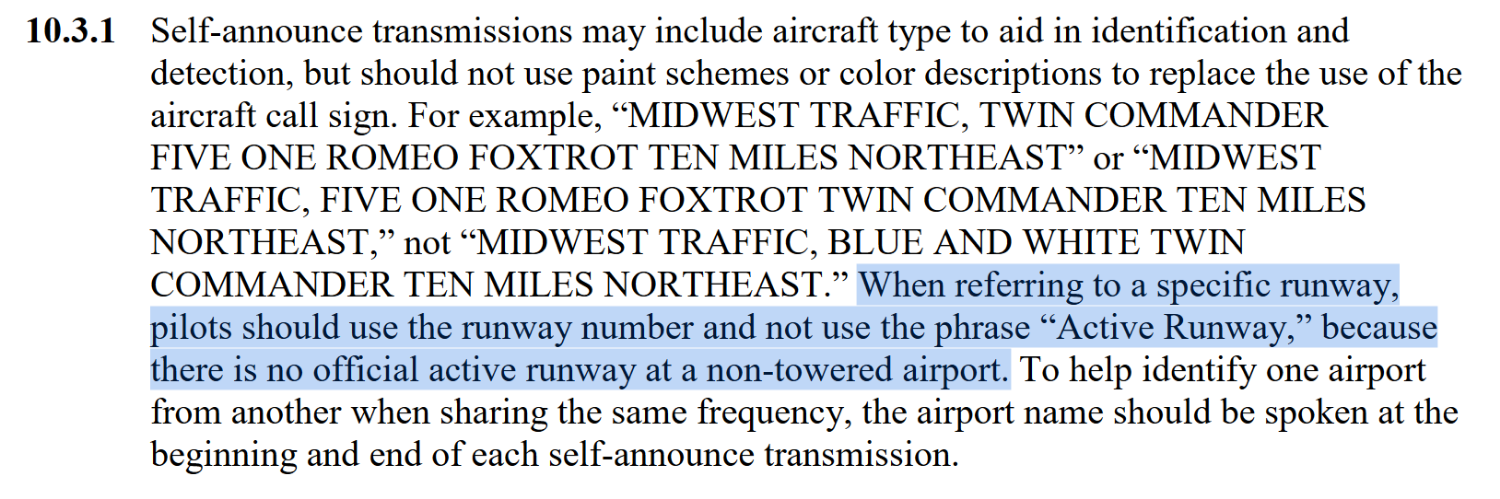
While we're at it looking at AC 90-66B, it actually specifies the word "active" as unapproved. Also "any traffic please advise" is strictly forbidden:
-
So, no GTN 750, G5s, sloped windshield, or sabremech cowl mod?
-
so which is it?
-
Do you commonly fly straight in finals at untowered airports? Do you do this all the time, traffic permitting, or never? What kind of pattern entry do you fly if you are oriented for a straight in final? What do you do if you are toward the end of downwind or already on base when conflicting traffic suddenly appears on final? Do you try to get ahead, behind, or get out of pattern all together? Do you get into arguments about this or say something about it on the radio?
-
Per the FAA, “Most midair collisions occur in VFR weather conditions during weekend daylight hours. The vast majority of accidents occurred at or near uncontrolled airports and at altitudes below 1000 feet."
-
At my home field my clearing call is usually "clear of niner at delta, taxiing alpha echo to the ramp". We have a lot of helicopters doing midfield departures or landing on the taxiway. Communication is great but it has to be concise and specific. "clear of the active" or "clear of the runway" is 4 words to say 1 thing "clear." At least saying "clear of three six" is 4 words to say 2 useful things!
-
Pilot announces: taking off 36 left crosswind 36 left downwind 36 left base 36 final 36 but now suddenly it’s “clear of the active” or “clear of the runway”!? Next thing you know, dingus #2 gets on asking “ten miles out, what’s your active?”
-
I don’t care what direction everyone else is landing, I’m not landing a Mooney with a tailwind.
-
What unapproved radio calls do you find yourself making at unpowered airports on the CTAF frequency?
-
Looking to see if I fit in a m20c
201er replied to Quantum Blueberry's topic in Vintage Mooneys (pre-J models)
Yeah, but they weren’t making so many by then. They built as many Cs in 1962 as that entire 1969-1977 period combined. Not to mention 300+ per year for most years up to 1965. -
Looking to see if I fit in a m20c
201er replied to Quantum Blueberry's topic in Vintage Mooneys (pre-J models)
And here’s a video I did in my J of the real world measurements. Of course the J is a mid body and 10” longer than a short body C. However, to my understanding, the front seat room and amount the front seats slide back is the same. The only difference is that the rear seat occupant has to be a child or they could end up an amputee if you side back suddenly. -
Looking to see if I fit in a m20c
201er replied to Quantum Blueberry's topic in Vintage Mooneys (pre-J models)
That’s a good plan. Mooney isn’t a good trainer to learn how to land a plane on. It has about the worst (in terms of hard landings when you don’t know what you’re doing) landing gear shock absorbers of any plane. You must land it aerodynamically and properly every time. It’s also fast which means things happen in a shorter time which makes it harder to learn and grasp everything. After earning your private and being truly comfortable in what you learned in, Mooney is a promising choice. It’s ok for complex and IFR training. You’re not pounding it with constant landings afterall! An M20C may not be the best IFR trainer (I’m gonna get a lot of hate for saying this) because most of them have the old cluster panels and limited avionics. If you can get an M20C with a 6 pack and GPS, then it’s great. Or, if you plan to make it your lifelong plane, then might as well learn to fly instruments with what you’ve got. An underrated benefit of doing instrument training in a Mooney is the ability to save a lot of gas by going slow. Afterall you gotta log a bunch of hours so you may as well go as slow possible to make it take longer. You still end up flying faster than a skyhawk while burning a lot less gas. In my J I was doing 120ktas on like 6gph while instrument training. I did my instrument and commercial in my J and it was worth it. But I would never recommend primary training in one. -
Looking to see if I fit in a m20c
201er replied to Quantum Blueberry's topic in Vintage Mooneys (pre-J models)
A bigger question is how you manage getting in and out. If you have a hard time getting in and out of the skyhawk, the Mooney will be a disaster. If you’re comfy in a skyhawk and getting in and out is a non-issue, the Mooney is reasonably in play as a post Private Pilot plane to own. For the purpose of training, it would be a big disadvantage. Mooney isn’t a trainer. Unlikely to save money either. -
^That’s a much nicer way of putting it than first instructor said when I passed my first ride. @Flyler keep that in mind! There’s more than can go wrong than can go right. It’s up to you to put in a continuous proactive effort to maintain a safe outcome. Congratulations and enjoy.
-
Isn’t that 16.1nmpg?