C.J.
-
Posts
211 -
Joined
-
Last visited
Content Type
Profiles
Forums
Blogs
Gallery
Downloads
Events
Store
Everything posted by C.J.
-
Which particular zerks were the problem for you? For me the forward/uppermost three zerks of the eleven on the nose gear were the biggest pain. The 90-degree coupler in the 8-piece accessory kit was very helpful here as well as on certain zerks on the MLG. Could not have got them done without it.
-
Given the MS posts re: the 40:1 gear's fragility, scarcity and price if you could find one, I'm very thankful for my manual gear.
-
@MikeOH Thanks, however, I have manual gear
-
@good2eat Thanks. It would be easier to have my own grease gun versus borrowing my A&P's. I bought the Lock-N-Lube coupler plus attachment kit last year. It makes getting to certain zerks far easier.
-
What's the consensus regarding Aeroshell 22 for greasing the landing gear. It meets MIL-PRF-81322 Mooney SMM uses obsolete MIL-G-7711 and MIL-G-81322 specs. A&P is not currently available to answer my question. I'm taking on the responsibility for this from now on as well as all other airframe lubrication. Also, anyone personally own &/or use a Milwaukee M12 Cordless Li-ION grease gun?
-
@LANCECASPER DM sent
-
@SilentT Here's a playlist of 9 videos that should be helpful until such time you get some advanced instruction in spins. Spencer Suderman covers all types of scenarios leading to stalls/spins and all of it is free of charge on YouTube. His explanations and video shots are exceptional and provide priceless info.
-
@SilentT I'm trying to locate a PDF regarding Mooney spin characteristics written by Mooney test pilot Bob Kromer. Thought it might be in MS downloads, but it isn't. Bottom line is there are very good reasons that intentional spins are prohibited in Mooneys. From what I remember it is imperative to apply anti-spin control inputs immediately and agressively. I'll post the file if I ever find it. While a student at ERAU in 1977 we all routinely and regularly practiced the 3 basic stalls in the M20C, both dual and solo. They are certainly nothing to be fearful of, but a certain amount of respect is warranted as with any aircraft. There was one occasion where I spoke to a student, who, as an observer from the back seat on a dual flight, had the flight instructor fail to intevene early and an inadvertent spin was entered. The altitude loss was significant, and he felt they'd never recover. It had happened earlier in the week and this guy was still visibly shaken just recounting the experience. If you want to become skilled at spin recorvery, find a reputable company that teaches aerobatics in a certified aircraft. I did exactly this in 1994 in a Pitts S2A with a former IAC National Silver Medalist. This comprised every possible botched stall entry and covered both upright and inverted spins. Trust me it will be the best money you'll ever spend.
-
Hi @ziggy122 Sorry you're having cold stating issues. As far as me turning off the boost pump, what @Andy95W said regarding this is also my reason. I'd only add I want all the juice from the battery being used by the starter (other than my anticollision beacon which uses next to nothing in amps). Throttle pumping as @Hank points out, is definitely effective under the conditions he outlined, however I've never needed to do that. Lots of good advice from other MS'ers here as well. In summary start with a well charged battery, some decent pre-heating (I highly recommend the "Reiff XP System with the Oil Cooler option") with an insulated cover and adequate priming & wait a minute for good vaporization. Best regards, C.J.
-
@MoonMan I prime with 6 throttle pumps with boost on below 50*F (4 throttle pumps when above 50*F) then boost goes OFF. Throttle cracked 1/4 - 1/2 inch Wait :30 seconds for fuel to atomize and then engage starter. My engine always starts in 2 seconds (yes, I've timed it) I don't pump the throttle during the start. I use a battery-minder charger/desulfator - battery is usually at 12.7 volts prior to start.
-
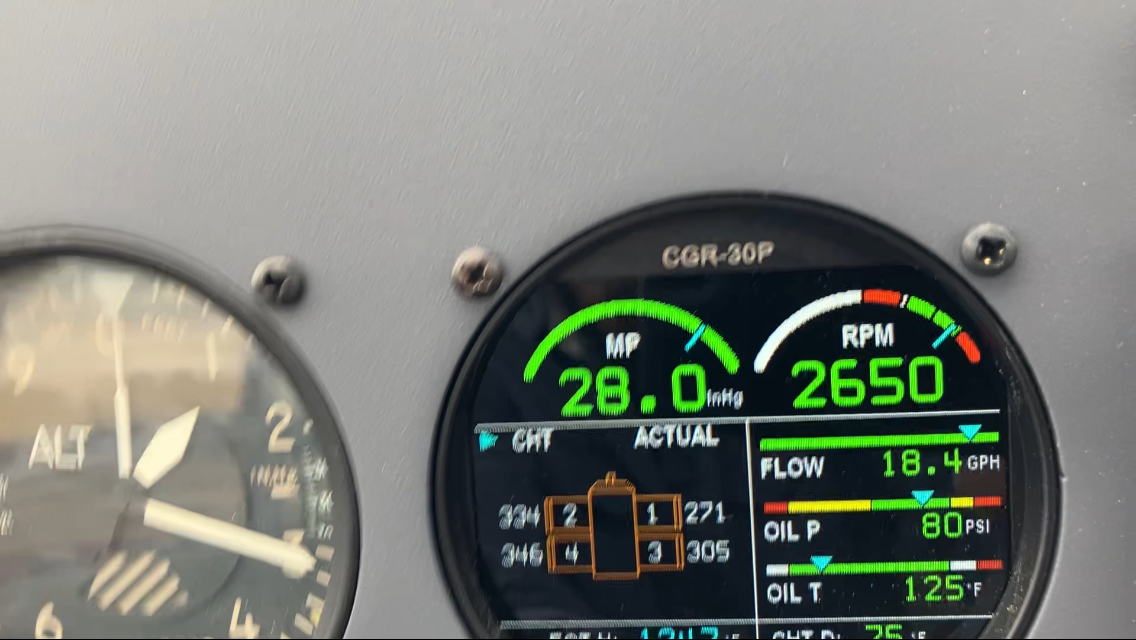
This was just a ground run-up. Climb CHTs AFTER applying rtv to gaps in doghouse reduced temps by 25*F. After carb was reamed 8%, climb reduced an additional 10*-15*F. End result climb CHTs 385-390*F versus about what you reported. Your doghouse appears to have no rtv applied to the gaps. Note the black rtv on my doghouse. I spoke to a Marvel Schebler tech re: 4164 fuel flow specs and was told there can be significant differences in T/O fuel flows between any two carburetors chosen right off the shelf. STD Atmosphere SL fuel flow should be 18 GPH.

-
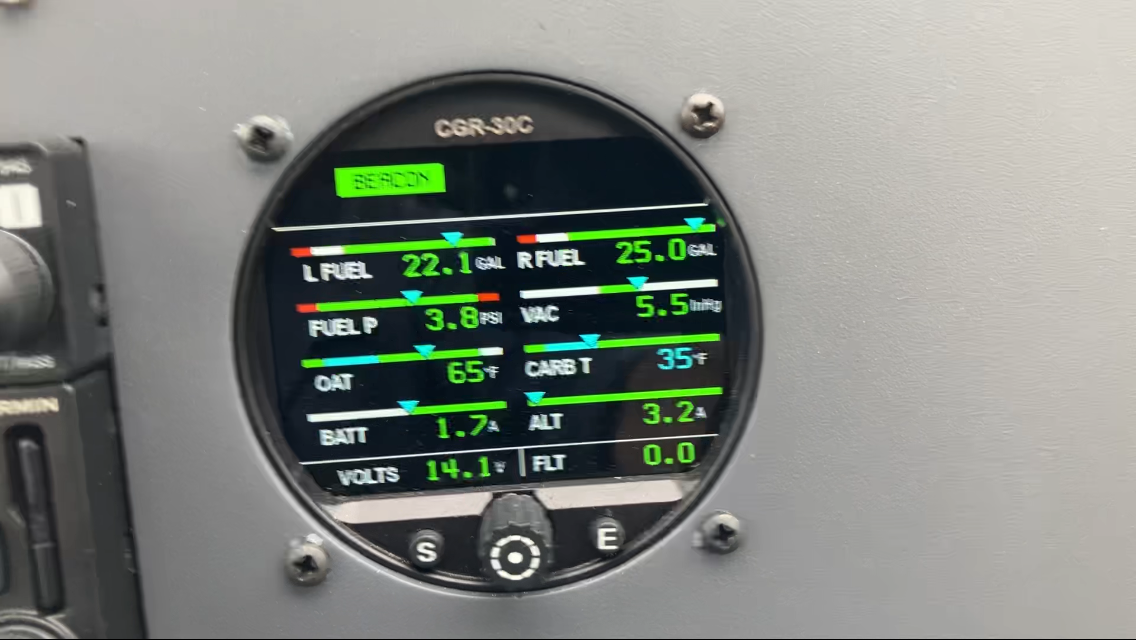
@Phil123 I had similar numbers to yours, however my C has std mags, Power Flow & Lasar inlet mod. I’d recommend WOT in climb even if you choose to reduce rpm temporarily for noise abatement. I’m cleaned up and pushing to 120 mph by 500’ - 600’ AGL as well. It seems all Cs run hot. Do the flashlight test & ensure any doghouse gaps are sealed with rtv. That step brought my cht’s down quite a bit in climb & cruise. I had my 10-4164-1 reamed by 08% & got better climb cht’s. An O360 can’t be timed to 20* degrees, only the IO-360 is authorized, but your A&P could be within 1* degree, iow 24* and still be legal. Here’s a recent run-up at 65*F & 1500’ DA.
-
Altimeter rebuild recommendations
C.J. replied to Matthew P's topic in Vintage Mooneys (pre-J models)
Rudy’s Aircraft Instruments. They overhauled my ASI. Very nice people, quick turnaround and reasonable $$. -
Well yes, it definitely depends. For the record I did state "IIRC" & "plane I've flown". The only retractable singles I've flown any meaningful time in were 1974 -'77 M20C's & my '65C. So far nobody has extended the invitation to fly their T-6G or any other warbirds, but I'd happily accept if offered Everything else I flew had 2 engines and approach flaps before gear extension was the way we operated regardless of which had the higher limitation speed. I didn't keep their AFM/POH when I stopped flying them, so ... C310R, C402B, PA31-350, SA226-TC, F28 Mk 4000, B737-2/3/400, B757/767, MD-80, A319/20/21 I'm 100% single pilot now and gear down before flaps works well for me and for this plane, but that procedure might change if bought something different.
-
^^^^^ I agree ^^^^ but having said that, IIRC, my 1965 C is the only plane I've flown where Vlo/le was higher than Vfe. For everything I flew in my previous life, flaps to approach setting prior to gear extension was the procedure IMC or VMC.
-
Congrarulations. When you can, post some photos.
-
Sounds good, I'll go with 737. Thanks Skip.
-
Need to reseal my doghouse with RTV however I don't remember what I used the last time. So, which is the correct one, 732 or 737? Thanks in advance.
-
Unfortunate incident with the AOPA sweepstakes Husky
C.J. replied to Shadrach's topic in General Mooney Talk
That's a lot of hostility for one post. Who pi$$ed in your coffee today? -
-
My Mooney's serial number is two #s earlier than yours and had its original VOR/LOC/GS antenna & coax. Its range was way better than yours, but not as good as it should've been. A new RAMI AV-525 & coax fixed the problem. My technician was unable to pull the original coax out of the vertical stabilizer, so just put new connectors at each end and then routed new coax forward.
-
-
Runway Entrance & Stop Bar Lights currently exist & are all great, but they are no substitute for staying heads-up while taxiing and complying with a hold short clearance, confirming you're cleared across or just stopping if in doubt or utilizing the no-cost low-tech method of looking out the window left & right when crossing an active runway.
-
I'm in the middle of a plastic repair & restore process right now. I recommend S.E.M. products, specifically their soap, adhesion promoter & paint. My results have been great. Just follow their directions. By all means get a respirator AND goggles because the adhesion promoter & paint fumes are horrible. You'll need nitrile (or neoprene) gloves and unless you want your finger to cramp up get a "Can Gun" aerosol spray trigger from Aircraft Spruce. Paint on a calm day ideally between 70* to 85*F. It's best to apply several very light coats (up to 7 or 8 in my case). It dries very fast but wait the directed amount of time between coats. If you've never spray painted before watch a YouTube video for proper technique. It's not difficult but I practiced on an old cardboard box just 3 times until I had it perfected. Leave your finished work to cure for a day or two before handling. Most if not all odors will have dissipated by then unless the ambient temperatures have been cool. Fun Facts - S.E.M. paint is expensive but totally worth it. IIRC McFarlane sells a limited number of colors and had it for a good price. Unfortunately, not the specific color I wanted. O'Relly Auto Parts was pricey and had supply chain issues. Amazon saved the day and was by far the least expensive but be aware they don't have returns on paint due to it being HazMat. Calculate your square footage necessary and order conservatively knowing you can always order more if needed. For cracks in the plastic, I initially tried "Satellite City" instant glue, specifically their "Hot Stuff" and "Super 'T'" product. It has the viscosity of water which I found difficult to control and the results were not what I'd hoped for. I ended up using 7 Quarical Easy ABS Repair Tips for Easy Plastic Solutions which is an all-in-one pre-mixed ABS solution which proved to be outstanding. My headliner had some very bad cracks, splits & holes The ABS resin resembles tar and is applied from the back so no will ever see it. Time will tell if it holds up but I'm very optimistic. If you need more specifics just send me a DM. It'd be easier to explain it on the phone. BTW great looking Mooney. Wow!!!
-
Both these companies are very good. Rudy overhauled my ASI. I bought an overhauled Mid-Continent p/n 1394T100-3Z TC from Commander that they had in stock for $950. Rudy Aircraft Instruments - Overhaul Prices Commander Instruments and Avionics, Inc.