
0TreeLemur
-
Posts
3,268 -
Joined
-
Last visited
-
Days Won
8
Content Type
Profiles
Forums
Blogs
Gallery
Downloads
Events
Store
Everything posted by 0TreeLemur
-
Yeah, but I didn't think mine was a dumb question...
-
I suppose (hope) that the knee vents are easier to get to than the overhead eyeball vents!?! We removed one of the overhead eyeballs last month to repair it. The thin wavy washer (forgot name of, son knew it) came out of its slot, causing the whole thing to stop working. It required surgery. Opposite of stuck. I like Skip's contact cleaner idea. Might break up some gunk.
-
Normally I fly with the knee-height eyeball vents open. If hot, they blasting me and my co-pilot. If not, they blast the avionics. On a recent multi-hour flight with OAT -9C they needed closing. The pilot's side vent closed. Co-pilot's side stuck open. It seems that there's probably one right way to lubricate the internal mechanism and many wrong ways. What's the right way? I want to avoid lubricating the eyeball joint itself - just the internal mechanism. Thanks!
-
Find a used B-hub Hartzell if you've got time to look. Airplane propellers were pretty much figured out by WWII. Every "new" prop feature since then is a tiny improvement. The Hartzell Top Prop is now $15k new. I bought one a few years ago and the paint wouldn't stay on the tips. They could care less.
-
Good to know. I've never tried that on the iPad.
-
I right click first. That simultaneously puts a white circle on the map at that point and opens that menu.
-
After I click on "Sounding" up pops this:

-
Weird. Chrome is where my premium subscription is set up. When I open windy.com in firefox, which is not premium, and right-click, I get a little menu that looks like this:

-
I use windy.com. If you right click on a point, you get a little pop-up menu that lets you select a sounding tephigram (deviation of temp. and dew point. vs height from dry adiabatic ). After the sounding appears, you can select skew-T optional toggle.
-

Flying CCW around a low tomorrow
0TreeLemur replied to 0TreeLemur's topic in Miscellaneous Aviation Talk
Got a little revenge today on the return flight- Santa Fe to Tuscaloosa (938 NM) non-stop in 5:25. 173 knots average groundspeed at 11,500. Landed with 18 gallons of fuel left in the tanks. Fun! As the plot shows, the further east we traveled, the tailwinds increased. Just before TOD we were up around 195 knots. At the beginning of the cruise descent the groundspeed hit 210 knots. Did not see a single cloud anywhere, all day.
-
Flying CCW around a low tomorrow
0TreeLemur replied to 0TreeLemur's topic in Miscellaneous Aviation Talk
We're on the ground in New Mexico. Going westbound around the north side of the low we too stayed as low as possible. Clouds galore. First time I've ever flown 1000 mile trip all on an IFR flight plan. First leg from Tuscaloosa to Tulsa kept us mostly perpendicular to the wind with avg. groundspeed of about 130 knots. Second leg to SAF we stayed at 6000 as long as possible and had groundspeeds increasing from 120 to 150 knots until we had to climb due to rising terrain and clouds to 10,000. The last hour and a half was a slog at 110-115 knots groundspeed and that good ol' front range turbulence. Many controllers were very busy. Lots of piston GA traffic today. Everyone I talked to was very professional and helpful. My co-pilot is aces! She really pulled her weight today in a high workload environment with complicated flight plans! Happy Thanksgiving everyone! Go Mooneyspace! -
New Blue Stain on Floor - Fuel Pump Problem
0TreeLemur replied to 0TreeLemur's topic in Modern Mooney Discussion
On our J the gascolator drain hole is about 2 ft aft of the boost pump drain hole, which is almost 2 ft aft of the engine driven fuel pump vent hose . -
New Blue Stain on Floor - Fuel Pump Problem
0TreeLemur replied to 0TreeLemur's topic in Modern Mooney Discussion
I took that panel off today and gave the boost pump a good looking over. Everything appears fine. Fittings are good, no external leaks. Since we tested it Sunday it hasn't leaked any more fuel. Went for a test flight today to top off with cheap ($4.30) fuel, and when I returned it was not leaking. I'm thinking that since I didn't fly for 5 weeks, maybe the seal dried out enough to let a little leak out. Anyway, I don't see this as something that grounds the airplane. The pump works fine (27 psi) and has stopped leaking out of its vent. Thanks everyone for sharing your thoughts. This board is a great resource. -
Tomorrow we're flying our J from Alabama to New Mexico. Normally we fly direct and it takes about 7:15 total. Because of a deep low over southern OK tomorrow that route gives us 45 knot headwinds at 4500! Worse up higher! 8:40 total flight time. I played the "what if" game using Foreflight and WIndy.com. What route gives us the shortest flight time? We ordinarily stop for fuel in Altus, OK, but that's a no-go. I tried Edmond, north of OKC, it cut the flight time to 8:20. I tried Wichita, KS. That cut the flight time to 8:00. I tried Emporia, KS, and that cut the flight time to 7:40. We'll actually have a slight tailwind from EMP to SAF. I suppose that jets and the airlines deal with this kind of thing all the time. First time for me that I'll be flying 100 nm further to shave 1:20 off our flight time.
-
New Blue Stain on Floor - Fuel Pump Problem
0TreeLemur replied to 0TreeLemur's topic in Modern Mooney Discussion
The one that is on there is a Weldon according to the logs. -
New Blue Stain on Floor - Fuel Pump Problem
0TreeLemur replied to 0TreeLemur's topic in Modern Mooney Discussion
We just went to the hangar and tested the boost pump. Two times, running for 1 minute each time. Three or four drops of fuel came out of the vent in the first 20-30 seconds then fuel stopped coming out of the vent. It produced 27 psi of pressure. Seems like it isn't something that would ground the airplane. -
New Blue Stain on Floor - Fuel Pump Problem
0TreeLemur replied to 0TreeLemur's topic in Modern Mooney Discussion
Thanks Skip! Just sitting in the hangar it is leaking a drop of fuel maybe once per 30 minutes or an hour. It is not a bad leak. I'm wondering if this is bad enough to prevent me from making the flight to New Mexico? -
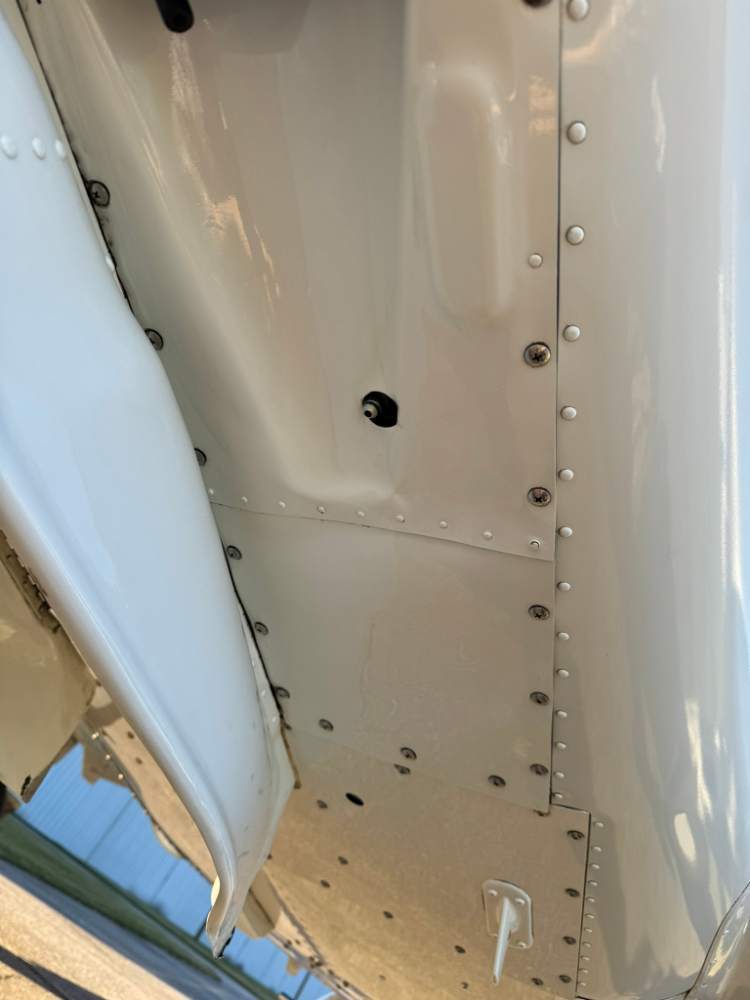
In late October I traveled to Europe for meetings and returned unwell. For this reason I hadn't flown in awhile. Yesterday I went to the hangar to check our J over in prep for our trip to New Mexico for Thanksgiving and I notice a new blue stain on the floor. Investigating, it's coming from a fitting below the engine. I remember reading somewhere that fuel coming out of this fitting means that the engine driven fuel pump is on its way to failure. Drat. Looks like another commercial flight...

-
Meltdown.
-
Hey Paul- thanks for sharing this. Any idea what caused the overboost? That's crazy. I've got an old manifold pressure gauge out of a P-51. I think it is normal max at about 50 in Hg, with a military red line at 60 in case of emergency. I'm surprised the head didn't pop off the cylinder.
-
The white buttons on the JPI EDM900 installed in my J are not the most responsive. Sometimes a single press is not effective, requiring another press. Sometimes a single press becomes a double press. From time to time when I press LF it becomes a double-press that activates LF and switches it to ROP mode. That's why I include the check to verify LOP mode.
-
Where I cruise above 7000', WOT, I pull the mixture back to a fuel flow just below 8 gph, (low 7 gph above 10k) then I press LF. Verify LOP mode, then richen slowly. The richest cylinder will peak first and the leanest will peak last. I then lean the mixture until the richest cyl. is where I want it. If below 65% power, I'll run it at peak EGT. If between 65-70% power, I'll run the richest cylinder about 20 LOP, the others will have colder EGTs. At 8000' this usually gives ff of about 8.3-8.5 gph. At 11,000' the ff is something like 7.8 gph. When OAT's are cold, I'll often need to richen further to keep all CHT's above 300. The GAMI spread on my engine is about 0.2 gph.
-
Where I usually fly, above 8,000', I've realized something lately. The technique of using the "Big Mixture Pull" then the Lean Find function on the JPI EDM900 to establish something like 25 or 50 F LOP, is not dissimilar from the way I was originally taught to lean an engine while a student pilot. Lean it out until it starts to run roughly, then enrichen until it smooths out. Admittedly, the trainer was carbureted vs. the fuel injection on my J, but the procedure and end result is surprisingly similar. My J will run deep LOP. The engine just gets quieter and quieter as it produces less and less power. When it starts running rough, it's waaay LOP. On long flights up high, especially in the winter, I find that the critical limit is running rich enough to keep CHT above 300 in all cylinders.
-
Nosewheel Steering Disconnection on Retraction
0TreeLemur replied to moosebreath's topic in Modern Mooney Discussion
I nominate this for the best post of the year! I think we need another button! -
While difficult, it is possible. Tower might say "you're number 3 behind a King Air and a Citation" and ask for an extended downwind, so you think "I'll wait to drop the gear." Then you get another traffic alert from tower, and after an intense search of the sky you report that you don't see the Citation, they ask you to do a 270. Next thing you know, you're slow and the gear are still up. Luckily, but for the grace of God, I did notice at the 500 ft call out that my gear were still up.