

Rick Junkin
-
Posts
1,443 -
Joined
-
Last visited
-
Days Won
8
Content Type
Profiles
Forums
Blogs
Gallery
Downloads
Events
Store
Everything posted by Rick Junkin
-
 You're correct, we need to adjust for GW. Roughly 1kt per 100 pounds in my M20M. If you're using Foreflight Performance subscription and you have your airplane performance set up you can get the approach speed for your projected landing weight from the Flights page. I don't have a J POH to reference, but the approach speeds for different weights are at the top of the Landing Distance chart in the M POH. Those speeds are also only computed for full flaps at the various GWs. If nothing else you can do what I did and use the Stall Speed chart, assuming there is one in your POH, and do the math for the approach speeds for no flaps, approach flaps and full flaps at the weights listed in the Stall Speed chart. My rules of thumb for empty weight plus fuel, just like we did in the jet (BAW + ordnance + fuel), as I said is 1kt per 100# (I use 15g of fuel as roughly right to make the math easier) but not sure that's appropriate for a J. Probably? "Better" and more familiar answer for you is to target the book approach value and then adjust with reference to AOA, but that requires installing a reliable AOA indicator. Now THERE'S an open Pandora's box!
 -
Tit probes. Have two which one do I really read.
Rick Junkin replied to warrenehc's topic in Mooney Bravo Owners
How do your individual EGTs compare to the TITs from the two probes? My TIT, as measured from the OEM location, is about 75-100Fº higher than the average of my EGTs. From your pictures it appears the OEM location probe is fairly new, while the other one shows signs of erosion at the tip and buildup at the base. I would expect, as @LANCECASPER pointed out, that the worn probe would be reading lower than actual. The fact that they are reverse of this, with the newer probe reading lower, is puzzling. This is a guess, but it may be possible that the buildup of gunk at the base of the second probe is retaining heat and causing the probe to read high. I agree with Lance, installing new probes at both locations would provide a more accurate basis for comparison. If the OEM probe is indeed fairly new you may only need to replace the secondary probe, which is looking a little worse for wear. I'm not a mechanic, just a maintenance-involved owner. -
Is this an emergent problem or has it always been this way? Are you always re-trimming in the same direction? Are you seeing the trim "drift" in smooth air? The first things that come to mind are either hysteresis/backlash or friction in the rudder control system. Have you looked at the condition and security of the pushrods and linkages? Were they lubricated recently?
-
Ly-Con options on IO-360-A1A Overhaul
Rick Junkin replied to Vance Harral's topic in Vintage Mooneys (pre-J models)
My cylinders were ported and balanced by Lycon before I bought the airplane. Anecdotally the airplane has TKS, which typically induces a speed penalty, but it still makes book speeds with slightly lower fuel flows (tenths of GPH). And I'm able to run LOP without vibration (TIO-540-AF1B) which again anecdotally could be aided by the cylinder balancing. Not a "smoking gun" endorsement but a positive performance report. -
Tit probes. Have two which one do I really read.
Rick Junkin replied to warrenehc's topic in Mooney Bravo Owners
Thanks for this info. Never would have occurred to me to drill into the turbo transition casting where this one is located. Makes sense that a second TIT probe would be required to get it displayed on a non-certified monitor. Having said that, here's a pic of my transition during installation of the overhauled exhaust. It has a second TIT probe mounting point cast into it. I thought it was odd, but now I understand why it's there. Thanks Paul!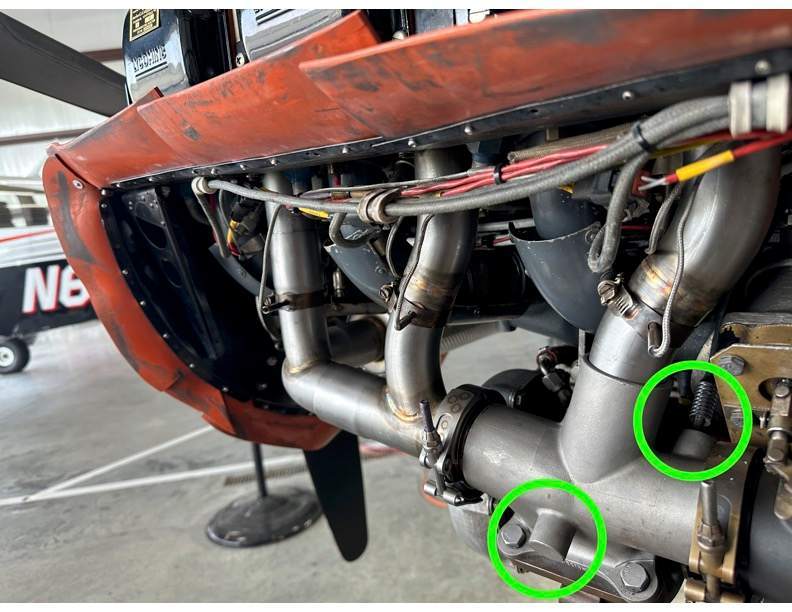
-
Apologies if this has been discussed before, but I just learned that EFIS Editor https://rdamazio.github.io/efis-editor/ can be used to import, edit, and print checklists created in Foreflight. It can also be used to create checklists from scratch and export them in the FMD format that Foreflight uses. I've been asking Foreflight to develop a web based checklist editor for years, and here the capability was available from a third party all along. The really cool thing for me is that this same editor can import/export your checklists in multiple formats for use in Garmin, Dynon, and other avionics. That means I can load the checklist I built for my G3X and export it in FMD format for redundant use in Foreflight. AND I can print it, something lots of folks have been wanting to do for years. I hope this is useful information for other folks.
- 1 reply
-
- 1
-

-
Tit probes. Have two which one do I really read.
Rick Junkin replied to warrenehc's topic in Mooney Bravo Owners
I'm curious as to why someone drilled into the turbo transition casting to install a second TIT probe. From the picture it looks like the second probe has been there for a while, judging from the build up at the base of the probe. It shouldn't be there, but someone obviously thought they needed it. Do the log books shed any light on when and why it was installed? To my knowledge that casting is no longer available except through salvage and plugging the hole after the probe is removed might be problematic. But I'm not a mechanic so someone else here probably has a solution to share. I had mine overhauled with the rest of the exhaust earlier this year and it came back looking like new. Just to make sure we're all talking about the same probes, I've put a green circle around the OEM probe location and a red square around the added probe. The #6 EGT probe is in the riser above the transition, right about the same place mine is.
-
Cirrus training CAPS use rationale
Rick Junkin replied to Rick Junkin's topic in Miscellaneous Aviation Talk
What year did you attend the Cirrus training course? -
What does an intake leak look like in a turbo?
Rick Junkin replied to Ragsf15e's topic in M20K Owners
Excellent. I'm looking forward to hearing if this resolves your issues. -
I thought this was interesting and enlightening. Some of you may already know this but it was new learning for me. A good friend of mine is an instructor at the Cirrus Training Center in Knoxville. He explained to me why he would almost never attempt an off-field landing in a Cirrus. He said there is a very high probability of nose gear collapse and flip-over on a rough field landing, which would likely trap the occupants inside. According to Jeff: The Cirrus CAPS system is designed to descend the airplane in a slightly nose down attitude. In addition to the honeycomb seat structure that absorbs an amazing number of Gs on ground impact, the nose gear structure is designed to fail in such a way as to also absorb impact energy. Because of this the nose gear is not as robust as one might think. Anecdotally I recalled hearing about quite a number of nose gear collapses on Cirrus aircraft as a result of bounced landings, which now makes more sense to me. Jeff then showed me some pictures of Cirrus airplanes upside down in pastures where an emergency landing had been attempted. Now, I know you're probably thinking the same thing I was, that any airplane could flip over on an emergency landing in a soft or rough pasture. But according to Jeff the odds are way against you in a Cirrus, and the risk of getting trapped in the airplane if it flips is exceedingly high. If an unknown open field were his only option in an emergency he would definitely use the CAPS. So that's why the Cirrus training emphasizes (insists?) that the CAPS is the answer to an engine failure over anything but a suitable/designated landing strip. In optimizing the airplane for the survival of the occupants after a CAPS deployment the nose gear was developed with a shock-absorbing collapse as a design feature. That explained a lot for me.
-
What does an intake leak look like in a turbo?
Rick Junkin replied to Ragsf15e's topic in M20K Owners
I think there is a good chance you'll see the spread narrow back to 0.5gph once you get the other issues sorted. Good luck! And yes, please do share the feedback you get from Savvy. Another opportunity for me to learn something. -
What does an intake leak look like in a turbo?
Rick Junkin replied to Ragsf15e's topic in M20K Owners
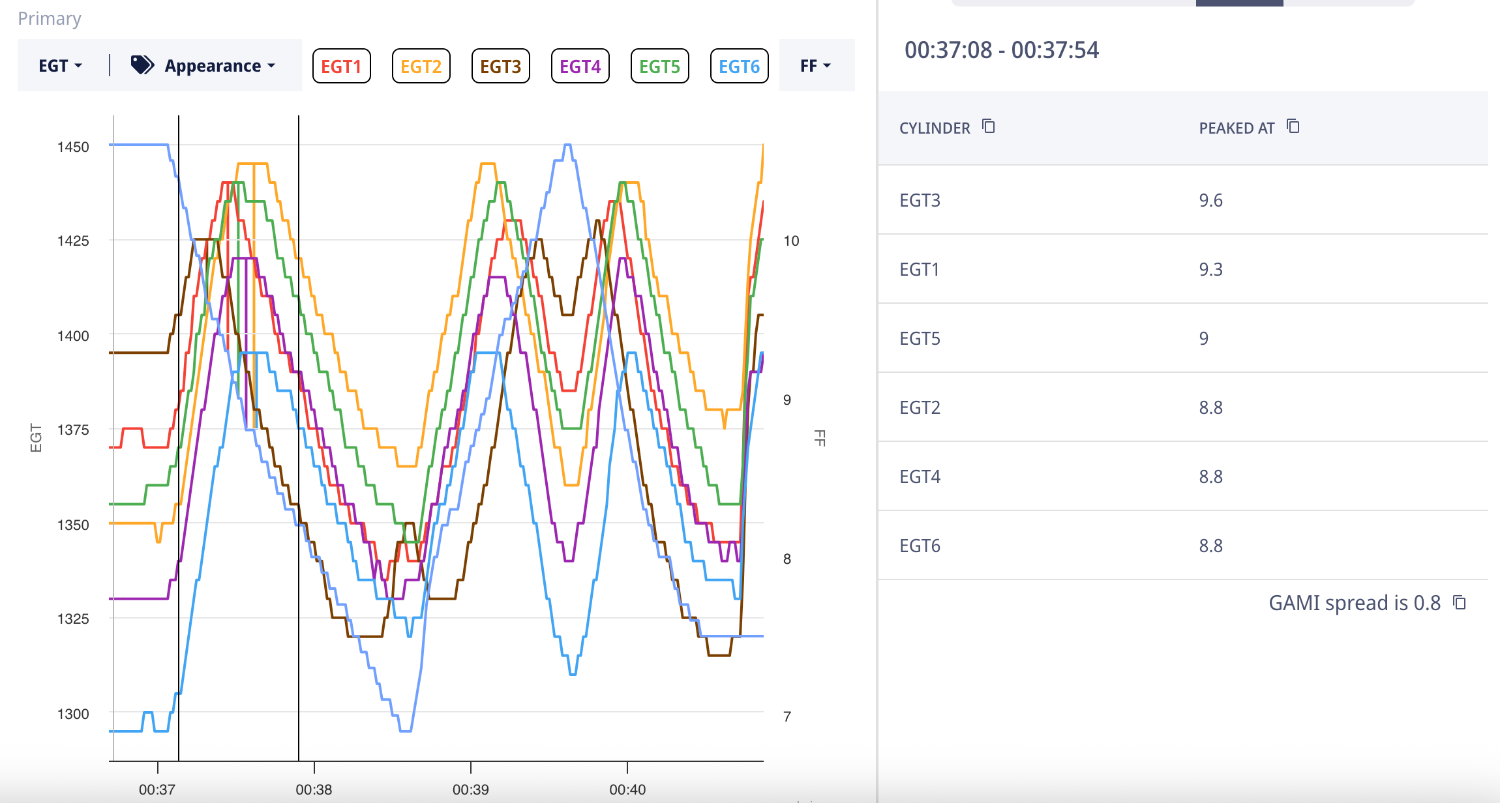
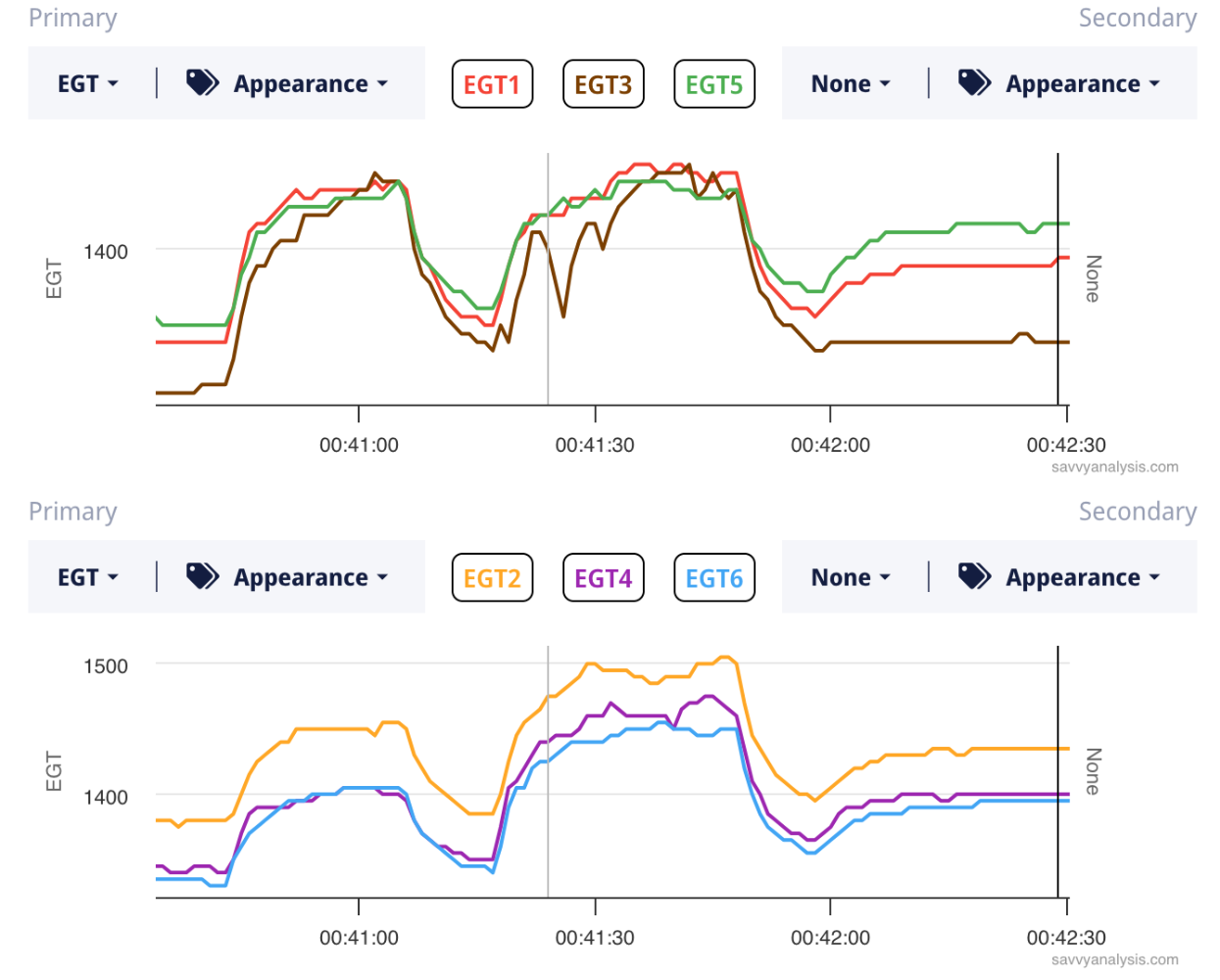
Ok, looking at the data here https://apps.savvyaviation.com/flights/shared/flight/10135421/f4cb8108-85d3-4a47-adf0-32b33235bc85 Caveat emptor - I'm not a mechanic, so this analysis is based on my own self-education and limited experience assessing engine data. You will definitely want to run anything I come up with by an expert for validation. That's what I do with my analysis of my own data. Bottom line up front: What I see in the data shows issues with the ignition system and indications of an intake leak on the even side of your engine, most likely at the #6 intake port. EDIT: However, all of these things can affect each other. So it's often best to make one change, reassess performance, and then proceed to the next change if things haven't resolved. The easiest check is the soapy water check for an intake leak, so I'd start there. Here are my observations. 1. Induction check - The even cylinder EGTs dropped less than the odd cylinders, with #6 dropping the least. The even side drops were 160/160/135 for #2/#4/#6, and the odd side were 190/210/190 for #1/#3/#5. Less of a drop indicates a leaner mixture which means more air, hence an intake leak on on the even side. A single leak on one cylinder could be bad enough to affect the whole bank. From the data #6 looks to be the worst, so that's where I'd start with a physical inspection using soapy water and intake pressurization. But I'd look at the whole even side. If you look at the tail end of the data trace for #6 you'll notice a "bounce" in the EGT that isn't present on the other cylinders, further nominating #6 as the source of the problem. 2. GAMI sweeps - These indicate your cylinders are not well balanced for LOP ops. There are 3 available data sets here. The first, moving from rich to lean, yields a spread of 0.8gph; the second, moving from lean to rich, is 1.1gph; and the third, moving from rich to lean, is 1.2gph. Here's the sampling of the best case, but you can see the other two sets of peaks as well. There's some work to be done here, but not before you take a look at your ignition. Which leads us to... 3. LOP Mag check - The first mag you checked looks to be a little weak, especially on the even side of the engine. #4 and #6 in particular. And then #3 on the second mag is a bit erratic, which may be a weak plug or wire, and #4 & #6 are again weaker than #2. You'll want to get this figured out first and then look at your GAMI spread again. EDIT: Disregard the comparison of #4 & #6 to #2. Minor differences between EGTs are expected and dependent more on probe placement and other flow factors that vary between cylinders. Comparing EGT behavior across multiple cylinders at different conditions is valid. Comparing absolute EGT values in most cases is not. My bad. Once again, I'm not a mechanic and this is an analysis of your data based on my own learning and limited experience. Get an expert's assessment before spending any money.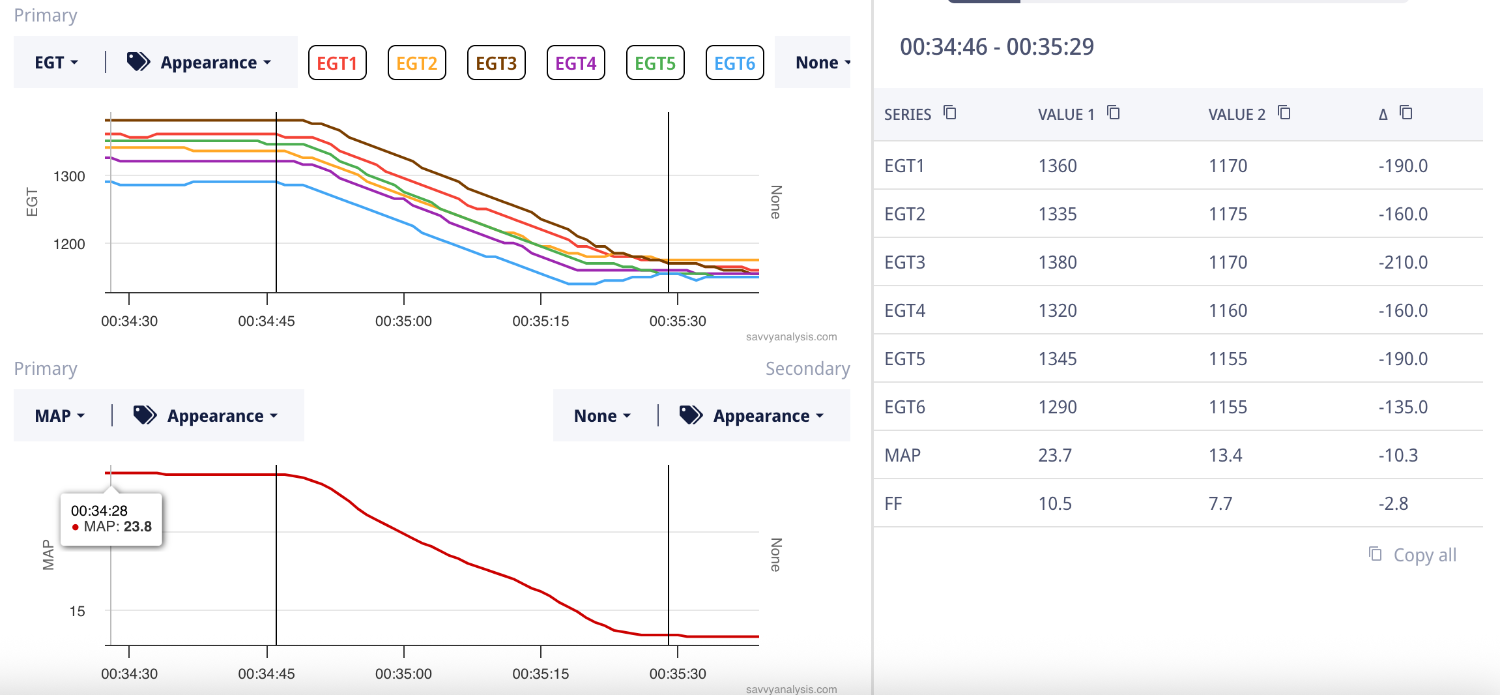
-
What does an intake leak look like in a turbo?
Rick Junkin replied to Ragsf15e's topic in M20K Owners
Perfect, I'll take a look and get back to you in a bit. Hopefully other folks will be looking as well -
What does an intake leak look like in a turbo?
Rick Junkin replied to Ragsf15e's topic in M20K Owners
@Ragsf15e You'll need to share the link from the Savvy page, not the copied link address you have in your browser. You'll find it on the right side of the Savvy page when you have the flight data displayed. The link will look like this https://apps.savvyaviation.com/flights/shared/flight/8944398/75270480-f077-4e40-9c9d-5b70f51d9a31 -
Default latitude and longitude format in the G1000
Rick Junkin replied to dkkim73's topic in Acclaim Owners
How do you make the change? What’s the menu/selection flow? -
Default latitude and longitude format in the G1000
Rick Junkin replied to dkkim73's topic in Acclaim Owners
Your best bet, if you’re planning to do this yourself, may be to enter config mode and look for a coordinate format setting option. But I’m guessing you’re trying to avoid entering that mode unless you know it will get you the result you want, which is a prudent move. There is sure to be a Garmin guru along shortly who can offer more info. Have you talked to an avionics shop with a Garmin dealership? Configuration changes are typically frowned upon by Garmin unless one of their dealers make the change. @Garmin Aviation Team -
Lasar Aviation Mooney Assurance Program - Really?
Rick Junkin replied to PeteMc's topic in General Mooney Talk
The whole pitch feels premature to me. My impression after reading through what LASAR has released is that they are still at the "back of a napkin" stage in this project but decided to put it out where people can see it to garner interest. Unfortunately they haven't presented anything detailed enough that we would regard as tangible value in which to be interested. There have been a number of threads here about pooling resources to do group orders of high demand parts in quantity but I can't recall that I've seen any of them be successful. I'm happy to stand corrected if folks have done it. LASAR apparently did it with the no-back springs on their own dime (as far as I know). If that is what this scheme is really all about, generating the up-front cash for more cost effective parts production, it would be nice if they were able to just state it clearly that way. Still, I would want to see a stronger value proposition than solely parts availability to warrant the annual subscription fee. Does LASAR have a presence here on MS? EDIT: I answered my own question (duh) @LASAR -
Hangars at Pineville LA 2L0 $75/month??!!!
Rick Junkin replied to Rick Junkin's topic in Miscellaneous Aviation Talk
I’ve been the steward of airplanes in North Carolina, California, Missouri and now Tennessee. NC and CA were tiedowns for practically free back in the late 80’s. In MO I leased hangars ranging from $130/month for a ratty bare bones bare bulb gravel floor manual door t-hangar to $280 for a nice newer t-hangar with good lighting and electric door that included utilities. The land lease for my current hangar in TN is ~$165/month. The hangar itself and utilities are my responsibility. I’m happy to have use of it. Yes, you’re correct, location makes a difference and I’ve always been a stone’s throw from a recreation destination or a “major metropolitan area”, if that applies to Knoxville . I was surprised by how out of touch I am with rural airport economics and how relatively affordable they are. Had I broadened my search, my retirement location selection may have been swayed. I guess it’s never too late for a change. -
Hangars at Pineville LA 2L0 $75/month??!!!
Rick Junkin posted a topic in Miscellaneous Aviation Talk
This article was in today's AOPA SmartBrief email. I must be missing something here, but they're talking about lowering the monthly hangar lease rate from $150/mo to $75/mo, UTILITIES INCLUDED. And the tenants are saying that's in line with other local airports. Have I just been living in the wrong places? https://www.kalb.com/2025/10/14/pineville-city-council-discuss-new-airport-hangar-rates-pafford-expansion/ -
What does an intake leak look like in a turbo?
Rick Junkin replied to Ragsf15e's topic in M20K Owners
The Foreflight checklist function. -
What does an intake leak look like in a turbo?
Rick Junkin replied to Ragsf15e's topic in M20K Owners
With an induction leak on a turbo, the leaking cylinder will run richer than the other cylinders in cruise at altitude. You identified lower EGT and higher CHT running LOP, which I’d correlate with #6 possibly running ROP, potentially due to an intake leak. EDIT: What you’re seeing on the ground at 1000RPM also correlates with a #6 induction leak, where #6 would now be running leaner than the the other cylinders. A GAMI sweep could show you what’s happening, but there is a comparative check you can do specifically driven by setting two discrete manifold pressures and comparing the EGT changes across the cylinders. They should all be about the same. The complete details for performing this check are on the Savvy site. ANOTHER EDIT: I couldn’t find the check on the Savvy site, so here’s what I use. As for looking at general engine data and trying to identify it, that’s more difficult without comparing a recent flight to an historical flight before you noticed a change. It can be done but you have to look for very minute EGT deviations in the data when moving from one power setting to another. You can also check for intake leaks on the ground with a spray bottle of soapy water and a buddy to move the prop for you.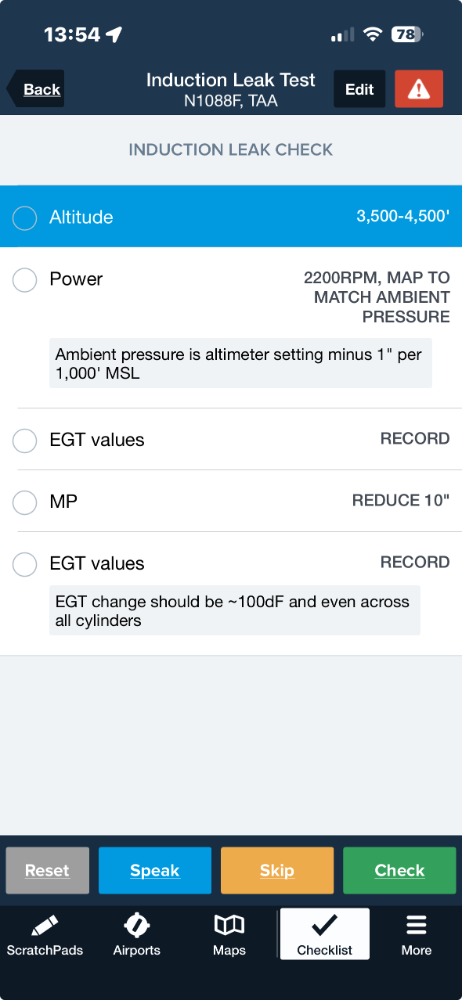
-
I have an automobile trash container that hangs from the back of the right seat that I use to hold things I might need in flight. That’s where my X3 and boom cannula wind up when I’m traveling alone. My wife’s will fit in there too. i’ll find a pic or link. EDIT: Here’s the one I have https://a.co/d/6jS7TUQ
-
Ditto, sort of. I have two of those. Each one contains a complete Precise Flight setup for each of the back seats to plug in to the ship O2. I have one of these https://preciseflight.com/product/premium-hard-shell-case-x3-demand-conserver/ that contains two X3 demand conserver setups for the front seats. They all fit into a small zipped duffel that resides on the hat shelf. Truth be told, my X3 setup is always in place and hooked up. And no, I've never had 4 adult people on O2 at altitude at the same time. I got all of that gear in my "new owner exuberance" with visions of many high altitude cross countries with friends in the back. Ain't gonna happen.
-
Basic Med popularity on MooneySpace
Rick Junkin replied to Bolter's topic in Miscellaneous Aviation Talk
This is the next piece of regulatory nonsense I'd like to see the alphabet organizations attack. I'm sure there are more than a few of us flying on basic med that wouldn't pass a third class medical without a special issuance or a stack of recurring test results, and some who couldn't pass a third class period. Those same people, if they were approaching aviation for the first time, could fly as a sport pilot with a "driver's license medical", but would be prohibited from doing so now because they failed the test for a higher standard of certification. And the thing is, for the uninitiated new student pilots, unfamiliar with the specifics of the FAA medical application/examination nuances, they have no idea they may be setting themselves up for lifetime disqualification from any type of flying just by filling out a medexpress application and going to an AME for an exam. It doesn't make sense to me. I admit I haven't researched the fact finding and decision rationale for why the regulation was written this way. It creates a situation where two different people could train for and be issued a sport pilot certificate that they can exercise with just a driver's license medical. Then when one of them decides to pursue a private pilot license and goes for his FAA class 3 physical, he's denied the class 3 and can never fly again. This almost happened to one of my students. He was about ready to solo and wanted to get going on his medical. Had we not taken the time to discuss the requirements and show stoppers before he started filling out his medical application he would have been denied for previous use of ADHD medication and forced into a lengthy and expensive evaluation process that may or may not have resulted in his getting a class 3. Instead we shifted our focus to sport pilot, which he ultimately put on hold. But he still has the option to go that route in the future. That option could have evaporated had he been denied his medical. My personal take-away was to have the conversation about medical show stoppers in the initial interview before we start training. That's a no brainer in hindsight, but he was my first experience with someone with a disqualifying medical history. Lesson learned. -
Basic Med popularity on MooneySpace
Rick Junkin replied to Bolter's topic in Miscellaneous Aviation Talk
Yes, this is true and I do.