

1980Mooney
-
Posts
3,772 -
Joined
-
Last visited
-
Days Won
7
Content Type
Profiles
Forums
Blogs
Gallery
Downloads
Events
Store
Everything posted by 1980Mooney
-
First Plane Purchase Questions- Open to Advice!
1980Mooney replied to tbenton1's topic in General Mooney Talk
Go to the KGVL City website. The good news is that the hangars are cheap at only $256/mo but they posted that the average waitlist time is 6 years! Lee Gilmer Memorial Airport | Gainesville, GA You are not going to get a Factory Rebuilt Lycoming for $40K. More like $55K You have missed a cost that unfortunately is more common with Mooney's - the cost to reseal leaking wetwing fuel tanks. Add $12K. -
Has Anyone Repaired the Tail Cone? UPDATE
1980Mooney replied to GeeBee's topic in Modern Mooney Discussion
It Since you have removed the empennage fairings previously, you know that they are just 2 pieces of flat aluminum attached by screws. They are not attached together at the bottom. They are open at the bottom. There is no way for them to make physical contact with the bottom of the stinger skin. Yes they can rub the side but not the bottom. It is hard to tell from the picture but as I look at it again, both the stinger bulkhead and the stinger skin which you have cleaned up the "eroded metal" look like they are heavily corroded. Is it thin from corrosion? I notice that you have a TKS plane. Could TKS fluid from your empennage leading edges pool down there? -
Has Anyone Repaired the Tail Cone? UPDATE
1980Mooney replied to GeeBee's topic in Modern Mooney Discussion
Does anyone else fly your plane? Test flight by any shop? -
This is a pretty good serial number reference by model calendar year: https://www.mooneyevents.com/chrono.htm
-
Just curious - how did you get it to him in Longview? Was it able to fly under a Ferry Permit? Or did it have to be disassembled and transported? If so does the $27.5K include transportation?
-
Need wheel assembly Cleveland 40-87
1980Mooney replied to cyrill's topic in Modern Mooney Discussion
OK - That explains it. This has been going on for a long time - I am assuming this plane is new to you. This was done by a prior owner. It is a "shade tree" mechanic fix. Totally unapproved. On some non-aviation sites, people talk about "fixing" loose bearing races by taking a center punch to the bearing housing to create more interference fit and to use super glue. Is the inner side housing for the bearing race also damaged/glued the same? -
Need wheel assembly Cleveland 40-87
1980Mooney replied to cyrill's topic in Modern Mooney Discussion
In all seriousness, I think you can get a new outer half from Air Power for $850. If I cross referenced properly page 5-11 of @PT20J's Cleveland Catalog above, you need part number 162-02800...but you need to verify yourself. 162-02800 | WHEEL HALF Cleveland - Air Power Inc
-
Need wheel assembly Cleveland 40-87
1980Mooney replied to cyrill's topic in Modern Mooney Discussion
Piper Short Wings.Org said the same thing in discussion on loose wheel bearing races. "If you have marks (Brinneling ) on the bearing or race it probably ocurred from months of pressure & slight movement. The bearing FAILURES I've seen were at these points." Also Timken notes FALSE BRINELLING Typical causes include excessive vibration during shipment or when the shaft is stationary. timken.com/resources/timken-bearing-damage-analysis-poster_7352-small/ 5556_Bearing-Setting-Brochure-1.pdf -
Need wheel assembly Cleveland 40-87
1980Mooney replied to cyrill's topic in Modern Mooney Discussion
I thought they were made out of gold......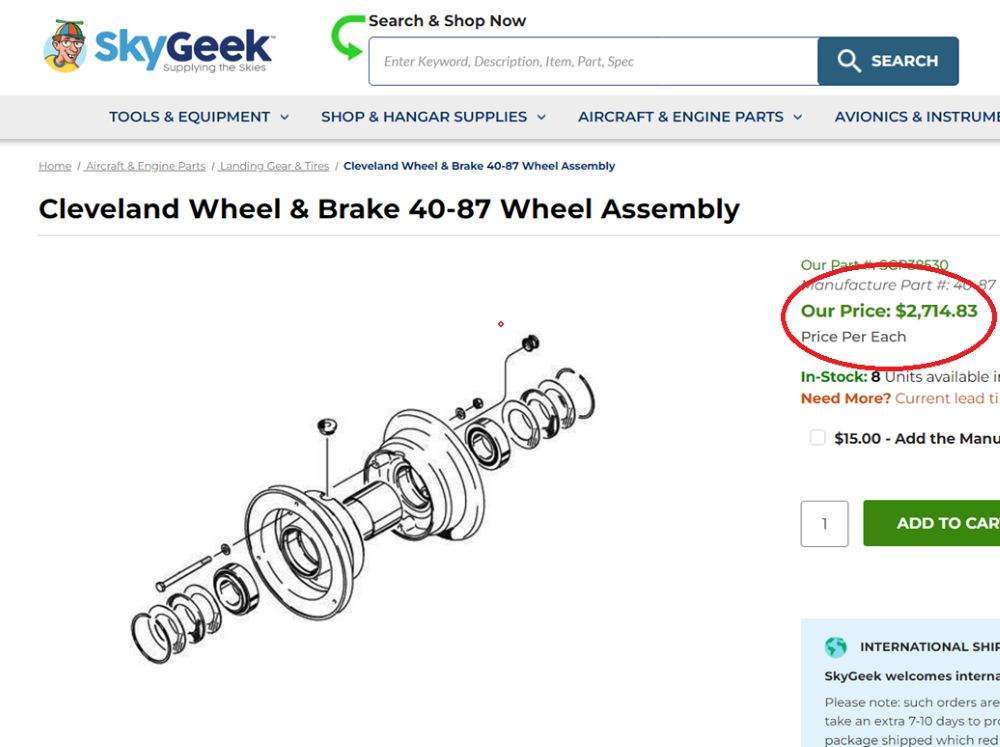
-
Need wheel assembly Cleveland 40-87
1980Mooney replied to cyrill's topic in Modern Mooney Discussion
At first, I thought this was crazy - that it must have the wrong size bearing race because there is no sign of galling, heat, build up, metal debris, etc in the pictures. I had never experienced, seen or even heard of before. But upon further searching: Pilots of America have witnessed this and commented online in 2022: "During inspection of wheel bearings in my C172M I found that the race had broken loose and is spinning in the wheel half itself. The mechanic said that the wheel assembly has to be replaced. I'm surprised that there is no way to build up material so that the race would fit tightly again. I'm just wondering why, I don't doubt my mechanic, but certainly not pleased with the $$ this is going to cost." An A&P commented on Reddit in 2022: "Spinning Races in McCauley Wheel" -"Been doing annuals for a while, usually if I find a bad race or bearing...it's more cut and dry. Seized, or burnt up cones. Grooves, cuts or corrosion in the cups...that sort of thing. Just got a 5.00-5 McCauley nose wheel in and both races are spinning freely...and they a can be pushed in or out with a little force by hand. I don't really have a good way to rig up a plunger dial indicator to check round, but with the races in, I don't see any obvious gaps...the bearings themselves move, maybe a little grindy but nothing insane. A crew member commented in the same discussion: "The crew I work for fly and maintain the BN2 islanders and we get 100 hours in every 4 weeks or so. We run Cleveland wheels and I think I’ve scrapped 5 or 6 in the last 6 months bc of this. We’ve got an engineer who works for us trying to work out a way to fix them but he reckons it’s just cheaper to buy new rims" Comments about what is causing it: Pilots of America: "My belief is that loose races are caused by improper bearing ADJUSTMENT. A complete lack of preload will do this. Several ways to go about it but you want zero side play and just a tiny bit of bearing drag." Short Wing Pipers.Org: "One of the reasons for a preload is to keep a load on the steel race in the aluminum wheel. Lack of preload can allow the race to loosen & wreck the wheel. You don't want the wheel rattling around since that can wear out the wheel halves so they won't hold the races anymore. Bottom line - It sounds like you need the new half of the Cleveland wheel and definitely install new bearings/races BTW - I see in your video that you have stick on wheel weights that have been painted. On a machined wheel hub of that size, there is generally no need to balance the hub. When you put the tire on make sure that the red dot on the tire aligns with the stem of the inner tube. -
Need wheel assembly Cleveland 40-87
1980Mooney replied to cyrill's topic in Modern Mooney Discussion
You refer to the bearing races as a "shrink fit" but aren't they really just a "press fit"? I have always pressed or used a soft drift to drift them in and out. No need to cool the bearing race or heat the hub. From "Kitplanes" - Maintenance Matters By far the preferred way to remove the race is with a hydraulic press. A large socket may work or you might need to find a piece of round steel stock that is large enough to engage the race, but small enough to pass through the hole in the wheel and push the race out. The exact size may vary with the size of the wheel. The other thing you will need is a solid object on which to rest the wheel hub when you are pressing the race out. Do not attempt to press out the race while supporting the wheel on its outer flange. The wheel is not designed to take this stress. As a distant second choice, you may use a drift punch and hammer to tap the race out of the wheel hub, also while fully supporting the outer portion of the hub during the process. More from Cessna Flyers on removing races with a hammer and punch or a bearing driver tool. - Cessna Flyer Association - DIY Wheel Bearing Service -
Huh...I guess I don't follow the logic. In a go around, my hand (which had been on the throttle all the time during short Final) is spread out on the throttle, pitch/rpm and mixture knobs. I press all three (3) knobs in simultaneously to "firewall forward". I don't get the "move in correct order". It is all 3 together - don't think and certainly don't put your head down to look - it's muscle memory reflex - it's by feel. Easy peasy...Bullet proof....Fail-safe. Given the angle of my hand, the mixture and pitch/rpm press in a little ahead of throttle. I do get your point if the pilot is fiddle/farting around with each push/pull knob individually (and worst of all looking down at the push/pull knobs). In 25 years on a Continental IO-550A in a J, I have never pushed full rich on landing. And over a thousand touch and go's with no issues while pressing all 3 firewall forward in executing go-arounds.
-
Mike Busch says "don't go full rich" - leave the mixture where it is. Landing Every POH I've ever read instructs you to advance the mixture to full-rich on final prior to landing. Don't do it! Pouring cold fuel on a hot cylinder head simply can't be a good thing for cylinder longevity. I recommend leaving the mixture leaned out for landing and taxi. I also recommend setting the props to top-of-the-green RPM, not shoving them full forward the way the POH instructs. Of course, if you have to make a go-around or a missed approach, don't forget to advance the mixture and prop controls before throttling up to full power. Operating Tips for Big-Bore Continentals - AVweb Until you do the full set-up of the Continental per SID97-3G (link below) you are just shooting in the dark. Continuous Flow Fuel Injection Systems Adjustment Specifications and Instructions The recommendation on Beechtalk for the same issue: "If you can't find a leak, have your mechanic perform the procedure called out in SID 97-3G, now included in the engine maintenance manual. Let him know that it needs to be performed as written, with no shortcuts allowed. When he or she thinks they nailed it, ask them to perform the run-up test procedure at least three times in a row to make sure it is repeatable. The three adjustments all interact in strange ways and the results are strongly dependent on whether you properly purge the fuel system prior to the next test. Also, make sure they properly apply the correction factor if the engine fails, as most do, to reach max rpms when the aircraft is not moving." Here is what an owner with an IO-550N posted on Beechtalk in 2022 regarding exactly your same issue and solution with SID-97 "I had exactly this behavior for over a year on my IO-550N. Lived with it with work-arounds such as keeping the fuel pump on, keeping revs above idle, etc. Eventually had it diagnosed as fuel pump setup being out of whack and has the SID 97 procedure done. It cured the problem completely and did not require purchase of any parts. The procedure took about 3 hours and I participated as the pilot operating the controls while the mechanic manipulated the fuel pump settings. It is a 2-person exercise, so I "saved" $300 by not having to have a second tech inside the airplane - plus it was a hell of an experience! The procedure is iterative by adjusting 3 things sequentially; each adjustment affecting the prior setting. IIRC, the parameters to be monitored were: idle rpm, idle fuel pressure, max rpm, max fuel pressure, and rise of idle rpm as mixture is leaned before cutout. It is potentially a very hazardous exercise as well as scary for a first-timer. The airplane has to be secured with tie-downs, full braking applied, and run up to full power for several seconds in each iteration. At 310 hp, the airplane was howling and bucking like a wild horse. We didn’t have tie downs on the ramp, so used double chocks and brakes - a really bad idea. During each iteration, at full power, I had to look down and record rpm and fuel pressure and on one occasion, the airplane jumped the double chocks and spun 90 degrees in the brief time I was looking down. When I looked up again, I was completely disoriented and hauled back the power before things became too exciting. I have seen pix of airplanes that rolled upside down when improperly secured during this operation. It is also a skilled job to know how to compensate for varying wind at each iteration. Each run up is done into the wind, and that could mean waiting for same wind speed each time and/or turning the airplane into wind that is varying direction. Bottom line, I learned a lot and problem solved."
-
1998 M20R Ovation Gear Retraction Issue
1980Mooney replied to Dustoff49's topic in Modern Mooney Discussion
I had a passenger once wedge something against the latch which popped it at some point in the flight. Since then I put a piece of clear packing tape over the edge of the latch about 1 inch (end of tape folded over so it can be pulled easily). -
1998 M20R Ovation Gear Retraction Issue
1980Mooney replied to Dustoff49's topic in Modern Mooney Discussion
I don't like to test the emergency system annually. Per Mark Rouch of Top Gun Aviation MSC: "Another problem with the newer actuators is the wear on the emergency extension cable. It is Teflon coated and the Teflon can tear and peel loose and that loose Teflon can actually jam the actuator. It actually happened during a practice emergency landing gear extension. My actuator is 45 years old. I am not going to take the chance of damaging or wearing the emergency extension out (25 pulls each time) just to practice on jack stands. If done every year it would have been subjected to at least 1,100 pulls. The last thing I want to do is write a check for $16,000 plus labor. No I would not like:
-
Fair point - the Factory wingtip fairings do not add 1.5 ft. The Factory J wingtip fairings (installed starting in the 1981 model year after 24-1037 which is the end of the 1980 model year) technically add 13 inches over the square J wing tips (1977 - 1980) as noted by Skip. My 1980 J has the LASAR (Loewen) Wing Tip Fairing STC SA4443NM (no longer available from LASAR). See picture below comparing Original square J vs LASAR vs Factory. The LASAR wingtips overlap the aluminum skin of the outboard edge of the wing. The Factory wingtips are attached flush with the aluminum skin of the outboard edge of the wing. The LASAR wingtips are attached with screws I think in the area where it overlaps which is a little further inboard from the square edge of the wing. It makes it hard to eyeball the relative width of the LASAR vs the Factory wingtip. I assume the LASAR(Loewen) created the STC with the same resulting wingspan dimensions as the Factory but I am not sure and there are no drawings. It has been nearly 20 years since I argued and argued with the City about this. The City actually came out with a tape measure to measure my wingspan and they said is was more than 36' 1". Even at 36" 1" I would not have qualified for the smaller hangar. Prior to the STC mod I would have qualified for the smaller hangar with 35' wingspan. I don't recall the measured wingspan claimed by the City, but it was clear that I was never going to win the argument. Since the airport is less than 5 miles from my house, I agreed to stay and pay.

-
Where I am hangared, Mooney’s with squared wingtips are approved for a slightly smaller hangar saving $100/month. The wingtips add 1.5 ft, just enough wingspan to push those with wingtips to a wider more expensive hangar. My J originally had square tips. The Missile conversion required the addition of wingtips. Next year I will mark 20 years that I have been in that hangar. Those wingtips have cost me $24,000 just in extra rent over that time. They add nothing to the plane other than appearance. The price of vanity!
-
Seriously? Another unleaded avgas thread . . . ?
1980Mooney replied to 76Srat's topic in Miscellaneous Aviation Talk
"austro isn't overly complex" - well it is like art or beauty I guess and in the eye of the beholder. The Austro has dual overhead cams, 4 valves per cylinder, chain cam belt, high pressure direct fuel injection, a gearbox to reduce rpm. "no plugs, wires" - well not exactly right because you have to have "glow plugs and wires". Because of durability problems with the original Thielert, Austro went with a cast iron block that added about 120 lbs. alone. -
Barn find Mooney is it worth my time?
1980Mooney replied to Tim VanDenHoek's topic in General Mooney Talk
I bet those 115° F days do wonders for all the elastomers plastics and electronics. What do you reckon the internal temperatures get? I see online that cars get up to 160° there. Toasty! -
Seriously? Another unleaded avgas thread . . . ?
1980Mooney replied to 76Srat's topic in Miscellaneous Aviation Talk
Our current engines and fuels are optimized for power, weight, functionality, simplicity and reliability. "viable SAF-burning alternative" sounds fine but there will be unintended consequences. E85 weighs 10% more than a gal. of Avgas and a gallon of E85 only has 79% of the energy (BTU's) of Avgas. Less energy density - who cares? Well maybe not if you are flying a 182 or a Dakota. But if you are in a Mooney, with limited Useful Load as it is, it can really limit the usefulness of our planes. A pound of Avgas has about 18.75K BTU. A pound of E85 only has 13.5 K BTU (some less). That means you need to haul an extra 39% more pounds of fuel to make the same trip. For those with the efficient 4 cylinders that might mean a 4 hour trip with half hour reserve, the fuel required will weigh an extra 105 lbs. (57 gal E85 vs 45 gal Avgas) But for those with the big 6's - many times we make a 4.5 hour trip with half hour reserve - I plan on 15 gph. That is 75 gallons Avgas. But with E85 the fuel required will weigh and extra 176 lbs. (104 gal E85 vs 75 gal Avgas). We will not be making that trip - extra fuel stops. If you are thinking about automotive efficiency and power then you need a solid block, water cooling and a lot, lot more complexity. And diesel? Look at the current Cont and Austro diesel solutions - tremendous complexity and not light. And DeltaHawk?....they are less complex but they are in their umpteenth redesign trying to shed weight to become competitive - it remains to be seen if their 2 stroke will be efficient. -
Barn find Mooney is it worth my time?
1980Mooney replied to Tim VanDenHoek's topic in General Mooney Talk
You are referring to this: -
What is the price?
-
Yeah - above @N201MKTurbo said "After I ground 1/4 inch of tread off of them, they are great tires." Give me a break - who has the time or skill to grind recapped tires down??? Does that fall into "owner preventive maintenance"?...like "I prevented my landing gear from binding/wedging and control rods from bending". After you pay your A&P to grind your "new" recaps down (if he will even agree to do it), do you really save any money over a proper new tire?
-
There was a post here on the “Final” outcome of the uncontainable 40:1 Dukes actuator gears. It’s gone.
-
I think so. Some are larger than others, i.e. Desser Monster Retreads