


captainglen
-
Posts
111 -
Joined
-
Last visited
Content Type
Profiles
Forums
Blogs
Gallery
Downloads
Events
Store
Everything posted by captainglen
-
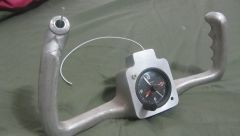
From the album: Wheel
-
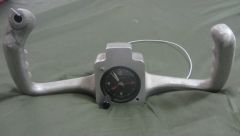
From the album: Wheel
-
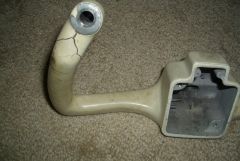
From the album: Wheel
-
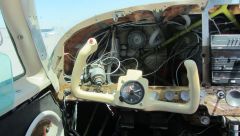
From the album: Wheel
-
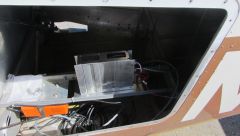
From the album: The Kimberley Mine
Strobe power supply installed in rear avionics rack with the ELT. Antenna cables and strobe cables still need to be shortened and routed. The cutout in the upper right is where the entry step will retract flush with the skin. -
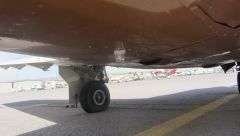
From the album: The Kimberley Mine
Newly installed lower strobe is at least twice as bright as the Whelen Sa that it replaced and together with the upper strobe has less than 1/4 of the drag profile as the unit they preplaced. -
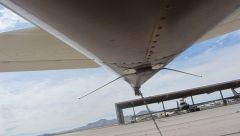
From the album: The Kimberley Mine
Newly installed NAV antenna; extremely low drag. -
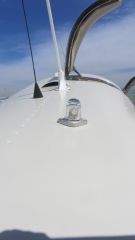
From the album: The Kimberley Mine
Newly installed upper strobe and #2 comm antenna. -
Definately wheel spin. Even after a normal takeoff it a good practice to tap the brakes just before retracting the landing gear.
-

M20F Fuel Transmitter Issue
captainglen replied to TonyPynes's topic in Vintage Mooneys (pre-J models)
One more thing I should mention is that the gague clusters themselves do not age well. The shafts of the D'Arsonval meters wear allowing radial play. Once the radial play is enough to allow the coil to come in contact with the magnet the meter will stick and tend to move in jumps. I have tried adjusting the shaft end jewels but most of the wear is at the shaft end percision points and the results of adjustment are poor at best. I am considering replacing my entire cluster with MITCHELL GAUGES because my oil temp has already secumbed to this disease. -
M20F Fuel Transmitter Issue
captainglen replied to TonyPynes's topic in Vintage Mooneys (pre-J models)
N201MKTurbo post mentioned the wire wound potentiometers inside the instrument cluster unit, these are the span adjustments for the fuel quantity gague and set the full level. The zero fuel quantity is set by bending the float arm. To avoid going back and forth between the two manually bring the floats to the top and adjust the pots to full indication, aduust the bend on the float arms tho jeat touch the bottom of the tank jest as the transmitter reaches the mechanical stop. -
Is Your Manifold Pressure Gague Accurate?
captainglen commented on captainglen's blog entry in captainglen's Blog
I would say $50 is a real bargain and well worth it. One thing to remember is that the instrument is plumbed to the manifold and the instrument breathes with changes in pressure. In carburated aircraft that means that fuel residue can accumulate in the lines and instrument. Fuel injected aircraft are more imune but the air cleaner doesn't take out everything and carburator heat bypasses the filter. Rubber lines degrade and shed contaminents and if possible should be replaced with silicone. -
Is Your Manifold Pressure Gague Accurate?
captainglen commented on captainglen's blog entry in captainglen's Blog
I do not know the rules for homebuilt aircraft but I know they are a lot laxer. Checking the range with a manometer is exactly what we would do in an instrument shop an it has been my experience that the span usually remains the same. The usual culprit in the offset is metalurgical changes in the bellows. -
Is Your Manifold Pressure Gague Accurate?
captainglen commented on captainglen's blog entry in captainglen's Blog
The bendable link sets the span which is the range between the lowest indication and the highest one. The screw sets the current position of the needle which would be called the zero except the gague does not have a true zero but indicates the pressure at the input port above absolute zero (average 29.92 at sea level). -
Is Your Manifold Pressure Gague Accurate?
captainglen commented on captainglen's blog entry in captainglen's Blog
I tried setting the altimeter to zero altitude but at my field elevation the Kolsman window goes out if range. As near as I can tell that method is only good to field elevations up to 1800 feet. -
Is Your Manifold Pressure Gague Accurate?
captainglen commented on captainglen's blog entry in captainglen's Blog
It has been a long time since I have had one open on a bench and as I remember there is a simple screw referred to as offset (Zeroing) span is set by bending a link but the instrument case must be opened. -
Is Your Manifold Pressure Gague Accurate?
captainglen commented on captainglen's blog entry in captainglen's Blog
This is a great method; I have not tried it yet bit I will! If it works and I have no dobt then it is the simplest possible method! -
All switches on a Mooney are breaker switches, if the switch has dropped it is the same as having a popped breaker. It is possible the breaker swithch has gone out of tolerance or that the becon has shorted out. One additional consideration is that a strobe unit has been installed that exceeds the current of the breaker switch and a switch that has the correct current capacity specified by the strobe manufacturer needs to be installed. The installed breaker switch is rated at 10 amps enough for a single head flashing strobe, not a starburst.
-
Missed Approaches with a Johnson Bar
captainglen replied to pinerunner's topic in Vintage Mooneys (pre-J models)
I am not IFR but find flap retraction much more critical than gear retraction depending on the type of flap retract lever you have. In my C model it is a knob and sometiles they do not retract as slow as I would like. I try to handle the knob lightly to feather them up but quite often they come up faster than I like. Some later modeld have a little lever and although I have never used one of these it seems like it should be easier. -
Portable ADS-B Solutions -- Moment of Truth!
captainglen replied to Marauder's topic in Avionics/Panel Discussion
With ADSB you do not pick up the replies that is what TCAD does. The replies are picked up by the interrogating radar installation and then rebroadcast to you in a geographically encoded format along with other information including weather. The results are quite similar except since TCAD toes not know exactly where it is or where the other traffic is it only knows how far away it is and what the altitude separation is. TCAS directly interrogates other aircraft and has a directional antenna which can give you a rough position for threat traffic. I fund My Dual brand receiver works just fine with Foreflight except I have to go into setup to select it each time I use it otherwise it will not be recognized. I have heard others report that Ilevil units work well with foreflight also. I like many others prefer Foreflight because of the confidence it gives me with regard to airspaces which have over the years become quite complex. The other reason I like foreflight is that it is fully legal as a paperless chart system. I do wish that Terminal Area Charts were included. -
Your engine, primarily the exhaust valves do not care about lean of peak or rich of peak, all they care about it temperature. Some older EGT indicators had a bulls eye at 1,400 degrees which at one time was considered ideal; current logic says 50 or 75 degrees off peak (I was taught 100). In carburated engines it is customary to run rich of peak because a slight vacuum leak could cause a cylinder or two to run a bit leaner than the richest cylinder. Typically this kind of imbalance will cause the engine to run rough when leaned to lean of peak. It is also fairly common for injected engines to run rough lean of peak which is why most mechanics do not reccomend it unless the engine is equipped with a matched set of injectors. A good graphic engine monitor that gives EGT for each cylinder can give you a lot more confidence when leaning your engine. As to when to enrich the mixture it is always best to go by the Pilot Opperating Handbook which assumes that leaning is an ongoing process except when at full power or just before landing in preparation for potential go around. At takeoff power a full rich in fact excessively rich mixture is used because the excess fuel is used as part of the engine cooling process. As for decent it is most important due to the high speed involved that all descents be made power on to avoid shock cooling of the front two cylinders. I will add a comment on shock cooling in that as a mechanic I find it far more common to find the back two cylinders declining in compression faster than the front two than the other way around. This could be because most pilots prefer power on descents or could be that shock cooling is really a bugaboo.
-
The AD on the hartzel is a nusiance, I had one fittes on a previous aircraft and found the blade attachments tend to retain water if exposed and will pit the hub shanks that go into the blades. The tolerances on the pitting is unforgiving and the part expensive. The McCauley propeller has far fewer SB'S and fewer inspections. I currently have the Hartzel and plan eventually to replace the bastard.
-
At some point you need trifocals, clear up top for the horizon the middle lens about 1/2 diopters and a third at the bottom for the chart on your lap at about 1 diopter. I have three but mu top lenses are corrective. There are several new variable focus solutions but have not been approved by the FAA (at least I do not think so). There are certain solutions that are specifically prohibited; an example is monovision contact lenses. In conclusion, Iunder current FAA regulations, pilots are prohibited from using monovision contact lenses to correct refractive error and/or presbyopia. Although a pilot is well adapted to monovision, the reduction in visual performance from using such lenses may be exacerbated under marginal visual conditions and high workloads. The bottom line is choose your vision correction solution carefully. I have been doing some research on the subject but will have to do more to locate the specific regulations. As near as I can tell if tested by your AME with the lenses you are to use under (CFR) Part 67.121.309 (d) (2) if your corrected vision meets the standards in Table 1 you are automatically good tyo go!
-
Leaking magnetic compass..
captainglen replied to Parker_Woodruff's topic in Modern Mooney Discussion
A compass leak at high altitude is indicative of an unseen bubble. The diaphram is designed to compensate only for thermal expansion of the fluid. Since fluid it theoretically uncompressable (in reality it is slightly at enormous pressure) altitude has no effect on fluid volume. The airpath compass body and backplate have no ridge and groove to assist the seal of the diaphram with only four small screws to hold it in place. An air bubble will expand greatly with altitude causing the fluid to bypass even a new diaphram. I tried the simple submersion and no matter how I turned the compass the last bubble would not come out. In desperation I used a 50cc catheter flush syringe (wife is a nurse) to blow the bubble out with force. It took several attempts with the bubble getting smaller each time but I got it clear and perfect. Point of note, if you do not disturb the compensating magnets a compass swing will not be necessary. Since the vertical card compass is really an undampened horizontal compass with a 90 degree gear they are prone to fairly wicked hysteresis. As the gears get dirty the hysteresis gets worse. Since the card is not floating weightless there is also an inertial mass to overcome which is done, but not adaquately by more powerful magnets than in most wet compass designs. the good news is that most small aircraft have enough vibration to act as a dithering vibrator helping to overcome the friction and card mass. This same vibration also assists your altimiter which is prone to hysteresis but in commercial jets because of low vibration the standby altimeter has an electrical vibrator. If your airplane flys too smooth the shortcomings of a vertical compass will be more noticable. This is more likely in twins than in single engine airplanes and jets fly extremely smooth. Quarter inch windshields can reduce some vibration even in single engine aircraft causing hysteresis to be more noticable. -
Is Your Manifold Pressure Gague Accurate?
captainglen commented on captainglen's blog entry in captainglen's Blog
some experience: Unlike other IO-360 engines your waste gate is not normalized which is to say that at sea level you are permitted 10" of boost. You are permitted a maximum TIT of 1650 degrees. You are fuel injected therefore with a balanced set of injectors you can run lean of peak without engine roughness. Shorter stroke means your mag timing is -20 degrees. You can maintain your full rated 210 horsepower all the way up to your service ceiling but cylinder life will be shorter than a normally aspirated version of the same engine. The turbine bearings will degrade over time due to harmonic wear affecting the efficiency eventually requiring replacement. Any specific questions?