
Shadrach
-
Posts
12,228 -
Joined
-
Last visited
-
Days Won
170
Content Type
Profiles
Forums
Blogs
Gallery
Downloads
Events
Store
Everything posted by Shadrach
-

Interesting engine baffle observation...
Shadrach replied to Shadrach's topic in Vintage Mooneys (pre-J models)
Quote: allsmiles If needed to be there Lycoming would have put it there! I don't want anything wedged or loose in my engine compartment. I'm a little weird this way! -
Interesting engine baffle observation...
Shadrach replied to Shadrach's topic in Vintage Mooneys (pre-J models)
Quote: takair Thanks for the explanation, makes more sense now. Will have to look closer at my E model next time I have the cowl off. My CHT are fairly even, #2 is hottest. Hottest EGT is number 3. I suspect this would only help CHT. -
Interesting engine baffle observation...
Shadrach replied to Shadrach's topic in Vintage Mooneys (pre-J models)
Take some time to familiarize yourself with the cylinder head design of the Lyc angle valve 360 (I'm not sure about the parallel valve engines). See the 1st attached photo...I'm shining a shop light in the lower cowl compartment. Looking down from the top through the cylinder head fins of cylinders #1 and #3, it's appearant that there is no light visible on the back side of cylinder #3 (the rear cylinder)... This is because the fins do not encircle the cylinder barrel completely. This is obvious when looking at the rear side of cylinder one (2nd attached photo). However, there is airflow around cyl #1 because it buts up against the front side of cyl#3. The back side of cyl #3 is butted up against the baffle wall. Mooney tried to solve this by by putting a pocket in the back side of the passenger side baffle wall (see 3rd attached pic) Cessna did not, and I understand that Cardinals suffer from a higher temps on cyl#3 for that reason. It is rumored that George Braly (of GAMI fame) came up with the "baffle seal wedge fix" to help the Cardinal baffle circulate air around cyl #3. I did it because "the pocket" did not seem to be letting enough airflow through as #3 was always significantly hotter. The "wedge" holds the the baffle wall off the cylinder allowing for additional airflow. I did a number of baffle tweaks during the engine install so the effects are probably cumulative. None the less, cyl #3 now runs about 50df cooler than before.


-
Interesting engine baffle observation...
Shadrach replied to Shadrach's topic in Vintage Mooneys (pre-J models)
Quote: Jeff_S I just learned something about my engine that helps explain some readings on the JPI. With the cowling off for an oil change, I noticed a single sensor wire attached to the top spark plug on #3, with nothing on the others. My A/P said that's because the factory CHT sensor uses the bottom plug, so the original installers put the #3 JPI sensor on the top while putting all the other JPI sensors on the bottom. And I have always noticed that #3 CHT gets the hottest in climb on the JPI. Once in cruise they level out nicely. It all makes sense to me. Heat rises, and airflow in climb isn't as strong as in cruise, plus power is higher of course. Just one more little mystery solved. -
Good luck, I have heard good things about Barry mounts as well, which will probably save you about $100 over the Lord mounts. Maybe someone else can ring in on that. This is a good read, even if you're not participating, it's good to know the process. As I said before, I don't think it's good if you can feel vibration through the yoke an seat... http://www.donmaxwell.com/publications/MAPA_TEXT/Alining%20Engine%20Using%20Shims/ALIGNING_YOUR_ENGINE.HTM
-
Quote: SkyPilot My 1967 M20F is a whopping 1800 pounds. It has some minor avionics upgrades but still has the Narco 12 and an antique ADF with wire sense antennae. These items will come out this winter and a skytech starter will go on. Other mods are electric gear and 3 blade prop. Paint was new in 1995. I'm also planning to get a new up to date weigh-in. If anybody has any good weight loss ideas, i'd like to hear them. It will likely be easier and cheaper for me to drop 30 pounds
-
.01 IPS is actually quite good. It stands for "inches per second" and is a measure of amplitude. New lord mounts should last longer than 500hrs and 10 years IMHO depending on climate. Instead of replacing, you can also swapping them around. I would check to see if the engine was properly shimmed at OH. $hit happens and sometimes planes go out of the shop without all of the finer points being attended to. 4cyl Lycs are not the smoothest engines for sure, but vibes in the yoke and seat = bad juju. I don't see how it could be shaking so much and read .01 during a dyno... I'm in KFDK and keep my F at KHGR. I'm an easy 45min flight from Mt Pleasant if you want to compare/contrast... Let me know.
-
1967 F Empty Weight:1684lbs Useful load: 1056lbs Fuel Fuel Payload: 672lbs If we'd remove the old remote compass, ADF and some other crap, we could break 700lbs for payload.
-
Mooney Acclaim 2008 landing gear grease
Shadrach replied to DeanGrose's topic in General Mooney Talk
My MX manual for a C,E,F,G calls for MIL-G-7711 (AS#6) or MIL-G-81322 (AS#22)... I just keep #6 and #5 around. #6 for the airframe and prop and #5 for the wheel bearings. -
Quote: testwest
-
Quote: Skywarrior Quote: Shadrach "CHTs will tell the story as OATs will not be warm enough to not mask what's going on in the combustion chamber..." FIFY. Chuck M.
-
From the album: Old Photos
-
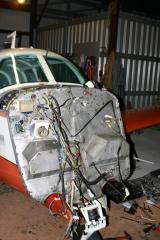
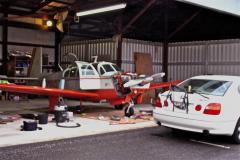
Crank case crack in right side case half bolt boss just aft of generator pad.
Shadrach posted a gallery image in Old MooneySpace.com Images
From the album: Old Photos
-
From the album: Old Photos
-
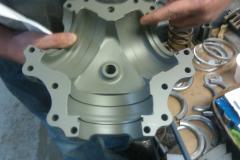
why we should not over-grease our prop hubs...
Shadrach posted a gallery image in Old MooneySpace.com Images
From the album: Old Photos
-

From the album: Old Photos
-

From the album: Old Photos
-
From the album: Old Photos
-
From the album: Old Photos
-
From the album: Old Photos
-
From the album: Old Photos
-
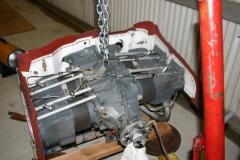
From the album: Old Photos
-
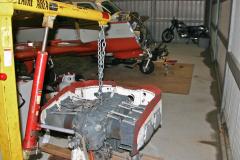
From the album: Old Photos
-
...
-
My peak EGT will only top 1500 down low or on cold high pressure days. As I said, I am almost always WOT unless descending. I fly LOP over peak under 5000 because I can develop plenty of power and keep CHTs low and best BSFC is achievable at good speeds. My stock F model will run 145kts+ LOP at 4500 to 7500 and a little faster down low.