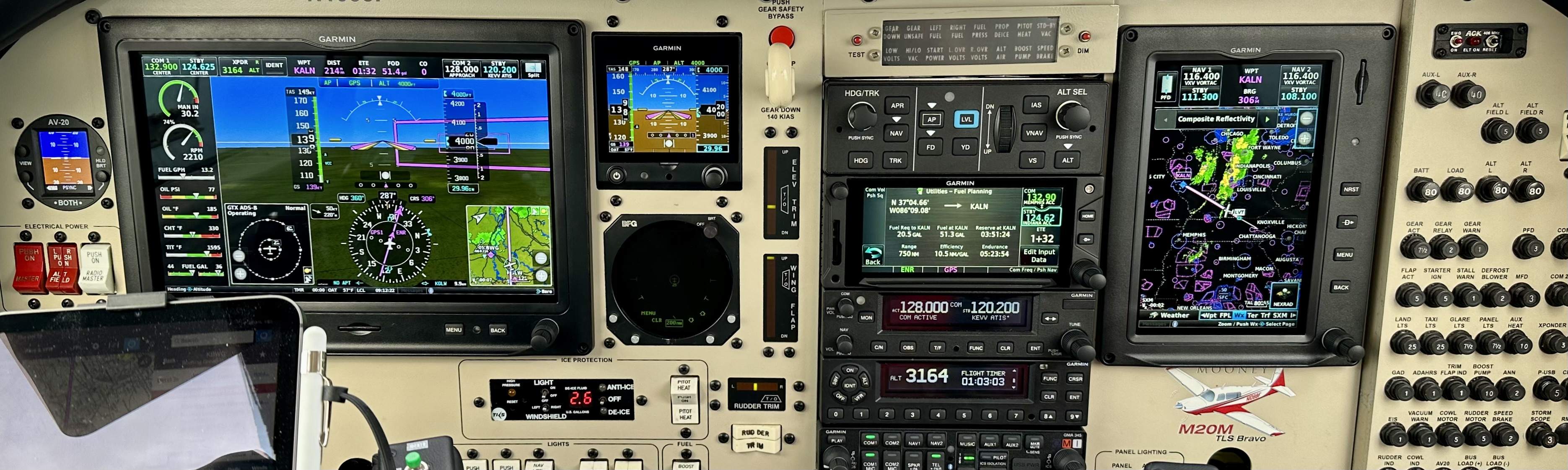

Rick Junkin
-
Posts
1,446 -
Joined
-
Last visited
-
Days Won
8
Content Type
Profiles
Forums
Blogs
Gallery
Downloads
Events
Store
Everything posted by Rick Junkin
-
I’m thinking the same. I observed the ball on the G3X wandering left and right about half a ball in the climb while the G5 ball remained solidly centered. I recorded some video to send to Garmin and my avionics shop.
-
I'm curious. What publication has the banned list in it, and is it publicly available?
-
Thanks Skip, that's my plan. I have data logging turned on and upload each of my flight data from the SD card to Savvy for graphical analysis/review. I exported the complete internal log once just to see what was in it but didn't see ongoing value in doing that. However now I'll export it again so I have a single file with all of the data for parsing. I'll use the diagnostic fault log to narrow my effort. I'm not optimistic that I will learn anything useful from this, but I'll give it a go. If the internal log doesn't contain additional data fields beyond what is in the flight log files I doubt I'll find anything that helps me identify the cause of the disconnects, but I have to look. It sure would be nice to have access to the design documents that define the parameters that generate the AP fail status I'm seeing. That would at least show me where to concentrate my efforts. Cheers, Junkman
-
Zero posts here this year about anything regarding the Caravan's preparations for and activities at KOSH. Just wondering.
-
I experienced disconnects early on right after my avionics were installed in Sep 2023, with the -21 servos and the original gain settings that were producing pitch oscillations. I believe that was with G3X software v9.15. I have v9.17 installed now with the alternate gain settings from the M20 J/K GFC 500 gain addendum and the disconnects are still happening inconsistently at the 2 hour point, +/-. Once the disconnects start happening I can re-engage the AP briefly and then it disconnects again. But it isn't consistent and I've had some flights where the AP operated normally throughout. BTW the J/K alternate gain settings smoothed everything out nicely. Garmin hasn't offered any feedback other than to say they are aware and have added my data to their existing engineering problem report on the issue. The Garmin folks at OSH had no new or useful information for me. The log file data doesn't give any clues as to what is precipitating the disconnects. Garmin isn't sharing anything they may be looking into. My next step is to delve into the rest of the data recorded elsewhere on the G3X to see if I can find anything in the diagnostic discretes. That will be an extremely tedious exercise because to my knowledge there is no way to extract that data from the unit and I'll have to look at it on the G3X screen. I'm going to start with exporting the entire data history from the G3X (I think I know how to do that) to see if that data is more granular than the log file data, and then set to gathering the rest of the diagnostic data from the G3X screens. I'll let y'all know if I discover anything. It will be a week or two. EDIT: Has anyone figured out who the new "Trek Lawler" is at Garmin? I haven't had any luck identifying a technically astute G3X person who's able and willing to talk openly about how to get some of these problems resolved. Cheers, Junkman
-

GAMI presentation from OSH '24
Rick Junkin replied to 0TreeLemur's topic in Miscellaneous Aviation Talk
This will likely prove to be a red herring but it’s out there. AOPA left their dual fuel Baron at OSH due to stains discovered under the wing with G100UL in it. Lots of interesting speculation but no reliable data yet. Read the comments. https://www.avweb.com/aviation-news/stains-on-aopa-baron-wing-to-be-checked-by-mechanic/ -
@Patrick Horan On your trip did you have any indications that #5 wasn't behaving properly? If it were truly not generating any compression I would expect you would see some anomaly in the EGT/CHT, although with a six cylinder engine you may or may not feel it in the engine operation unless you were specifically looking for it.
-
Don't give up on that cylinder quite yet unless there is a smoking gun that says it is bad, or there is some other indication of a problem other than the compression test. Oil puddling, depending on how much is there, can be explained in some cases by aligned ring gaps. Continental has a service bulletin SB03-3 about what to do when a cylinder "fails" a compression test and it can be used as a reference for your Lycoming too, if you want to use it in light of the fact that Lycoming is silent on the matter. Basically it says to fly the engine for an hour and check it again. As for #2 and #4, can you post pictures? I'd like to see what a bent valve looks like through a borescope so I know what to look for. Cheers, Junkman DIFFERENTIAL PRESSURE TEST AND BORESCOPE INSPECTION PROCEDURES FOR CYLINDERS..pdf EDIT: How much oil are you using? How many hours before you need to add a quart?
-
You’d do well to research the Mooney Safety Foundation (MSF) and Mooney Aircraft and Pilots Association (MAPA) to familiarize yourself with the rich history and experience base of these organizations. The MSF Pilot Proficiency Program (PPP) is recognized by insurance underwriters for discounts, so the weekend events are more than just informal courses. The M20M relevant documentation from Mooney and Lycoming leaves a lot of holes, and those holes are filled by the experience of the folks who have been and are flying and maintaining the airplane now. The original POH guidance was driven by both marketing as well as technical interests and if you follow it as written you stand a good chance of pushing your airplane too hard. We have all searched for the authoritative guidance from the manufacturers and have come up short because it isn’t in their best interest to update the POH and other documents with information that conflicts with the original publication content. However you will find bits and pieces of changing recommendations in the service bulletins and service instructions released by both Lycoming and Mooney through the years. It’s a research project well worth your time. Cheers, Junkman
-
@Patrick Horan Have you had your mag timing checked recently? Should be 20 degrees BTC. I’m surprised you were LOP at 30/2200 at 15gph. What was your peak TIT and what was the fuel flow at peak? I see peak TIT at about 14.6gph at 30/2200. A lot of things look out of whack so I’d like to confirm your fuel flow is accurate, your mag timing is correct, and your TIT is accurate. I mentioned before that your TIT indications look about 100 low relative to your EGTs. How many hours ago was the TIT probe changed last? Cheers, Junkman
-
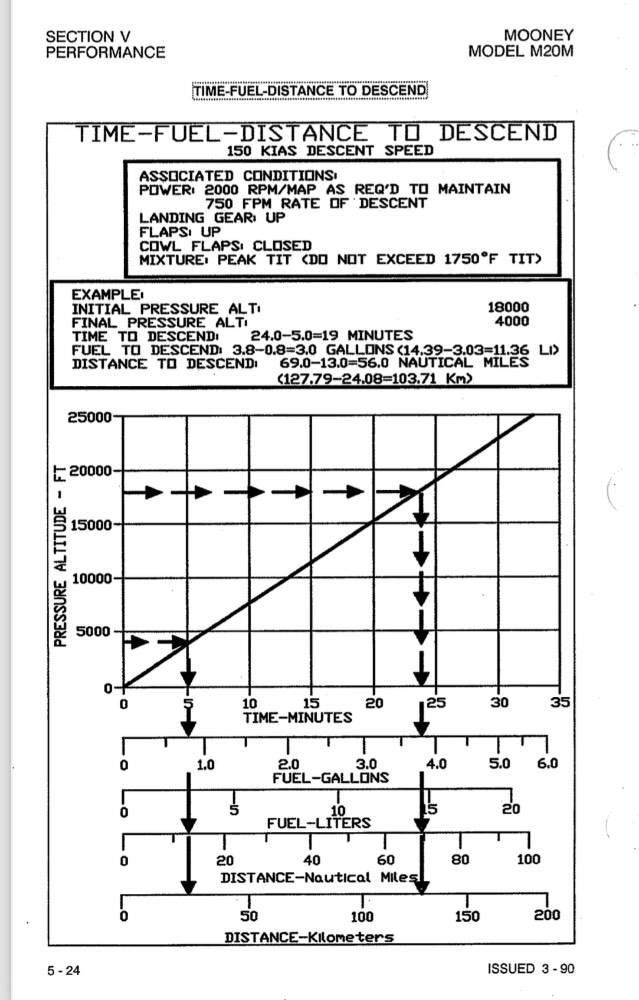
The Chapter 5 performance charts in the POH for the M20M call for 2,000RPM and 750FPM for descent. 2,400RPM is called out for cruise climb and maximum cruise. Where do you see 2,400RPM for descent? I can’t find it, maybe in a different version of the POH? Cheers, Junkman
-
@Pinecone I’m having the same issue. It disappeared initially after updating to G3X Touch V9.17, but it’s back again. Same kind of thing where it occurs at about the 2 hour point +/- and I’m able to re-engage, but this repeats multiple times after that point. I sent in log files about 6 months ago and was told through email that they added my data to an engineering ticket that was already open from other reports of the same issue. I haven’t heard anything more back. I’ll be compiling failure data from my trip to KOSH to send to Garmin again. Let us know if you hear anything new from Garmin, I’ll do the same. Cheers, Junkman
-
That made me laugh.
-
Performance is only part of the equation, so I wouldn’t pass up a nice Bravo. I love mine and have applied the resources to make it my forever airplane. And keep in mind we were comparing the Bravo and the Encore, not a straight 252, and Encores are relatively rare and not often on the market. And when they are they are priced higher than a similarly equipped Bravo. There are good reasons for that, many mentioned in this thread.
-
The baggage compartment and forward of the front seats. I was corrected above. The forward space allows the front seats to be a little further forward, effectively creating more leg room in the back.
-
I stand corrected.
-
Always the voice of reason.
-
There it is! Thanks @Pinecone. @snowman, this is the comparison you were looking for in real terms from real people flying real airplanes. See the 252 Encore performance numbers above. And also the Bravo numbers at 19,000 from @Fritz above. Here are the same numbers for my Bravo at 17,000 cruise: 30", 2200 RPM, at 13.2 GPH, LOP for 70% power, for a 180 KTAS cruise. Nearly identical, with the 252 Encore winning for economy and useful load. The Bravo can go faster if you whip it, up around 190 KTAS, but it costs at least 18 GPH ROP to get it. The Encore can also go faster but for less of a fuel penalty. So the only other factor that comes to mind is the Encore mid body vs the Bravo long body, and that's pretty meaningless (in my opinion) unless you have a regular mission to carry folks in the back seat. There are other factors, but this should get you headed where you want to go in your decision process. Good luck with your search! Cheers, Junkman EDIT: To answer your question about prices, if I were to put my Bravo up for sale right now I would be asking in the neighborhood of $250K. Well maintained 1989 airplane with a mid time engine and a contemporary glass panel. But it isn't for sale and won't be for quite some time (knock on wood) .
-
The Schauer unit you're looking at has more functionality. A charger as well as a 20A power supply. The White Lightning units have a bit more power at 27A but aren't suitable for use as a charger for a discharged battery. They do make a unit that has an actual BatteryMinder built in but it is about twice the cost. The White Lightning units do have very solid construction, weighing twice as much as the Schauer units, and display both output volts and amps, have a timer function you can set to keep from overcharging an in-circuit battery if you forget to turn it off, and have a couple of USB power ports that I've used to power my borescope and keep my iPad charged while displaying the borescope images. It seems more designed for constant use in a shop environment rather than for occasional use by us hobbyists, which I guess means it will last me forever? But I think the Schauer unit will also last forever in our environment, so is likely the better choice. Cheers, Junkman
-
It's a more expensive option, but you could consider using a White Lightning GPU if you anticipate needing to run avionics for an extended time without taxing the battery. I picked one up while my panel was in work so that I could sit in the cockpit for hours on end reviewing all of the configuration settings and learning how I wanted to exploit all the new-to-me capabilities. For just doing database updates it, again, is probably overkill but it works for me. It's also useful while doing maintenance that requires power on the airplane. Cheers, Junkman
-
@toto I'm thinking @Niko182 was only updating the nav data on the G3X, which goes very quickly. Updating the whole suite of databases takes about 20-25 minutes, with the FlightCharts and the IFR & VFR Charts taking the bulk of the time. If you also use an iPad with Foreflight or Garmin Pilot or other EFB with current charts you can reference that as your source of the required current charts and not worry about updating the G3X Touch FlightCharts or IFR & VFR Charts every cycle. One technique to streamline your data management chore would be to download only the G3X Nav Data update to an SD card and then use another SD card to download the rest of the chart data. Insert the Nav Data SD card before engine start and load it, fly, then put in the other SD card after landing/shutdown and load the rest while you're putting the airplane to bed. If all you're running is the G3X you'll be drawing less than 4 amps on a 28V system, 8 on a 12V system, which won't kill an otherwise good battery in 20 minutes. If you have a BatteryMinder or similar you can connect that before starting the post-flight data load and not have to worry about the battery at all. This is probably complete overkill, but here’s how I manage my G3X and GTN data cards. I use a bunch of ‘em. G3X data on the left with two separate sets of identical cards (-1 and -2) for the GDU460 and GDU470 data so I can update both G3X GDUs at the same time. GTN cards are on the right. GDU460-2 and GDU470-2 (not in the case) were loaded with the recent database updates and my checklist file and remain in the airplane now for flight data logging. When the next update cycle comes around I’ll load both GDU460-1 and GDU470-1 with the new data and move the cards to the top slots in the case, which reminds me that they have the new data on them, and go to the airplane and swap them for the -2 cards and put the -2s in the second slots in the case. Same for the GTN card on the right side, I’ll load it and move it to the top slot, swap it out, yada yada. The rest of the cards are used for what they’re labeled. This is just one more exercise that allows me to revel in my geekiness/nerdiness. Cheers, Junkman

-
I fly a TLS/Bravo. There is a good chart that shows a comparative plot of book cruise speeds vs altitude for alot of the Mooney models, and unfortunately I can't find it right now. Maybe someone else can and post it here? It really depends on how hard you're willing to push the engine, but the 252 can out-perform a Bravo at higher altitudes at the same or lower fuel flows. I run LOP in the mid teens and conservatively get 170-175KTAS at 13.2 GPH for an efficiency of about 13 NM/Gallon, no wind. EDIT: Found it! Again these are book max performance values, which with the Bravo will be extremely unkind to your engine and nobody uses them. I think I was remembering the Rocket performance which is better than the Bravo at altitude. The 252 and M20M are much closer in performance when the M is operated more conservatively, and the K generally gets the edge on economy. LOP ops affects that, but I can't speak to real world 252 numbers. However, the chart gives a reasonable relative comparison across the models. As for the discussion of weights, again it depends. To compare with the data posted above from 1996, my airplane comes in at an empty weight of 2460 with full 55# of TKS fluid, vs the 2527 in the original 1996 data sheet. The Charlie weights in the tail can be removed in many airplanes that have had glass panel upgrades, gaining another ~20# of useful load. According to the chart in the maintenance manual I could have taken mine out after my panel upgrade (and I did for a short time) but I'm a big boy at 270# so I put them back in to keep the CG further back beyond the max weight step when I'm solo with little baggage. Many of us fly with the rear seats removed, gaining another 30# of useful load. So for my airplane if I emptied the TKS tank, removed the Charlie weights and have the back seats out, my empty weight goes from 2460 down to 2355, a whopping 170# less than the data sheet and yielding a useful load of 1,013!! This doesn't answer the engine weight question definitively, but the standard dry weight listed on page 2-4 in the Lycoming TIO-540 Operator's Manual (attached) is 493#. I'm waiting for a 252 owner to weigh in. I'm a fan of that airplane, perhaps the best example of a Mooney ever produced. Or maybe an Encore. Or... hell they're all great. Cheers, Junkman 1-Lycoming TIO 540 series operating handbook.pdf

-
@0TreeLemur was talking about download speed from his JPI to the USB, which is fast. Uploads to the Savvy site are slower but still fast, something less than 10 seconds per log file. I don’t see much difference whether I upload from my iPad or my computer using wifi, and using “cellular”on the iPad only takes a few seconds longer. It takes more time to set up split screen with the Savvy site and the files app than it does to transfer the data. Cheers, Junkman
-
I upload my data from the G3X SD card to the Savvy website by pulling it out and inserting it into an SD card adapter plugged into my iPad before I leave the cockpit. Piece of cake. You could do the same thing with anything that uses an SD card or USB stick, you just need the right adapter. EDIT: I use split-screen mode on the iPad and just drag the log files into the Savvy upload box. Cheers, Junkman

-
At that power setting on a M20M you should be able to set around 18GPH ROP and keep the temps in check. Have you tried opening your cowl flaps in cruise? Some folk have reported needing them half way open in cruise for adequate CHT control. Your CHTs are relatively even so probably not a baffling issue. Your TIT doesn’t look correct to me, as compared to the individual EGTs. Generally the TIT runs about 50 degrees higher than the average of the individual EGTs on my engine. Yours looks about 100 degrees lower than where I’d expect it to be, which may indicate a tired and failing TIT probe. They last 200-300 hours in my experience. If you want to try something different and are willing to run at a lower power setting, try 30/2200 and ~16.5GPH. That’s a ROP setting at about 75%. Adjust the cowl flaps to see if you can keep the CHTs in the 360-380 range. TIT will be in the mid 1500s. If you want to try LOP, pull the fuel flow back to 13.2GPH and see if your engine will run ok there. That’s 70%. You should be able to keep CHTs in the 330-350 range and the TIT under 1600. You’re having temp control issues so I recommend moving to a lower power setting for your experimenting to see if you can get things under control, and then work up to a higher setting as you learn how your engine performs and what it needs to keep the temps where you want them. Cheers, Junkman