

mikefox
-
Posts
89 -
Joined
-
Last visited
Content Type
Profiles
Forums
Blogs
Gallery
Downloads
Events
Store
Everything posted by mikefox
-
I've landed on many dirt or grass strips in my M20J, including several in Mexico (Mulege) and Canada (Tsunia Lake). Some owners I have spoken with take the inner gear doors off to provide a bit more clearance to the ground at the expense of a few knots. Also, I am very cautious about the landing and take-off distance numbers in POH's for grass strips. The aircraft manufacturer is not obligated to test on grass strips, so these numbers may very well come from the engineer's calculations, and many assumptions need to be made, including type of grass, length of grass blades, dampness of grass, and firmness of surface. This adds up to lots of uncertainty in my book, as an aeronautical engineer! So I add 50% margin, hone my soft and short field skills, and go have fun....
-
I have an '89 M20J and the electric fuel pump is making some "squealing" noises when priming for engine start. I have two questions: 1. Anyone else experience a "noisy" electric fuel pump, and could it indicate that it is on its last leg? 2. If the electric fuel pump were to fail, is it possible to start the engine cold without it? Thanks, Mike
-
One quick note on Va. Many pilots are sorely mistaken about the meaning of Va. Slowing to Va simply means that the limit loads on the wing will not be reached prior to aerodynamic stall. So you are not likely to cause structural damage to the main spar at or below Va. However, Va does not necessarily say anything about loads on other parts of the aircraft. There can be severe loads imposed on the tail structures, empenage, etc. from turbulence and/or control movements at speeds below Va. All we need to look at for proof is AA587. If one had access to all the engineering data for an aircraft, one could make more informed decisions about imposed loads, but this is not usually available to the pilot. We should also worry about fatigue to metal parts with the loads imposed by turbulence. In any turbulence beyond light, it is wise to slow the aircraft to Va. The lower gust loads will reduce metal fatigue issues. It gives a better ride to the passengers as well!
-
Anybody know of a great avionics shop in/near CA?
mikefox replied to DaV8or's topic in General Mooney Talk
Quote: DaV8or It is a bit far, but if they do a good job, on time and on budget, then it might be worth it. What did you have done and do you have pictures to post? -
Anybody know of a great avionics shop in/near CA?
mikefox replied to DaV8or's topic in General Mooney Talk
It may be a bit far for you from Oakland, but Ramona Avionics in San Diego County just did a new panel for us, and working with them was a real pleasure from start to finish. -Mike -
Pulled ours for panel upgrade. Found burned insulation on wire bundle behind Loran! That's a good enough reason for me to do a panel upgrade every 20 years or so regardless.... Mike 1989 M20J
-
My partbers and I have owned a 1989 M20J for 8 years. Fairly reliably the variable cost (all maintenance other than basic annual inspection + engine and airframe fund) has been $50 /hour + fuel. The basic annual inspection (before extra repairs) has been around $1800/year. Unfortunately, hangars are very expensive in San Diego! Good luck with your airplane purchase! You are doing it right by getting the figures upfront before committing....
-
My 1989 M20J needs a new EGT gage (2 1/4"). I'm not sure I'm ready to plunk down for an analyzer yet. Anyone have any thoughts on a TSO'd replacement gage? Thanks, Mike
-
I am considering upgrading to an Aspen EFD1000 Pro and a Garmin 530. I currently have old Narco radios and a Century 2000 autopilot. What has been the experience with the Aspen? I just read that Aspen is coming out with a box this summer to replace the attitude information sent to legacy autopilots, making the AI truly only a backup instrument - this sounds really exciting. Anyone know anything more about this? Thanks, Mike
-
Seems like there are a number of topics going in this thread. I'll comment on a couple of them. When to put the gear down: Once vectored onto modified base for an instrument approach (before final intercept vector) I reduce power to 16" MP and 2500 RPM. This gets me about 120 kias level. Gear comes down about 1/2 dot before glideslope intercept and power goes to 14" MP (Gear down to Go down!) Gear speed: no need to drop gear at substantially low airspeed. If gear speed is 133 kias, then 120-125 is certainly good. The issue with dropping or operating at higher speeds may not be the static loads on the gear or doors, but could be flutter or other dynamic loads. As an aeronautical engineer, I would be tempted not to mess with the gear speed on the high end, unless one knows exactly why the speed was set where it was. But it should not be necessary to use a very low speed - there should be sufficient margin in the design. I use 120-125 as it gives me enough margin that I know I won't exceed Vle or Vlo.
-
78 M20J glairshield lighting control
mikefox replied to comanche's topic in Modern Mooney Discussion
Quote: comanche My lights come on bright, stay on for a few minuted then go off, come on dim, go bright, quit, flicker...you get the picture. where can I get replacement rheostats? inexpensive ones? what value are they? -
-
-
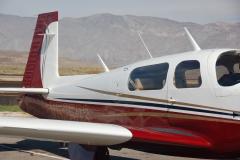
From the album: #mikefox's album
-
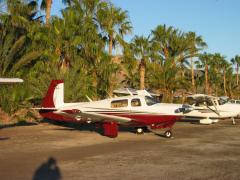
From the album: #mikefox's album
-
Quote: edgargravel I agree with Jolie. I slip mine all the time on crosswind finals. I find such an approach to be stable this way. Fly 5 mph faster and use less flaps, but forward slips create fairly solid performance right down to the numbers. I do not use it as a device to reduce speed on descent or to get down faster. Those are planning issues and I try and solve them further out - or I am going around. I have heard from many sources that our "short body" Mooneys have a very comfortable flight envelope when it comes to slips. My own experience (about 350 hours) in my own E model supports that view. I hear (but I do not know) that J's are OK with slips too. I have also read that it is primarily the "long bodies" where problems can occur in attitudes and configurations that do not tend to bother our shorter birds. IIRC, I read about "... a former Mooney factory test pilot with more than 14,000 hours of flight test work exploring the complete flight envelope of many models of Mooney including the J ..." who ended up UWOF because of a loss of control in a cross controlled approach. An article in the May 2007 MAPA log discussed it: On August 4, 2004, approximately 0845 Central Daylight Time, a Mooney M20J single-engine airplane was destroyed upon impact with terrain following a loss of control while maneuvering for landing at the Olney Municipal Airport (ONY), near Olney, Texas. See Trey Hughes editorial in the same edition on slipping: I don’t know how many Mooney owners or operators have had the chance to experience a cross-controlled stall in a Mooney, but those who have been unfortunate enough will agree that it is a place that no one wants to go twice. Mooneys, especially the long-body models, have a tendency to roll toward the deflected rudder when they are stalled in an uncoordinated condition. This roll can be abrupt and unannounced. Especially with flaps extended, during a slipping maneuver, it is very easy to lose elevator effectiveness and suddenly get a nose-down pitching moment. I have talked with several Mooney factory test pilots – both present and past – who agree that a slip is not a normal maneuver in a Mooney and should not be attempted at low airspeeds and altitudes. ..... While the short airframes (pre-J) are not as susceptible to this issue, slips in even these models should be approached with a lot of caution. Remember a Mooney, even those with 200 hp or less, has the flight characteristics of a high performance aircraft and should be flown as such. Slips are not part of normal operations and not how these airplanes were designed to be flown. If a slip must be preformed, remember to keep the airspeed above about 80-85 KIAS and you will avoid the possibility of a tail stall and the subsequent loss of control. So, to quote Forrest Gump, "careful is as careful does." I know my Mooney and I know how it handles a cross controlled stall (at altitude of course with an instructor on board) and Trey is correct. It will roll toward the deflected rudder. The difference is that my E model is not as violent in this manoeuvre as the longer bodies and can be recovered before it enters a spin. Location of the CG can also either mitigate or compound the issue. Now, having said all that, this is just my opinion and it is worth as much as you paid for it.