

wombat
-
Posts
847 -
Joined
-
Last visited
-
Days Won
4
Content Type
Profiles
Forums
Blogs
Gallery
Downloads
Events
Store
Everything posted by wombat
-
Does the rocket conversion include flap gap seals? They are pop riveted on, so I don't think the factory did it.

-
Substitute Vintage Parts (Pre-1980 CAR3 and Part 23) Program
wombat replied to bradp's topic in General Mooney Talk
That AC seems to apply only to aircraft type certificated before January 1, 1980. But it's been 14 years since then... Why can't they move the date up? (So says someone who is probably buying a 1985 airplane) -
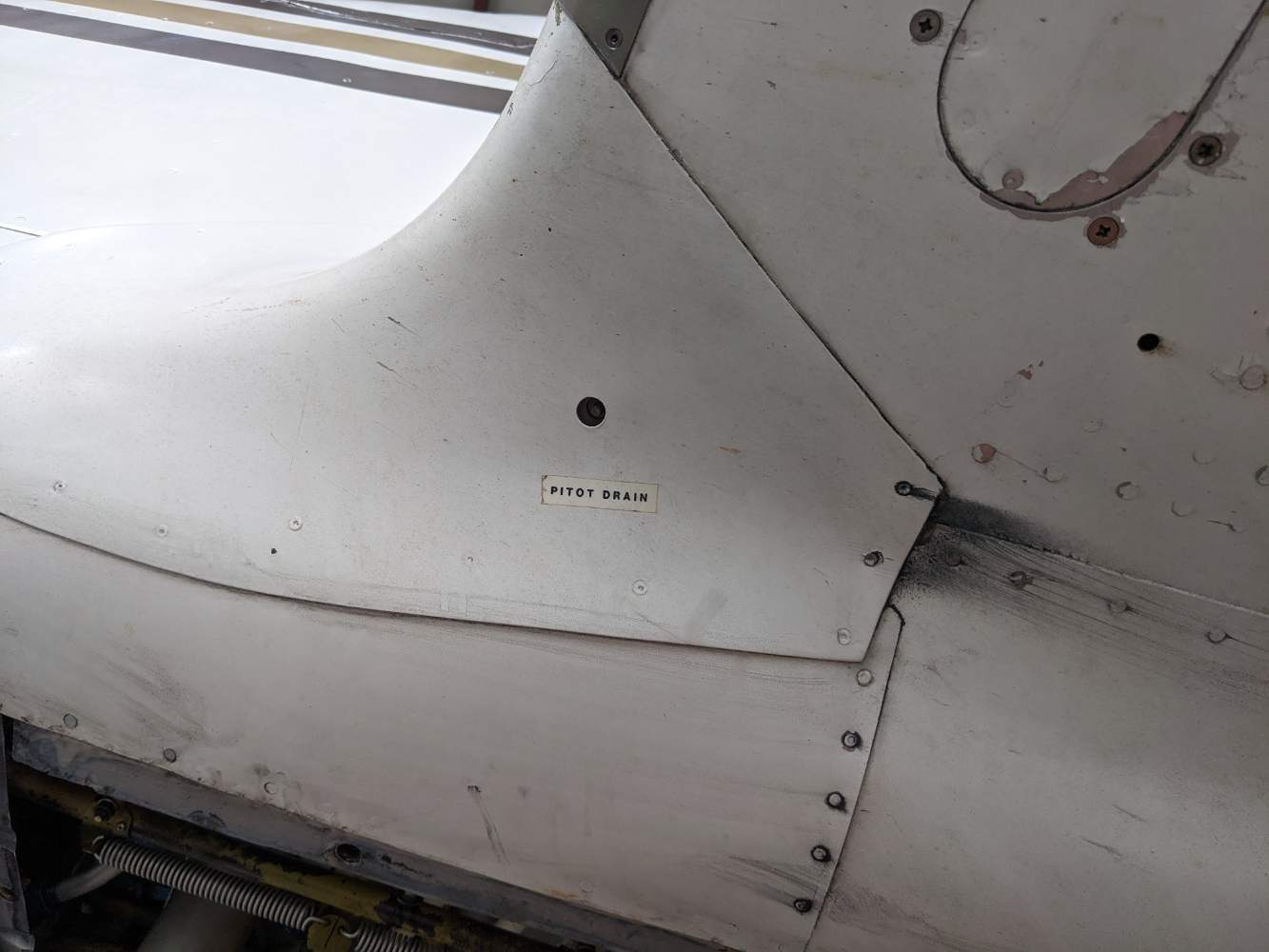
On the pilot side near the back of N5773S is the static drain. The label is printed in such a way as to make it right-side up if you have your head upside-down, or are sliding under the plane with your feet further toward the pilot side wingtip. Edit: I was told my pictures are not visible to everyone else.


-
If buying a plane with a high-time or even mid-time engine I need the oil analysis reports if they are having oil analysis done. I understand @exM20K's unhappiness at what appears to be a company I do business with (Blackstone) sharing customer data with other customers without asking for permission. If Blackstone has this on their web page as part of the terms of service...Well, bad on me for not reading it thoroughly enough. If they don't have it there, bad on them. And if I were to suffer any loss due to their policy that was not published, I would probably seek compensation. A loss due to selling a plane with an engine where I had an oil report that said something like.. Oh, I don't know... "...a jump like this probably shows trouble...(lots of other text omitted talking about how bad things are) Caution!" that they then sent to someone else without asking for permission first, and then I lost the sale.... Anyway, it doesn't really bother me too much because I will always be forthright about the condition of anything I sell. If they have a checkbox for "Share your data with others?" I would check it. But I think @exM20K is being reasonable if he says he is bothered by this enough to find a different vendor and wants to tell all of us about his decision. That's a fine way to behave. Not my way, but my way isn't for everybody. Don't want to focus on the relatively rare negative situations here, but...if the seller has oil analysis data and fails to provide it I will assume they are hiding something bad and will not buy that plane. If they provide it only after asking I'll kind of roll my eyes because they should have provided that earlier with the logbooks. If they lie about it and I find out about it before I've spent any money, I will not buy that plane. That seller is dishonest and I'll never do business with them. You shouldn't either. If I find out about it after I have spent some money but before I have bought the plane I will require all of my money back including such things as travel expenses and prebuy costs. If they refuse, I strongly suspect that the court system would back me up on this and compel them to pay based on their fraudulent statements about what information they have about the condition of the aircraft. If they lie about it and I find out about it after I have purchased the aircraft, I would ask them to provide the reports (or more accurately, ask them to tell the oil analysis company to provide the reports, since that individual has proven themselves to be dishonest) and if they fail to do so, I would probably ask the courts to compel them to based on the assumption that refusing to do so is highly likely because they have committed fraud in failing to disclose this information. This would most likely come up only if an engine problem was discovered relatively shortly after the purchase that would probably have shown up in oil analysis... Such as, for example, extremely high chrome that went from in the 30's to 60's all the way up to 360 over 50 hours of flying... Totally random example. The same goes for engine monitor data. If you have it, provide it. If you fail to do so, I will assume you are hiding something. Regardless, I'll be sharing my experience with that seller, good or bad. There are records that the seller is required to transfer to the buyer when the aircraft is sold. According to 91.417.(b)(2)) , 91.417(a)(2) records must be transferred No other records must be transferred, but if a seller didn't want to give me ALL the old maintenance records (even unofficial maintenance records like shop invoices) I would probably walk away or only offer to buy at an extremely steep discount. Saying this as someone in the middle of two separate issues that are related to this: I'm in the middle of buying a plane and have been making decisions on when I might want to walk away instead of continuing. The oil analysis on my brand C aircraft is showing super-high chrome in the last 50 hours of flying. High enough that Blackstone called me. This is after 400 hours of flying this engine and getting oil analysis done the whole time at roughly 30 hour intervals.
-
The one on N5773S has a label. Update: Uploading picture in a different way.
-
Re: Damage history.... It's a big price discount because many potential owners will not buy a plane with any damage history. But as a buyer, since the price discount is already included in the price you pay, it's not really a problem. When considering the time cost of money, it's actually a better deal. If you could magically purchase aircraft at 1% of market price (99% discount!), but also had to sell them at 1% of market price (The same 99% discount), we'd all do that! Financially there is nothing different between that and a 10% to 15% discount that 'damage history' gives. But why do some buyers shun airplanes with damage history? I suspect they think that the aircraft is less safe or will have further maintenance costs. This suspicion is based on my conversations with other aircraft owners over the last 10+ years. My personal opinion is the risk of an accident or incident, or further maintenance costs from a 'damage history' airplane are negligible. Not zero, but small enough that on a statistical scale you won't be able to show any additional risk. The much larger risk factors are corrosion and un-reported/un-repaired damage. If an airplane had an incident and is repairable, that repair was done to FAA standards. The same organization that made the standards the airplane was built to. There are no additional limitations on that airplane and it is officially just as safe as it was before. There are many events that can cause damage to the aircraft that don't get found or reported as damage. A hard landing that doesn't cause any obvious damage or an in-flight turbulence event could both cause damage that is undetected by maintenance and could cause a later accident/incident or unexpected repair costs. But after one of those you don't have a certified mechanic looking at the airplane for damage that might have been caused by the event. But with a 'damage history' causing event, you *DO* have someone specifically looking for issues that could have been caused by the event. On the other hand, some maintenance shops might be particularly picky about how previous shops have performed and logged repairs. I took a C-branded 182 to a shop for annual and the shop would not sign off on it because they wanted to open up the wing to inspect a repair made 40 years previously. They said they didn't think there was enough detail in the logbook entry to convince them that the repair had been made correctly. I pointed to a logbook entry that said the repair had been made in accordance with the C-brand repair manual and FAA standards (I don't remember the exact wording) and that other A&P's (At least 10) had signed off on this in the 40 years since then. I ended up taking the plane back with the annual inspection completed but not airworthy and with a discrepancy list. One ferry permit later and at another shop, I had a logbook entry that said something like "Found entry in logbook documenting repair to left wing in accordance with manufacturer and FAA requirements." Mike Bush has written about damage history a little; https://resources.savvyaviation.com/wp-content/uploads/articles_eaa/EAA_2013-12_damage-history.pdf I wish he would do an analysis of accidents/incidents and maintenance costs associated with aircraft damage after the initial repair has been completed. He has enough data that his analysis could perhaps be considered authoritative and he has enough market attention this could significantly alter the 'damage history' aircraft market. So says the guy who has a prebuy on a 'damage history' airplane that was supposed to start today.
-
TSIO-520-NB throttle and turbo control questions....
wombat replied to wombat's topic in Modern Mooney Discussion
Yeah, I've found Mike's stuff to be very reasonable and what he advises is normally what I try to do. Hard to run LOP on a Continental O-470 though. When leaning, one of the cylinders starts missing before the last one even reaches peak EGT, let alone get even the slightest lean of it. But what you are saying about him running WOT all the time was part of the reason I was thinking it was possible to get the throttle all the way open before spooling up the turbo. If your throttle doesn't open all the way until 35", running at 25" at FL180 with the turbo providing 12" of boost and the throttle partially closed seems wasteful. Well, if I do end up buying this plane, I guess I'll see how it runs LOP. -
TSIO-520-NB throttle and turbo control questions....
wombat replied to wombat's topic in Modern Mooney Discussion
The plane I'm looking at is N5773S. It's still up on controller.com at the moment. -
TSIO-520-NB throttle and turbo control questions....
wombat replied to wombat's topic in Modern Mooney Discussion
Oh, believe me I understand the overall benefits and costs of having a turbo. With luck (Well, good maintenance on behalf of the seller) I'll own a plane with a turbo this time next month. -
TSIO-520-NB throttle and turbo control questions....
wombat replied to wombat's topic in Modern Mooney Discussion
It's starting to make sense @kortopates In Mike's description, the upper deck pressure is always at much as the turbo can do given the exhaust flow up to the maximum upper deck pressure, which is just a little above maximum intake manifold pressure. That fits the "Fixed Absolute Pressure System" in the PDF that Rich attached. In the case of the TSIO-520-NB, which is a Variable Absolute Pressure System there is a the addition of the linkages and cams that take the throttle position and provide that as an input to the pressure controller, so the pressure controller will vary the upper deck pressure to just enough to overcome the fluid friction losses of the intake system. This is the "Variable" part of the variable absolute pressure system. Sounds a bit inefficient to use the turbo to boost the upper deck pressure then restrict it with the throttle again. But I don't know how much power we're talking here. If the ambient pressure is 29", I've got the throttle halfway open, turbo is boosting to maybe 34" and because the throttle is 1/4 closed, it restricts it back to 30". As I open the throttle more, the upper deck pressure will increase, and the difference between upper deck and manifold will decrease. But running at say 25" at FL210 and having the throttle partially closed still sounds wasteful. So the shape of the cams and angles of the linkages would determine the map of throttle position to target upper deck pressure. And the more closed the throttle, the greater the differential between upper deck and manifold pressures would be. At wide open throttle, it would be the most efficient with least differential. The description of the system in the PDF Rich attached is: VARIABLE ABSOLUTE PRESSURE SYSTEM (TWIN ENGINE, WITHOUT COVER): Operation: The variable absolute pressure controller (direct sensing, without cover) works much like the nonvariable absolute pressure controller in that it senses deck pressure, compares it to a reference absolute pressure, and adjusts the wastegate butterfly (controlling turbocharger speed) to maintain sea-level horsepower at varying altitudes. It differs from the nonvariable version, however, in that it is directly linked to the engine throttle, and through a system of cams and followers, adjusts itself to varying power settings, achieving the optimum deck pressure for a given throttle movement. A pressure relief valve, set slightly in excess of maximum deck pressure, is provided to prevent damaging overboost in the event of a system malfunction. A sonic venturi, if installed, is incorporated to provide a constant source of compressed air to the cabin pressurization system. An intercooler, if fitted, is added to cool the compressor outflow and increase cylinder charge air density. -
TSIO-520-NB throttle and turbo control questions....
wombat replied to wombat's topic in Modern Mooney Discussion
Thanks, @N201MKTurbo. So it sounds like the throttle control in the cockpit in this case will connect to the 470836-18 or 633388-10 pressure controller and that pressure controller will actuate both the waste gate and engine throttle as necessary (Through oil pressure and a system of cams and followers, respectively) to achieve the absolute pressure set by the cockpit throttle control. I'm assuming then that the controller is set to keep the actual engine throttle as wide open as possible and the turbo wastegate as open as possible (Lowest boost) to achieve the desired absolute intake pressure. But as a pilot I don't actually have control over these things directly and I can consider the control in the the cockpit to be simply setting the manifold pressure however I want. As long as it's within the manufacturer's allowed operational parameters, of course. -
TSIO-520-NB throttle and turbo control questions....
wombat replied to wombat's topic in Modern Mooney Discussion
There has to be some mechanism for controlling manifold pressures below ambient pressure though, so you can't just control the wastegate with the throttle control. Let's say I wanted to climb from sea level at 25" of manifold pressure.... When I start the throttle is partially closed and the wastegate is fully open so the turbo is spinning as slowly as possible. As I climb, the throttle needs to open more and more until it's fully open, and then the turbo needs to start spinning faster by closing the wastegate. At some point if I keep climbing I'll exceed the critical altitude of the turbo and the wastegate would be fully closed and the manifold pressure would start dropping. (This altitude may be above the service ceiling of the airplane) -
How does the linkage from the throttle knob work to control the throttle and turbo? Does the throttle control have two stages, one for the actual throttle and one for the turbo? Does the turbo automatically try to maintain 2" of upper deck pressure over the intake manifold pressure? Something else? Does anyone have diagrams of this? This is for the install on a Mooney Rocket
-
Some sample A&P schools... https://www.bigbend.edu/academics/aviation-maintenance-technology/ https://scc.spokane.edu/What-to-Study/Hands-on-Building-Trades/Aviation-Maintenance-Technology If things went perfectly my way, I'd do a couple of online courses for a few terms while I keep working my job and then pick and choose courses based on schedule like having one really busy day then a day off, so I can go home. Things never go that smoothly, but I can try to get things as close as I can.
-
FYI, I'm using Savvy to coordinate the prebuy for an East Coast (Maryland) Rocket. I am also going out to see the plane in person and fly it. Hopefully with the seller, but if not, then with someone that has more recent mooney experience than me.
-
I am planning on going to school for my A&P when I retire from my regular job. Just a few more years.....
-
Jimmy and I are still working on finding our stride. Let's see how it all goes. I think we've got a shop to do the exam the week after next and I'm now coordinating to get the plane over to the shop's location, and trying to get dates locked down so I can buy airline tickets to go see it then. But so far I'm not seeing anything to keep me from buying it.
-
Sorry I don't have an answer to your question, but for $750, you can have savvy Aviation find some maintenance shops and manage the prebuy for you. It's extra money, and probably kind of big compared to the value of most '65 Mooneys, but it would work.
-
Thanks. I do too.
-
Well, I now have a signed purchase agreement; just waiting on the prebuy. The one I'm looking at is N5773S https://www.controller.com/listing/for-sale/221183449/1985-mooney-m20k-305-rocket-piston-single-aircraft If anyone has any knowledge of this plane other than what I can get from the FAA or in the advertisement, please let me know!
-
Updating Panel with New Switches and Annunciator Lights
wombat replied to Me & 8883's topic in Avionics/Panel Discussion
Oh jeez I hope this doesn't devolve into an argument too.... But here we go! The FAA has a thing or two to say about Aeronautical Replacement Parts. You can read more here: https://www.faa.gov/documentLibrary/media/Advisory_Circular/AC_20-62E_CHG_1_Editorial_Update.pdf The FAA has defined several types of parts. (In their doc these are lettered, but the BB here can only do numbers and I'm too lazy to make the list manually) FAA Approved Parts Acceptable Parts Article Commercial Part Product Standard Part Interface Component Surplus Overhauled Rebuilt As Is Owner/Operator Produced Part Time-Limited Part The things I think we'd be most interested in are Standard Part (Paragraph 6(f)) and Owner/Operator Produced Part (Paragraph 6(n)). f. Standard Part. A part manufactured in complete compliance with an established U.S. Government or industry-accepted specification, which includes design, manufacturing, and uniform identification requirements. The specification must include all information necessary to produce and conform to the part. The specification must be published so that any party may manufacture the part. Examples include, but are not limited to, National Aerospace Standard (NAS), Air Force/Navy (AN) Aeronautical Standard, Society of Automotive Engineers (SAE), Aerospace Standard (AS), Military Standard (MIL-STD), etc n. Owner/Operator Produced Part. Parts that were produced by an owner/operator for installation on their own aircraft (i.e., by a certificated air carrier). An owner/operator is considered a producer of a part, if the owner participated in controlling the design, manufacture, or quality of the part. Participating in the design of the part can include supervising the manufacture of the part or providing the manufacturer with the following: the design data, the materials with which to make the part, the fabrication processes, assembly methods, or the quality control (QC) procedures. The FAA is also quite specific about Electrical Parts and Instruments, they wrote section 13 just for that. 13(b) is even more specific, it reads: b. Discrete Electrical and Electronic Component Parts. Electrical and electronic parts, such as resistors, capacitors, diodes, and transistors, if not specifically marked by the equipment manufacturer’s part number or marking scheme, may be substituted or used as replacement parts, provided that such parts are tested or it is determined that they meet their published performance specifications and do not adversely affect the performance of the equipment or article into or onto which they are installed. The performance of such equipment or article must be equal to its original or properly altered or repaired condition. Integrated circuits such as hybrids, large scale integrated circuits (LSIC), programmable logic devices, gate arrays, application specific integrated circuits (ASIC), memories, Central Processing Units (CPU), etc., are not included because their highly specialized functionality does not readily lend itself to substitution. And in general what we are talking about is the Replacement of Parts and Materials, which is paragraph 8 (a) a. Replacement of Parts and Materials. The performance rules for replacement of parts and materials used in the maintenance, preventive maintenance, and alteration of aircraft that have (or have had) a U.S. airworthiness certificate, and components thereof, are specified in § 43.13 and part 145, § 145.201. These rules require that the installer of a part use methods, techniques, and practices acceptable to the FAA. Additionally, the installer of a part must accomplish the work in such a manner and use materials of such quality that the product or appliance worked on will be at least equal to its original or properly altered condition with respect to the qualities affecting airworthiness. We can find 43.13 here: https://www.ecfr.gov/current/title-14/chapter-I/subchapter-C/part-43/section-43.13 So to answer @Utah20Gflyer's direct question, which I'm actually assuming was more of a joke, but I'm taking it seriously as an example of how I would try to use the document to answer the question about other parts.... The wire does not need to be STC'd as long as it is a MIL-STD or SAE wire. For @Me & 8883's question about MS switches, I'm assuming we're talking about something like this one: https://www.aircraftspruce.com/catalog/elpages/7270_5_5.php?clickkey=32749 It says it's "MIL-C-5809 qualified", so my guess it this would be considered a 'Standard Part', and may be substituted or used as replacement parts. Side note: In their document they mix singular and plural. (Part Vs. Parts) and that bothers me. -
@geoffb Thanks, I might head down there at some point. My father-in-law lives in Corvallis and keeps his planes there and I get there once a quarter or more. Part of my mission with the Rocket is to get down there more often. I saw N252AC for sale, and since it doesn't have TKS I'm not interested at this time. If I got a flight in that it would be purely a gift from the seller.
-
Oops, pitot static transponder expires soon
wombat replied to M20 Ogler's topic in General Mooney Talk
Last spring the transponder for my 182 was misbehaving. Sometimes, no matter code I put in, it was showing up to ATC as '7777', which they said was "live military operations in US airspace".... But then it would start replying normally again. It didn't seem to be affected by me power cycling it After about 3 flights with a radio call from ATC in the middle that started with "Uhhh... N12345...." I replaced the KT76 with a GTX327. I'd been holding out for a big panel upgrade, but decided I didn't think I could justify turning that transponder back on any more. -
Oops, pitot static transponder expires soon
wombat replied to M20 Ogler's topic in General Mooney Talk
That all sounds correct to me. -
Oops, pitot static transponder expires soon
wombat replied to M20 Ogler's topic in General Mooney Talk
OK, back to this. I was getting frustrated and was probably going to write stuff in a snarky and insulting way, which I don't want to do. From past experience doing that is not helpful. I choose to believe that all of us are trying to do the right thing and get good information out to the Mooney community. @philiplane You asked about the altimeter and encoder talking to each other.... They don't, which is why there is a correspondence test required between the altimeter and altitude encoder. 91.217 says (I'm paraphrasing here) that if you install an altitude digitizer or an altimeter, they must be tested to report the same altitude *****OR***** they are both TSO'd. So you don't even need to do the test if both the altimeter and encoder are TSO devices. I will once again bring up the point that the data correspondence test is between the altimeter and encoder, and while you *could* use the output of the transponder to see what the encoder is reporting for altitude (which is required by 91.411(c), no transponder is required to do this to comply with 91.413. You could do it with a vacuum and multimeter, setting the altitude on the static system and looking at the altimeter, then probing each of the wires on the gray code output of the encoder. You also bring up the transponder transmitting at the right wattage and frequency... That is tested with Appendix F, on the bench. Specifically frequency is subpart (a) and wattage (power) is subpart (d) The only thing about altitudes in that appendix F is it says "Verify that the altitude reported in the replies to UF = 4 are the same as that reported in a valid ATCRBS Mode C reply." That's bench checkable. Regarding 91.227.... There is nothing in there that requires a periodic re-test. It's available here: https://www.ecfr.gov/current/title-14/chapter-I/subchapter-F/part-91/subpart-C/section-91.227 Regarding the install..... Well, I will once again mention that I'm not making any claims about if a non-A&P can do that. BUT if the transponder has been bench checked IAW Appendix F, no further testing needs to be done in order to comply with 91.413 after the transponder is re-inserted into the aircraft. You mention 91.225, which is about ADS-B Out. It's available here: https://www.ecfr.gov/current/title-14/chapter-I/subchapter-F/part-91/subpart-C/section-91.225 There is no periodic re-check requirement. You mention the instructions for continued airworthiness from the ADS-B manufacturer. There is nothing in the two I've looked at that require what I think you are talking about. For the uAvionix wingtip unit I have installed. It can be found here: https://uavionix.com/downloads/skybeacon/skyBeacon-Continued-Airworthiness-Manual-UAV-1002112-001.pdf The important parts are on pages 13 through 15, in sections 8.3 through 8.6. In 8.6 they do bring up altitude encoder testing, but this is only for IFR operations, so is not relevant for our discussion which was just the 91.413 requirement. And even then, it's only applicable if your ..."altitude encoder has been recently adjusted,"... For the Garmin units, I found what I'm assuming is a valid maintenance manual here: http://www.n927sf.com/Current POH AFM FMS/Garmin GTX 345 Maintenance Manual - 190-00734-11_07.pdf The instructions for continued airworthiness start on page 4.1 (page 41 of the PDF). For "testing" in table 4.1, they say to refer to 14 CFR 91.411 and 91.413 and part 41 appendixes E and F. (appendi? appendixes?) There are annual 'Equipment Visual Inspection" requirements and a 10 year or 2,000 hour electrical bonding test, but that's it. If it matters, the shop that I have service my current aircraft does not add a line "found ADSB compliant" to the annual inspection log entry. Nor does the mooney service center who has been doing the work on the Mooney I'm looking to buy. Recommending a periodic PAPR is fine, but that's just a recommendation. Yes, they send out letters to aircraft owners whose aircraft are out of spec. But that does not make a requirement for a periodic re-check of your ADS-B out equipment. If I take a transponder in for a check in accordance with part 43 appendix F and they charge me for performing a test to meet the requirements of 91.227 I'll be angry. There is no reason to test that. Not in 91.227, not in the Garmin maintenance manual, not in part 43 appendix F. As you say, the Garmin service manual does include language about the regulatory test. But if I'm not flying IFR, no testing at all is required to comply with 91.411. And a bench check is sufficient to comply with 91.413. And after a removal, (as of Rev 7, but not before), 'sufficient' testing in accordance with part 43 Appendix E paragraph C must be completed. Now *THAT* is a nebulous requirement. What is sufficient testing? Good job, Garmin. NOT. But this is not a periodic requirement, this is about removing, replacing, or modifying. @N201MKTurbo I have had a few similar experiences. A few years ago I was ferrying a plane into the Seattle area with a transponder that had long passed the 91.413 check time. When airborne, but before the 30NM mode C veil, I called ATC on the radio for flight following and told them my transponder was inoperative. They told me to proceed as requested. I also told Renton tower before I entered their airspace. When I bought my 182, on the flight back to Seattle (BFI) my very first flight in my new plane the transponder died on the way, about 1 hour away from Seattle. Fortunately I was on flight following and they told me before I inadvertently flew under the mode C veil with an inop transponder. Totally weird side note about 91.225.... subpart (f) says ..." must operate this equipment in the transmit mode at all times unless -" and then (f)(2) says "Otherwise directed by ATC when transmitting would jeopardize the safe execution of air traffic control functions." .... So my conclusion is that if you are directed by ATC to turn it off for a reason other than jeopardizing the safe execution of air traffic control functions, you are prohibited from turning it off! Now that's a wild condition!!! As a pilot, I wouldn't necessarily know why ATC asked me to turn it off. But if they ever do, I'm totally asking them if it's because transmitting would jeopardize the safe execution of air traffic control functions.