

George Braly
-
Posts
73 -
Joined
-
Last visited
-
Days Won
1
Content Type
Profiles
Forums
Blogs
Gallery
Downloads
Events
Store
Everything posted by George Braly
-
Based on the G100UL fuel leak thread what's your position?
George Braly replied to gabez's topic in General Mooney Talk
As to "this" being forced on you - - please remember - - we are trying to solve a problem created by the Obama Administration EPA. Further, this "problem" is a problem which - - without the G100UL Avgas "solution" - - leaves our entire high performance fleet at risk of grounding as a result of a single industrial accident in England. **************** With respect to your second item, from 2010 through about 2012, we tried rather diligently to pursue the ASTM "consensus development" process. Ultimately, there were two problems. First: ASTM would not allow the use of their own ASTM D6730 /D6733 standard for conducting "DHAs" (Detailed Hydrocarbon Analysis) which is a much improved way of insuring uniformity of fuel production and is a laboratory test tool that should greatly diminish product liability risks for the fuel producers, the distributors, & the FBOs. Second: Late in that time frame we first learned that one of the major ASTM members was attempting to obtain patents which appeared to us to be based on confidential disclosures we had previously made to ASTM committees about G100UL Avgas. As a result, the FAA agreed that we could proceed independently with an STC. -
The ICAs for G100UL Avgas are data acceptable to the administrator that authorize the substitution. In addition, these types of changes are classified by the FAA as "minor changes" . It is my understanding, from a lunch conversation with Mike Busch, yesterday, that they only require "acceptable data" upon which the mechanic can rely. However, I want to investigate the subject some more when we get through some of the higher priority items.
-
Help me understand, how did the fuel get to those spots on the top of the wing ? When was the plane last painted ? And last, I think it is likely those brown spots will polish out. Not positive. But we have done that as an experiment using fuel we deliberately spilled on painted aircraft parts, and which we allowed to dry for several days. It takes some elbow grease and a series of polishing compounds to make that work.
-
Yes. That was included as part of the very first testing we did for the FAA related to material compatibility. The FAA required us to create an elaborate "rig" test. That operational rig test included essentially all of the fuel system components from both Lycoming and Continental engine and related aircraft systems. A partial list of OEM components (used condition) tested include: 1) Lycoming fuel pump; 2) Continental fuel pump; 3) fuel spiders (with the diaphragms) for both Lyc & TCM) ; 4) a couple of different AC fuel selectors; 5) various check valves; 6) fuel injectors; fuel lines of various materials; 7) three different fuel bladders - - 1954 ; ~ 1980; and 1985 year models; and a lot more. The fuel pumps were electrically driven but were heated with electric heaters so they operated at engine operating temperatures. That "operational" or 'dynamic' testing continued for a period of about nine months. The FAA randomly came by to inspect the testing in progress. PAFI people saw a presentation on the dynamic test rig at an ASTM meeting and really liked it. They asked for a copy of the drawings and test plan which we provided. Note: One thing we have learned recently, those diaphragms are sensitive to oxygenates - - such as ETBE. We had several similar diaphragms fail after short exposures to ETBE based fuel chemistries when we were doing some comparison testing on our test stand. Again, let me know if you have more questions.
-
https://precisionairmotive.com/wp-content/uploads/2019/06/RS-76-Rev1.pdf 1) That link to allied signal / Bendix was posted in another message, but it is copy / pasted here for convenience. I think the "take away" from that 44+ year old document is that there has been a recognized industry effort to eliminate nitrile components from aircraft fuel systems that goes back nearly half a century. Unfortunately, compliance by portions of the industry has been less than robust. We required removal of rubber / nitrile fuel hoses from all of the TAT Turbo systems some 20 years ago, and replacement with teflon lined hoses. 2) Yes. The fuel used for that soaking is from the same batch produced in Baton Rouge that was sent to California. 3) Yes. We run DHAs (Detailed Hydrocarbon Analysis) per ASTM D6700 or D6733 (basically Gas Chromatograph technology) on every fuel batch produced. That will typically detail every molecule that shows up with a concentration > ~ 0.01%. If there were any contamination it would show up on the DHA. 4) The SDS for 100LL and G100UL is extremely broad. That is true of almost all types of fuels. The control of the actual quality of the fuel is pretty much unrelated to the SDS. The control actually takes place in the FAA approved specification - - not in the SDS. The FAA approved G100UL avgas specification is much (very much) tighter controlled than is the ASTM D910 specification for 100LL. 5) Depending on the refinery producing the batch of 100LL, there can be as little as about 15% toluene, to as much as 29% toluene (by mass fraction - - m/m). We added the extra toluene to our local FBO 100LL in order to make sure we had a "boundary condition" on upper toluene included in the paint testing.
-
G100UL paint testing by YouTuber mluvara
George Braly replied to Shiroyuki's topic in Modern Mooney Discussion
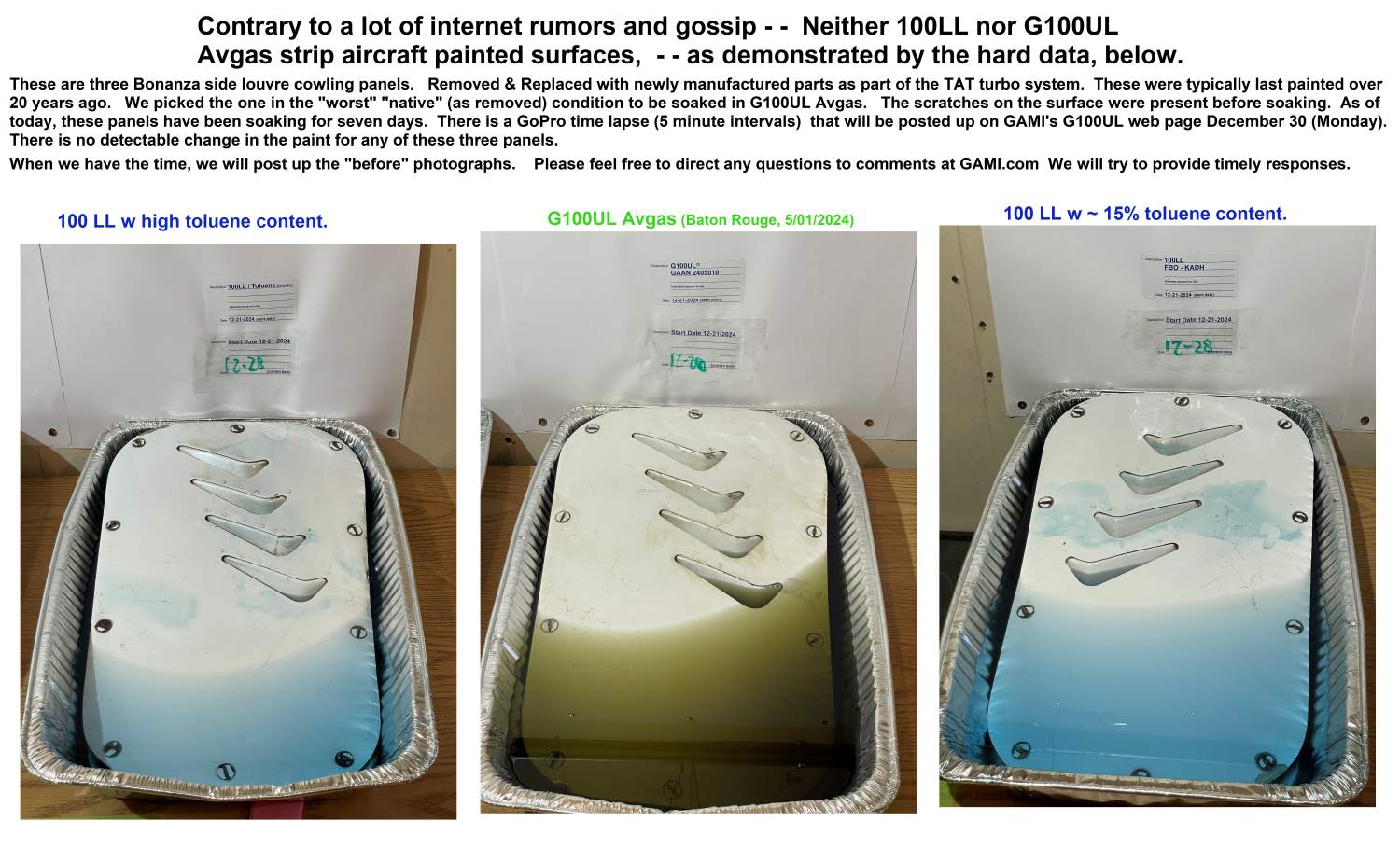
Mike, 1) An unleaded fuel that has equal or better characteristics than 100LL. Causing damage in excess of 100LL, in any regard, is not acceptable. 2) Priced the same...LOL! I know that is unrealistic. Question is, what is an acceptable premium, 'for the children, and all'? What you state above is not unreasonable. Taking 2) (pricing) first: GAMI has always said that the cost of the components to produce G100UL Avgas, at the initial and lower volumes, will typically be about 80 cents to $1.10 more / gallon than the cost of the components to produce a gallon of 100LL. As batch volumes enlarge, that differential will narrow. Other than that differential - - there is absolutely no reason the price of G100UL avgas would be any higher than that original cost differential. All of the other "mark-ups" in the supply chain remain unchanged - - cost of transportation, insurance, etc. Same same. Taking up your first point: 1) There is convincing contrary evidence that exposure to G100UL avgas does not "strip paint" or otherwise compromise the basic adhesion of the paint to the aircraft structure. A) Consider: Independently of GAMI - - G100UL Avgas was tested by Embry Riddle for over a year. That was done under their complete control. The FAA did also supervise that testing. ERAU engineers and pilots did all of the work and wrote the test plans and the reports - - which the FAA approved. There were no dips, leaks, nor any evidence of any damage to any paint. At the conclusion of the test program, the (1400 hour engine - - with a year of additional flying on G100UL Avgas - - was torn down and found to be in as good or better condition than when it started. Noticeably - - with no evidence of any lead deposits or spark plug fouling. The only (paint) "damage in excess of 100LL" that is being claimed is the report damaged paint on a Mooney. However, extensive testing reveals that G100UL does not strip paint, or damage the paint. At least not aircraft paint that was applied in the manner in which normal aircraft paint is typically applied. When that report first appeared, I was headed to Europe to meet with some aviation people in Europe about deployment of G100UL there. Before I left, I organized the small experiment whose results you see in the photograph documenting the results of the test that was conducted while I was gone. Those (20+ year old) painted panels have been soaking in G100UL Avgas for over a week. There is not the slightest hint of any damage to the paint. Even the paint at the edges of the pre-existing scratches in the paint remains fully bonded. Any comments and questions are always welcome. George (gwbraly@gami.com)
-
G100UL paint testing by YouTuber mluvara
George Braly replied to Shiroyuki's topic in Modern Mooney Discussion
Marc, I am back in country. Please feel free to contact me about follow up on this effort. George -
Marc, I apologize if my posts up on BT were unclear. I will try to go back there and clear that up. It has been a bit difficult as I have been out of the country for the last 10 days, and am just now getting back to a real desk where I can spend the time to read the numerous postings. The following are hard facts: For the last forty-four years - - various OEMs have been recommending the replacement of nitrile / buna N fuel system components with "modern" fluorosilicone type O-rings, gaskets, seals and other fuel wetted components in our aircraft. There is a 1980 (yes, 44 years ago) Allied Signal / Bendix service document that states exactly that. It is not a mere coincidence that was happening in 1980. The "timing" of that Bendix service document is consistent with the advent / roll-out of 100LL (which first began about 10 years earlier). As mentioned elsewhere, that fuel often (nearly always) contained significant levels of toluene. A whole new small maintenance business was created to reseal Mooney fuel tanks (example: Weep No More, in Minn.) A C-421 owner on BT reported that when he recently ordered new seals and O-rings from Textron, they were Viton and fluorosilicone - - not nitrile. When GAMI was first drafting the ICAs to go with the G100UL Avgas STC, the Wichita Certification engineers forwarded that draft (as they are supposed to do) to the FAA "AEG" group (now AED) for review. The AEG group is a subdivision of Flight Standards that is responsible for maintenance instructions. The AEG group actually asked GAMI to make the language in the ICAs related to the replacement of older style O-rings, hoses, and gaskets, "more explicit" or "stronger" , as the AEG group had been trying to get the industry and the mechanics to stop using nitrile type O-rings and seals as replacements - - for decades. Again, if you have any specific questions, please post them up or send them to me directly. I will try to provide data to support the answers. Also, see the recent / ongoing testing, reflected in the photograph, below. George Please feel free to ask me any explicit questions you want for which you do not believe you have received satisfactory answers.
-
G100UL paint testing by YouTuber mluvara
George Braly replied to Shiroyuki's topic in Modern Mooney Discussion
Please see the data in the image, posted with this message. These are old parts removed from the Bonanzas which we remove and replace with newly manufactured parts when we install turbo systems. The paint is ~ 20 years or more old on each of these panels. There are scratches and bare spots where paint had previously "flaked off" on each of them - - prior to beginning the soaking. In particular, the flat head panel fasteners all exhibited some age from repeated removals and replacements over the years. One cannot detected any difference from the "before" and "after" photographs. We will try to post up those "before" photos as well as a time lapse photographic history of the previous seven days of soaking - - hopefully on Monday. This small data set represents about the fourth or fifth time, over the past 14 years, that we have conducted similar testing. All with the same good results. If you doubt the validity or integrity of this data - - you are invited to visit our facility in Ada, and see this testing, first hand. George Braly
-
Based on the G100UL fuel leak thread what's your position?
George Braly replied to gabez's topic in General Mooney Talk
Please see the data in the image, posted with this message. These are old parts removed from the Bonanzas which we remove and replace with newly manufactured parts when we install turbo systems. The paint is ~ 20 years or more old on each of these panels. There are scratches and bare spots where paint had previously "flaked off" on each of them - - prior to beginning the soaking. In particular, the flat head panel fasteners all exhibited some age from repeated removals and replacements over the years. One cannot detected any difference from the "before" and "after" photographs. We will try to post up those "before" photos as well as a time lapse photographic history of the previous seven days of soaking - - hopefully on Monday. This small data set represents about the fourth or fifth time, over the past 14 years, that we have conducted similar testing. All with the same good results. If you doubt the validity or integrity of this data - - you are invited to visit our facility in Ada, and see this testing, first hand. George Braly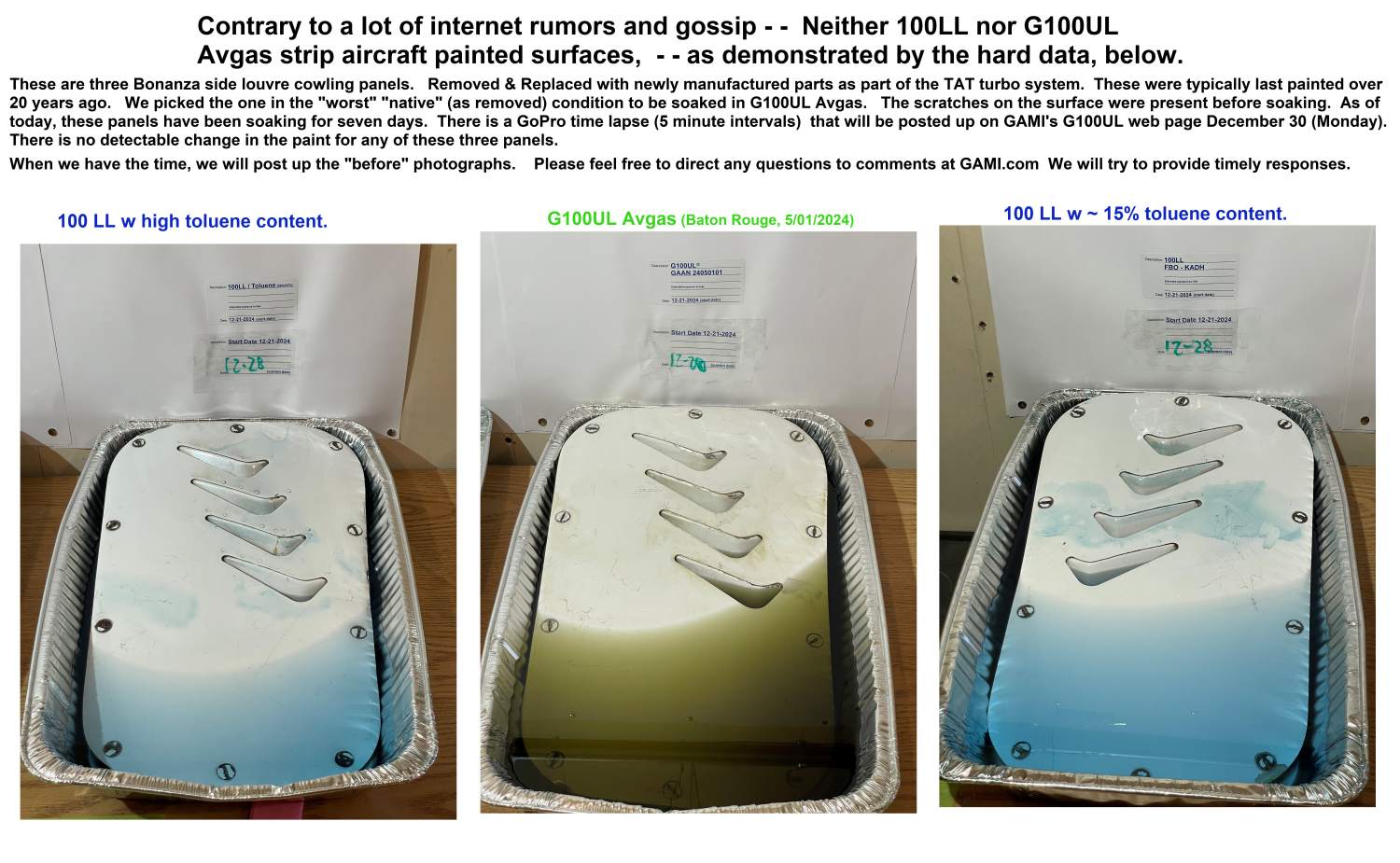
-
Marc, About six months or a year after the 2018 FAA Reauthorization Act was passed, with some PAFI related language, a very senior person in the FAA / PAFI management told me that the FAA had decided that in order to NOT have to do STCs, the FAA would have to go to "rule making" and amend the FARs. That is normally a two year process, or longer. The FAA management has failed to seriously undertake any effort to do that. At various times, the PAFI / EAGLE management has suggested in public statements that the PAFI program would allow the FAA to define a "Fleet Eligibility List" for a new fuel. Then the owner could have his mechanic verify that the owner's plane was on that specific "Fleet Eligibility List" and then the owner could order placards from GAMA or some other organization and the mechanic could then sign off a form 337 and send it to OKC and get the placards installed and then the owner of the "fleet eligible" aircraft could legally fly. There was never any guarantee that the "Fleet Eligibility List" would include all of the airplanes, or even any specific fraction of the fleet. The FAA has failed for over six years to provide any definitive "guidance" or to issue a Policy Statement or to issue an amended ORDER that would implement that "Fleet Eligibility" process. The basic problem with the concept is that it directly conflicts with the regulatory language you cited WRT "Major changes" and "Minor Chnages". Regards, George
-
The FAA would disagree with your quibbles about the terminology. The FAA has approved the means and methods to amend the operating limitations to include the use of a new fuel chemistry, other than the existing approved fuel chemistries. The substance remains the same. Any airplane owner in any state can elect to legally use G100UL avgas. That requires the airplane owner to "follow the process". In this case, the well traveled STC "process."
-
100% of all spark ignition piston engines are approved to use G100UL Avgas. 100% of all airplanes that use spark ignition piston engines are approved to use G100UL Avgas. ~ 98.5% of all AIRCRAFT are approved to use G100UL Avgas. The operative language is in the congressional reauthorization bill. It states if the FAA has approved the fuel for use in "nearly all aircraft..." Normally, Congressional language interpretation of that phrase means " more than 90%." The rotorcraft approval is pending. It should have already been done, but there was an unexpected delay triggered by some unexpected "FAA" activity.
-
Ah... G100UL is fully approved (by the FAA) to be mixed in any combination with ASTM UL94 (the fuel made by Swift) - - so long as the mixture of the two fuels is used in an engine and airplane already approved for use of UL94. Swift can state whatever they want - - but that statement remains true. Observation: It is likely true that if the fuel used at UND had as little as 20% G100UL avgas (or 100LL) mixed in with the UL94 they were using - - then they would NOT have had the excessive valve seat erosion / wear that they documented. That observation is based on the hard engine test stand data we presented at the G100UL forum last Oshkosh.
-
You might re-read the consent decree. There are provisions there that would exclude $200/'gallon fuel from the concept of "commercially available." Everyone should understand - - the issue before the Court in California is the enforcement of a civil contract. This contract was adopted by the Court as part of a consent decree. The issue before the Court is whether or not the distributors (NOT the FBOs - - at least not yet, at this time) violated their formal agreement.
-
Here is a modest proposal: If the Mooney folks would like to learn more, GAMI will offer to host a "Mooney Delegation" here at Ada. Maybe anywhere from 3 to six participants ? I will print out all of the material compatibility test data that the FAA has approved and we can sit down around a conference room and review that. I will answer any questions. In the process you can get a chance to see the engine test cell and maybe have an opportunity to observe while it is run on G100UL vs 100LL vs "other" PAFI/EAGLE type fuel chemistries. There may be some additional items of interest. Let me know?
-
>>As an aside, is it even established that it's Toluene that's causing damage to sealant/paint?<< For the 100LLs produced up until the last few years, it was common for them to have as much as 29% toluene and then another 3 or 4% other aromatics for a total around 33% aromatic content. The vast majority of that was simple paint store toluene. The last 100LL sample I had analyzed by DHA at the lab was a decade ago. I have posted that analysis. Can do that again. But, yes, it is the toluene that did that for 100LL. Some of the 100LL only had about 15% toluene, but from the refineries with lower quality aviation alkylate - - they used increasing toluene to provide the octane they needed. Xylenes are a related molecule, but less aggressive chemically - - according to the retired refinery - expert chemist retained by the FAA in 2012 to do an independent evaluation of the G100UL avgas fuel chemistry. George
-
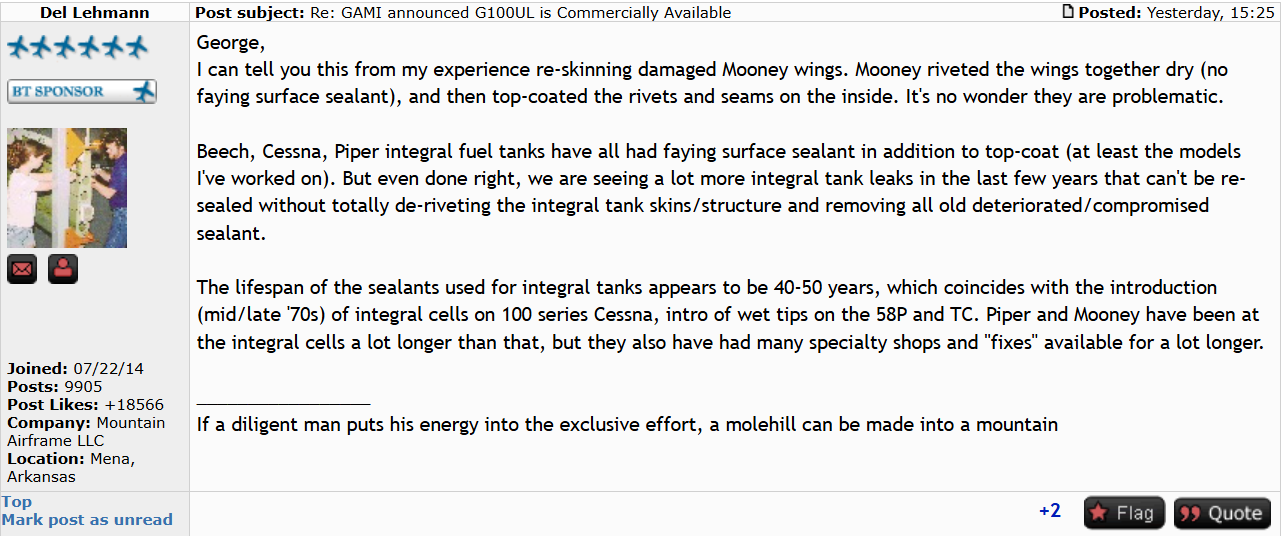
Larry, Below is a report from Del Lehmann who has run a maintenance shop in Mena, Arkansas, for many many years. He posted this on the BeechTalk Forum. It is reproduced with his permission. Note his comment about the construction method used at Mooney: "Mooney riveted the wings together dry (no faying surface sealant), and then top coated the rivets and seams on the inside." That is not the industry standard method for constructing riveted integral wing tanks. They should have used sealant when the placed the ribs into the structure and then riveted and then done the over coat with polysulfide sealant. Also note his observation that he is seating a lot of "old deteriorated / compromised sealant" - - before G100UL avgas was ever even approved. Del Lehmann's experience is consistent with our experience with an integral fuel tank we "re-worked" here at GAMI in a Piper Lance. When we got that tank out, the sealant was so soft and "gooey" that you could scrape it up with a putty knife and smear it around between your thumb and finger. On 100LL. We re-sealed that tank and re-installed it and then we did some significant flight tests and detonation tests (Lycoming IO-540) using G100UL avgas, with no further leaks. Also - - this is a "Deja vu, all over again" situation. A very large number of the same Mooney fuel tank sealant failure issues came up during the 1980s due to the aging of that fleet and the deployment of 100LL which very often had very high levels of toluene in the production fuel. There were also similar issues with some of the other "wet wing" fuel tanks in Pipers and some Cessna aircraft. Please let me know if you have more questions about this. George
-
First: We (GAMI) had nothing to do with the deletion of the thread. I was as surprised as everyone else. However, let me repeat something posted in the deleted thread: We have soaked painted aircraft parts in G100UL avgas for extended periods. The paint remained fully intact without any visual evidence of any degradation. I am a bit time constrained with ongoing certification work - - but when I get time - - I will try to find some pictures. So - - how to explain the difference in the results on the bottom of the wing of the Mooney? The paint on the parts removed from the Bonanzas was no more than about 20 years old. But it was in visibly good condition. Before and after soaking. The surrounding paint on the bottom of the Mooney wing ? You can evaluate that for yourself. George
-
Thank you for reposting that - - -
-
With respect the discussion about the high levels of toluene and aromatics sometimes found in 100LL, see the attachment, which is a "DHA" (Detailed Hydrocarbon Analysis) using a standard ASTM test method, that was run at the reference fuel laboratory (Dixie Services, Deer Park, Tx) from a sample pulled from our local FBO 100LL, supplied by rail from the Phillips refinery in Borger Texas.

-
WRT Cirrus Fuel Tank Sealants - - Up until ~ 2010-2011 they (primarily) used "polysulfide" (PSFD) sealant (i.e. MIL-S-8802) for their fuel tanks. From then until May of 2023, they used "polythioether" (PTE) sealant , AMS-3277. Starting in May of 2023, immediately after their discovery of the PTE sealant issue in their SR22T, they switched back to only using the PSFD at the Cirrus factory. However, in the interim, prior to 2010, they then also sometimes used the PTE sealant. Our 2007 TNSR22 Cirrus (N223TN) - - as it turns out - - had the same PTE sealant as Cirrus used from 2010-2023. That was the same sealant (PTE) that was in the wing of the Cirrus SR22-T that was found to have some sealant debonding. However, that was a Cirrus "in-house" R&D aircraft and nobody at Cirrus ever inspected the fuel tank before they started using G100UL Avgas. That aircraft is the same make and model Cirrus factory owned aircraft that was used for earlier PAFI fuel testing, including the infamous "Shell Fuel" - - ie the fuel that was withdrawn from PAFI by Shell because it was literally "melting" Piper fuel bladders and stripping the paint of the wings of C-172s at Embry Riddle where it was (briefly) "tested." GAMI's TNSR22 Cirrus has had G100UL Avgas in the RH wing tank for most of the last 14 years. Borescope inspection reveals that (PTE) sealant is, literally, in "pristine" condition. We have conducted soak testing on two other Cirrus wings (from salvage yards) with PTE sealant. NONE of that sealant has, ever, shown the slightest hint of any adhesion failure. Summary: Polysulfide (PSFD) is a better sealant for our fuel tanks than PTE, as it appears to be more "fault tolerant" of improper application techniques. But, properly applied, in accordance with the manufacturer's instructions, PTE also works.
-
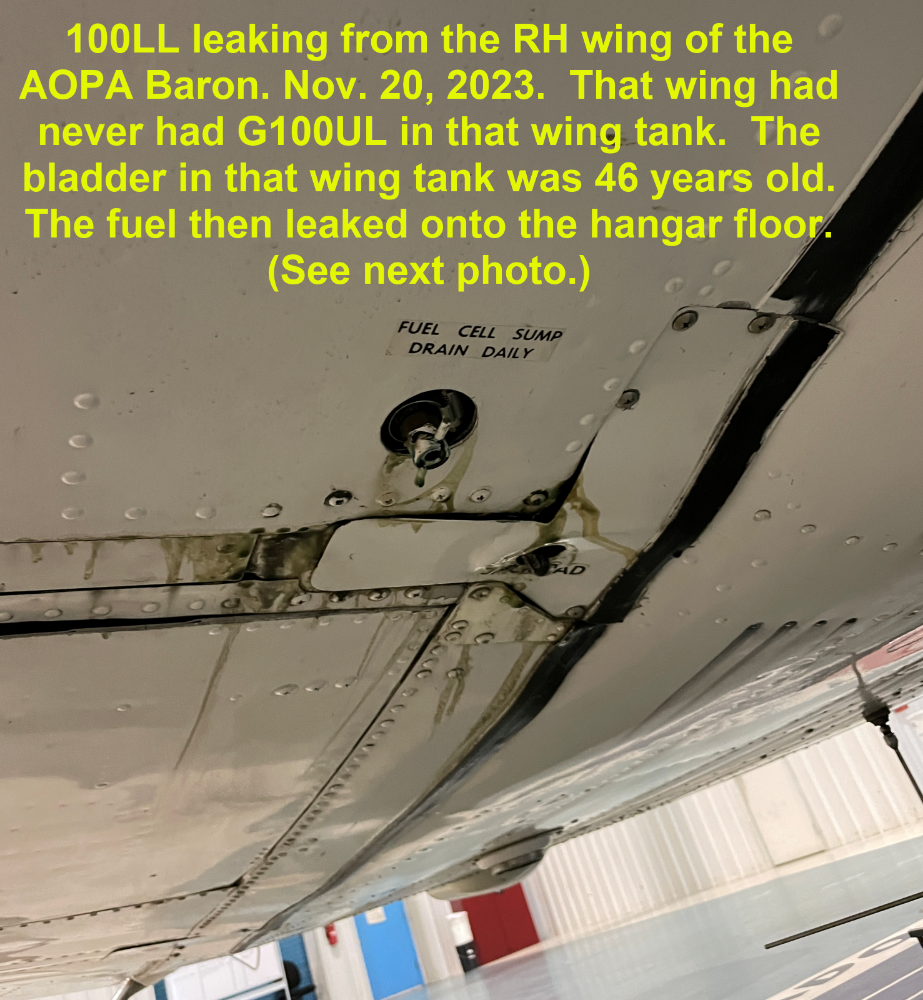
Very much appreciate the discussion and the feedback, here. Please allow me to provide a response to some of the messages. 1) I am a big Mooney fan. Flew a 67 Mooney Super 21 for nearly 2,000 hours. Commuted to and from law school in Norman, Ok. to the family Ranch (100miles each way) on a daily basis for 3 years. 2) Part I - - Some aviation fuel chemistry history: A- During WWII fuels with very large amounts of aromatics were adopted. Arguably, the Air War would have been much more costly in terms of losses for the fighter aircraft without the introduction of aromatics to aviation gasoline. The fuel approved for D-Day was "100/150" - - and used a lot of different aromatic components; B- In the ranking of the levels of "aggressiveness" as solvents, the ranking starts (most severe) with benzene. Then add a single CH3 group and you get toluene. Yes. Paint stripper you buy at the paint store. C- Add a second Ch3 group and you get xylenes (three isomers - ortho, meta, & para) Xylenes are significantly less aggressive as a "paint stripper" than is toluene. <== THAT is important. Keep that in mind. D- Many fuel bladders were developed during WWII and are labeled "approved for aromatics" or something similar. If you look closely at some of the P-51s and other planes at Oshkosh, you will see a placard that states "approved for aromatic fuels." Part II - - Post WWII. A- We had "Green" 100/130 with LOTS and lots of lead. And even purple 115/145 (with lots of aromatics) At the end of the piston airline and going into the late 1970s and 1980s, the ASTM folks decided to drop the lead content and created BLUE 100Low Lead. Still lots of lead. But much less than GREEN 100/130. B- Some of the refiners had very good "aviation alkylate" (~ 70% of some 100LL fuel formulations) with relatively high MON values for that aviation alkylate (a less than pure form of isoctane). Those refineries could make 100LL with relatively low levels of aromatics (almost always "toluene" from the paint store). Maybe 10-20%. C- Other refineries (P66 at Borger, Tx, for example) had lower MON quality "aviation alkylate" and the had to use a LOT of toluene. I can show you detailed hydrocarbon analysis (GC-FID) test results for local (Ada, Ok. FBO) P66 Borger, Tx 100LL that has 29% toluene and another 4% of other aromatics for a total of about 33% aromatic content. 3) Fleet Experience during the transition to 100LL - - A-Starting shortly after the introduction of 100LL, with high levels of aggressive toluene, A LOT of Mooney, Piper, and other airplane owners that had aluminum integral fuel tanks (no bladders) began to leak fuel out of lots of rivet holes. That started a whole new business for G.A. with companies initially specializing in re-sealing those tanks. Later, companies developed retrofit fuel bladders for those problematic "integral fuel tanks". B- A big part of the problem was the aircraft manufacturers did an "inconsistent" (careful choice of words) job of applying the polysulfide sealant to the interior (rivets and seams) of the aluminum integral wing tanks as they were manufactured. [As we have learned during material compatibility testing, the devil is in the details when it comes to the proper application of sealants to fuel tanks. ] C) Over the decades, the level of toluene from most refiners has decreased due to better quality aviation alkylate, but some refiners - - for at least some production runs - - still (from looking at their data sheets) still have a lot of toluene. 4) G100UL Avgas - - A- Uses a very high quality aviation alkylate (2-4 MON numbers higher than the alkylate used for 100LL) and then uses xylenes rather than toluene in order to achieve the 100/150+ octane/supercharge rating for G100UL avgas. The right choice of xylene isomers will have higher octane blending value than does toluene. Using "xylenes" also has the advantage of being less chemically "aggressive" than is toluene. But the high quality alkylate and the premium xylene isomers also "cost more" than the related components in 100LL. BUT - - there ends up being no lead. B- We did extensive material compatibility testing, including a whole variety of older bladders and a whole range of tests for sealants applied to aluminum. All of that supervised (in person) by multiple FAA engineers and managers and then later approved by the FAA. 5) The 100LL we have at the airport in Ada (typically Phillips from Borger, Tx) still tends to have a lot of toluene in that fuel. A- Late October of 2023, AOPA brought their 1965 demonstration Baron to Ada. Two freshly overhauled IO-520s. One fuel bladder was 46 years old and the other ~50 years old. They were supposed to have been replaced with new, prior to the start of testing, but the bladders were on "back-order". B- G100UL avgas was exclusively kept in the LH bladder and 100LL was exclusively in the RH bladder. C-Within 30 days, we noticed fuel "spots" on the hangar floor. Investigation - - we found fuel leakage and staining on the bottom of the RH wing - - which had ONLY ever had 100LL. See photographs. 6- Oshkosh, the leakage from the LH wing tank (G100UL Avgas) was ( based on Eagle Fuel evaluation) caused by pre-existing damage to the tanks and the gaskets associated with the access panels. (In addition, there were pin-hole leaks in both fuel bladders). 7)-G100UL Avgas is NOT a threat to normal aircraft paint. A- Embry Riddle did extensive certification testing of G100UL avgas. They used G100UL in their C-172s for over a year, at Daytona Beach. They had no evidence of any fuel leaks and they had zero staining on the wings. B- As part of our due diligence, wee have deliberately spilled a LOT of G100UL Avgas onto various painted components from the many Bonanza aircraft that come through the TAT shop for turbo systems. That includes LOTs of wing tips and the lower cowling access panels, both of which are removed and replaced (with tip tanks and newly louvered lower access panels.) C- Some of that has been allowed to dry on those painted surfaces and then the process was repeated. NO SIGN OF ANY LOSS TO THE INTEGRITY OF THE ADHESION OF THE PAINT. D- We have even soaked a couple of those side panels in G100UL for a week or more. The paint was fine at the end of that. E- What does and will happen - - is if you do not properly clean up the spilled fuel, and allow it to dry, it can and will leave a light tan stain on the paint. If you do properly clean it up, it will not stain the paint - - even after repeated spills in the same location. But, to date, we have never seen any evidence of any type of "paint striping" activity to any of the dozen or more aircraft parts that were removed from our customers Bonanzas and used as "test articles." See https://g100ul.com/dl/Refueling Hygiene G100UL Avgas.pdf F- An aside - - some of the recent crystal and graphene coatings improve the resistance of aircraft paint to any damage from any variety of 100LL or G100UL - - but that is not a cure all. See the link Refueling Hygiene! 8. So "what happened" on the bottom of the Mooney wings ? A- In one case, the sump drain appears to be leaking. Likely the fittings inside the wing are also leaking. B- In the other case, there appears to be some kind of leakage from inside the wing. Not sure from the photographs. C- Almost certain that old drain valve has a "nitrile" set of O-rings. D- The paint on the bottom of the wings has likely had many months of exposure to steady drips of 100LL. In California, probably with only ~ 15% toluene in the 100LL . . . maybe. E- No information about the age of the paint on the bottom of the wings, but from its overall appearance and the multiple rivet holes that are bare and which have lost their paint - - it is likely a they are rather old paint jobs. The paint on my personal Bonanza, N11RT is about 35 years old and it is in much better condition than the appearance of the paint (away from the damaged paint). F- It would be good to know the age of the paint for each of those two aircraft. 9. What to do ? A-There is a long standing FAA / maintenance bulletin (20 + years old ???) that tells mechanics that when they find fuel leaks or deteriorated fuel lines or gaskets or O-rings, they should replace those components with parts that are made from chemically resistant materials (viton, fluorosilicones, etc.) Those types of materials are specifically stated to be for use with a wide variety of fuels, including aromatic based fluids. A lot of mechanics have ignored that recommendation over the years. Last . . . 10. I would like to have the chance to borescope an older Mooney fuel tank that has not been converted over to a bladder. A- If anyone on this forum would like to bring their plane to Ada we can do that here. You might find it interesting. If you have the STC you can probably leave with some G100UL in your tank, if you want. I hope this information helps to bring some clarity and understanding to these issues that will be the subject of conversations during the transition away from leaded avgas. Regards, George Braly gwbraly@gami.com

- 545 replies
-
- 24
-

-